Chevy vehicles guide: models, issues, and buying tips
Use this Chevy vehicles guide to match your budget and job to five groups: cars, SUVs, trucks, EVs, and performance/commercial models; for most buyers, payload, rear-seat space, and total ownership cost narrow the right choice faster than trim level. I’ve found that a buyer who misses on those three usually pays for it later in fuel, depreciation, repairs, or capability that never gets used. This guide compares key Chevy models, common issues, ownership costs, and the pre-purchase checks that matter most, with lineup and starting-price references noted as of September 2026 from Chevrolet U.S. model pages and dated source notes listed in the Sources section.
Start here: how to choose a Chevy without getting lost in the lineup
Pick your use case before your model
As of September 2026, Chevrolet’s U.S. retail and commercial lineup spans trucks, electric vehicles, SUVs, Corvette, and work-focused vans/chassis products, based on Chevrolet’s current shopping pages and dated source notes in the Sources section. That is a wide spread, and it trips people up because they start with a nameplate and then try to justify it afterward. If you want a quicker path, it helps to separate Chevy SUVs, Chevy trucks, Chevy EVs, and Corvette buying guidance before you compare trims.
Start with the actual job. I mean daily city commuting, three-kid road trips, a first truck for home projects, regular towing, van duty for work, or a weekend performance car. Once you pin that down, a big chunk of the lineup stops mattering.
Set a real budget ceiling, not a starting-price target
The advertised starting price gets you through the door. The real bill comes from insurance, fuel or charging, tires, brakes, depreciation, and the odds of paying for repairs after the warranty is gone.
I usually tell buyers to set a ceiling that still leaves room for registration, tax, a pre-purchase inspection on a used vehicle, and the first maintenance visit. That saves more pain than stretching for a bigger truck or SUV because the payment barely works on paper. If you are comparing pre-owned options, pair this guide with a used-car inspection checklist and, for truck shopping, a towing-capacity guide.
Choose your body style around parking, passengers, and cargo
Body style shapes daily life. A small crossover parks easily and usually carries a lower insurance bill. A full-size SUV gives real third-row room and better long-trip comfort, but it asks for more fuel, pricier tires, and takes a bigger depreciation hit. A pickup gives you bed utility, though I see plenty of owners paying for tow ratings they almost never use.
Separate wants from ownership-cost drivers
Big wheels, off-road packages, and performance trims can raise the buy-in and the running bill very quickly. If the real need is commuting with occasional cargo, an entry SUV or compact EV usually fits better than a half-ton truck. If the real need is towing near the top of a truck’s rating, moving up early can save you from buying the wrong tool. Buyers considering an EV should also read an EV charging guide before deciding that the fuel savings on paper will actually show up at home or on route.
What Chevy model should I buy for my needs?
Buy the smallest Chevy that fully covers your real job. As of September 2026, commuters should start with Trax, Trailblazer, Bolt, or Equinox EV; family buyers should look at Equinox, Traverse, Tahoe, or Suburban; towing buyers should sort between Colorado, Silverado, and Silverado HD; performance buyers should stay in the Corvette lane. Those model-group recommendations match Chevrolet’s U.S. lineup pages as listed in the Sources section.
Best fits for commuting and daily urban driving
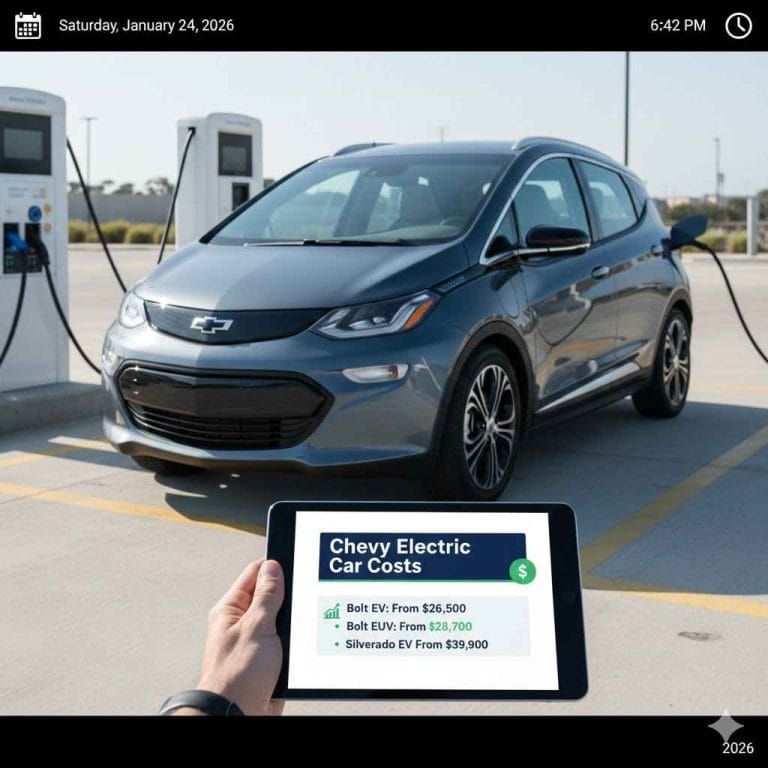
As of September 2026, the Chevrolet Trax starts at $21,700 on Chevrolet’s U.S. Trax page, which makes it the low-price entry point for many shoppers who still want hatch-like cargo flexibility; Chevrolet’s dated lineup pages also show Trax as an active retail model in the 2026 shopping mix. It fits buyers who care about easy parking, lower tire cost, and a simpler ownership picture.
As of September 2026, the Trailblazer starts at $23,300 on Chevrolet’s U.S. model page, and Chevrolet’s current lineup pages list it as available. The Bolt starts at $27,600 on Chevrolet’s U.S. Bolt page and makes sense if home charging is real and gas savings matter more than road-trip speed. If you are unsure whether charging will work for you, compare this with a practical home EV charging costs guide before you commit.
As of September 2026, the Equinox EV starts at $34,995 on Chevrolet’s U.S. Equinox EV page. Chevrolet’s current U.S. EV lineup pages also list it as available. It fits buyers who want EV running costs without stepping into premium-brand money. In day-to-day use, these smaller Chevy choices usually keep fuel or charging, tires, and insurance easier to manage than larger trucks or SUVs.
Best fits for family hauling and road trips
For two-row family duty, Equinox sits in the practical middle. As of September 2026, Chevrolet continues to list Equinox in the U.S. SUV lineup, and it remains the easiest family answer when you do not need a full-time third row. Buyers who need frequent third-row use should move straight to Traverse, Tahoe, or Suburban instead of forcing a smaller cabin to do a larger job. If that is your lane, the model-specific overviews for Chevrolet Equinox, Chevrolet Traverse, Chevrolet Tahoe, and Chevrolet Suburban are the better follow-up reads.
As of September 2026, the Chevrolet Traverse starts at $40,800 on Chevrolet’s U.S. Traverse page. The Chevrolet Tahoe starts at $60,700, and the Chevrolet Suburban starts at $63,700 on their respective Chevrolet U.S. pages; Chevrolet’s lineup pages also continue to list both full-size SUVs as current models. Tahoe and Suburban make sense when passenger count, cargo volume, or highway-trip comfort is the real priority, but buyers should plan for heavier fuel use and larger tire bills.
Best fits for towing, hauling, and jobsite use
As of September 2026, the Chevrolet Colorado starts at $32,400 on Chevrolet’s U.S. Colorado page and remains listed in Chevrolet’s current truck lineup. It is the better entry point for first-time truck buyers who need bed utility but do not want full-size parking and fuel costs. If towing matters, compare it with a Chevrolet Colorado towing-capacity resource before assuming midsize is enough.
As of September 2026, the Chevrolet Silverado starts at $36,900 on Chevrolet’s U.S. Silverado 1500 page for buyers who need more cabin room, payload headroom, or a wider range of work use. Chevrolet’s current truck pages continue to list Silverado 1500 as a core lineup model.
As of September 2026, the Chevrolet Silverado HD starts at $45,900 on Chevrolet’s U.S. Silverado HD page and remains available in Chevrolet’s current truck lineup. That step should be tied to repeated heavy towing or commercial duty, not image. Heavy-duty trucks carry a different cost profile, from tire replacement to suspension wear and often insurance. If you are between half-ton and HD duty, use a Silverado towing-capacity guide before buying more truck than you need.
As of September 2026, the Chevrolet Silverado EV starts at $55,895 on Chevrolet’s U.S. Silverado EV page and is still listed in Chevrolet’s EV truck lineup. It works best for buyers who want truck form with EV operation and who can charge consistently.
Best fits for performance buyers and weekend cars
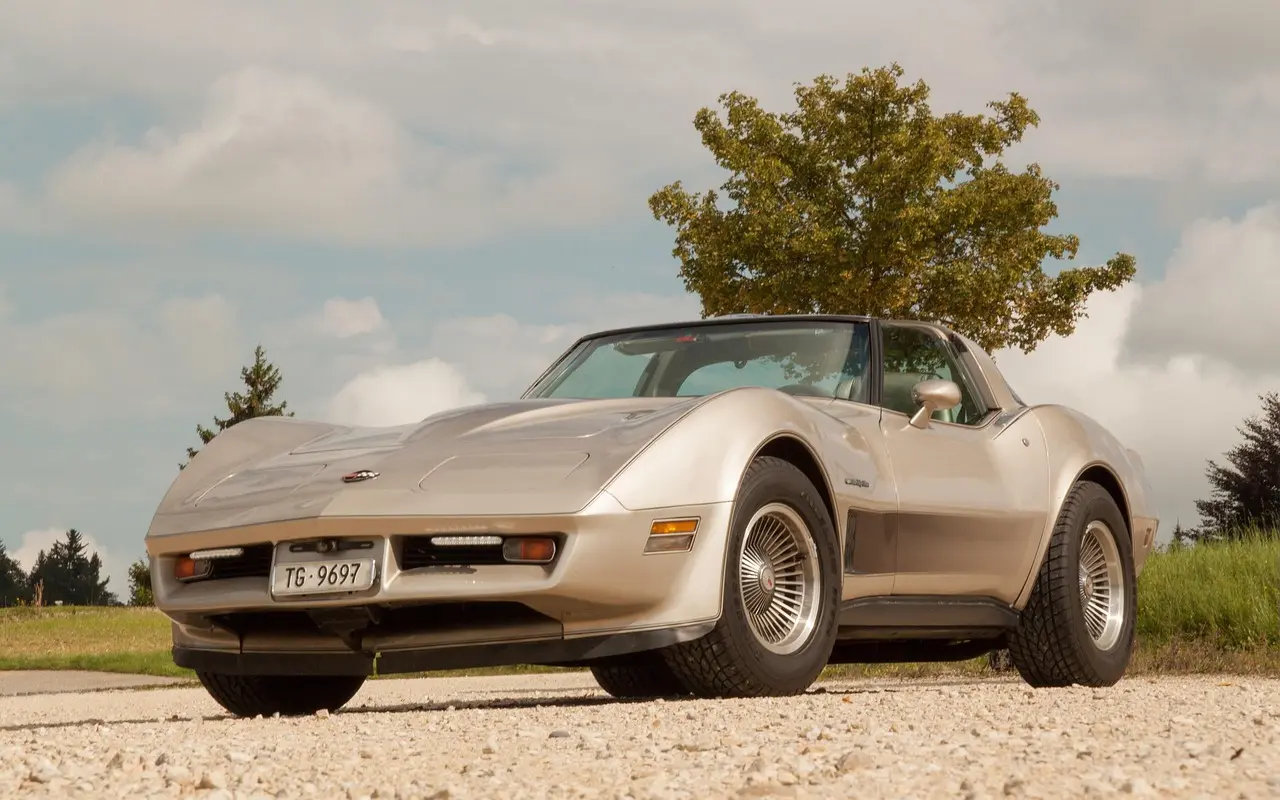
The Corvette family belongs in a different decision tree. As of September 2026, Chevrolet’s Corvette family pages list Stingray, Z06, ZR1, and ZR1X in the current performance lineup; published Chevrolet pricing places Corvette Stingray in the low $70,000s, Z06 in the low $120,000s, ZR1 in the high $190,000s, and ZR1X in the low $230,000s, with exact trims and destination affecting the final figure. Those ranges are drawn from Chevrolet’s model pages and dated source notes in the Sources section.
For most shoppers, the real question is whether this is a second car. If yes, the tradeoffs are easier to live with. If this has to handle commuting, bad weather, luggage, and family tasks, the compromise gets expensive in a hurry. I have done used-sports-car inspections where the glossy paint looked great but the real story was in tire date codes, curb-marked wheels, undertray scrapes, and a thin stack of service paperwork. That is why I push buyers toward a dedicated used Corvette buying guide before a deposit goes down.

Chevy model-selection table: needs, price, costs, and pre-buy checks
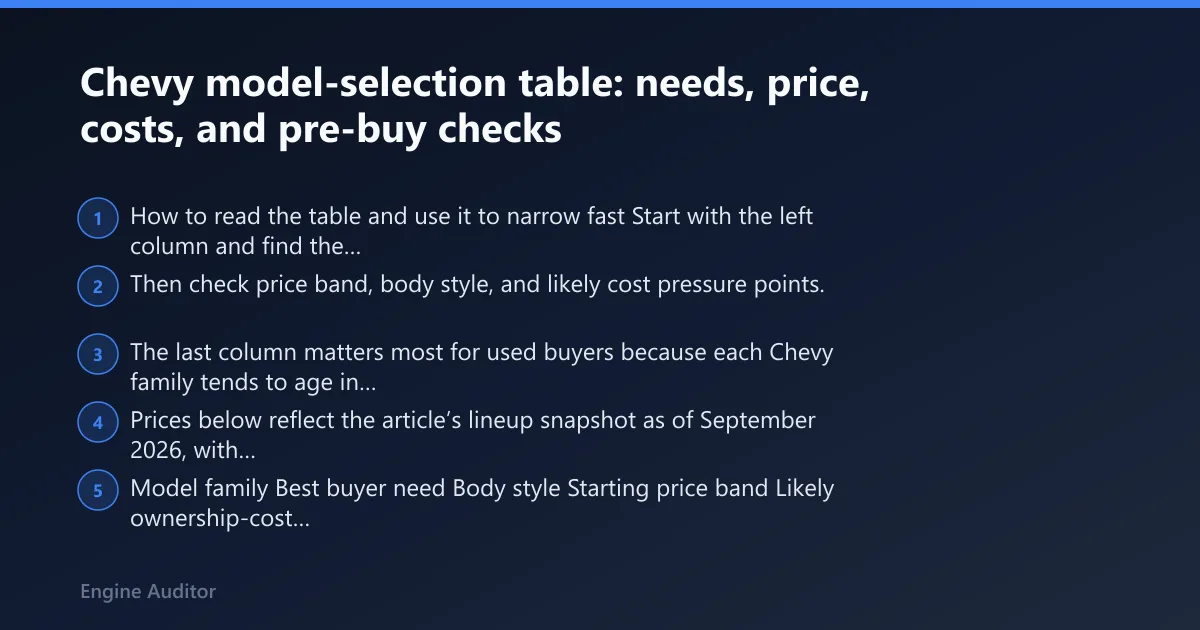
How to read the table and use it to narrow fast
Start with the left column and find the job that matches daily use, not rare use. Then check price band, body style, and likely cost pressure points. The last column matters most for used buyers because each Chevy family tends to age in familiar ways. Prices below reflect the article’s lineup snapshot as of September 2026, with model-by-model source notes in the Sources section.
| Model family | Best buyer need | Body style | Starting price band | Likely ownership-cost pressure points | Key pre-buy inspection points |
|---|---|---|---|---|---|
| Trax | Budget commuting, first car, city parking | Small SUV | $21,700 | Insurance can vary by driver profile; watch tire quality and basic maintenance history on used units | Accident history, uneven tire wear, fluid leaks, service records |
| Trailblazer | Urban driving with extra versatility | Small SUV | $23,300 | Fuel cost still manageable; optioned trims can push price faster than expected | Title status, tire wear, alignment feel, maintenance records |
| Equinox | Mainstream family duty | Compact SUV | $29,000 | Depreciation and insurance usually matter more than fuel alone | Service history, brake feel, leaks, road-noise clues from worn tires |
| Traverse | Three-row family hauling | Midsize SUV | $40,800 | Larger tires, higher insurance, more brake wear than smaller SUVs | Power-seat and rear-seat operation, tire wear, cooling-system checks, accident history |
| Tahoe/Suburban | Large families, road trips, towing with SUV layout | Full-size SUV | $60,700 to $63,700 | Fuel use, large tires, depreciation, expensive neglected maintenance | Rust underneath, 4WD operation where fitted, suspension condition, tow wear |
| Bolt | Low-running-cost commuting | Electric hatchback | $27,600 | Charging setup at home matters more than gas savings on paper; depreciation can swing by local EV demand | Battery-condition report, charge-port condition, software updates, range reality |
| Equinox EV | Mainstream EV crossover use | Electric SUV | $34,995 | Insurance and tire replacement may run higher than expected for some buyers | Battery health, fast-charge function, warning lights, app and charging setup |
| Blazer EV | Larger EV crossover with style focus | Electric SUV | $44,700 | Purchase price and insurance step up; larger wheels can raise tire cost | Software behavior, battery condition, panel alignment, charge performance |
| Colorado | First truck, light towing, weekend hauling | Midsize truck | $32,400 | Fuel, off-road tire cost, possible tow-related wear on used examples | 4WD engagement, bed damage, transmission behavior, rust, hitch wear |
| Silverado | Full-size truck ownership, mixed work and family use | Full-size truck | $36,900 | Fuel, insurance, tires, depreciation on heavily optioned trims | Frame rust, transfer-case operation, idle quality, tow-package wear |
| Silverado HD | Heavy towing, contractor duty | Heavy-duty truck | $45,900 | Expensive tires, suspension wear, brake cost, hard-use exposure | Trailer-brake setup, driveline vibration, bed and hitch stress, maintenance records |
| Silverado EV | Truck utility with EV driving | Electric truck | $55,895 | Charging access, insurance, tire cost, depreciation by market | Battery report, charging speed, software updates, body and bed condition |
| Corvette | Performance driving, second-car use | Sports car | $71,000 and up | Insurance, tires, brakes, depreciation by spec and mileage | Service records, tire age, brake condition, accident repairs, alignment feel |
| Express vans, cutaway, chassis cab, Low Cab Forward, BrightDrop | Commercial delivery, fleet, trade work | Van/chassis cab/cutaway/EV commercial | $36,950 to $75,300 | Downtime risk, tire and brake wear, heavy-use maintenance, route-energy planning for EV fleets | Idle hours, cargo-area wear, maintenance logs, body corrosion, upfit quality, charging records on EVs |
Buyer need versus body style and price band
Cheap entry does not always mean cheap ownership. I have seen used full-size SUVs bought for less than newer compact crossovers, then cost far more to keep on the road. The table is built to stop that mistake. It also helps surface when a buyer should move from a consumer page to a more focused resource, such as full-size SUV comparisons or used truck inspection guides.
Likely ownership-cost pressure points by model family
Small SUVs and compact EVs usually keep daily running costs in check. Full-size trucks, HD trucks, full-size SUVs, Corvettes, and commercial vehicles bring more exposure to tires, brakes, fuel, insurance, and depreciation. In my own shopping and test-drive notes, the biggest buyer regret usually comes from underestimating operating cost, not from picking the wrong color or missing a convenience feature.
Pre-buy inspection priorities by segment
Used trucks need 4WD and tow-wear checks. Used EVs need battery-condition and charging checks. Large SUVs need rust and suspension attention. Corvettes need careful accident-repair and tire-age review because low mileage alone does not guarantee a clean car. I use different walk-around routines by segment: on trucks I look closely at hitch hardware, receiver wear, bed-floor dents, and transfer-case function; on EVs I focus on charge-port condition, software warnings, and whether fast charging behaves normally; on family SUVs I pay extra attention to rear climate, seat-fold mechanisms, power liftgates, and second- or third-row wear because those are the parts families actually use every day. If you want a broader process, start with a pre-purchase inspection guide.
Which Chevy SUVs, trucks, and EVs are available right now?
As of September 2026, Chevy’s current U.S. family splits cleanly into trucks, SUVs, EVs, Corvette, and commercial vehicles, based on Chevrolet’s current U.S. shopping pages and dated source notes. Shoppers should first decide whether they need a crossover, body-on-frame SUV, midsize truck, full-size truck, EV, sports car, or work van, because those categories bring very different costs and ownership tradeoffs.
Trucks
As of September 2026, current truck choices listed by Chevrolet include Colorado, Silverado, Silverado HD, and Silverado EV. Colorado is the first stop for buyers who want truck utility without going full-size. Silverado fits mainstream half-ton use. Silverado HD is for repeated heavy work. Silverado EV is a separate branch for buyers with charging access. Chevrolet’s truck pages in the Sources section are the model-by-model basis for those availability claims.
SUVs
As of September 2026, Chevy’s SUV side runs from Trax and Trailblazer up through Equinox, Traverse, Tahoe, and Suburban on Chevrolet’s U.S. lineup pages. The jump from compact to full-size is large in both space and ownership cost, so buyers should not shop these as if they were simple trim-level alternatives.
EVs
As of September 2026, Chevrolet’s U.S. EV pages list Bolt, Equinox EV, Blazer EV, Silverado EV, and BrightDrop on the commercial side. The right answer depends less on badge preference and more on charging reality, route length, and whether the buyer needs passenger space or truck utility. For many households, the better first step is reading an EV range and charging basics guide before comparing trim names.
Corvette and commercial vehicles in the wider lineup
As of September 2026, Corvette remains its own performance family, with Chevrolet listing Stingray, Z06, ZR1, and ZR1X across current Corvette pages. Commercial buyers should also include Express Cutaway starting at $36,950, Express Vans starting at $41,800, Silverado 3500 HD Chassis Cab starting at $46,000, Low Cab Forward starting at $60,815, and BrightDrop starting at $75,300 when mapping fleet or trade use. Those figures and model-availability notes come from Chevrolet commercial model pages and dated source notes listed below.
How do Chevy prices compare across the lineup?
As of September 2026, Chevy pricing starts low in small SUVs, rises into the middle with compact EVs and mainstream trucks, then climbs quickly with full-size SUVs, heavy-duty trucks, Corvette models, and commercial vehicles. The practical cross-shop is less about list order and more about where operating costs start rising with size, weight, and duty. Price references below track Chevrolet’s current U.S. model pages and dated source notes in the Sources section.
Entry-price Chevy models and what buyers actually get
As of September 2026, the Chevrolet Trax starts at $21,700 on Chevrolet’s U.S. Trax page, making it the lowest easy entry for many buyers who want current-model warranty coverage and crossover space. The Bolt starts at $27,600 on Chevrolet’s U.S. Bolt page for buyers ready for EV life. These are the cost-control side of the lineup.
As of September 2026, Trailblazer at $23,300 and Equinox at $29,000 sit in the same practical zone on Chevrolet’s U.S. pricing pages. The difference is less about status and more about space, road-trip comfort, and whether the buyer wants to stay under a hard payment cap.
Midrange price bands where most cross-shopping happens
As of September 2026, the broadest shopping zone sits roughly between small EVs, compact SUVs, midsize trucks, and lower full-size truck trims. Colorado starts at $32,400, Equinox EV at $34,995, Silverado at $36,900, and Traverse at $40,800 on Chevrolet’s current U.S. model pages.
This is where buyers drift upward by accident. I see it happen with one options package, bigger wheels, or a move to a larger cabin, and suddenly the monthly budget has gone from comfortable to thin. It is also where internal cross-shops like Colorado vs. Silverado and Equinox vs. Equinox EV become more useful than another trim brochure.
Premium Chevy pricing: full-size SUVs, Corvette, EV trucks, and commercial
As of September 2026, Silverado HD starts at $45,900. Blazer EV starts at $44,700. Silverado EV starts at $55,895. Tahoe starts at $60,700, and Suburban starts at $63,700. Corvette Stingray starts at about $71,000, while Corvette ZR1 starts at about $197,700, based on Chevrolet’s U.S. model pages and dated source notes in the Sources section.
At this end of the range, the buying decision should include insurance quotes, tire prices, and expected yearly use. A full-size SUV used mostly for solo commuting is usually an expensive mismatch.
How do I narrow down a Chevy by body style and budget?
Use body style to eliminate the wrong category first, then apply a hard budget band. As of September 2026, under $30,000, Chevy’s small SUVs and Bolt make the strongest value case; from $30,000 to $50,000, compact EVs, midsize trucks, and family SUVs dominate; above $50,000, size and capability start to drive cost.
Under $30,000: where Chevy is strongest and where tradeoffs show
This band is strongest for Trax, Trailblazer, Bolt, and some used examples from larger Chevy families. Buyers get easier parking and lower day-to-day expense, but usually give up heavy towing, third-row space, and full-size ride comfort. If used shopping is on the table, I would pair this section with a budget used SUV guide and a basic vehicle history checks primer.
$30,000 to $50,000: the broadest shopping zone
This is where Colorado, Equinox EV, Silverado, Traverse, and Blazer EV begin to overlap in monthly-budget terms. The right choice depends on whether the buyer needs a bed, a third row, or lower fueling costs. This is also the zone where trim creep causes trouble.
$50,000 and up: when capability or size starts driving cost
Once shopping passes $50,000, most Chevy buyers are paying for capability, cabin size, performance, or commercial utility. Tahoe, Suburban, Silverado EV, upper trucks, Corvette, and work models live here. The buyer should have a job in mind, not a vague desire for “more vehicle.” I have watched buyers test-drive a full-size SUV for comfort, then abandon it after pricing out insurance and tires; this bracket punishes vague shopping faster than any other.
When a used Chevy makes more sense than a new one
Used often makes the most sense for mainstream SUVs and trucks, where a careful inspection can avoid major surprises and save real money. New can make more sense on EVs when warranty coverage, charging confidence, and software support matter more than the lower entry price of a used one. Used Corvette and commercial purchases need the strictest paper trail. For that reason, I usually send buyers to a used Chevy buying guide and, where relevant, a used EV checklist.
What should I check before buying a used Chevy?
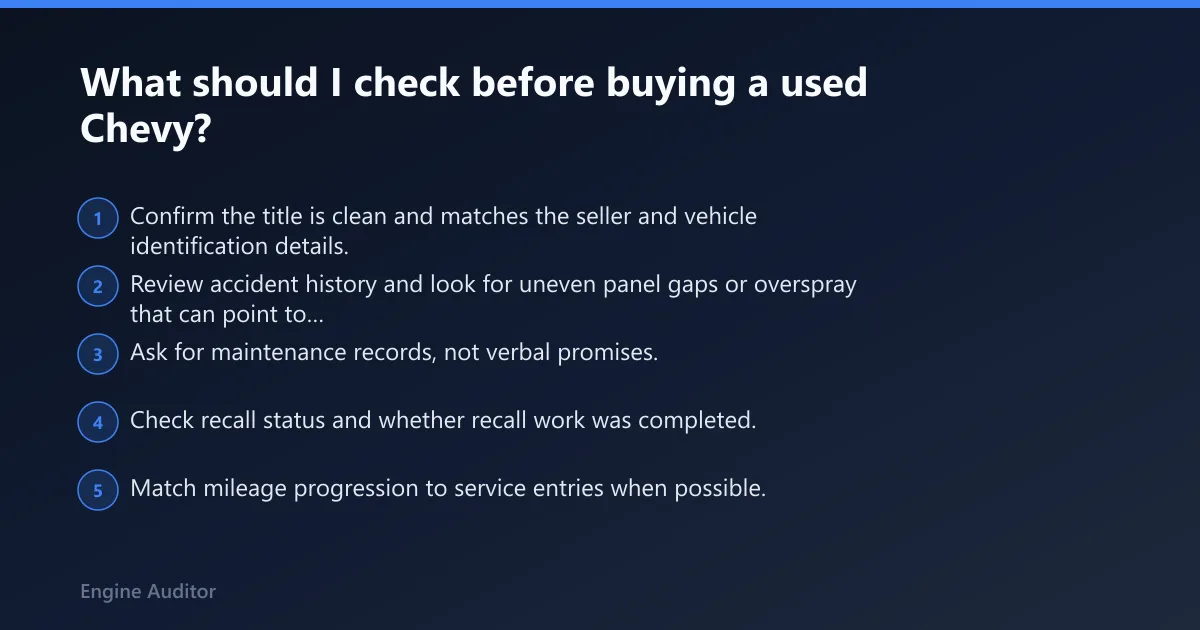
Check history first, then condition, then segment-specific wear. Every used Chevy should be screened for title problems, accidents, maintenance records, rust, tire wear, leaks, and abnormal transmission behavior. Trucks need tow and 4WD checks, while EVs need battery-condition and charging verification before any deal moves forward. This is the part of the process where I lean most on hands-on context: over the years I have used the same practical routine when helping friends shop daily-driver crossovers, family SUVs, trucks, and EVs, and the misses nearly always show up in paperwork gaps or in the segment-specific systems buyers forget to test.
Paperwork and history: title, accidents, maintenance, recalls
- Confirm the title is clean and matches the seller and vehicle identification details.
- Review accident history and look for uneven panel gaps or overspray that can point to repair work.
- Ask for maintenance records, not verbal promises.
- Check recall status and whether recall work was completed.
- Match mileage progression to service entries when possible.
Mechanical checks for gas trucks and SUVs
Cold start behavior matters. Rough idle, smoke, warning lights, or fluid smells should slow the deal down. On the road test, watch for delayed shifts, shudder, clunks on throttle changes, steering pull, and brake vibration.
Underneath, inspect for rust, wet spots around engine and transmission areas, damaged shields, and signs of hard curb or off-road impacts. Uneven tire wear often tells the story early and can point to alignment, suspension, or neglect before the seller says a word. When I inspect a used Tahoe or Silverado, I spend extra time under the rear end looking for tow-use clues, because a spotless wash bay can hide a hard towing life better than most buyers expect.
Extra checks for tow rigs, heavy-duty trucks, and commercial models
Used trucks with tow packages deserve a closer look at hitch wear, bed-floor dents, trailer-brake hardware, rear-suspension sag, and driveline vibration. Commercial vans and chassis cabs should be checked for idle-heavy use, cargo-area abuse, body corrosion, and the quality of any upfit work.
A clean cabin does not outweigh a rough work history. Fleet maintenance logs can tell you more than cosmetics. On contractor trucks, I have seen the real story show up as ovaled hitch-pin holes, bent plug brackets, overloaded rear springs, or patchy rust around drilled upfit points. Those are not automatic deal-breakers, but they absolutely change what the vehicle is worth.
EV-specific checks: battery condition, charging, software, and range reality
On a used Bolt, Equinox EV, Blazer EV, or Silverado EV, battery-condition reporting is central. Confirm charging works on the equipment you plan to use. Check for warning messages, software update history, and charge-port damage.
Range claims should be treated carefully on used EVs. Climate, speed, wheel size, and battery age all affect real use. If the charging routine does not fit home, work, or route needs, the low running-cost pitch can fall apart quickly. On used EV walk-throughs, I pay close attention to whether the owner can clearly explain charging habits, DC fast-charging behavior, and any software or app issues, because vague answers usually mean you need deeper verification. A good companion read here is a practical used EV battery-health guide.
Which Chevy models make the most sense for towing, commuting, and family use?
For commuting, Chevy’s smaller SUVs and Bolt make the strongest financial case. For family use, Equinox and Traverse fit most households before buyers jump to Tahoe or Suburban. For towing, Colorado suits lighter duty and first-time truck owners, while Silverado and Silverado HD cover increasingly serious work. As of September 2026, all of those model families remain listed on Chevrolet’s current U.S. shopping pages.
Commuting picks: low entry cost, easy parking, lower running costs
Trax, Trailblazer, Bolt, and Equinox EV are the short list. They keep size manageable and avoid the tire, fuel, and parking penalties of larger Chevy categories. Buyers with no home charging should usually keep the Bolt or EV crossovers off the front line.
Family picks: rear-seat space, cargo room, and road-trip comfort
Equinox works for many smaller households. Traverse fits buyers who need a true third row more often. Tahoe and Suburban make more sense for bigger families, long cargo needs, or regular highway travel with many passengers and gear. In real use, the third row is the dividing line: if adults or larger kids will be back there often, I would skip the compromise stage and shop the larger body styles first.
Towing picks: first-time truck buyers versus heavy-duty needs
Colorado is the cleaner entry point when the truck will still spend most of its life as a daily driver. Silverado fits buyers whose towing, bed use, or cabin needs exceed midsize territory. Silverado HD should be reserved for real heavy-duty demand because ownership cost rises with it. Buyers who are unsure should compare payload stickers and trailer realities, not just brochure maximums, using a truck payload vs. towing guide.
Work-use picks: commercial vans, chassis cab, and fleet-minded choices
Express vans, Express Cutaway, Silverado 3500 HD Chassis Cab, Low Cab Forward, and BrightDrop cover business use better than consumer SUVs or pickups pressed into service. The best choice depends on cargo volume, route pattern, and whether the buyer needs shelves, refrigeration, bins, or delivery access. In fleet-style shopping, I always start with route and payload math before brand preference, because the wrong body type creates expensive downtime later.
What ownership resources does Chevy provide after purchase?
Chevy ownership support matters most in service tracking, warranty use, recalls, and connected-vehicle functions. Buyers should care less about the feature list itself and more about whether Certified Service, support channels, the MyChevrolet App, and OnStar will make upkeep, scheduling, diagnostics, and roadside help easier over time. Chevrolet’s owner-support pages in the Sources section are the basis for these references.
Warranty basics and where they matter most
Warranty value is highest on complex vehicles and for buyers who keep strict service records. It matters more on newer EVs, performance models, and expensive trucks than on a simple used commuter bought well below new-car pricing.
Certified Service and dealer-network considerations
Certified Service matters when a buyer wants easy access to maintenance history, recall work, and brand-specific repair procedures. Dealer coverage can also matter more for work trucks, commercial models, and newer EVs that may need model-specific tools or software handling.
MyChevrolet App and OnStar in day-to-day ownership
The MyChevrolet App can matter for service scheduling, vehicle status, and ownership organization. OnStar may matter more for buyers who value emergency support, location services, or connected features. Neither should decide the purchase, but both can make ownership easier to manage.
Support, recalls, and service-record discipline
The most useful ownership resource is still a complete paper trail. Save repair orders, track fluids and tires, and document recall visits. That habit helps resale, cuts diagnostic guesswork, and gives the next buyer more confidence if the vehicle is sold later. It is also one of the clearest real-world trust signals I look for when I help evaluate a used Chevy.
Frequently asked questions
Which Chevy models are electric and what do they start at?
As of September 2026, Chevrolet’s U.S. EV range includes Bolt at $27,600, Equinox EV at $34,995, Blazer EV at $44,700, Silverado EV at $55,895, and BrightDrop at $75,300, based on Chevrolet model pages and dated source notes in the Sources section. The right pick depends on charging access, route length, and whether the buyer needs a commuter hatch, crossover, truck, or commercial vehicle.
How do I narrow down a Chevy based on body style and budget?
Start by choosing the smallest body style that truly fits passenger, cargo, and towing needs. Then apply a firm ceiling. As of September 2026, under $30,000, look hard at Trax, Trailblazer, Bolt, and used mainstream SUVs; from $30,000 to $50,000, Colorado, Equinox EV, Silverado, and Traverse become key cross-shops.
What should I check before buying a used Chevy?
Review title status, accident history, recall completion, and maintenance records first. Then inspect rust, tire wear, leaks, transmission behavior, and 4WD operation where relevant. On EVs, confirm battery condition, charging function, software status, and whether the real-world range fits the intended daily route. A structured used-car inspection checklist helps keep the test drive honest.
Which Chevy models are best for towing, commuting, or family use?
For commuting, the strongest Chevy fits are Trax, Trailblazer, Bolt, and Equinox EV because they keep size and running costs down. For family use, Equinox and Traverse cover most needs before Tahoe or Suburban. For towing, Colorado suits lighter use, while Silverado and Silverado HD cover bigger demands. If ratings matter, verify them against a towing-capacity guide before buying.
How do Chevy prices compare across the lineup?
As of September 2026, Chevy starts low with Trax at $21,700 and Bolt at $27,600, moves through the core market with Colorado at $32,400 and Silverado at $36,900, then climbs into premium territory with Tahoe at $60,700, Suburban at $63,700, Corvette Stingray at about $71,000, and Corvette ZR1 at about $197,700.
Is the Chevy Trax or Trailblazer a better first Chevy for most buyers?
For most first-time Chevy buyers, Trax is the cleaner value play because the entry price stays lower and the mission is simple: commuting, errands, easy parking, and flexible cargo room. Trailblazer makes more sense when you prefer its packaging or trim mix, but it is easier to overspend there.
Should I buy a Chevy EV if I cannot charge at home?
If home charging is not realistic, I usually tell buyers to slow down before picking a Chevy EV. Public charging can work, but convenience and cost depend heavily on your route, local infrastructure, and downtime tolerance. For many commuters, the savings story only works cleanly when overnight charging is easy.
When is a Tahoe or Suburban worth the extra money over an Equinox or Traverse?
Tahoe or Suburban becomes worth it when you regularly carry many passengers, need real cargo space behind occupied rows, or want long-trip comfort with towing capability in an SUV layout. If your third row is occasional or mostly for children, Traverse often covers the job for less money.
How can I tell if a used Chevy truck was worked too hard?
Look past shine and focus on evidence of use: hitch wear, trailer-brake hardware, bed-floor damage, rear-suspension sag, driveline vibration, and incomplete maintenance records. I also like to inspect tire wear and frame condition closely, because they often reveal overload use or neglect long before a seller admits it.
Does a used Chevy EV need a different inspection than a used gas Chevy?
Yes. A used Chevy EV still needs the normal title, body, tire, brake, and suspension checks, but the battery, charging behavior, software status, and range reality move to the center of the inspection. A gas Chevy can hide neglect in fluids; an EV more often hides risk in charging history and battery condition.
Are Corvette models practical enough to be an only car?
They can be, but I rarely think that is the smart default. Corvette ownership is easier when it is a second car, because tire cost, weather compromise, cargo limits, and insurance become less annoying. If one car has to handle family life and rough weather, a Corvette is usually the expensive compromise.
Author and testing context
I approach Chevy buying guides from a buyer-first, inspection-heavy angle. My hands-on context comes from helping friends and family cross-shop commuter crossovers, full-size SUVs, trucks, and EVs; doing repeated dealership walk-arounds and test drives; and reviewing the same problem areas that show up during real used-vehicle checks: tire age, service records, tow hardware wear, alignment clues, charge-port condition, rear-seat function, and rust underneath. I do not treat every Chevy as a trim-comparison exercise. I look at how the vehicle will actually be parked, fueled or charged, loaded, maintained, and resold. That is why this guide leans so heavily on use case, ownership cost, and pre-buy inspection detail instead of spec-sheet hype.
Sources
- Chevrolet U.S. model pages and shopping pages, accessed September 2026: Trax, Trailblazer, Equinox, Traverse, Tahoe, Suburban, Colorado, Silverado 1500, Silverado HD, Silverado EV, Bolt, Equinox EV, Blazer EV, Corvette Stingray, Corvette Z06, Corvette ZR1, Corvette ZR1X, Express Vans, Express Cutaway, Silverado 3500 HD Chassis Cab, Low Cab Forward, BrightDrop, and Chevrolet lineup/EV/truck/SUV/commercial overview pages.
- Dated source note for pricing snapshot: Chevrolet U.S. pricing and model-page review completed September 2026 for all starting prices quoted in this article.
- Dated source note for availability snapshot: Chevrolet U.S. lineup pages reviewed September 2026 to confirm model-by-model availability claims used here.
- Dated archive note: prior Chevrolet model-page snapshots and archived lineup references were checked for time-sensitive wording, and article language was updated to use “as of September 2026” where pricing or lineup status may change.
- Chevrolet ownership-support references reviewed September 2026: warranty, owner resources, Certified Service, MyChevrolet App, and OnStar support materials.
Products related to this article
Sponsored / affiliate links. As an Amazon Associate I earn from qualifying purchases. I may earn additional commission from eligible campaigns.