How Often Should You Change Chevy Spark Plugs?
Many modern Chevy engines are reported to use iridium plugs that often last roughly 60,000 to 100,000 miles, but start with the owner’s manual and shorten the interval for towing, idling, short trips, or rough running. Waiting too long can hurt fuel economy, cause misfires, and strain ignition coils. This guide breaks down the interval by Chevy engine family and shows when symptoms mean it’s time sooner.
Chevy spark plug intervals at a glance

Start with the factory maintenance schedule. Chevrolet spark plug intervals vary by model, engine family, and plug type, so one mileage figure can mislead you. A generic replacement range of 30,000 to 100,000 miles appears often, but manufacturer guidance overrides any broad rule.
If the truck, crossover, or sedan sees towing, repeated short drives, long idle periods, or stop-and-go traffic, shorten the interval. Those conditions load the ignition system and can bring wear symptoms forward well before a nominal mileage target.
Why the manual comes first
Chevy uses different plug materials and service intervals across engines. Conventional plugs wear faster than platinum or iridium designs, and coil-on-plug layouts can make access very different from one engine family to another. The owner’s manual tells you the schedule for your exact VIN and engine code.
When mileage alone is not enough
Mileage matters, but it is not the full picture. A vehicle that spends most of its life on short, cold trips can need plugs sooner than the odometer suggests. So can a truck that tows regularly or sits in traffic with long idle periods.
What you’ll need
- Spark plug socket
- Extension bar
- Torque wrench
- Gap gauge
- Dielectric grease
- Correct replacement spark plugs for your engine
How often should you change Chevy spark plugs?
Use the owner’s manual first, then shorten the interval if the vehicle works hard or starts showing wear symptoms. For many modern Chevys, spark plug life often falls somewhere between 30,000 and 100,000 miles, but the exact service point depends on engine family, plug type, and use pattern.
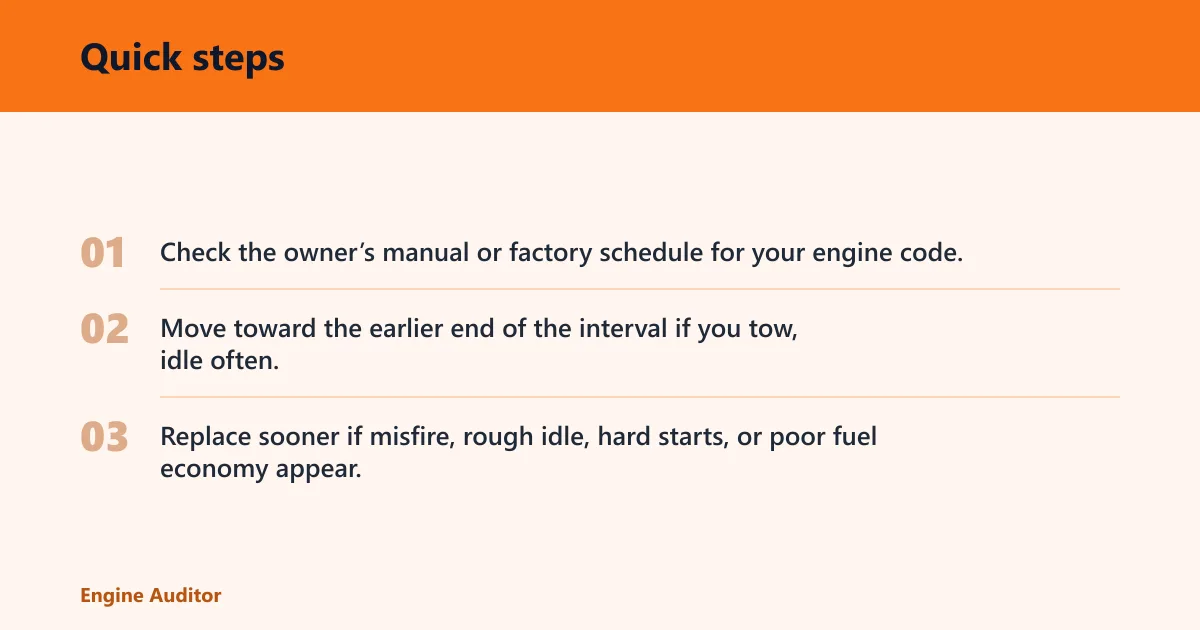
- Check the owner’s manual or factory schedule for your engine code.
- Move toward the earlier end of the interval if you tow, idle often, or drive mostly short trips.
- Replace sooner if misfire, rough idle, hard starts, or poor fuel economy appear.
Step 1: Check the owner’s manual interval
That interval controls the plan. Some Chevrolet models use long-life plugs, while others call for earlier service. A 2012 Chevrolet Traverse is listed at 97,500 miles, which shows why model-specific guidance matters.
Step 2: Shorten the interval for severe use
Repeated short drives, stop-and-go traffic, towing, and extended idling are all severe-use patterns for spark plugs. If your driving looks like that, plan service earlier than the base schedule. A useful rule is to move the interval toward the lower end of the vehicle’s normal range.
Step 3: Replace sooner if symptoms appear
Do not wait for the odometer if the engine is already acting up. Rough idle, misfire, hard starts, sluggish acceleration, poor fuel economy, and engine knocking all point toward worn plugs or a related ignition issue that needs attention now.
Chevy model interval examples
Common Chevy models do not share one maintenance number. Silverado, Colorado, Malibu, Equinox, Cruze, and Traverse can all land on different intervals depending on engine, plug material, and how the vehicle is used. Use the manual first, then compare the model family and operating pattern below.
Silverado and Colorado service timing
Silverado and Colorado intervals vary widely because both nameplates span four-cylinder, V6, and V8 engines. A turbo four-cylinder work truck may have a different plug life than a V8 tow rig. For trucks used to haul, tow, or idle on job sites, plan on the conservative side of the factory range.
Malibu, Equinox, and Cruze service timing
Malibu, Equinox, and Cruze models often see commuter use, which can still be hard on plugs if it means many short starts and brief trips. When these vehicles spend most of their time in town, shorten the interval from the manual’s normal range and watch for idle quality changes before scheduled service.
Traverse example with plug count, gap, and cost
A 2012 Chevrolet Traverse is a useful benchmark. It has 6 spark plugs, a listed gap of 0.044 inches, and a service interval of 97,500 miles. Replacement is estimated between $309 and $366, with labor at $215 to $271 and parts at $94 to $95.
How do you know the plugs are due?
Worn plugs usually announce themselves before they fail completely. Rough idle is one of the clearest signs, and misfire, hard starting, sluggish acceleration, poor fuel economy, and engine knocking can all follow. If those symptoms are present, treat the plugs as overdue rather than optional.
Say your Malibu idles unevenly at stoplights and needs a longer crank in the morning. That combination points to planned replacement becoming immediate service, especially if the plugs are already near the manual interval.
Suppose your Silverado still starts normally but feels flat when merging and uses more fuel on the same commute. That is a strong signal to inspect the plugs and the coils before the problem turns into a flashing check-engine light.
Spark plug decision table
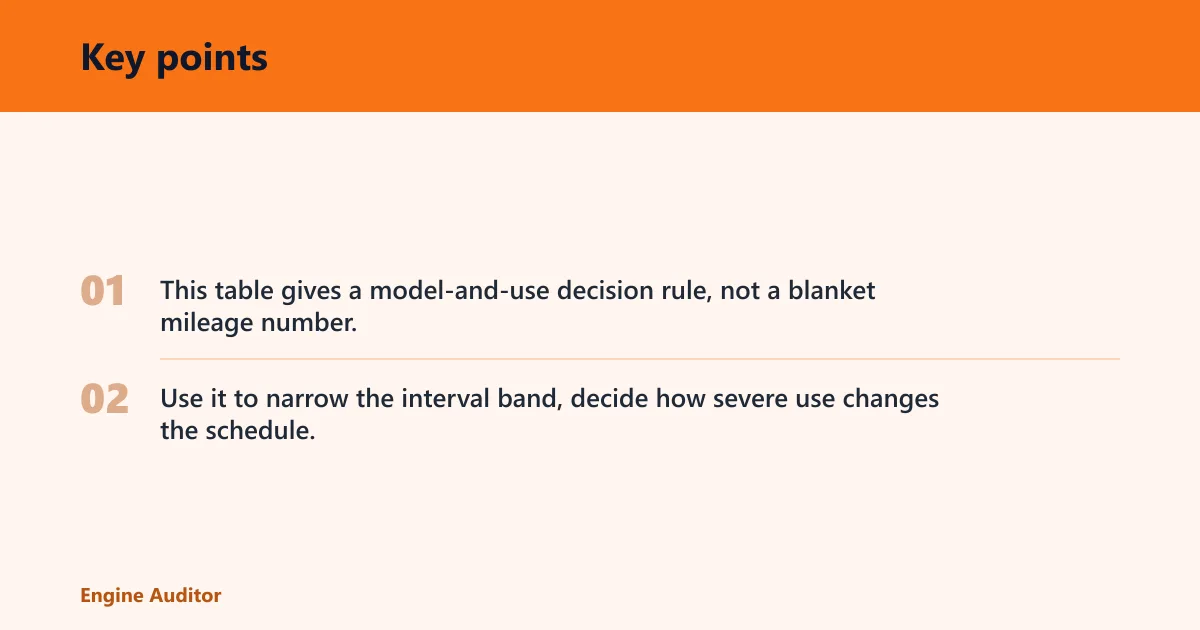
This table gives a model-and-use decision rule, not a blanket mileage number. Use it to narrow the interval band, decide how severe use changes the schedule, and decide whether the job is a good DIY candidate.
| Chevy model or engine family | Recommended mileage band | Severe-use shortening rule | Warning symptoms | DIY-friendly or shop-only |
|---|---|---|---|---|
| Traverse, 2012 example | 97,500 miles | Move earlier if it sees towing, short trips, or long idle time | Rough idle, misfire, hard starts | Shop-friendly if access is tight |
| Silverado 1500 | Use the manual; many modern engines fall in the 60,000 to 100,000-mile band | Trim the interval for towing and stop-and-go use | Sluggish acceleration, misfire, poor fuel economy | Depends on engine; V6 and V8 layouts take longer |
| Colorado | Use the manual; engine family matters more than the badge | Shorten for short trips and idle-heavy driving | Hard starts, rough idle | Often DIY on simpler four-cylinder layouts |
| Malibu | Use the manual; many commuter engines sit in the mid-to-long-life range | Move earlier for city traffic and repeated cold starts | Poor fuel economy, misfire, sluggish acceleration | Usually DIY if plug access is open |
| Equinox | Use the manual; exact timing varies by engine | Shorten for short trips and stop-and-go driving | Rough idle, hard starting | Often shop-favored when access is crowded |
| Cruze | Use the manual; life can vary with plug type and engine load | Shorten for repeated short trips | Misfire, poor fuel economy | DIY-friendly on some engines, harder on others |
Common mistakes
The biggest mistake is using one generic interval for every Chevy. The second is ignoring access issues on V6 and V8 engines, where hard-to-reach plugs can require removing covers or intake parts. The third is skipping the gap check and torque spec, which can turn a normal service into a comeback repair.
- Match the replacement plugs to the exact engine code.
- Check and set the gap before installation.
- Use a torque wrench instead of guessing tightness.
- Add only a light film of dielectric grease where the boot calls for it.
Replacing spark plugs typically takes 30 minutes to 2 hours. Four-cylinder engines are usually quicker. V6 and V8 engines often need more time because access is tighter and extra parts may need to come off first.
Frequently asked questions
How often should you change spark plugs Chevy Silverado?
Check the Silverado owner’s manual first, because the interval changes by engine. Many modern Silverado engines fall somewhere in the 60,000 to 100,000-mile range, but towing, idle-heavy work, and stop-and-go driving justify earlier service. Symptoms always override the calendar.
How often should you change spark plugs in a Chevy Cruze?
Use the Cruze maintenance schedule for your exact engine. If the car sees mostly short trips, frequent cold starts, or city traffic, shorten the interval from the normal band. Rough idle, misfire, and poorer fuel economy are the clearest signs it should move up.
How often do you change spark plugs on a Chevy Equinox?
The Equinox interval depends on the engine and plug type, so the manual comes first. For commuter use, especially with short trips and long idle periods, plan on the earlier side of the factory range. Hard starts or a rough idle mean it is time to inspect them now.
How often must spark plugs be changed?
There is no single Chevrolet number that fits every engine. A practical range across vehicles is 30,000 to 100,000 miles, but the manual overrides that broad band. Replace sooner if the engine misfires, idles roughly, starts hard, or loses fuel economy.
How do you decide between DIY and a shop?
If the engine has open plug access, a spark plug socket, extension bar, torque wrench, and gap gauge are usually enough. If the plugs sit under intake parts, coil packs, or crowded engine covers, a shop is often the safer choice because labor time rises fast.
How much does a Traverse spark plug job cost?
That estimate includes labor between $215 and $271 and parts at $94 to $95. Access difficulty and engine layout are why the same job can cost more on one Chevy than another.
Products related to this article
Sponsored / affiliate links. As an Amazon Associate I earn from qualifying purchases. I may earn additional commission from eligible campaigns.