Chevy Transmission Slipping? Symptoms, Causes, and Fixes
If your Chevy slips under throttle, flares between gears, or drops into limp mode, stop hard driving and scan for codes. Keep driving can turn a fluid-level issue or sensor fault into burnt clutches, a failed torque converter, or a rebuild. This guide shows how to tell true slip from gear-hunting or shudder, what codes and symptoms matter, and what to check first.
What slipping feels like in a Chevy


The classic pattern is engine speed rising without a matching rise in vehicle speed. On a Chevy, that can show up as a flare on acceleration, a delayed move into gear, harsh or late shifts, or a shudder that comes and goes under load.
That pattern is not always the same fault. RepairPal groups transmission problems into fluid level, internal pressure, worn holding devices, and electronic control problems, and those buckets can feel similar from the driver’s seat. KBB also lists grinding, slipping, jerking, delayed engagement, and unusual noises among common signs.
Why the same symptom can point to different faults
A short flare during an upshift can point to a control problem, low fluid, or worn clutch capacity. A steady highway shudder can point more toward torque-converter lock-up trouble than a gear train fault. A hard slip under towing load raises concern for worn holding parts or pressure loss.
Say your Silverado revs jump from 2,000 to 3,000 rpm on a merge, but the truck barely gains speed for a second before catching. That is a more serious signal than a simple late shift, because the engine and road speed are no longer tracking together.
📊 The wikiHow guide says transmission fluid should be replaced at about 100,000 miles. Source: Wikihow.
Chevy slip triage table
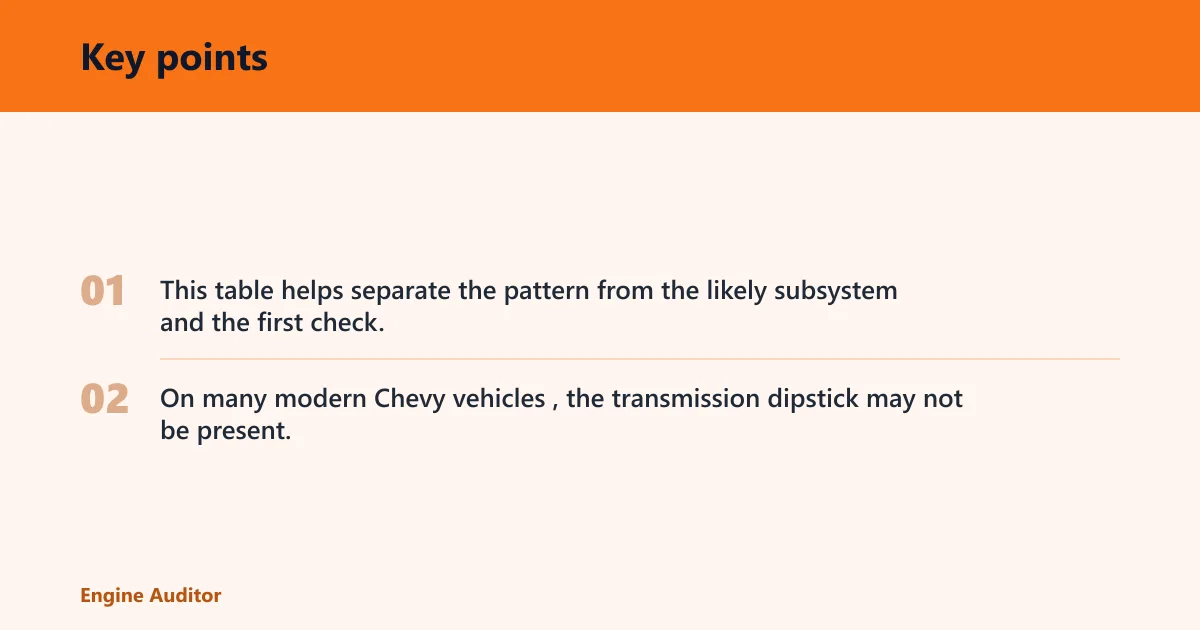
This table helps separate the pattern from the likely subsystem and the first check. It is a triage tool, not a final diagnosis. On many modern Chevy vehicles, the transmission dipstick may not be present, so level checks should follow the owner’s manual procedure.
| Symptom at startup, hot, highway, or towing | Likely cause category | Quick at-home check | Should you stop driving | Likely repair tier |
|---|---|---|---|---|
| Delayed engagement after startup or after shifting from Park to Drive | Low fluid, worn valve body, internal pressure loss | Check fluid level and condition if the vehicle has a dipstick; scan for warning lights | Yes, if the delay is getting worse or the warning light is on | Fluid service or electrical/hydraulic repair |
| RPM flare on acceleration with weak forward motion | Clutch pack wear, low pressure, solenoid control fault | Look for burnt fluid and scan for transmission codes | Yes, if flare is repeated or active codes are present | Electrical/hydraulic repair or rebuild |
| Highway-speed shudder, especially near lock-up | Torque converter lock-up clutch slip or failure | Note whether the shudder appears at steady speed and light throttle | Use caution; get diagnostics soon | Electrical/hydraulic repair or replacement |
| Slip or harsh shifts only when hot | Fluid breakdown, valve body wear, clutch wear | Check whether the fluid is dark brown or black and smells burnt | Yes, if hot slip is repeatable | Fluid service, electrical/hydraulic repair, or rebuild |
| Slip while towing or climbing a grade | Clutch pack wear, pressure loss, pump issue | Stop the tow, then inspect for codes and fluid condition | Yes | Rebuild or replacement |
| Slip with transmission warning light and fault codes | Electronic control fault, incorrect gear ratio, component slipping | Read codes immediately | Usually yes, especially with P0894 or P0730 active | Electrical/hydraulic repair or rebuild |
Is it really slipping or just a lookalike?
Not every Chevy transmission complaint is true slip. Gear-hunting, torque-converter shudder, and limp mode can all feel wrong to the driver, but they point to different systems and different levels of urgency. Sorting them out keeps you from buying the wrong repair first.
Gear-hunting versus true slip
Gear-hunting means the transmission keeps choosing different gears because it cannot settle on the right one. True slip means the engine speed rises without a matching increase in vehicle speed. Gear-hunting is annoying; repeated slip is more likely to damage clutches or overheat fluid.
Torque-converter shudder versus gear slip
A torque converter can cause shudder at highway speeds, especially when the lock-up clutch engages or fails. That can feel like a rumble strip under light throttle. It is not the same as a gear pack slipping, although both can come with harsh or delayed shifts.
Limp mode and what it means on the dash
Limp mode is the computer’s protection strategy. It may hold one gear, limit shift range, or make the car feel underpowered. If the transmission warning light comes on with limp mode, treat it as a scan-now event, not a wait-and-see problem.
Picture a Traverse that stays in second or third and refuses normal upshifts after a warning light appears. That is not the same as a minor flare. The computer has already decided something is wrong enough to protect the transmission.
What causes Chevy transmission slip?
Chevy automatic transmissions slip for the same broad reasons as other automatics, but the diagnosis path matters. Low, old, or wrong automatic transmission fluid can reduce hydraulic pressure or change shift quality. Solenoids, valve body wear, clutch packs, torque converter faults, and pump problems can all sit behind the same symptom.
Fluid level, condition, and type
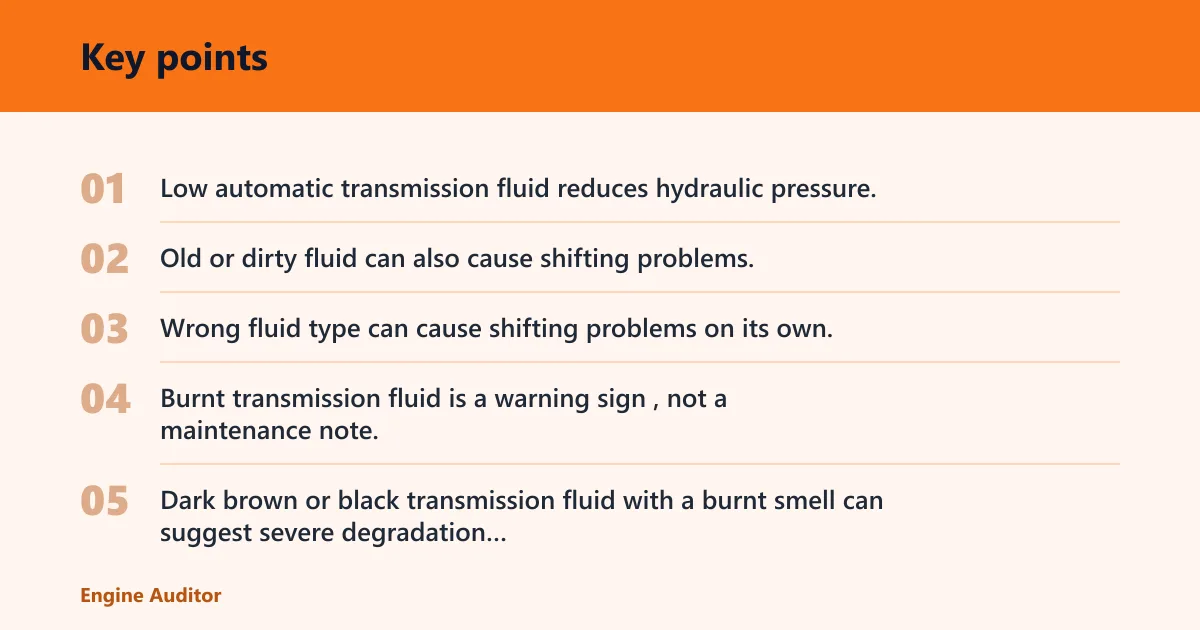
Low automatic transmission fluid reduces hydraulic pressure, and low pressure can lead to slip. Old or dirty fluid can also cause shifting problems, especially if it has lost heat control or load-carrying ability. Wrong fluid type can cause shifting problems on its own.
Burnt transmission fluid is a warning sign, not a maintenance note. Dark brown or black transmission fluid with a burnt smell can suggest severe degradation or possible clutch damage.
Shift solenoids and valve body faults
A shift solenoid is an electro-hydraulic control component. When it sticks or fails, shifts can come in late, flare, or feel wrong under load. Transmission fault codes in the P0700-P0799 range often point toward the control side of the system, but that range is broad and usually needs a scan tool to narrow down the actual fault.
The valve body is the hydraulic control center of the transmission. Debris or wear there can cause delayed or slipping shifts. Depending on the damage, a shop may clean, rebuild, or replace it rather than replace the whole transmission.
Clutch packs, torque converter, and pump issues
Clutch packs are the friction plates that hold gears engaged. When they wear, slip often shows up under load, during towing, or on harder acceleration. Worn clutch packs usually point to rebuild-level repair.
The torque converter can also slip if the lock-up clutch fails or physically breaks down. That often shows up as highway-speed shudder or a flare during lock-up. Pump problems are less common as a first guess, but they can cause low pressure across multiple gears.
What should you check first?
Start with the simplest checks that still matter: fluid level, fluid condition, warning lights, and codes. On many Chevy vehicles, there is no transmission dipstick, so do not assume a hood-level pull check is possible. Follow the owner’s manual procedure before adding fluid or assuming the level is correct.
- Check for a transmission warning light or service message.
- Read codes with a scan tool as soon as possible.
- If the vehicle has a dipstick, check level and condition exactly as the manual specifies.
- Look for dark brown or black fluid and a burnt smell.
- Note when the symptom happens: startup, hot, highway, towing, or all the time.
Any transmission warning light should trigger an immediate code scan. If the fluid is accessible, condition matters as much as level. Low fluid, burnt fluid, or the wrong fluid type can all worsen slip.
What do P0894 and P0730 mean?
P0894 is a transmission component slipping code, and ranking sources describe it as very serious. P0730 is an incorrect gear ratio code tied to slipping diagnosis. Both codes raise the risk level because they point to actual transmission control or mechanical mismatch, not just a vague drivability complaint.
Why both codes change the decision
KBB says not to drive with an active P0894 code, and it also says it is not recommended to drive with a P0730 code. If either code is active, the transmission is telling you that the control system has detected a condition that can damage internal parts quickly.
How the fault code narrows the guess matters. P0894 pushes suspicion toward a pressure, clutch, or converter problem. P0730 can show up when the gear ratio does not match what the transmission commanded, which can happen with slip, sensor issues, or internal wear.
What a shop checks next
A proper diagnosis starts with scan tool data, then moves to a road test and hydraulic checks. A shop will look at command-and-response behavior, line pressure behavior, and whether the symptom appears only hot, only under load, or only at highway speed. That pattern often separates a fluid-service candidate from a mechanical failure.
How the next step changes the repair tier
If the fluid is low and the transmission still shifts normally after correction, the repair may stay in the fluid-service range. If solenoid codes or valve body behavior line up with the symptom, electrical or hydraulic repair becomes more likely. If clutch slip is load-related and repeated, a rebuild starts to make more sense.
Consumer Reports warns that power-flushing can dislodge sludge and particles. That matters on a Chevy with neglected fluid or unknown service history. A forceful flush can turn marginal debris into a fresh problem, so fluid service should match the transmission’s condition, not a one-size-fits-all routine.
Lucas says its Transmission Fix is not recommended for CVT transmissions. That is a reminder that additives are not a universal answer, and Chevy automatics are not all the same. Wrong fluid or the wrong treatment can make a borderline issue worse.
How much does it cost to fix a slipping transmission?
Cost depends on the fault source, not just the symptom. Fluid service is often the lowest-cost repair path for a slipping transmission. Electrical or hydraulic repair sits in the middle. A rebuild or replacement is the high end, and it becomes more likely when slip is tied to clutch wear, severe contamination, or repeated active codes.
Repair path and cost logic
| Likely path | Common trigger | Cost tier | What it usually means |
|---|---|---|---|
| Fluid service | Low fluid, dirty fluid, wrong fluid concern | Lower | First check, not a cure for worn parts |
| Electrical or hydraulic repair | Solenoid fault, valve body wear, pressure issue | Middle | Parts and labor can vary by transmission family |
| Rebuild or replacement | Worn clutch packs, repeated slip, burnt fluid, major internal damage | Higher | Internal wear is no longer a minor repair |
For Chevy owners, model and transmission family matter. A 6L80, 8L90, or 10-speed complaint can look similar from the driver’s seat while leading to different parts, labor, and software checks. That is why codes and symptom pattern should guide the estimate, not the complaint alone.
Frequently asked questions
Why is my Chevy transmission slipping when I accelerate?
Acceleration slip usually points to a pressure loss, clutch wear, solenoid control fault, or torque-converter problem. If the engine revs climb but the vehicle does not speed up, that matches the classic slip pattern. A scan and fluid check are the fastest ways to sort it out.
What does transmission slipping feel like in a Chevy?
It often feels like a brief flare in engine rpm, delayed engagement, harsh or late shifts, or a shudder under load. The same source lists grinding, slipping, jerking, delayed engagement, and unusual noises as common signs. The key clue is mismatch between engine speed and road speed.
Can I drive my Chevy if the transmission is slipping?
If the slip is mild and no warning light is on, short careful driving to a repair point may be possible. If the symptom worsens, the transmission warning light comes on, or active P0894 or P0730 codes are present, do not keep driving. Damage can spread fast.
Can low transmission fluid cause slipping in a Chevy?
Yes. Low automatic transmission fluid reduces hydraulic pressure, and that can cause slip or delayed shifts. If your Chevy has a dipstick, check the level and condition by the manual’s procedure. On many newer models, there is no dipstick, so the check is not as simple.
How do I know if it’s a bad solenoid or worn clutch packs?
Solenoid issues often show up as delayed, odd, or inconsistent shifting with fault codes in the P0700-P0799 range. Worn clutch packs usually create load-related slip, especially under hard acceleration or towing. A scan, road test, and hydraulic data are usually needed to separate them.
Will changing the transmission fluid fix slipping?
Sometimes, but not always. If the problem is low, dirty, or wrong fluid, service may help. If the transmission is already slipping because of worn clutch packs, a failing torque converter, or internal damage, fluid service will not reverse the wear. Wrong service can also make things worse.
What does burnt transmission fluid mean on a Chevy?
Dark brown or black fluid with a burnt smell points to severe degradation or possible clutch damage. That is a sign the transmission has likely run hot or slipped long enough to overheat the fluid. It should move the diagnosis toward a deeper inspection, not just a top-off.
When is a slipping transmission a rebuild instead of a simple repair?
Repeated slip under load, burnt fluid, active P0894 or P0730 codes, or evidence of worn clutch packs all push the job toward rebuild or replacement. If the fault sits in a solenoid or valve body, repair may stay narrower. The pattern and code data decide the path.
Can a Chevy transmission slip only when hot or under load?
Yes. Heat can thin degraded fluid and expose pressure problems, and load can reveal clutch wear that does not show up during gentle driving. Slip only when hot or towing is a warning that the transmission may be near the edge, even if it seems fine cold.
Products related to this article
Sponsored / affiliate links. As an Amazon Associate I earn from qualifying purchases. I may earn additional commission from eligible campaigns.