Chevy Malibu vs Honda Accord: Which Sedan Wins Out?
I would pick the Honda Accord for most buyers; choose the Chevy Malibu only when the lower sticker matters more than fuel cost, resale, and cabin room over time. Pick the wrong one and you will spend more over five years on gas, depreciation, or cramped passengers. I break down ownership math, commuter use, family room, and budget tradeoffs here.
Chevy Malibu vs Honda Accord: which one makes more sense for your budget?
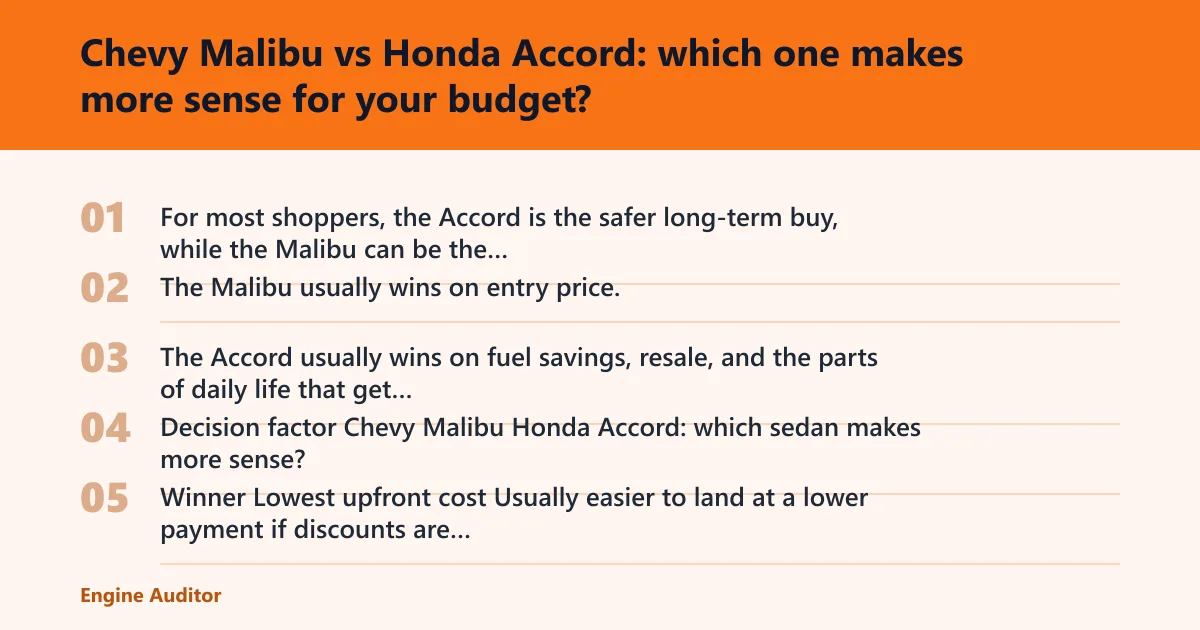


For most shoppers, the Accord is the safer long-term buy, while the Malibu can be the smarter short-term deal when a discount matters most. The Malibu usually wins on entry price. The Accord usually wins on fuel savings, resale, and the parts of daily life that get expensive after year two.
| Decision factor | Chevy Malibu | Honda Accord: which sedan makes more sense? | Winner |
|---|---|---|---|
| Lowest upfront cost | Usually easier to land at a lower payment if discounts are strong. | Higher entry cost, but more equipment and stronger long-term value. | Chevy Malibu |
| Best highway commute | Good commuter, especially if the deal is strong. | Better fuel economy fit for high-mileage driving. | Honda Accord |
| Best family space | Useful for five, but the cabin is not the class leader. | More convincing rear-seat and overall packaging for families. | Honda Accord |
| Best resale value | Typically weaker resale because the used market discounts it harder. | Usually holds value better. | Honda Accord |
| Best used-buy value | Can be the bargain if you want a lower purchase price and accept faster depreciation. | Good used buy, but often costs more because the market knows it keeps value. | Chevy Malibu |
Lowest upfront cost
The Malibu is the easier entry point when sticker price is the main constraint. Chevrolet’s own current entry pricing context shows a Trax starting at $21,700, which helps explain where the brand sits on the value ladder, while the Malibu has historically been positioned as the more affordable midsize step up.
The Accord usually asks for more money up front, especially once you move past the base gas car and into hybrid trim territory. That extra spend is not wasted if you keep the car a long time, but it does matter when the down payment is thin.
Best highway commute
The Accord is the stronger commuting tool because fuel savings build fast on long trips. A 650-mile test trip once showed the Honda with a 4-mpg advantage over the Chevrolet, and that kind of gap is exactly what changes weekly fuel bills for high-mileage drivers. The Honda in that comparison used a 2.2-liter four-cylinder engine, while the Chevrolet used a 3.1-liter six-cylinder engine. (caranddriver.com)
That older comparison is not a modern spec sheet, but the logic still holds: a lighter, thriftier powertrain usually pays off when the odometer climbs quickly. The Malibu can still make sense if the commute is short and the purchase discount is meaningful.
Best family space
The Accord is the better family car because it tends to package its cabin more efficiently. The Honda Accord was described as the smaller car in the group in the referenced comparison, yet it still had a lower trunk liftover than the Chevrolet, which is the kind of small usability detail families feel every day.
The Malibu can carry five, but families often care about rear-seat room, easy child-seat loading, and a trunk that is easy to use. The Accord wins those day-to-day tasks more often.
Best resale value
The Accord wins because the used market generally trusts it more and pays accordingly. The Malibu usually drops faster in value, which hurts owners who trade early or finance too much of the purchase price.
That depreciation gap can matter about as much as fuel economy over a few years of ownership. A car that is cheaper to buy but softer on resale can end up costing the same, or more, by the time the loan is over.
Best used-buy value
The Malibu can be the better used buy when the price difference is wide enough. If the car is already several years old and the shopper wants the lowest check amount, Malibu pricing often gives more metal for the money.
The Accord is still the better used bet for buyers who care about long-term value retention and easier exit pricing later. Cheap to buy and cheap to keep are not the same thing.
According to 1992 Chevy Lumina vs Ford Taurus vs Honda Accord vs Toyota… — The 1992 Accord LX was priced at $17,160. (source)
Is the Chevy Malibu cheaper than the Honda Accord?
Usually yes on the sticker, but not always by enough to settle the deal by itself. The Malibu is typically the lower-priced midsize sedan, while the Accord often asks for more money because of its stronger resale, better efficiency, and broader trim strategy.
MSRP, destination charge, and trim walk
The Malibu’s trim walk usually works in the buyer’s favor if you want a plain commuter with a sane payment. The Accord’s trim walk is wider because it offers gas and hybrid versions, and that extra spread gives shoppers more ways to spend more.
Price should not be read as one number. A base car, a mid-trim car, and a loaded car live in different buckets once destination and options are included.
How discounts and incentives change the deal
This is where the Malibu can punch above its badge. Chevrolet models often rely more on incentives and dealer discounting to move volume, which can make the Malibu look stronger on paper than on a window sticker.
The Accord usually leans less on big discounts and more on steady market demand. That keeps transaction prices firmer, but it also supports resale later.
Monthly payment impact on a typical loan
Even a modest price gap changes a monthly payment once financing is rolled in. On a typical loan, the Malibu’s lower purchase price can free up cash flow, but the Accord’s stronger residual value may reduce the real ownership hit if the buyer plans to trade or sell in a few years.
If the payment must be as low as possible right now, the Malibu has the edge. If the total paid after resale matters more, the Accord is usually the better math.

Which gets better gas mileage, Malibu or Accord?
The Accord, especially in hybrid form, is the better fuel-economy choice. The Malibu can still be reasonable for a gas-only midsize sedan, but the Accord’s lineup gives shoppers a clearer path to lower fuel use without moving out of the sedan class.
Gas-only MPG versus hybrid MPG
The Malibu is the simpler gas-only option. The Accord gives buyers a more efficient hybrid option, and that can matter for anyone who spends a lot of time on the road or wants fewer fuel stops.
Hybrid systems usually cost more up front, but they can repay that premium for long-distance commuters and heavy suburban drivers. Gas-only buyers get simpler ownership, but they give up the efficiency ceiling.
Highway commute math
The old 650-mile test trip is a useful reminder that highway efficiency adds up fast. The Honda’s 4-mpg advantage in that trip is the kind of spread that turns into real cash over a year of commuting.
If your routine is mostly short city trips, the gap narrows. If your week is filled with interstate miles, the Accord’s edge grows.
How your driving style changes the gap
Heavy throttle use, short-hop errands, and cold starts hurt both cars. The Accord’s hybrid variants are less sensitive to stop-and-go traffic, while the Malibu’s gas-only setup is more straightforward but easier to punish with an impatient right foot.
Calm drivers usually see better results than lead-foot drivers in either car. The difference is that the Accord gives a bigger reward for disciplined driving.
Which sedan has more interior space and everyday usefulness?
The Accord is the better packaging job for most buyers, even though the Malibu is no back-seat penalty box. The Honda’s cabin and trunk details work better for families, commuters with gear, and anyone who loads the car often.
Rear-seat legroom and seat comfort
The Accord is usually the easier car to live with in the second row. Adults fit more naturally, and child seats tend to be less annoying to install and remove.
The Malibu is acceptable for five-passenger use, but acceptable is not the same as relaxed. Families feel that difference on longer drives.
Trunk space and cargo flexibility
The Accord’s lower trunk liftover in the comparison matters more than brochure trivia suggests. A lower lift point makes groceries, luggage, and strollers easier to load, especially for smaller adults and parents juggling bags.
The Malibu can still haul a weekend’s worth of stuff, but the Accord is better when cargo duty becomes routine rather than occasional.
Five-passenger use for families and carpool duty
For occasional five-up trips, both sedans work. For repeat carpool duty, the Accord is the one that feels less cramped and less compromised.
That difference is why many families end up paying extra for the Honda. Space is a daily-use feature, not a luxury trim feature.
Powertrain, drivability, and maintenance: what feels better to own?
The Malibu is the simpler sedan to understand, while the Accord gives the broader powertrain range and the better long-haul ownership case. The Chevrolet’s setup can be fine for easy commuting, but the Honda usually feels more polished when the miles stack up.
Malibu engine and transmission setup
The Malibu has traditionally leaned on a smaller trim and engine lineup, which makes it easier to shop but less flexible. That narrower lineup keeps the buying process simple, yet it also limits how much efficiency or performance a shopper can tune for.
For maintenance, simpler can be good. Fewer choices often mean fewer decision points at service time, though that does not automatically beat the Accord’s stronger value case.
Accord gas and hybrid powertrains
The Accord’s engine and hybrid variants give shoppers a real choice between simplicity and efficiency. The gas version suits buyers who want straightforward ownership, while the hybrid is the smarter pick for people who drive enough to cash in on fuel savings.
That flexibility is one reason the Accord keeps showing up in buyer shortlists. One model can cover more use cases.
Passing power, stop-and-go behavior, and service complexity
The older comparison with a 3.1-liter Chevrolet six-cylinder and a 2.2-liter Honda four-cylinder shows how powertrain character affects a car’s feel. Bigger-displacement engines can feel relaxed, but efficiency often suffers. Hybrids can feel a little different in stop-and-go traffic, yet they usually win on fuel use.
Service complexity is the hidden cost here. A gas-only sedan is usually simpler than a hybrid, but simplicity does not erase the Accord’s ownership advantage if the buyer drives enough miles.
How do safety features and ownership costs compare?
Both sedans can be equipped with the core safety tech shoppers expect, but the Accord usually gives more confidence on the ownership side because it tends to hold value better. Safety should be checked trim by trim, because standard equipment and driver-assistance content change with version.
Driver-assistance features by trim
Do not assume the lower trim has the same safety kit as the top one. The right question is which version gets the braking aid, lane support, and camera package you actually want without climbing too far up the price ladder.
That matters more on the Malibu, where the value equation can be tempting but the equipment mix still needs a close read.
Crash-test reputation and standard safety gear
Shoppers should look for the model-year safety record before they sign. A sedan with good crash performance and a full basic safety list is easier to recommend, especially if it is going to carry children or frequent passengers.
Braking confidence is also part of the safety story. A car that feels predictable under hard stops is easier to trust in traffic.
Maintenance, insurance, resale value, and warranty coverage
The Malibu can cost less to buy, but the Accord often wins the total-cost picture because it holds value better. Insurance can vary by trim and driver profile, yet depreciation is usually the larger swing factor over three to five years.
Warranty coverage helps early ownership, but it does not cancel resale losses. That is why the Accord’s stronger used-market standing often matters more than the monthly payment difference on day one.
Buyer-matching scorecard: which sedan wins each scenario?
The right answer changes by use case. The Malibu is the budget move. The Accord is the ownership-math move. This scorecard sorts the choice by what the buyer actually needs, not by brand loyalty.
| Scenario | Chevy Malibu | Honda Accord: which sedan makes more sense? | Recommendation |
|---|---|---|---|
| Lowest upfront cost | Better when discounts or incentives are strong. | Usually costs more to get into. | Chevy Malibu |
| Best highway commute | Fine if the commute is modest. | Better fit for high-mileage driving and fuel savings. | Honda Accord |
| Best family space | Works, but not as easy to live with. | More usable cabin and trunk packaging. | Honda Accord |
| Best resale value | Usually loses value faster. | Typically retains value better. | Honda Accord |
| Best used-buy value | Lower purchase price can win here. | Often costs more on the used market. | Chevy Malibu |
What should I compare before choosing a Malibu over an Accord?
Compare the out-the-door price, expected fuel bill, rear-seat needs, and resale loss before deciding. Those four items do more to shape ownership cost than trim names or badge preference. If the Malibu is only a little cheaper, the Accord usually earns the premium back.
- Check the full drive-off price, not just MSRP.
- Estimate fuel cost based on your real commute.
- Look at rear-seat access if you carry kids or adults often.
- Compare insurance quotes for the exact trim you want.
- Ask how much value each car will likely keep after three to five years.
Choose Chevrolet Malibu if… / Choose Honda Accord if…
Pick the Malibu if your budget is tight, your commute is short, and a lower payment matters more than the strongest resale or cabin room. Pick the Accord if you drive a lot, need family-friendly packaging, or plan to keep the sedan long enough for depreciation and fuel savings to matter.
Choose Chevrolet Malibu if…
You want the lower check amount at signing. You are shopping for a good-enough commuter rather than the class leader. You are buying used and want the lowest entry cost, even if resale later is softer.
Choose Honda Accord if…
You log a lot of highway miles. You want better five-passenger usability. You care about resale value and a more convincing total-cost picture over several years.
Frequently asked questions
Chevy Malibu vs Honda Accord: which is better to buy?
The Accord is the better buy for most shoppers because it usually wins on fuel economy, cabin packaging, and resale value. The Malibu is the better buy only when the lower upfront cost is the main goal and you are comfortable giving up some long-term value.
Is the Chevy Malibu cheaper than the Honda Accord?
Usually yes. The Malibu tends to sit lower on the price ladder, and Chevy often needs discounts or incentives to keep it competitive. That lower sticker can help a monthly payment, but it does not always beat the Accord after depreciation and fuel are included.
Which gets better gas mileage, Malibu or Accord?
The Accord usually does, especially in hybrid form. The Malibu can be reasonable as a gas-only sedan, but the Honda lineup gives shoppers a stronger efficiency ceiling. That difference matters most for commuters who put real miles on the car every week.
Is the Accord more reliable than the Malibu?
For ownership planning, the Accord is usually the safer bet. It tends to have a stronger reputation in the used market and often costs less in depreciation pain over time. The Malibu can still be a sensible choice, but the Honda is usually the calmer long-term purchase.
Which sedan has more interior space, Malibu or Accord?
The Accord is the better interior package for most families and adults in the back seat. In the older comparison, the Honda was described as the smaller car in the group, yet it had a lower trunk liftover than the Chevrolet, which makes daily loading easier.
Is the Malibu still worth buying in 2026?
It can be, but only for the right buyer. If you find a strong discount, want a lower payment, or are shopping the used market for value, the Malibu still makes sense. If you care more about resale, space, and long-term fuel cost, the Accord is the better bet.
Products related to this article
Sponsored / affiliate links. As an Amazon Associate I earn from qualifying purchases. I may earn additional commission from eligible campaigns.