Chevy Dealer Service vs Independent Mechanic: Where to Go
Take a Chevy dealer for warranty work, recalls, and complex electronics. Choose an independent mechanic for routine maintenance and many mechanical repairs. Pick the wrong shop and you can slow a claim, miss a bulletin, or pay dealer labor rates for work a local shop can do for less. This guide compares warranty status, repair type, model complexity, and cost so you can pick the lower-risk shop.
| Decision factor | Chevy dealer service | Independent mechanic | Winner |
|---|---|---|---|
| Warranty-sensitive repairs | Best fit for work tied to Chevrolet original warranty, recall handling, and service records that need dealership documentation. | Can handle some covered work if the shop follows proper procedures and you keep records, but it is less direct for claim support. | Chevy dealer service |
| Routine maintenance | Handles oil changes, tire rotations, spark plugs, and brake inspections, often with service specials or coupons. | Also handles routine maintenance, often with lower labor cost potential and flexible parts sourcing. | Tie |
| Complex diagnostics | Often better for model-specific fault tracing, dealer systems, and service bulletins. | Can be strong on diagnosis, but capability varies more by shop and scan-tool access. | Chevy dealer service |
| Parts strategy | Commonly uses OEM parts with factory-spec fit. | May use aftermarket or OEM parts, which can lower cost or match owner preferences. | Tie |
| Older or high-mileage vehicles | Works well, but the price gap can be hard to justify on simpler post-warranty repairs. | Often the better value when the vehicle is out of warranty and the repair is straightforward. | Independent mechanic |
| Heavy mechanical work | Strong option for transmission work, engine repairs, collision repair, and other major jobs. | Can be a better fit if the shop specializes in Chevrolet or the exact failure type. | Tie |
Dealer or independent: the real trade-off
The real question is simple: does this repair need warranty awareness, OEM parts, Chevrolet-specific diagnostics, or software access? Dealers are more likely to have those tools on hand. For ordinary work, an independent mechanic can usually do the job for less labor cost.
What each shop type is best equipped to handle
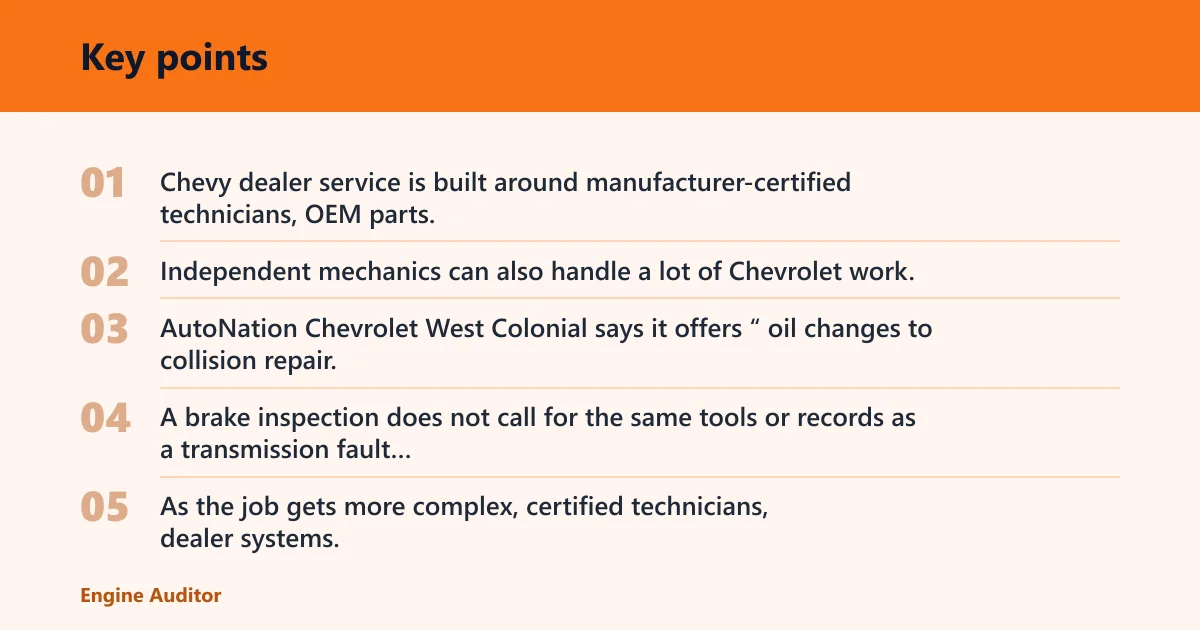
Chevy dealer service is built around manufacturer-certified technicians, OEM parts, routine maintenance, major repairs, and warranty-aware service. Independent mechanics can also handle a lot of Chevrolet work, especially when they stock OEM or aftermarket parts and have a track record with make-specific diagnosis.
AutoNation Chevrolet West Colonial says it offers “oil changes to collision repair, and everything in between,” says its service team is “Chevrolet certified,” and says it is qualified for vehicles “still protected by Chevy’s original warranty.” It also says repairs use “all OEM parts.”
Carroll Chevrolet says its technicians are “highly trained and certified,” lists service for “Silverado 1500, Silverado 2500 HD, Trax, Trailblazer or Equinox,” and says its technicians are “certified to perform whatever work you may need.” That is the kind of evidence you want for model-specific or complex work.
Why repair severity changes the answer
A brake inspection does not call for the same tools or records as a transmission fault or an intermittent electrical problem. As the job gets more complex, certified technicians, dealer systems, and service bulletins matter more. That is why this comparison has to be made repair by repair.
Suppose a 2019 Equinox needs an oil change and tire rotation before a road trip. An independent mechanic is often enough if the shop documents the work and uses the correct fluid and filter. Now suppose the check engine light returns after an update and the transmission shifts harshly only when hot; that is a stronger case for Chevy dealer service.
Chevy service comparison table
Here is the side-by-side view that matters most: parts, labor, diagnostics, and warranty fit. Check this first, then call either shop.
| Criterion | Chevy dealer service | independent mechanic | Winner |
|---|---|---|---|
| Parts | OEM parts are standard and are the factory-spec choice for dealer repairs. | Aftermarket or OEM parts may be available, depending on the shop and the job. | Tie |
| Labor cost | Usually higher, especially on complex work that needs brand systems or specialized technicians. | Often lower, particularly for maintenance and common mechanical repairs. | independent mechanic |
| Diagnostics | Strong for Chevrolet-specific faults, software updates, and service bulletin access. | Varies by shop; some are excellent, but capability is less uniform. | Chevy dealer service |
| Warranty support | Well suited for covered repairs and recordkeeping tied to Chevrolet original warranty. | Can service the vehicle, but you need good documentation to protect claims. | Chevy dealer service |
| Convenience for simple work | Good if you want one-stop brand service or need a dealer coupon for scheduled maintenance. | Good if the shop is local and the repair is ordinary. | Tie |
Parts
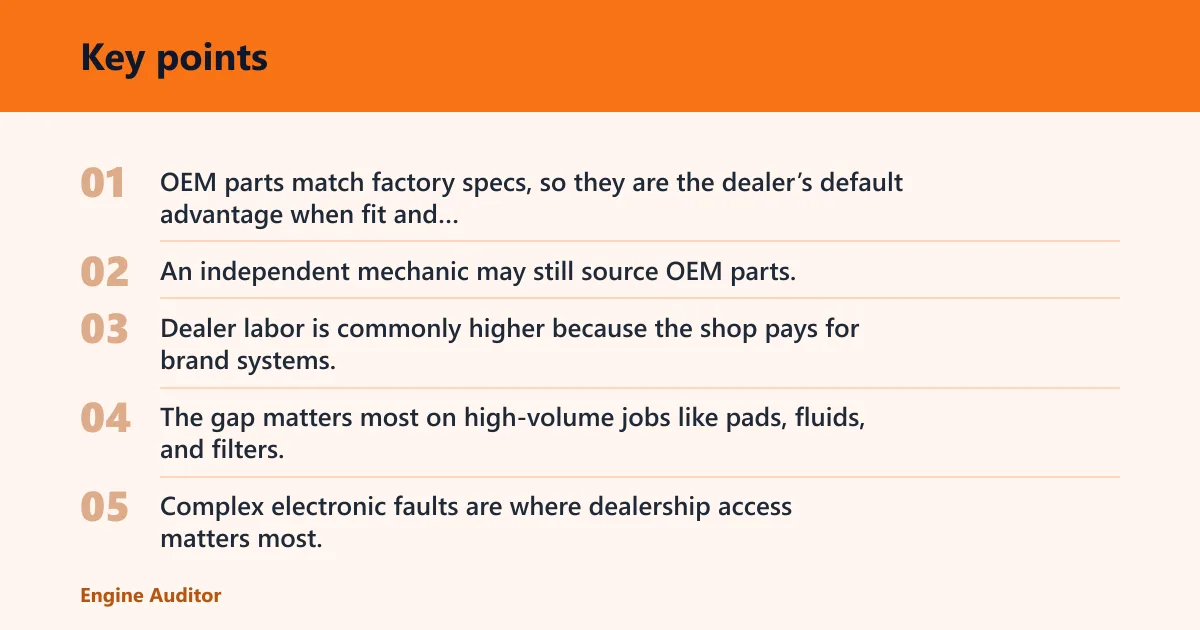
OEM parts match factory specs, so they are the dealer’s default advantage when fit and part matching matter. An independent mechanic may still source OEM parts, but many also offer aftermarket choices that can cut the bill or fit an older Chevy that no longer needs a brand-new part price.
Labor cost
This is where local shops often pull ahead. Dealer labor is commonly higher because the shop pays for brand systems, factory training, and a service department set up for warranty work and complex diagnostics. The gap matters most on high-volume jobs like pads, fluids, and filters.
Diagnostics
Complex electronic faults are where dealership access matters most. Certified technicians have brand training, model-specific knowledge, and access to dealer systems and service bulletins, which helps when a problem depends on software, calibration, or a known Chevrolet repair pattern. A good independent mechanic can still diagnose many faults, but the burden is on the shop to prove capability.
Warranty support
Warranty questions are about documentation and eligibility, not brand loyalty. A Chevrolet original warranty covers the vehicle while it is in effect, but you still need service records that show proper maintenance and correct repairs. Dealer paperwork often makes that cleaner when a claim is possible.
When should you choose a Chevy dealer for service instead of a local shop?
Choose Chevy dealer service when the repair is tied to active warranty coverage, a recall, a known bulletin, or a problem that needs brand-specific diagnostics. It is also the safer choice for transmission issues, advanced electrical faults, engine repairs, and software-related fixes that depend on dealer systems or Chevrolet-certified technicians.
Active warranty repairs and recall work
If the vehicle is still protected by Chevy’s original warranty, dealer service is the cleaner path for claim handling and documentation. AutoNation Chevrolet West Colonial says it is qualified for vehicles “still protected by Chevy’s original warranty,” which is exactly the kind of shop claim that matters for covered repairs.
Transmission, engine, and advanced electrical faults
These jobs are not basic maintenance. They often need deeper scan-tool access, more time spent confirming the fault, and parts choices that affect long-term reliability. A dealer is not always the only correct choice, but it is often the lower-risk one when the failure is intermittent or system-wide.
Model-specific bulletins and software updates
Some Chevy problems are updates, calibrations, or known bulletin fixes, not old-school mechanical failures. That is where dealer systems and certified technicians can save time, because the shop may already have the factory procedure for the exact model and fault code.
When does an independent mechanic make more sense?
An independent mechanic makes more sense for routine maintenance, many brake jobs, and post-warranty repairs where the work is straightforward. It is also the better value on older or high-mileage Chevys when the owner wants to control cost without giving up competent service or proper parts selection.
Routine maintenance and brake work
Oil changes, tire rotations, spark plugs, and brake inspections can usually be done at either shop. If the local shop documents the work, uses the correct fluids and parts, and can explain the inspection, there is little reason to pay dealer pricing just for a badge on the building.
Older or high-mileage Chevys
Once the warranty is gone, the value question changes. A 12-year-old Silverado with about 140,000 miles does not necessarily need dealer pricing for every hose, sensor, or brake service if a trusted shop can source the right part and explain the diagnosis clearly.
A common first-timer mistake is taking a simple no-start complaint to the dealer because the dashboard feels modern. If the issue turns out to be a corroded battery cable on a high-mileage Trax, an independent mechanic may solve it faster and cheaper than a brand-only approach.
Cost control without losing repair quality
Independent mechanics often have lower labor cost potential and can choose between aftermarket and OEM parts. That flexibility matters when the repair is common, the part is not software-dependent, and the owner wants a practical fix instead of a factory-only one.
What does your Chevy warranty actually require?
Your warranty usually does not force every repair into a dealership bay, but it does require proper service and documentation. Keep invoices, part descriptions, mileage, and dates. If the work could become part of a claim later, dealer documentation is easier to defend.
What service records to keep
Keep every maintenance invoice, even for simple jobs. The record should show the vehicle, mileage, date, service performed, and parts used when possible. That paper trail helps if you later need to show that a failure was not caused by missed maintenance.
How to protect coverage with outside repairs
An independent mechanic can work on a Chevy that is still under warranty. The key is doing the work correctly and keeping proof. If the shop uses proper fluids, follows the service schedule, and documents the job, you reduce the risk of a warranty dispute.
When dealer documentation matters most
Dealer paperwork matters most when the failure is close to the warranty line, involves a recall, or could be blamed on prior service. It also matters for software updates and repairs that a dealership can tie directly to Chevrolet service records.
Choose Chevy dealer service if… / Choose an independent mechanic if…
Use Chevy dealer service when the repair is under warranty, tied to a recall, or depends on Chevrolet-specific diagnostics or software access. Use an independent mechanic when the vehicle is out of warranty, the repair is routine or mechanical, and the shop can document parts and labor clearly.
Choose Chevy dealer service if…
- The repair is covered by Chevrolet original warranty or could become a claim.
- You need transmission work, engine repairs, collision repair, or advanced electrical diagnostics.
- The vehicle needs a software update, bulletin-based fix, or model-specific procedure.
- You want OEM parts by default and dealer documentation for resale or warranty protection.
Choose an independent mechanic if…
- The work is routine maintenance, brake service, or another common repair.
- The Chevy is older, high-mileage, or clearly out of warranty.
- The shop specializes in your make or has a strong Chevrolet diagnostic track record.
- You need better cost control and are comfortable asking about parts source and labor warranty.
What should you ask before booking service?
Ask the shop what parts it will use, how it diagnoses the problem, and whether its estimate separates diagnosis from repair. Also ask about labor warranty, service specials, and whether the quoted work could affect warranty claims or future resale documentation.
Parts source and labor warranty
Ask whether the shop will use OEM parts, aftermarket parts, or a mix, and ask what warranty applies to the labor. That answer tells you whether the quote is based on factory-correct repair or a lower-cost substitute that may be fine for the job.
Diagnostic process and estimate format
A serious repair quote should explain how the fault was found, what testing was done, and what happens if the first repair does not fix the problem. That matters most for complex electrical faults and intermittent drivability issues, where a vague estimate can get expensive fast.
Service specials and coupon eligibility
Dealer service specials and coupons can narrow the gap on scheduled maintenance. If the dealer has a discount on oil changes, tire rotations, or brake inspections, compare the final out-the-door total against the independent shop before you decide.
Frequently asked questions
Is it better to take my Chevy to the dealer or an independent mechanic?
It depends on the repair type. Dealer service is the safer bet for warranty work, recalls, software-related problems, and complex diagnostics. An independent mechanic is often the better value for routine maintenance, common brake work, and many post-warranty repairs.
Does dealer service keep my Chevy warranty valid?
Dealer service can make warranty documentation easier, but it is not the only way to preserve coverage. An independent mechanic can also service the vehicle if the work is done correctly and you keep detailed invoices, mileage, and parts records.
Are Chevy dealer repairs more expensive than independent mechanics?
Usually, yes, especially for labor. Dealer service often costs more because of brand-specific training, OEM parts, and diagnostic access. The gap is most noticeable on routine jobs; on warranty or software-heavy repairs, the dealer may be the better value.
Can an independent mechanic work on a Chevy that is still under warranty?
Yes. The shop can perform maintenance or repairs while the warranty is active, but you should keep every invoice and confirm the parts used. That documentation helps protect later claims if the same system fails again while coverage is still in effect.
What repairs are worth paying dealer prices for on a Chevy?
Transmission work, major engine repairs, advanced electrical diagnosis, collision repair, and bulletin-based fixes are the strongest dealer cases. Those jobs benefit most from Chevrolet-certified technicians, dealer systems, and OEM parts, especially when the vehicle is still under warranty.
Is it okay to get routine maintenance done at an independent shop?
Yes. Oil changes, tire rotations, spark plugs, and brake inspections can usually be done well at either shop. The key is keeping the service record and confirming that the fluids, filters, and parts meet the vehicle’s requirements.
What should I ask before choosing a Chevy service shop?
Ask what parts the shop will use, how it diagnoses the fault, whether the labor has its own warranty, and whether any service specials apply. If the job could affect warranty coverage or resale value, request a written estimate and keep every record.
Products related to this article
Sponsored / affiliate links. As an Amazon Associate I earn from qualifying purchases. I may earn additional commission from eligible campaigns.