Chevy 4WD vs AWD: what’s the difference for buyers?
Chevy AWD fits commuting and slippery pavement. 4WD fits pickups and SUVs when you need low-speed trail traction, heavier towing confidence, or both. Pick the wrong one and you can spend more, burn more fuel, or end up with a drivetrain that suits the driveway but not the job. This guide compares commuting, snow, towing, and off-road needs so you can choose the right Chevy drivetrain.
This guide is part of our Chevy vehicles guide: models, issues, and buying tips series.
| Decision factor | Chevy 4WD | AWD: what’s the difference for buyers | Winner |
|---|---|---|---|
| Daily pavement use | Part-time 4WD can be the wrong tool on dry roads if the system lacks a center differential. | Built for full-time use on dry pavement and automatic traction management. | AWD |
| Deep snow, mud, steep grades | Low-range gearing and a transfer case make it the stronger choice. | Good for light snow and mixed traction, weaker for serious terrain. | Chevy 4WD |
| Towing and hauling | Better for launches, boat ramps, and low-speed control when loads get heavy. | Fine for normal road use, but not the first pick for hard towing work. | Chevy 4WD |
| Fuel economy | Usually worse because of added weight and friction. | Typically better; front-drive-based AWD can reduce combined economy by 1-3 mpg. | AWD |
| Ownership fit | Best for trucks and body-on-frame SUVs with real work to do. | Best for commuters, crossover buyers, and mixed-weather driving. | Tie |
Chevy 4WD vs AWD: what’s the real difference?
The short answer is plain. AWD changes torque automatically for pavement and shifting grip, while 4WD sends power through a transfer case for tougher terrain and low-speed control. That hardware choice changes the feel, the limits, and the roads each system suits.
How Chevy AWD works compared with 4WD
Chevy AWD systems use wheel speed sensors, throttle position, steering angle, and road speed to decide when to send power where it is needed. The system is tuned for rain, light snow, and mixed traction, and it can run full time on dry pavement.
Chevy 4WD uses a transfer case to mechanically distribute power to both axles. Many systems also offer selectable 2WD and 4WD modes, and some add low range for slow, forceful traction work.
Why the mechanical design changes how each system feels
AWD feels quiet in normal use. It reacts as the road changes, which is why it suits commuting and highway driving so well.
4WD feels more deliberate. It is heavier and usually built to take more abuse, but that extra hardware is there for mud, steep grades, deep snow, and work-site or trail use.
📊 MotorTrend says old-school 4WD systems with no center differential should not be driven on dry pavement in 4WD mode. Source: 4WD vs. AWD: What’s the Difference?.
Which is better for snow, AWD or 4WD?

For packed snow, slush, and wet commutes, AWD is the better daily-driving choice because it manages traction automatically and stays happy on pavement. For deep snow, unplowed roads, and steep driveways, 4WD is the better tool when the snow is deep enough to slow the vehicle itself, not just the tires, because low-range gearing and the transfer case give the driver more control at low speed.
Packed snow and slush on commutes
AWD does well here because the system can react quickly when one tire starts to slip. MotorTrend notes that the most efficient AWD systems can reconnect the propeller shaft in milliseconds when traction is needed, which is exactly the kind of response that helps in stop-and-go winter driving.
Deep snow, steep driveways, and unplowed roads
4WD is the better tool when the snow is deep enough to slow the vehicle itself, not just the tires. Low range helps keep momentum controlled, and a Chevy truck or body-on-frame SUV with 4WD is better suited to pushing through snow that would have an AWD crossover spinning its tires.
When tires matter more than the badge
Good winter tires still matter more than either badge for ordinary snow travel. A worn all-season tire with AWD is not a substitute for a proper winter tire in a snow belt.
Can you drive Chevy 4WD on dry pavement?
Only if the system is designed for it. Old-school 4WD systems with no center differential should not be driven on dry pavement in 4WD mode, because the front and rear axles cannot rotate at different speeds the way the road demands.
Why part-time 4WD can bind on dry roads
On a dry surface, the front and rear tires travel slightly different paths in a turn. Without a center differential, that difference creates driveline windup, which can cause binding, tire scrub, and wear.
When AWD is fine on dry pavement
AWD is built for full-time use on dry pavement. It routes torque with clutches and sensors instead of locking the front and rear axles together all the time.
The wear and handling risks buyers miss
Drivers often ignore a flashing dash light or leave a truck in 4WD longer than needed. That habit can make the vehicle feel awkward in parking lots and can add wear to tires and driveline parts over time.
Is AWD better for daily driving than 4WD?
Yes, for most commuters. AWD is the better daily-driving choice when the route includes city streets, highways, rain, occasional light snow, and regular parking-lot maneuvering. 4WD makes more sense when the daily routine also includes towing, dirt roads, or real winter obstacles.
Commute type: city, highway, mixed weather, and parking-lot use
AWD fits mixed-weather commuting because it is always ready and does not need driver input. That matters when the weather changes fast and the driver wants predictable behavior on pavement.
Fuel economy and ride feel
In many cases, AWD may return slightly better fuel economy than 4WD on a similar vehicle. Front-drive-based AWD systems can reduce EPA combined economy by 1-3 mpg, while 4WD adds weight and friction, and MotorTrend notes some 4WD systems add more than 200 pounds compared with AWD systems.
Maintenance and long-term ownership tradeoffs
4WD ownership needs more attention to tire matching and transfer-case maintenance. If the tires are mismatched or the system is used the wrong way, wear goes up fast. AWD is simpler for normal street use, but it still benefits from consistent tire wear and regular service.
Which Chevy models have AWD vs 4WD?
Chevrolet offers true 4WD on Silverado 1500, Silverado 2500, Silverado 3500, Colorado, Tahoe, and Suburban. Chevy AWD is more common on crossover-style and road-focused SUVs, where the system is aimed at pavement, weather traction, and everyday use.
Silverado family and Colorado: what typically gets 4WD
These are the trucks where 4WD belongs. Their chassis, cargo use, and towing jobs line up with a transfer case, selectable drive modes, and sometimes low-range gearing.
Tahoe and Suburban: where AWD and 4WD can both appear depending on trim and platform
These larger SUVs can be configured for different jobs. A buyer should check whether the trim is set up as a road-first AWD model or a truck-style 4WD model, because the difference affects towing feel, snow behavior, and dry-road use.
Why crossover-style Chevy AWD and truck-style 4WD are not interchangeable
AWD fits road-oriented shoppers better. 4WD fits buyers choosing a Chevrolet truck or body-on-frame SUV because it is built around a transfer case and the loads those vehicles see.
Does 4WD help more for towing and hauling?
Yes, in the situations that matter most to truck buyers. 4WD helps more at launch, on slippery ramps, and on grades where controlled low-speed torque matters. It does not automatically improve every towing situation, especially once the rig is rolling on dry pavement.
Towing launches and boat ramps
Low-range gearing can multiply torque at low speeds, which helps the driver pull away smoothly with a trailer. That matters on wet boat ramps, gravel launch areas, and steep campground entries.
Hauling on job sites and loose surfaces
A loaded truck often needs traction when the surface is dirt, mud, or graded gravel. 4WD gives the driver a better chance of moving a heavy load without wheelspin.
What 4WD does not do
4WD is not magic towing capacity. It helps with control and traction, but axle ratings, hitch limits, cooling, and brakes still decide what the vehicle can safely pull.
What does 4WD low range do on a Chevy?
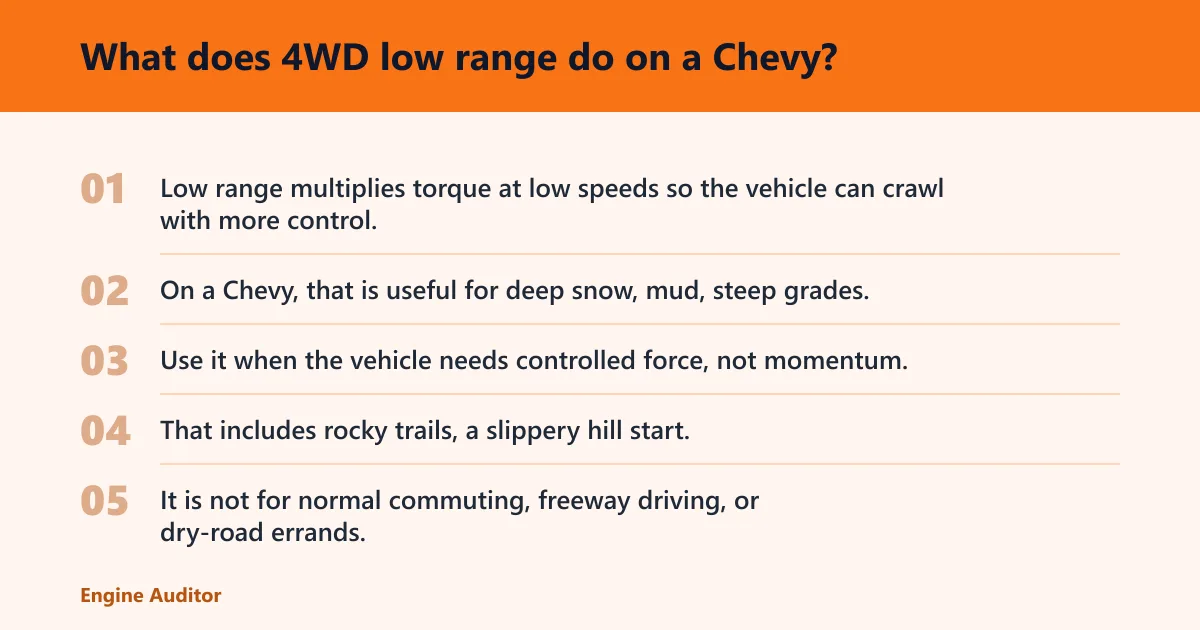
Low range multiplies torque at low speeds so the vehicle can crawl with more control. On a Chevy, that is useful for deep snow, mud, steep grades, and slow towing launches where finesse matters more than speed.
When low range is the right tool
Use it when the vehicle needs controlled force, not momentum. That includes rocky trails, a slippery hill start, or a trailer launch where the driver wants smoother throttle response.
When low range is the wrong tool
It is not for normal commuting, freeway driving, or dry-road errands. The lower gearing is there for traction and control at low speeds, not for day-to-day cruising.
Is AWD or 4WD more fuel efficient?
AWD is usually more fuel efficient. The hardware is lighter and creates less drag than 4WD, and front-drive-based AWD systems can reduce combined economy by 1-3 mpg. 4WD typically costs more in fuel because of the transfer case, extra mass, and added friction.
Why AWD usually wins at the pump
AWD systems spend much of their time sending power where it is needed without keeping the driveline locked into full-time truck-style operation. That design helps preserve economy in everyday driving.
Why 4WD costs more to run
4WD brings heavier parts and more rotating mass. MotorTrend also notes that some 4WD systems add more than 200 pounds compared with AWD systems, and that extra mass has a real effect over time.
Chevy drivetrain decision checklist
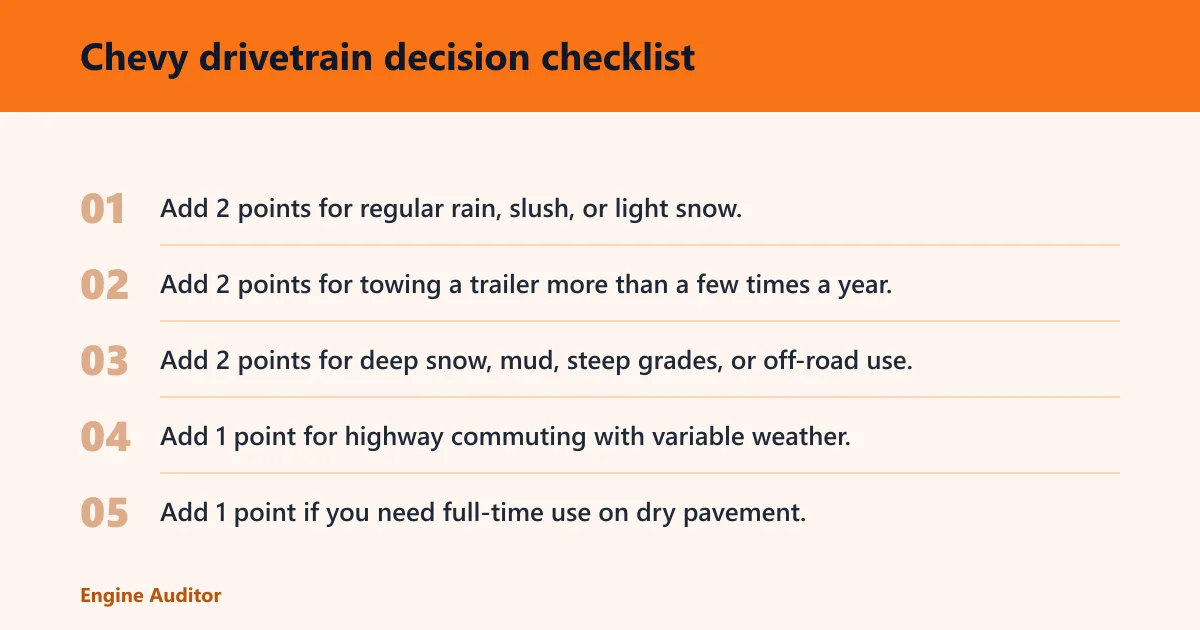
This checklist turns buyer needs into a drivetrain choice. Use the row that most closely matches the real vehicle use, not the one that sounds toughest.
| Road conditions | Towing frequency | Off-road severity | Commute type | Recommended drivetrain | What to avoid |
|---|---|---|---|---|---|
| Rain, dry pavement, light snow | Rare | None | City or highway | AWD | Buying 4WD just for weather traction |
| Packed snow, slush, freeze-thaw mornings | Occasional | Light dirt roads | Mixed commute | AWD | Assuming 4WD is needed for every winter drive |
| Deep snow, mud, steep grades | Occasional to frequent | Moderate to severe | Rural or access-road use | 4WD | Staying in two-wheel drive when traction is poor |
| Boat ramps, trailers, work-site gravel | Frequent | Moderate | Mixed | 4WD | Expecting AWD to replace low-range control |
| Dry roads, mild climate | Rare | None | Easy commute | Neither | Paying extra for driveline hardware you will not use |
Simple scorecard: AWD, 4WD, or neither
- Add 2 points for regular rain, slush, or light snow.
- Add 2 points for towing a trailer more than a few times a year.
- Add 2 points for deep snow, mud, steep grades, or off-road use.
- Add 1 point for highway commuting with variable weather.
- Add 1 point if you need full-time use on dry pavement.
If the total is in the middle range, AWD may be the better fit. If the total is on the higher end, 4WD may make more sense. If the total is very low, neither option may be worth the cost.
Choose AWD if… / Choose 4WD if…
Choose AWD if your Chevy will spend most of its life on pavement, in rain, light snow, and stop-and-go traffic. Choose it if you want automatic traction management, full-time dry-pavement use, and better fuel economy than a truck-style 4WD system.
Choose 4WD if you buy a Silverado, Colorado, Tahoe, or Suburban for towing, hauling, steep driveways, deep snow, mud, or trail use. Choose it if low-range gearing, selectable modes, and tougher low-speed control matter more than fuel economy.
Choose neither if your driving is mild, your climate is forgiving, and the vehicle will never leave pavement. In that case, the extra cost, weight, and maintenance may buy more hardware than you will ever use.
Frequently asked questions
What is the difference between Chevy AWD and 4WD?
Chevy AWD is designed to manage traction automatically for pavement and changing weather, using sensors and electronically controlled clutches. Chevy 4WD uses a transfer case to mechanically distribute power, and it is meant for tougher terrain, low-speed control, and truck-style work.
Which is better for snow, AWD or 4WD?
For packed snow and slush, AWD is usually the easier daily-driver answer. For deep snow, unplowed roads, or steep driveways, 4WD is stronger because low-range gearing and the transfer case help the vehicle keep moving when conditions get worse.
Can you drive Chevy 4WD on dry pavement?
Not if it is an old-school part-time system with no center differential. MotorTrend says those systems should not be driven on dry pavement in 4WD mode. AWD is designed for full-time dry-pavement use, which is why it fits commuting better.
Is AWD better for daily driving than 4WD?
Yes, for most buyers. AWD is better for commuting because it works automatically, stays happy on dry pavement, and usually uses less fuel. 4WD makes more sense when daily use also includes hauling, towing, or rough access roads.
Does 4WD help more for towing and hauling?
Yes, especially at low speed. 4WD with low range helps with trailer launches, boat ramps, and slippery job sites. It does not increase payload or trailer ratings by itself, but it gives the driver more control when the load is heavy and traction is poor.
Is AWD or 4WD more fuel efficient?
AWD is generally more efficient. Front-drive-based AWD systems can reduce combined economy by 1-3 mpg, while 4WD adds weight and friction and may add more than 200 pounds compared with AWD systems. That difference shows up every time the vehicle is driven.
Products related to this article
Sponsored / affiliate links. As an Amazon Associate I earn from qualifying purchases. I may earn additional commission from eligible campaigns.