Used Chevy buying guide: models that hold up best
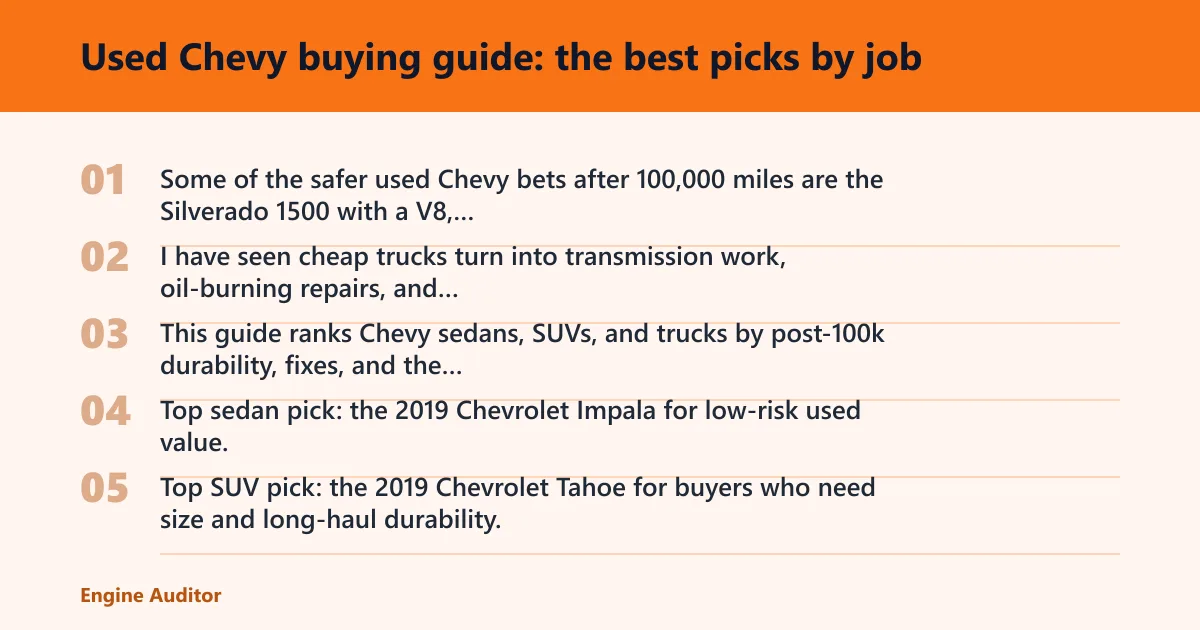
Some of the safer used Chevy bets after 100,000 miles are the Silverado 1500 with a V8, Tahoe/Suburban with a V8, and Malibu with a four-cylinder; avoid first-year redesigns and trucks with questionable 8-speed behavior unless the shifting feels sorted. I have seen cheap trucks turn into transmission work, oil-burning repairs, and suspension bills that erase the savings fast. This guide ranks Chevy sedans, SUVs, and trucks by post-100k durability, fixes, and the owner profile each one fits.
This guide is part of our Chevy vehicles guide: models, issues, and buying tips series.
Top sedan pick: the 2019 Chevrolet Impala for low-risk used value. Top SUV pick: the 2019 Chevrolet Tahoe for buyers who need size and long-haul durability.
Used Chevy buying guide: the best picks by job
Quick picks
| Model | Best for | Key spec | Price range | Buyer-fit verdict |
|---|---|---|---|---|
| 2019 Chevrolet Tahoe | Family hauler, tow rig | 5.3-liter EcoTec3 V8 or 6.2-liter V8; 6L80 on early fourth-gen, 10-speed on later trims | Value sweet spot: 2017–2020 | Best full-size SUV bet if service history is clean |
| 2019 Chevrolet Impala | Commuter | 2.5-liter four-cylinder or 3.6-liter V6; J.D. Power 91/100 | $10,000–$21,000 | Best sedan value if you want low drama after 100,000 miles |
| 2018 Chevrolet Silverado 1500 | Truck, mixed daily use | V6 and V8 engine options; Z71 package available | $20,000–$32,000 | Best work-truck balance when the maintenance file is complete |
| 2020 Chevrolet Malibu | Commuter | 1.5-liter turbocharged engine or 2.0-liter turbocharged engine; J.D. Power 84/100 | $12,000–$22,000 | Good low-cost sedan if you inspect the transmission behavior carefully |
| 2019 Chevrolet Equinox | Small family SUV | 1.5-liter turbocharged engine or 2.0-liter turbocharged engine; J.D. Power 86/100 | $15,000–$22,000 | Solid compact SUV when you prioritize cabin space over speed |
What makes a used Chevy worth buying after 100,000 miles
After 100,000 miles, the buy decision changes. Engine choice matters more than badge appeal, and transmission behavior matters more than trim level. A clean maintenance record, normal shift feel, and an unbent cooling system beat a glossy listing with missing service notes.
Used Chevys can run a long time when the powertrain pairing is right. The wrong pairing turns a cheap purchase into a long repair list, especially on trucks and larger SUVs that have seen towing, idle time, or skipped fluid service.

Is a used Chevy Tahoe a good buy?
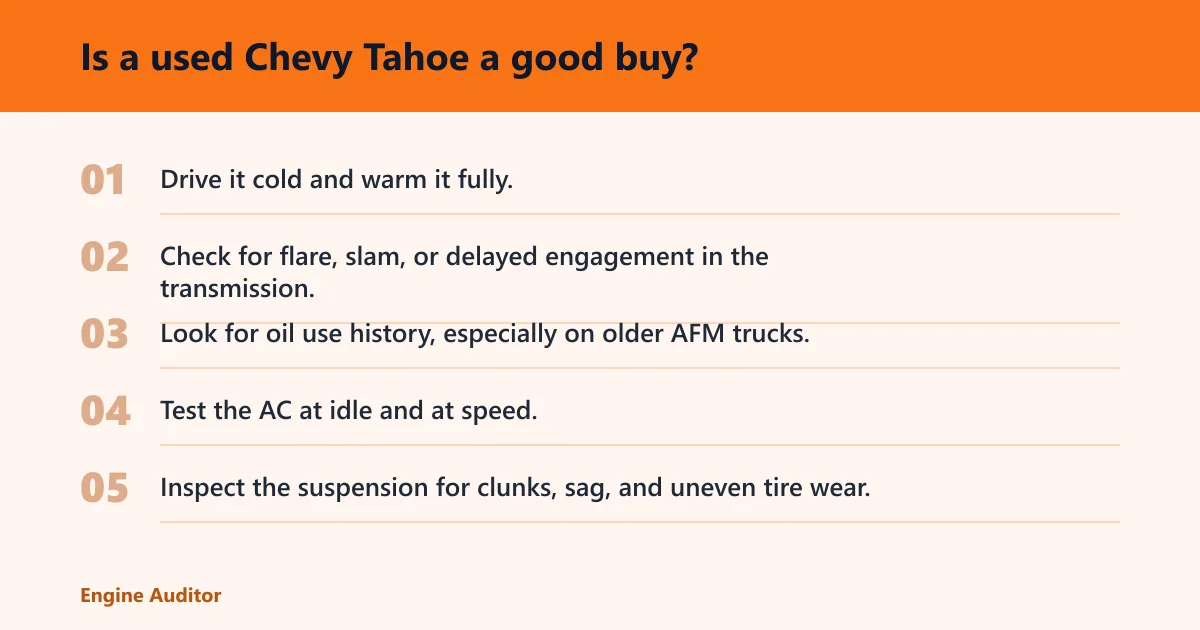
Yes, if you stay in the 2017–2020 window and avoid neglected examples. The Tahoe is the full-size SUV I would point a large-family buyer or tow shopper toward first, because the right engines and transmissions can cover very high mileage with fewer surprises than the problem years.
Best years and the ones to skip
The Tahoe sweet spot is 2017–2020. The 2015 Tahoe is flagged for first-year redesign issues, and 2007–2011 trucks can bring AFM lifter and oil consumption problems that are expensive to sort out after purchase.
Best engines and transmissions
The 5.3-liter EcoTec3 V8 is the safer mainstream choice. The 6.2-liter V8 on higher trims is the stronger puller, but it usually costs more to buy and fuel. Early fourth-gen Tahoes used the 6L80 six-speed automatic; later trims moved to a 10-speed automatic. Both can be fine when service is documented and the shift quality is clean.
A well-maintained Tahoe can reach 200K–250K+ miles. That claim matters only if the truck has proof of routine oil changes, cooling-system upkeep, and transmission service. A high-mile Tahoe with a clean file is a different risk than one with no history and a rough idle.
Buyer fit
The Tahoe fits tow use, large families, and long-mile ownership. It is not the cheap commuter in this group. It is the SUV for buyers who need room, want V8 pull, and will pay attention to fluid changes and suspension wear.
What to inspect on a Tahoe
Focus on transmission shifts, AC system performance, suspension condition, and rust. Those are the bills that usually tell the truth faster than a clean seat or fresh tires.
- Drive it cold and warm it fully.
- Check for flare, slam, or delayed engagement in the transmission.
- Look for oil use history, especially on older AFM trucks.
- Test the AC at idle and at speed.
- Inspect the suspension for clunks, sag, and uneven tire wear.
- Look underneath for rust and tow damage.
Chevrolet Malibu: the low-cost commuter that can age well
The 2020 Malibu is the year to target if you want a lower-cost commuter and can verify maintenance. Its 1.5-liter turbocharged engine is the common buy, with a 2.0-liter turbocharged engine available in some trims. J.D. Power lists it at 84/100, which helps, but that rating does not replace a test drive and service records.
Why 2020 is the year to target
The 2020 Malibu sits in a price band of $12,000–$22,000, which keeps the entry cost reasonable for a midsize sedan. That matters because a commuter car should leave money in reserve for tires, brakes, and the occasional sensor or cooling repair.
1.5-liter turbo versus 2.0-liter turbo
The 1.5-liter turbocharged engine is the volume choice and the one that usually makes the most sense for commuting. The 2.0-liter turbocharged engine gives more punch, but it also makes the purchase more about preference than necessity. For a commuter, the better deal is often the simpler, lower-output setup with clean records.
Who should buy it and who should pass
Buy the Malibu if you want a calm daily driver, low purchase price, and decent comfort. Pass if you want towing ability, heavy cargo duty, or a car with no paperwork. Turbo sedans are less forgiving when oil changes were skipped.
Chevrolet Equinox: the compact SUV pick for careful shoppers
The 2019 Equinox is the year to look for if you want a compact SUV that keeps costs under control. It shows up with a 1.5-liter turbocharged engine, and some trims use a 2.0-liter turbocharged engine. J.D. Power rates it 86/100, which is a useful data point, not a purchase guarantee.
Why 2019 is the year to look for
The 2019 Equinox is listed at $15,000–$22,000, so it lands in the middle of the used-market budget. That price often fits families who need a smaller SUV but do not want the fuel and tire costs of a full-size rig.
What matters in the engine choice
The 1.5-liter turbo is the usual commuter-family compromise. The 2.0-liter turbo is the stronger option if you carry people and cargo more often. Either way, the real buy/no-buy decision comes down to service history, coolant condition, and whether the transmission feels crisp or hesitant on the road test.
Family use and repair-risk tradeoffs
The Equinox fits small families who want easier parking and moderate fuel cost. It is not the strongest long-haul hauler in the Chevy group, but it can be a fair buy when the price is right and the records are clean.
Chevrolet Silverado 1500: the truck choice that can go the distance
The 2018 Silverado 1500 is the year to target if you want a truck that can work and still behave like a daily driver. It comes with V6 and V8 engine options, it may wear the Z71 off-road package, and well-kept examples can last beyond 200,000 miles.
Why 2018 is the recommended year
The 2018 model sits in the sweet spot for price and age. It is listed at $20,000–$32,000, which is not cheap, but it buys access to a truck that should still have real life left if it was not abused on the job.
What makes one Silverado last and another fade
Powertrain choice and use history drive the outcome. A truck that spent its life towing with missed fluid service will age very differently from one that saw normal commuting and light hauling. The V6 is fine for lighter duty. The V8 is the safer long-haul pick for buyers who want margin.
What to inspect on a used work truck
Check for transmission behavior, cooling-system condition, frame rust, bed wear, and signs of hard towing. Pay attention to hitch hardware, brake wear, and axle noise. A truck that lived hard often shows it in the small things first.
Other strong used Chevy buys: Impala, Traverse, and Suburban
The 2019 Impala, 2019 Traverse, and 2019 Suburban each fit a different buyer. The Impala is the sedan value play. The Traverse is the three-row family mover. The Suburban is the full-size SUV for buyers who want more cargo room and can live with lower fuel economy.
2019 Chevrolet Impala
The 2019 Impala is the best sedan value in this lineup. J.D. Power gives it a reliability rating of 91 out of 100. It was offered with a 2.5-liter four-cylinder engine and a 3.6-liter V6 engine, and it sits in a $10,000–$21,000 price range.
For commuting, the Impala is the quietest low-drama choice here. It is the sedan I would rank above the Malibu for buyers who care more about long-term stability than a lower entry price.
2019 Chevrolet Traverse
The 2019 Traverse is the pick for families that need three rows and up to eight passengers. It uses a 3.6-liter V6 engine and sits in a $18,000–$32,000 price range. It is the right answer when a compact SUV is too small and a Tahoe is more than you need.
2019 Chevrolet Suburban
The 2019 Suburban offers strong V8 power, an automatic transmission, and roughly mid-teens city / around 20 mpg highway fuel economy. That makes it the full-size family hauler for buyers who need cargo space first and fuel savings nowhere near first.
What should I inspect before buying a used Chevy?
Inspect service history, transmission behavior, oil use, cooling-system condition, and evidence of hard towing. Those five items catch most of the expensive mistakes. A clean interior helps resale, but it does nothing for a slipping transmission or a truck that has cooked its fluids.
Model-specific failure points
Tahoe buyers should be strict about AFM history, shift feel, suspension wear, AC output, and rust. Malibu and Equinox shoppers should focus on turbo maintenance, coolant leaks, and transmission smoothness. Silverado buyers should look for tow abuse, underbody rust, and axle or brake wear that hints at hard work.
What extra value a certified pre-owned unit can justify
Certified pre-owned makes sense when the car is already near the top of the market and the warranty coverage adds real protection on the powertrain. It is most useful on higher-cost SUVs and trucks. On cheaper sedans, a private-party car with a strong record can make more sense if the inspection is clean and the price reflects the risk.
- Ask for oil change proof, not just a verbal claim.
- Check cold-start behavior and idle quality.
- Test all gears under light and moderate throttle.
- Inspect cooling hoses, reservoir level, and signs of overheating.
- Look for tow hardware, uneven rear tire wear, and sagging suspension.
- Pay extra only for warranty coverage that protects the powertrain and major electronics.
How to choose
If the buyer needs a commuter, start with the 2019 Impala, then the 2020 Malibu if price matters more than size. If the buyer needs a family hauler, start with the 2019 Traverse or the 2019 Tahoe depending on passenger count and cargo demand. If the buyer needs a truck, the 2018 Silverado 1500 is the safer long-mile bet.
Buy certified pre-owned when the price gap is small and the warranty adds meaningful coverage. Buy private party when the service file is stronger than the listing price suggests and the inspection is clean. Do not pay extra for a bad engine/transmission pairing just because the body looks fresh.
Frequently asked questions
What used Chevy models are the most reliable?
The 2019 Impala, 2019 Tahoe, 2018 Silverado 1500, and 2020 Malibu are the strongest starting points in this group when they have good records and the right powertrain pairing. The rating alone is not enough; the engine, transmission, and maintenance history decide whether the car stays cheap to own.
Which Chevy years should I avoid when buying used?
Avoid the 2015 Tahoe if you want to skip first-year redesign issues, and be careful with 2007–2011 Tahoe models because of AFM lifter and oil consumption problems. Also be cautious with any used Chevy that has rough shifts, missing oil-change proof, or clear signs of tow abuse.
Is a used Chevy Tahoe a good buy?
Yes, if you shop the 2017–2020 window and avoid neglected trucks. The Tahoe has the size, towing strength, and long-mile durability that bigger families and tow buyers need. A clean 5.3-liter V8 truck with smooth shifts is the one to chase.
Which Chevy SUV lasts the longest?
The Tahoe is the longest-life SUV bet here when bought in the right year range. A well-maintained example can reach 200K–250K+ miles. The Suburban is close behind, but the Tahoe usually gets the nod because it has the same basic strength with a slightly easier market to shop.
What mileage can a well-maintained used Chevy reach?
That depends on model and use, but the high-mile ceiling is real. A well-maintained Tahoe can reach 200K–250K+ miles, and a Silverado 1500 can last beyond 200,000 miles. The catch is simple: poor maintenance, towing abuse, and bad powertrain pairings shorten that life fast.
Should I buy certified pre-owned or private party?
Certified pre-owned is worth more on expensive SUVs and trucks when the warranty covers powertrain risk and the price premium is not out of line. Private party can be the better deal on sedans if the service records are complete and an independent inspection confirms the car is healthy.
What should I inspect before buying a used Chevy?
Check the service records first, then drive the car for shift quality, brake feel, cooling performance, and noise. Look for oil use, transmission hesitation, rust, and signs of hard towing. Those items tell you more than trim level, infotainment, or a clean detail job.
Which used Chevy gives the best value for the money?
The 2019 Impala usually gives the best value for the money if you want a sedan, because it combines a strong reliability rating, a low entry price, and a simple ownership profile. If you need an SUV, the 2019 Tahoe is the stronger long-term value when the budget and use case justify the size.
Products related to this article
Sponsored / affiliate links. As an Amazon Associate I earn from qualifying purchases. I may earn additional commission from eligible campaigns.