Chevy Fuel Economy Problems: Why Mileage Suddenly Drops
If mileage drops by roughly 10–15% from tank to tank, confirm the change first, then check tire pressure, fuel trims, misfires, and brake drag; stop driving if the drop comes with a flashing check-engine light, overheating, or rough running. Ignoring a real MPG drop can waste fuel quickly and let a small fault turn into catalytic-converter or engine damage. This guide shows how to separate normal variation from a real problem and ranks the most likely causes by urgency and cost.
Chevy MPG drop checklist


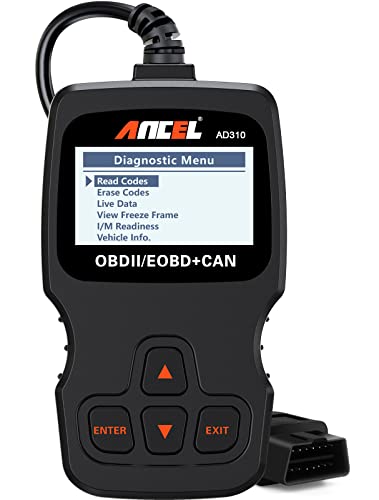
Use this table before you replace parts. It separates a real fuel-economy loss from a bad readout, then points you toward the most likely cause. The fill-up method matters because the dash MPG number can drift after tire-size changes, reset issues, or a gauge that may learn slowly over time.
| Symptom | Likely cause | Next action |
|---|---|---|
| Dash MPG looks worse, but no drivability change | Trip computer error, reset issue, tire-size change | monitor |
| Tank-to-tank MPG is down about 10–15% | Tire pressure, short trips, cold weather, driving style | monitor |
| All four tires show low pressure | Underinflation, slow leak, seasonal pressure loss | monitor |
| Rough idle, slow acceleration, possible misfire | Spark plugs, ignition fault, fuel-control issue | urgent |
| Fuel smell, wet patch, or drips under vehicle | Fuel leak | urgent |
| Drop starts right after tire change or service | Wrong tire size, low pressure, alignment issue, oil service issue | monitor |
| Drop appears with check-engine light | Misfire, sensor issue, fuel-control fault | urgent |
| Winter driving, short hops, lots of idle time | Normal seasonal and use-pattern loss | monitor |
Fill-up-method MPG check
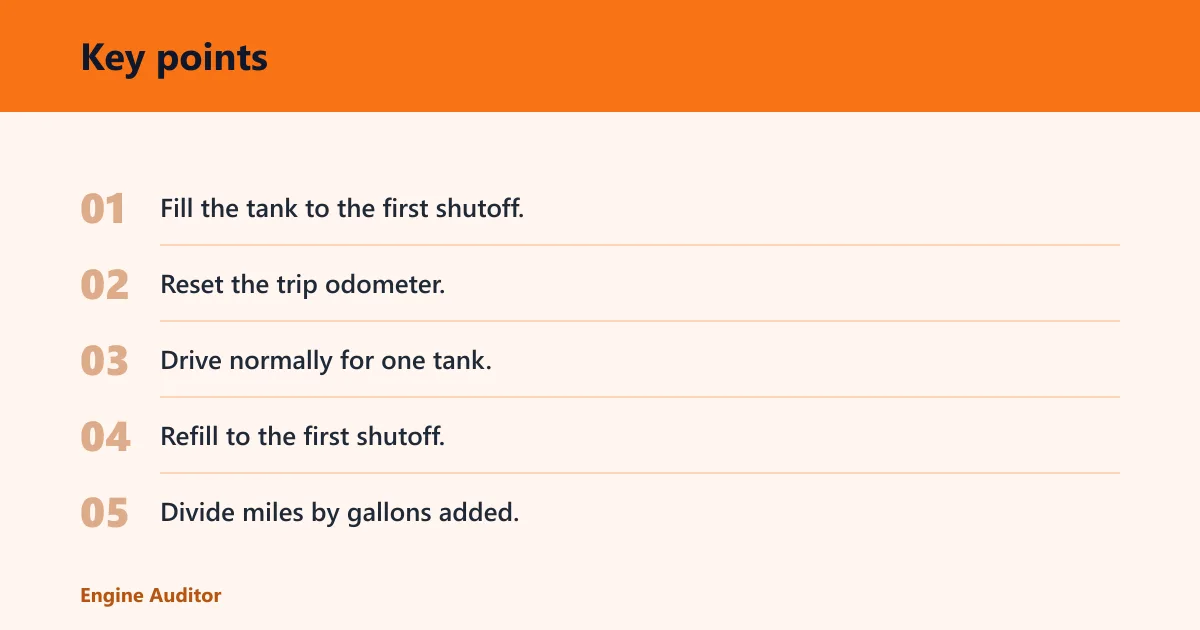
Use the same pump when possible, fill to the first automatic shutoff, reset the trip odometer, and divide miles driven by gallons added at the next fill-up. That method is more reliable than a single dash reading. If the dash says the MPG fell, but tank-to-tank math does not, the problem is measurement, not fuel use.
- Fill the tank to the first shutoff.
- Reset the trip odometer.
- Drive normally for one tank.
- Refill to the first shutoff.
- Divide miles by gallons added.
- Repeat for a second tank if the result is close to borderline.
Severity rating guide
Normal means the loss matches weather, cold starts, traffic, or a recent change in route. Monitor means the drop is real, but the vehicle still drives normally and there is no smell, leak, or warning light. Urgent means rough running, a flashing light, overheating, a fuel smell, or visible leakage.
Why did my Chevy mileage suddenly drop?
A sudden MPG drop can be normal if your trips changed, the weather turned cold, or you added more idle time. It becomes a real fault when the drop is confirmed at the pump and comes with rough running, a warning light, a fuel smell, or a change that started right after service, a tire change, or a curb strike.
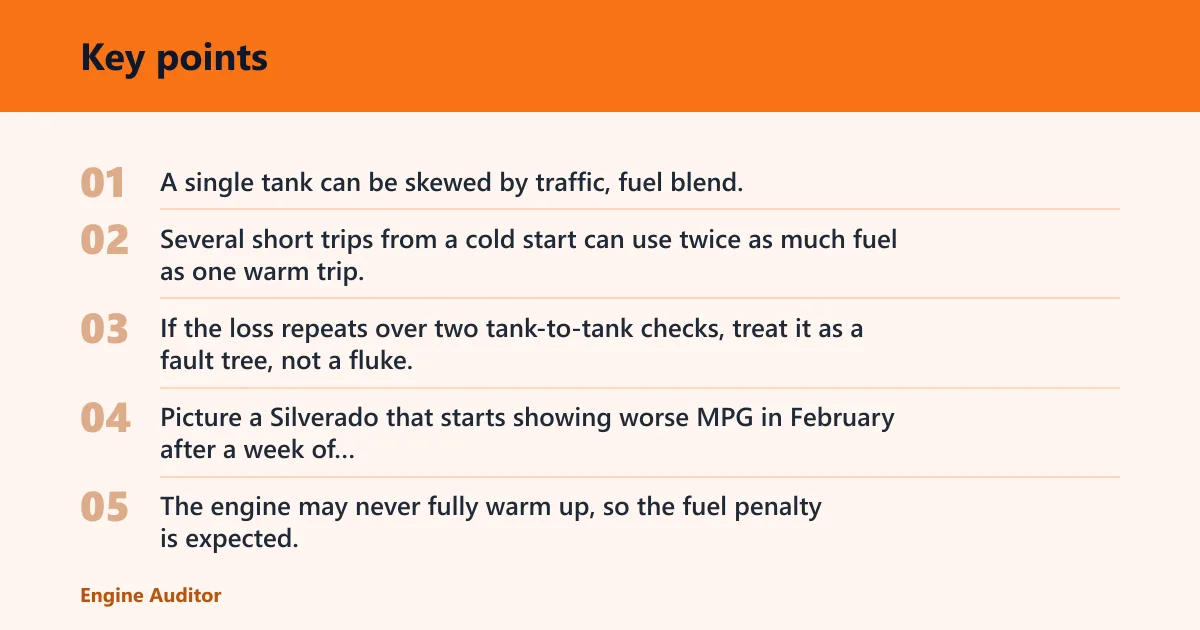
Normal change or real fault
Start with the pattern. A single tank can be skewed by traffic, fuel blend, or several short errands from a cold start. Several short trips from a cold start can use twice as much fuel as one warm trip. If the loss repeats over two tank-to-tank checks, treat it as a fault tree, not a fluke.
Picture a Silverado that starts showing worse MPG in February after a week of five-minute errands. The engine may never fully warm up, so the fuel penalty is expected. Now picture the same truck losing mileage right after new tires and a service visit. That points to pressure, size, or reset issues first.
First signs that point to a vehicle issue
Look for rough idle, slow acceleration, harder starts, brake drag, or a fuel smell. A dash MPG drop with no other symptom often traces to driving pattern or weather. A drop with a check-engine light, exhaust odor, or a wet patch under the vehicle needs faster action.
When the drop is urgent
Stop driving if the check-engine light is flashing, the engine is overheating, the vehicle runs rough, or you smell gasoline or diesel outside the cabin, since those are commonly treated as urgent warning signs. Fuel leaks are a fire risk. A no-drive rule is the right call when there are drips, wet lines, or a strong fuel odor near the tank, rail, or engine bay.
Check the easy causes first
Before you suspect a sensor or fuel-system fault, check the simple losses that raise drag or waste fuel. Tire pressure, speed, idling, short trips, and cold weather can move MPG more than many owners expect. These causes are common, cheap to inspect, and easy to confuse with a mechanical problem.
Tire pressure and rolling resistance
Underinflated tires raise rolling resistance, and that affects all four corners if pressure has drifted down across the set. Properly inflated tires can improve fuel economy by about 0.6% on average. Underinflation can reduce mileage by about 0.2% for every 1 psi drop across all four tires. Check pressure when the tires are cold, and do it about once a month.
A low tire can also come after a temperature drop, a slow leak, or a recent tire swap. If all four tires are down together, seasonal loss is likely. If one tire is lower than the rest, look for a puncture or valve-stem problem.
Aggressive driving and speed
Hard acceleration, rapid braking, and speeding can cut MPG fast. Aggressive driving can lower highway mileage by 15% to 30% and city mileage by 10% to 40%. Gas mileage drops rapidly above 50 mph, so a steady highway cruise still loses fuel economy when speed climbs.
A heavier right foot hurts city driving more because stop-and-go traffic repeats the same wasted acceleration and braking. Steady throttle, earlier braking, and lower cruise speed usually recover more fuel economy than one part swap ever will.
Idling and short trips
Idling burns fuel with zero distance covered. Traffic congestion, warm-up time, and parking-lot waits all add fuel use without adding miles. Short trips are especially costly because the engine spends a larger share of the trip below full operating temperature.
Trip clustering matters. Five short errands with cool-down time between them can be worse than one longer route that lets the engine warm fully. If the MPG drop came with school runs, delivery routes, or repeated stop-and-go trips, the problem may be usage, not damage.
Winter weather and cold starts
Winter hurts MPG through thicker fluids, longer warm-up, tire-pressure loss, and more cabin heat use. The engine runs richer during cold start until it reaches temperature, so the first minutes of driving use more fuel. City-use severity is higher because a cold engine spends more of the trip in warm-up mode.
Suppose a Traverse loses MPG only during freezing weather and returns to normal by spring. That pattern fits normal seasonal loss. If the winter drop is much larger than usual or comes with rough idle, check the rest of the checklist.
Could maintenance be the reason?
Yes. Old oil, a clogged air filter, worn spark plugs, and poor alignment can all hurt MPG. Maintenance-related losses are often gradual, but they can seem sudden when several small issues stack up after a service visit or a tire change. Start with the simplest recent work first.
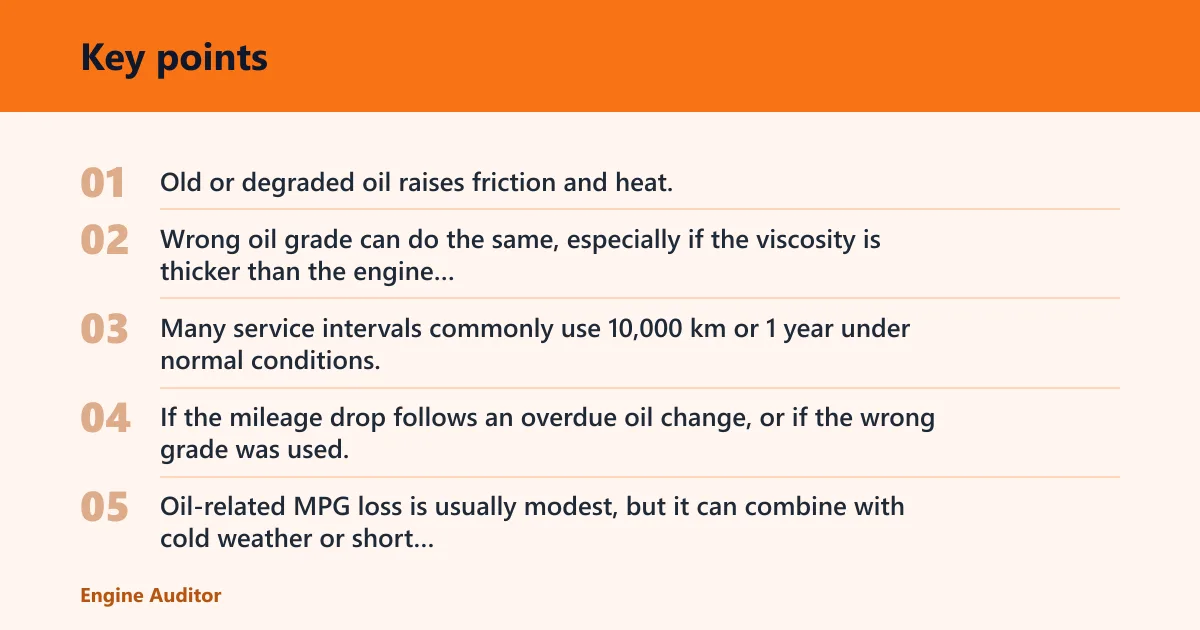
Engine oil condition and oil grade
Old or degraded oil raises friction and heat. Wrong oil grade can do the same, especially if the viscosity is thicker than the engine calls for. Many service intervals commonly use 10,000 km or 1 year under normal conditions, but severe use can call for earlier service.
If the mileage drop follows an overdue oil change, or if the wrong grade was used, that is worth checking before chasing more expensive parts. Oil-related MPG loss is usually modest, but it can combine with cold weather or short trips.
Air filter restriction
A dirty air filter can reduce Chevy fuel economy by restricting airflow, especially on dusty roads or in heavy debris. A clogged filter does not always create a warning light. It can still affect throttle response and fuel use if airflow drops enough.
Replacement timing depends on driving conditions. Dusty-road exposure shortens service life, so a filter that looks acceptable in a mild commute may be overdue after repeated dirt-road use or construction-zone driving.
Spark plugs and misfire
Worn spark plugs can cause poor fuel economy, slow acceleration, rough idling, and harder starts. On many engines, these symptoms show up before a hard failure. If the engine feels uneven at idle or hesitates on acceleration, plugs and ignition parts move up the list quickly.
That matters on Chevy trucks and SUVs with V6 or V8 engines, where a mild misfire can waste fuel long before the driver sees a dramatic fault. A check-engine light makes the case stronger, but a rough idle alone deserves attention.
Wheel alignment after service
Wheel alignment problems can increase drag and tire wear, which raises rolling resistance. A curb strike, suspension repair, or tire change can leave the wheels slightly off enough to affect MPG. If the steering wheel is off-center or the vehicle pulls, alignment should be checked.
Alignment can also expose another issue. Uneven tire wear or a bad road-force balance may feel like a fuel economy problem because the vehicle resists rolling normally.
Can a check engine light cause worse fuel economy on a Chevy?
Yes. A check-engine light can point to a fault that changes fuel trim, triggers a misfire, or forces the engine to run inefficiently. If the light is flashing, stop driving. If it is steady and the vehicle still runs normally, scan data can help sort a mild sensor issue from a problem that needs immediate repair.
Misfire and sensor-related causes
Misfires, oxygen-sensor faults, mass-airflow issues, and evaporative-system faults can all hurt fuel economy. A misfire wastes fuel directly, while a bad sensor can make the engine run richer or leaner than it should. On a Chevy, that can show up as rough idle, hesitation, or a smell from the exhaust.
What scan data can tell you
Scan data can show fuel trims, misfire counts, and whether the engine is stuck in open loop or running outside normal correction range. That helps separate a fuel-control problem from a simple driving-pattern change. If the code points to a misfire, spark plugs and ignition parts move up before cosmetic maintenance items.
After a tire change or service, what should you check?
After tire or service work, check tire size, pressure, alignment, and any reset that may have changed the dash reading. A sudden MPG change right after service is often a setup issue, not a failed engine part. That is especially true when the vehicle still drives normally.
Tire size and pressure reset
If the new tires are a different size, the odometer and trip computer may read incorrectly. That can make the MPG display look wrong even if actual fuel use has not changed much. Also reset the tire-pressure monitoring system if the vehicle requires it, then verify all four tires are at the proper pressure.
Alignment after repair
After suspension work, a tire change, or a curb hit, a fresh alignment check can prevent drag and uneven wear. If the steering wheel shifted or the vehicle feels heavier to roll, do not wait for the tires to wear unevenly before checking alignment.
Fuel economy changes right after service
A mileage drop right after an oil change, tire swap, brake job, or alignment issue should be compared against the old baseline using the fill-up method. A dash reset can make the change look larger than it is. If the tank-to-tank number is still down, move from measurement issues to mechanical checks.
When should you stop driving?
Stop driving if you smell fuel, see drips or wet patches, hear a severe misfire, or get a flashing check-engine light. Those are not normal MPG complaints. They are fault conditions with safety risk. If the smell is strong outside the vehicle, arrange a tow rather than trying to nurse it home.
Fuel smell rule
A gasoline or diesel smell near the vehicle is a no-drive warning when it is strong, new, or paired with visible wetness. Check around the tank, filler area, fuel lines, rail, and engine bay only if it is safe to do so. Do not keep driving to “see if it clears.”
Wet patch or drip inspection
Any fresh drip or puddle under the vehicle deserves immediate attention. Fuel leaks are a safety hazard and can worsen quickly. If the drip looks like fuel, do not start the engine again until it has been inspected.
Tow versus monitor decision
Monitor only when the drop is confirmed but the vehicle runs normally and there is no smell, leak, or warning light. Tow when there is a fuel odor, visible leakage, a flashing light, or rough running. That split keeps a small MPG complaint from turning into a larger repair.
Frequently asked questions
Can low tire pressure make my Chevy use more gas?
Yes. Low tire pressure raises rolling resistance, which makes the engine work harder. Properly inflated tires can improve fuel economy by about 0.6% on average, and underinflation can reduce mileage by about 0.2% for every 1 psi drop across all four tires. Check pressure when the tires are cold.
What Chevy maintenance problems hurt gas mileage the most?
The common maintenance-related causes are low tire pressure, old or wrong engine oil, a clogged air filter, worn spark plugs, and poor alignment. Of these, a misfire or significant brake drag can have the fastest effect. After service, verify pressures, tire size, and alignment before assuming a bigger fault.
Does a dirty air filter reduce Chevy fuel economy?
Yes, a dirty air filter can reduce fuel economy by restricting airflow, especially on dusty roads. The effect is usually gradual, but it can show up as weaker throttle response or reduced MPG. Replace it on schedule, and inspect it sooner if the vehicle sees dirt-road or dusty construction use.
Why does my Chevy get worse mileage in winter?
Winter MPG usually drops because cold starts need extra fuel, tire pressure falls as temperatures drop, and the engine stays in warm-up longer. Short city trips magnify the effect. If the loss appears only in cold weather and disappears later, it is often normal seasonal behavior.
Products related to this article
Sponsored / affiliate links. As an Amazon Associate I earn from qualifying purchases. I may earn additional commission from eligible campaigns.