Chevy SUV vs Truck: Which Fits Your Needs?
Pick a Chevy SUV when family comfort, enclosed cargo, and daily commuting matter most. Pick a Chevy truck when you need regular towing, muddy cargo, or jobsite hauling. Pick the wrong body style and you’ll burn fuel you didn’t need to, fight parking every day, or own a bed that sits empty. This guide maps Chevy SUV and truck choices to family use, towing, cargo, commuting, camping, and work.
This guide is part of our Chevy vehicles guide: models, issues, and buying tips series.
Chevy SUV vs truck: the real trade-off

The split is plain: Chevy SUVs put people and covered cargo first, while Chevy trucks put open-bed utility and trailer work first. Trim level changes comfort and features, but it does not change that basic job. I’ve watched buyers regret the wrong body style within a week, once they start hauling payload, hitching trailers, or loading dirty gear every weekend.
| Decision factor | Chevy SUV | truck: which body style fits your needs? | Winner |
|---|---|---|---|
| Cargo security | Enclosed cargo area keeps groceries, luggage, tools, and sports gear out of sight and out of weather. | Open bed is flexible, but exposed unless you add a cover or cap. | Chevy SUV |
| Towing and payload | Good for lighter trailers and occasional towing. | Built for higher trailer weight and heavier payload, with the Silverado and Silverado HD aimed at the top end. | truck: which body style fits your needs? |
| Passenger comfort | Usually easier for kids, older passengers, and long freeway days. | Cab comfort can be strong, but cargo bed design still shapes the package. | Chevy SUV |
| Parking and maneuverability | Usually easier in garages, crowded lots, and tight city streets. | Longer wheelbases, cabs, and beds make parking and turning harder. | Chevy SUV |
| Worksite utility | Good for mixed duty, but enclosed cargo limits dirty or oversized loads. | Open-bed hauling, tie-down flexibility, and payload strength suit jobsite use. | truck: which body style fits your needs? |
Cargo security changes the daily equation
An SUV wins when the load has to stay dry, hidden, and organized. That is why families, commuters, and road-trip buyers keep landing on SUVs: the cargo area closes, locks, and still works in bad weather. A truck bed is more flexible for bulky items, but it stays exposed.
Towing and payload push buyers toward trucks
Once towing becomes routine, the truck body style has the edge. Chevy’s truck lineup, including Colorado, Silverado, Silverado HD, and Silverado EV, is grouped by Chevrolet for truck duty, while the SUVs sit in a different category. That split matters because the truck body is built around bed utility and higher trailer focus.
Passengers usually prefer the SUV layout
Most shoppers feel the difference in the second row first. SUVs are generally easier to climb into, easier to load with child seats, and easier to use every day. That is especially true in three-row models such as Traverse, Tahoe, and Suburban, where passenger access matters as much as cargo volume.
Which is better for passengers, cargo, and parking?
Chevy SUVs are usually better for passengers, enclosed cargo, and parking in tight spaces. Chevy trucks win when the cargo is dirty, tall, awkward, or better left in an open bed. If the vehicle will live in a garage, school pickup line, or apartment lot, the SUV body style is usually the easier fit.
Passenger seating and third-row use
Trailblazer and Equinox suit smaller households or commuters who still want usable passenger space. Traverse, Tahoe, and Suburban move into family-hauler territory, with three-row seating for larger groups and more flexible kid-and-luggage combinations. Trucks can carry passengers well in the right cab, but the cabin is not why people buy them.
Enclosed cargo space vs open-bed hauling
For groceries, backpacks, luggage, camera gear, and sports bags, enclosed cargo is hard to beat. That is where SUVs earn their keep. For mulch, job materials, coolers, muddy boots, and lumber, a truck bed is simply more practical.
City parking, garage fit, and turning ease
Smaller SUVs, especially Trailblazer and Equinox, are friendlier in city parking and daily maneuvering. Trucks usually demand more attention in parking garages, drive-throughs, and cramped curb spots. The larger the cab and bed, the more that trade-off shows up every day.
How do Chevy SUVs and trucks compare on towing and hauling?
Chevy trucks are the clear choice for frequent towing and heavier hauling. SUVs can tow enough for many boats, campers, and lighter trailers, but trucks handle payload and trailer duty with more margin. When the trailer is regular, long, or heavy, the truck side of the lineup is the safer fit.
Tow ratings versus payload
Tow rating gets the attention, but payload matters just as much in real ownership. A truck carries tools, tongue weight, passengers, and cargo with fewer compromises. SUVs can pull a trailer, but they give up flexibility once the cabin, rear cargo area, and hitch load all have to coexist.
Bed length, cab size, and trailer use
Colorado brings midsize pickup flexibility, with cab and bed choices that suit mixed use. Silverado moves into full-size truck territory with more towing focus and more cab and bed options. Silverado HD is the heavy-duty choice when trailer work and jobsite demands dominate the calendar.
When a Chevy SUV can do the job
If towing is occasional and the trailer is modest, an SUV can be the smarter daily driver. Tahoe and Suburban are common family-and-tow choices because they combine people space with real trailer ability. That balance works for a camper or boat owner who does not want a bed in place of a rear seat.
Fuel use, ride feel, and daily driving comfort
Chevy SUVs usually feel easier to live with every day because they are more passenger-focused and often simpler to park. Trucks often bring a more work-first setup, especially in the rear. Body-on-frame construction is common in larger SUVs and trucks, while smaller SUVs like Trailblazer and Equinox are more commuter-oriented in layout and feel.
Body-on-frame vs unibody differences
Body-on-frame vehicles are common where towing and durability matter, which is why truck-based SUVs like Tahoe and Suburban sit close to truck behavior. Unibody SUVs generally feel more carlike in steering and everyday use. For buyers, that usually means less fuss around commuting and city errands.
Commute comfort and road noise
Equinox is the practical daily driver choice for many households. Trailblazer is the smaller, city-friendlier entry point. Larger SUVs can be quieter and calmer on long trips, while trucks often ask the driver to accept more size, more turning effort, and more compromise around rear cargo.
4×2 vs 4×4: when it matters
Four-wheel drive is helpful for snow, dirt, boat ramps, and trail access, but it is not mandatory for every buyer. A 4×2 truck can be a sensible pavement-and-haul choice, and an SUV with the right tires can handle plenty of winter duty. Choose 4×4 when traction needs are real, not hypothetical.
Chevy model examples by buyer type
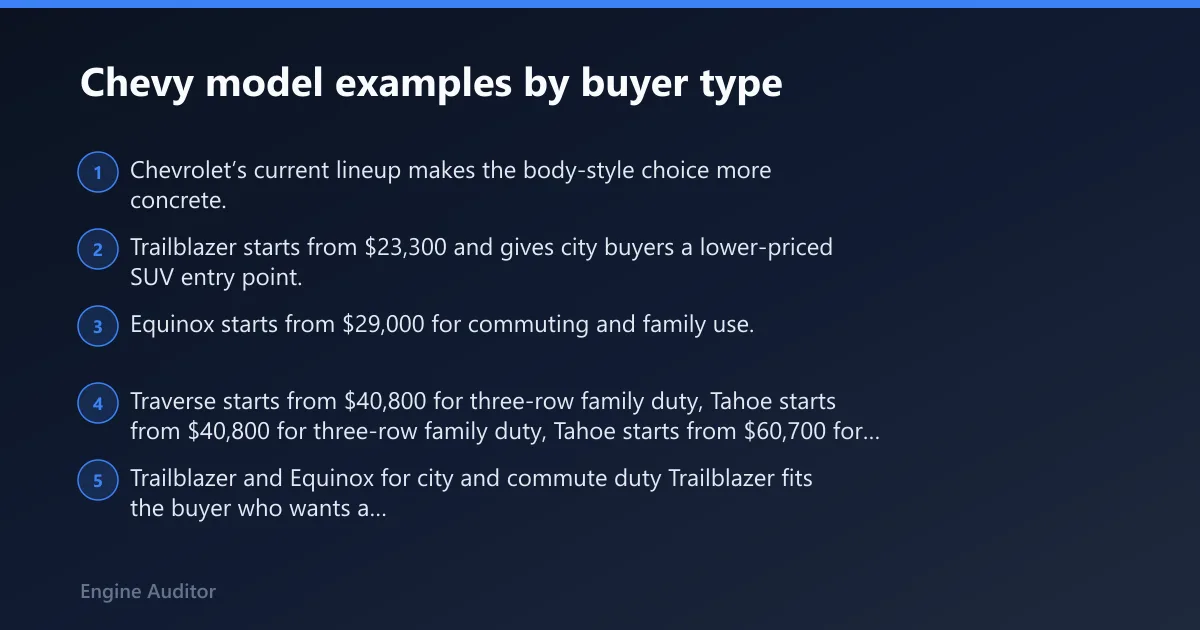
Chevrolet’s current lineup makes the body-style choice more concrete. Trailblazer starts from $23,300 and gives city buyers a lower-priced SUV entry point. Equinox starts from $29,000 for commuting and family use. Traverse starts from $40,800 for three-row family duty, Tahoe starts from $60,700 for full-size SUV balance, and Suburban starts from $63,700 for the most passenger and cargo room among Chevy SUVs.
Trailblazer and Equinox for city and commute duty
Trailblazer fits the buyer who wants a small SUV that is easier to place in traffic and parking. Equinox is the better all-around commuter and family choice when the daily routine includes school runs, errands, and occasional road trips. Both are easier to live with than a truck in dense urban use.
Traverse, Tahoe, and Suburban for families
Traverse is the sweet spot for many three-row shoppers who need people space without stepping into full-size SUV bulk. Tahoe adds stronger tow-and-family balance. Suburban is the long-road-trip answer when maximum passenger and cargo room matter more than parking convenience.
Colorado, Silverado, and Silverado HD for work and towing
Colorado starts from $32,400 and is the midsize pickup for buyers who need a truck without jumping to full-size dimensions. Silverado starts from $36,900 and brings full-size truck capability with more cab and bed choice. Silverado HD starts from $45,900 and is the truck to look at when towing and worksite use are the priority, not convenience.
Decision matrix: SUV vs truck for Chevy shoppers
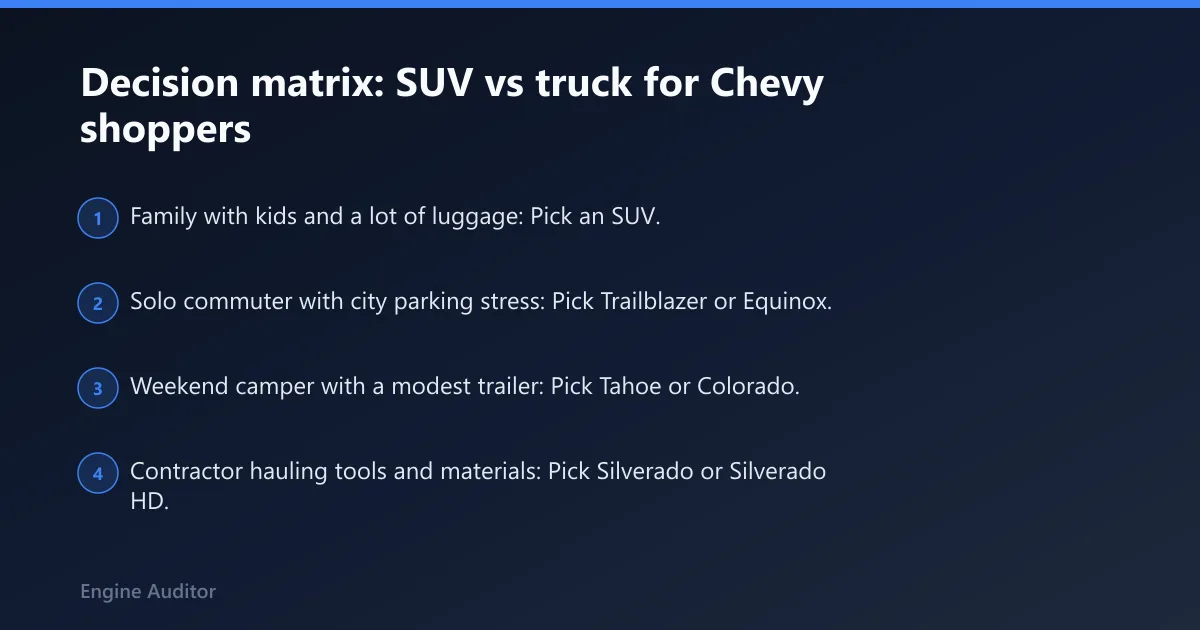
The right answer depends on the job the vehicle does most often. Use this matrix as a first pass, then narrow by model size. Chevy’s SUVs are often a better fit where people and enclosed cargo matter most; Chevy’s trucks are often a better fit where payload, trailer work, and open-bed utility matter most.
| Decision factor | Chevy SUV | truck: which body style fits your needs? | Winner |
|---|---|---|---|
| Towing | Enough for many light and mid-size trailers | Stronger for frequent towing and heavier trailers | truck: which body style fits your needs? |
| Cargo security | Locked, covered cargo area | Open bed, unless equipped with accessories | Chevy SUV |
| Passenger comfort | Usually easier for families and road trips | Good cab space in many trims, but less passenger-first by design | Chevy SUV |
| Parking | Usually easier to live with in tight spaces | Longer, wider, and harder to place | Chevy SUV |
| Fuel use | Usually the easier daily-driver choice | Usually the higher-use work vehicle choice | Chevy SUV |
| Worksite utility | Mixed-use, lighter-duty needs | Best for tools, materials, and dirty cargo | truck: which body style fits your needs? |
Scenario picker for families, commuters, campers, and contractors
- Family with kids and a lot of luggage: Pick an SUV. Traverse for three-row value, Tahoe for tow-and-family balance, Suburban for maximum space.
- Solo commuter with city parking stress: Pick Trailblazer or Equinox. The smaller footprint matters more than bed utility.
- Weekend camper with a modest trailer: Pick Tahoe or Colorado. Choose the SUV if enclosed cargo and passengers matter more than bed space.
- Contractor hauling tools and materials: Pick Silverado or Silverado HD. Colorado fits lighter mixed use; Silverado HD fits heavier trailer work.
Hard cutoff guidance for moving up in size
Move from SUV to truck when your trailer use becomes regular, your cargo is dirty or oversized, or the rear of the vehicle starts feeling like a compromise every week. Move from Colorado to Silverado when payload, cab room, or trailer weight starts outgrowing a midsize pickup. Move to Silverado HD when the trailer is no longer occasional and the truck is expected to earn its keep.
Choose Chevy SUV if… / Choose Chevy truck if…
Choose a Chevy SUV if your priorities are people space, enclosed cargo, and daily ease. Choose a Chevy truck if your priorities are payload, trailer work, and open-bed utility. If the vehicle will carry kids during the week and luggage on the weekend, the SUV is usually the cleaner fit. If it will haul tools, tow often, or take abuse, the truck is the right call.
Choose a Chevy SUV if…
- You want groceries, luggage, and sports gear kept inside and out of sight.
- You spend more time commuting, parking, and doing school runs than towing.
- You need family seating, with Traverse, Tahoe, or Suburban handling the bigger households.
- You want a city-friendly entry point, with Trailblazer or Equinox fitting that role well.
Choose a Chevy truck if…
- You tow boats, campers, or trailers with any real frequency.
- You carry tools, mulch, equipment, or dirty cargo that does not belong in a cabin.
- You need cab, bed, payload, and 4×2 or 4×4 choices that fit work and weekend use.
- You are deciding between Colorado, Silverado, and Silverado HD based on how hard the truck will work.
Frequently asked questions
Should I buy a Chevy SUV or a Chevy truck?
Buy the SUV if daily commuting, passengers, and enclosed cargo matter most. Buy the truck if towing, payload, or jobsite hauling will be part of normal use. The right choice is the one that fits the most common trip, not the most dramatic one.
Is an SUV or truck better for towing a boat or trailer?
A truck is usually the better towing choice because it is built around trailer work and payload. An SUV can still be a good match for lighter boats or occasional towing, especially if passenger comfort and enclosed cargo matter on the same trip.
Which Chevy body style is better for a family road trip?
Most families will prefer a Chevy SUV because it is easier for passengers, luggage, snacks, and rest stops. Traverse works well for three-row family trips, while Tahoe and Suburban are better when the crew is larger or the packing list is long.
Which is easier to park and drive every day: a Chevy SUV or truck?
A Chevy SUV is usually easier to park and easier to live with in traffic. Smaller choices like Trailblazer and Equinox are especially friendly for city use. Trucks can be daily drivers too, but the bed, wheelbase, and turning demands are harder to ignore.
Do Chevy trucks get better payload and towing than SUVs?
Yes, trucks generally offer more payload and stronger towing. That is why Colorado, Silverado, and Silverado HD are grouped under Trucks by Chevrolet. If the trailer gets heavier or the cargo gets dirtier, the truck body style is the practical step up.
Which Chevy SUVs have the most cargo and passenger space?
Suburban is at the roomy end of Chevy’s SUV lineup, with Tahoe close behind and a smaller footprint. Traverse is the three-row choice for many families who want a more manageable size. Those three cover most large-family use cases without moving to a truck.
Is a Chevy truck or SUV better for snow, camping, and hauling gear?
Both can work, but the best answer depends on what “gear” means. An SUV is better for enclosed, weather-protected cargo and passenger comfort. A truck is better for muddy, bulky, or heavy loads, and 4×4 helps when snow or trail use is real.
What Chevy model should I choose if I want one vehicle for work and weekends?
Colorado is the balanced starting point for mixed duty, because it gives truck utility without jumping straight to a full-size footprint. Silverado is better if work is more demanding. Tahoe is the SUV answer when family use matters as much as towing and cargo.
How do Chevy SUV and truck prices compare?
Chevrolet lists Trailblazer from $23,300, Equinox from $29,000, Traverse from $40,800, Tahoe from $60,700, and Suburban from $63,700. On the truck side, Colorado starts from $32,400, Silverado from $36,900, and Silverado HD from $45,900. The body style choice often changes the budget before trims do.
Should I pick a Colorado, Silverado, Traverse, Tahoe, or Suburban?
Pick Colorado if you want a midsize truck for mixed work and weekend use. Pick Silverado if you want a full-size truck with more capability. Pick Traverse for family space in a manageable SUV, Tahoe for stronger tow-and-family balance, and Suburban for the most room and long-trip comfort among the group.
Products related to this article
Sponsored / affiliate links. As an Amazon Associate I earn from qualifying purchases. I may earn additional commission from eligible campaigns.