Chevy Engine Trouble Codes: What They Mean and How to Fix Them
Chevy trouble codes are OBD-II fault numbers; start with the code family, then check fuel delivery, air leaks, ignition faults, and wiring before replacing parts, and stop driving for a flashing CEL, low oil pressure, or overheating. Ignoring the wrong code can waste money, hide a misfire, and turn a minor fault into catalytic converter or engine damage. This guide explains what Chevy code families mean, the first three checks that rule out bad parts, and when the fault is mechanical, electrical, or software-related.
How Chevy trouble codes work
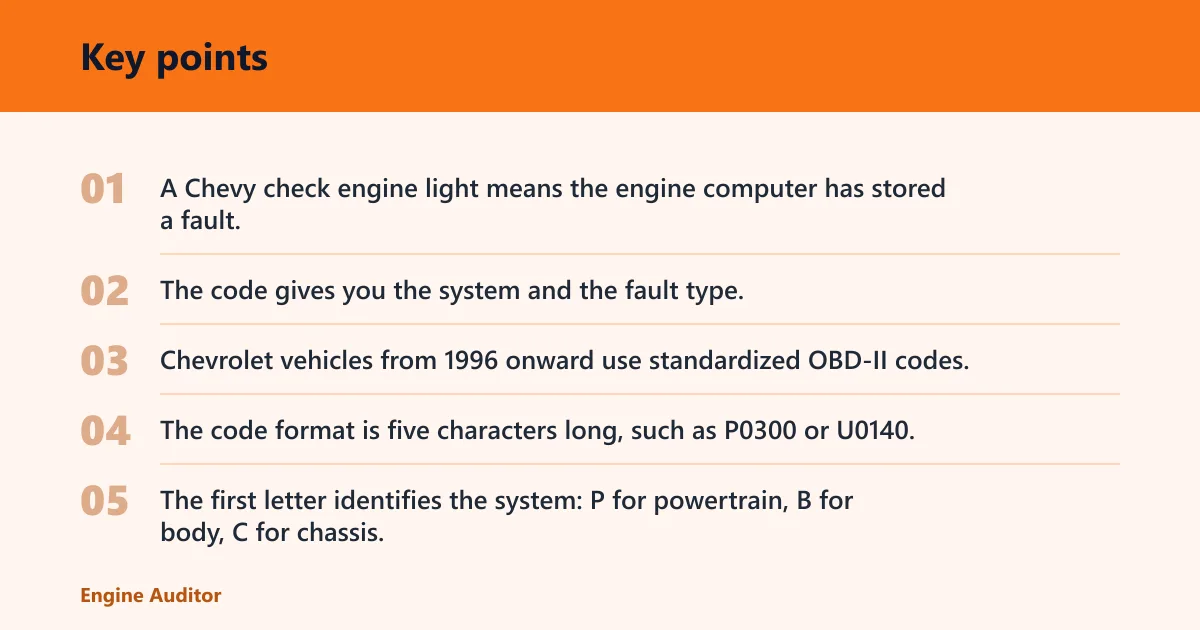

A Chevy check engine light means the engine computer has stored a fault. It does not name the failed part by itself. The code gives you the system and the fault type, then freeze frame data and live data help narrow the cause.
Chevrolet vehicles from 1996 onward use standardized OBD-II codes. The code format is five characters long, such as P0300 or U0140. The first letter identifies the system: P for powertrain, B for body, C for chassis, and U for network or communication faults. A code starting with P0, C0, B0, or U0 is generic and standardized across manufacturers. A code starting with P1, C1, B1, or U1 is manufacturer-specific and defined by GM.
That split matters on Chevy models. A basic reader may show the code, but a GM-specific fault often needs enhanced data before the diagnosis makes sense.
Stored codes, pending codes, and freeze frame data
Stored codes are faults the computer has confirmed. Pending codes are faults that have appeared but have not yet met the conditions for a confirmed fault. Freeze frame data records RPM, coolant temperature, load, fuel trim, and vehicle speed when the code set. That snapshot can tell you whether the fault happened at idle, cruise, cold start, or under load.
For example, a lean code that sets at idle with high positive fuel trim points you toward an air leak. The same code at highway speed with normal idle trims may point elsewhere. That is why the code family comes first, but freeze frame comes right behind it.
What scanner do you need for Chevy codes?
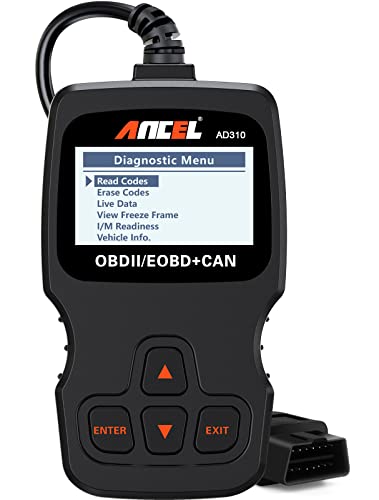
A basic OBD-II scanner can read stored codes on many Chevy models, and it can usually clear them. A better scanner can also read pending codes and live data. For many Chevrolet faults, especially GM-specific P1 codes or throttle and transmission data, a GM-capable scan tool is the better buy.
Read the code, then check the live data that matches the complaint. If the scanner can show short-term fuel trim, long-term fuel trim, coolant temperature, throttle position, mass air flow, and vehicle speed, you can separate a bad sensor from a real engine problem much faster.
What a basic OBD-II scanner can read
A basic reader is fine for confirming the light, reading the code, and checking whether a code is pending or stored. It is also useful for a quick driveway triage. It is not enough for every Chevy fault, especially if you need manufacturer-specific data or module communication details.
Why GM-enhanced data matters on some Chevys
Some Chevy codes are broad at the OBD-II level but narrow in GM data. A P2135 throttle correlation fault, for example, may need throttle position data from both sensors before the fault becomes clear. A P0700 also tells you the transmission control module has set a fault, but it does not name the internal transmission code by itself.
Suppose a Silverado sets P0171 and shows high fuel trim at idle, but the fuel trim drops closer to normal as engine speed rises. That pattern often points to an intake air leak rather than a bad oxygen sensor. The scanner data matters more than the guess.
Chevy DTC triage table
| Code family | Most likely Chevy causes | First test | False fix to avoid | Safe to drive? |
|---|---|---|---|---|
| P0300 | Vacuum leak, worn plugs, ignition coil fault, injector issue, low compression, lifter problem on some GM engines | Check misfire counters, inspect plugs and coils, compare fuel trim, verify cylinder-specific misfire if possible | Replacing all coils without cylinder confirmation | Caution; stop if flashing CEL |
| P0171 | Air leak, intake gasket leak, PCV issue, dirty MAF, low fuel delivery | Smoke test or intake inspection, then review fuel trim at idle and cruise | Replacing the oxygen sensor first | Caution |
| P0101 | Dirty or skewed MAF, intake leak, wiring issue, air filter restriction | Inspect intake ducting and MAF connector, compare live airflow data | Replacing the MAF without checking for leaks | Caution |
| P0128 | Thermostat stuck open, coolant temp sensor issue, cooling system airflow problem | Check coolant warm-up rate and actual coolant temperature | Replacing the temperature sensor first | Usually safe, but fix soon |
| P0299 | Boost leak, charge air tube split, wastegate issue, turbo icing, control solenoid fault | Inspect charge pipes, clamps, and intercooler plumbing | Replacing the turbo first | Caution; limit boost |
| P0420 | Exhaust leak, misfire history, fuel trim issue, catalyst aging | Check for upstream engine faults and exhaust leaks before the converter | Replacing the catalytic converter before upstream checks | Usually safe short term |
| P0442 | Small EVAP leak, loose cap, purge or vent issue, cracked hose | Inspect cap seal and EVAP hoses, then smoke test if needed | Replacing the purge valve blindly | Usually safe |
| P0455 | Large EVAP leak, cap problem, disconnected hose, cracked canister line | Check cap, filler neck, and EVAP lines for obvious openings | Replacing the charcoal canister first | Usually safe |
| P0507 | High idle from vacuum leak, throttle body buildup, PCV leak, learned idle issue | Check idle trims and inspect throttle body and intake leaks | Replacing the throttle body before air leak checks | Usually safe |
| P0510 | Throttle closed position issue, pedal or throttle correlation fault, wiring fault | Inspect throttle and pedal data with key on, engine off | Replacing the pedal assembly without data | Caution |
| P0521 | Oil pressure sensor fault, wiring issue, real oil pressure problem | Verify oil level and compare scan data to a mechanical gauge if needed | Replacing the sensor before confirming pressure | Stop if oil pressure warning is present |
| P2135 | Throttle position correlation fault, wiring issue, throttle body fault | Check throttle sensor data and connector condition | Replacing the throttle body without checking the wiring loom | Often reduced power; caution |
| P2101 | Throttle actuator control issue, wiring fault, throttle body problem, module command issue | Inspect throttle body connector and compare commanded vs actual throttle angle | Replacing the throttle body before wiring checks | Often reduced power; caution |
| P2176 | Throttle position not learned, throttle body carbon buildup, low voltage event | Check throttle relearn status and battery voltage history | Replacing the throttle body without relearn | Caution |
| P0700 | Transmission control system malfunction | Scan the transmission module for the specific code set | Replacing the transmission on P0700 alone | Caution; scan soon |
What do common Chevy codes usually point to?
Most Chevy codes fall into a repeatable pattern: misfire, air leak, boost loss, EVAP leak, throttle fault, or transmission control fault. The code narrows the system, but the likely cause still changes with engine family, mileage, and platform. A 4.3L truck, a turbo four-cylinder, and a V8 with active fuel management do not fail in the same way.
P0300 and misfire checks
P0300 means random or multiple cylinder misfire and is common across many GM vehicles. It can be caused by lifters, ignition, fuel, or air issues. The first move is cylinder-level confirmation: check whether one cylinder is failing or whether the misfire moves. If the misfire stays random, look at vacuum leaks, fuel trim, and ignition pattern before swapping parts.
P0171 and intake air leak checks
P0171 means system too lean, bank 1. On many Chevy engines, especially turbo GM engines, it often traces back to air leaks. A smoke test or careful intake inspection is the fastest way to separate a leak from a sensor problem. A lean code with high idle trims but calmer cruise trims is a strong leak clue.
P0299 and boost loss checks
P0299 means turbo underboost. On Chevy turbo engines, that often points to a charge air tube, clamp, intercooler joint, wastegate issue, or icing in cold weather. Do not replace the turbo first. Check the plumbing and air management path first, because a split hose can mimic a failed turbo.
P0420, P0442, and P0455 patterns
P0420 is catalyst system efficiency below threshold, bank 1. It can follow misfires, fuel trim problems, or exhaust leaks, so the converter is not the first suspect. P0442 and P0455 are EVAP leak codes. Those usually point to a cap seal, a cracked hose, or a vent path problem before anything expensive.
A common first-timer mistake is to replace the converter because the code sounds serious, then discover an upstream misfire was the real cause. The safer sequence is engine fault first, exhaust leak second, converter last.
P0507, P0510, P0521, P2135, P2101, P2176, and P0700
P0507 usually points to high idle, often from an air leak or throttle body issue. P0510 can involve throttle closed position or pedal correlation. P0521 needs care because it can mean sensor trouble or real oil pressure trouble. P2135 and P2101 often show up with Reduced Engine Power mode, which is the vehicle’s way of limiting throttle when the computer sees a mismatch.
P2176 often appears after battery work, low voltage, or throttle body service and may need a relearn. P0700 means the transmission control system has a fault, but you still need the transmission module code to know what failed.
How do you fix a Chevy check engine light without replacing parts?
Start with the code, the symptom, and the freeze frame. Then inspect the obvious things first: loose intake tubes, cracked vacuum lines, unplugged connectors, damaged wiring, and obvious fluid or boost leaks. After that, compare live data to the fault before buying a part. That sequence avoids the most common wasted swaps.
- Confirm the code is stored or pending, and note the freeze frame.
- Inspect hoses, connectors, grounds, intake ducting, and visible wiring damage.
- Use live data to see whether the fault is electrical, air-related, fuel-related, or mechanical.
If a code points to airflow, use a smoke test or intake inspection before replacing the MAF or throttle body. If a code points to fuel trim, look at air leaks and fuel delivery before touching the catalytic converter or oxygen sensor. If a code points to throttle control, compare commanded and actual throttle values before replacing the throttle body.
When is a Chevy code a mechanical, electrical, or software fault?
Mechanical faults usually involve compression, timing, lifters, boost leaks, or exhaust restriction. Electrical faults involve sensors, grounds, wiring damage, and connector corrosion. Software or calibration-related faults usually involve learned throttle position, idle relearn, or module communication issues. The same code can land in different buckets depending on the data.
If P0300 comes with low compression on one cylinder, that is a mechanical problem. If P2135 follows corrosion in the throttle connector, that is electrical. If P2176 appears after battery replacement and the engine otherwise runs normally, a relearn or calibration issue may be the real fix.
Can you drive with a Chevy trouble code?
Some codes are safe enough for short, careful driving. Others are not. A steady check engine light with no overheating, no oil pressure warning, and normal power usually allows cautious driving to a repair site. A flashing light, reduced engine power, overheating, or low oil pressure means stop driving and diagnose immediately.
Reduced Engine Power mode usually points to throttle-related faults such as P2135 and P2101. The vehicle limits throttle opening to protect the engine and drivetrain. That is not a code to ignore, especially if the car barely accelerates or will not maintain speed in traffic.
Picture a Malibu that sets P0420 after weeks of rough idle. You can usually drive it short distances while you check for the misfire that likely damaged the converter. Now picture a truck with P0521 and an oil pressure warning. That is a different case. Shut it down and verify oil pressure before running it again.
Frequently asked questions
What do Chevy engine trouble codes mean?
Chevy engine trouble codes are OBD-II fault numbers that point to a system and a fault type. They do not identify the failed part by themselves. Start with the code family, then check freeze frame, live data, and obvious air, fuel, ignition, wiring, or cooling issues before replacing anything.
How do I read Chevy diagnostic trouble codes?
Plug an OBD-II scanner into the diagnostic port under the dash near the steering column. Read the stored code, note whether any pending codes are present, and save freeze frame data if your scanner can show it. Then use the code prefix to decide whether you need generic or GM-enhanced data.
What does P0300 mean on a Chevy?
P0300 means random or multiple cylinder misfire, and GM vehicles use it often. It can come from ignition, fuel, air, or even lifter problems on some engines. Do not guess at coils first. Confirm whether one cylinder is bad or whether the fault is scattered across several cylinders.
What scanner do I need to read Chevy trouble codes?
A basic OBD-II scanner can read many Chevy codes, but a GM-capable scanner is better when you need live data, enhanced codes, or module details. That matters for throttle faults, transmission faults, and manufacturer-specific P1 codes. Cheap readers can confirm the light, but not always the cause.
How do I tell if a Chevy code is generic or GM-specific?
Look at the first character after the letter. A code starting with P0, C0, B0, or U0 is generic and standardized. A code starting with P1, C1, B1, or U1 is manufacturer-specific and defined by GM. That difference tells you how far a basic reader will take you.
Products related to this article
Sponsored / affiliate links. As an Amazon Associate I earn from qualifying purchases. I may earn additional commission from eligible campaigns.