Chevy truck trim comparison: WT, LT, LTZ, High Country
For many Silverado 1500 buyers, LT is often the best-value trim for commuting, family use, and light towing; WT is generally the lowest-priced trim, LTZ adds leather and more driver-assist content, and High Country is the top-end choice. Pick the wrong trim and you pay for features you will not use, or you leave out basics you will notice every day. This guide compares WT, LT, LTZ, and High Country by price, equipment, towing relevance, and buyer fit.
This guide is part of our Chevy vehicles guide: models, issues, and buying tips series.
| Factor | Chevy truck trim comparison: WT | LT vs LTZ vs High Country | Winner |
|---|---|---|---|
| Price / cost context | Lowest entry point; base work-truck role; lowest-cost trim | LT is a middle trim with better value balance, LTZ is upper-mid pricing, and High Country is top-end pricing for premium content | Chevy truck trim comparison: WT |
| Cabin feel | Plain, durable, cloth-first; least expensive cabin materials | LT adds more comfort and convenience, LTZ adds leather and a more premium feel, and High Country has the most upscale materials and finish | LT vs LTZ vs High Country |
| Tech / driver aids | Basic infotainment and safety content; most straightforward tech setup | LT is a clear step up in everyday tech, LTZ adds more driver-assist content, and High Country has the most standard premium tech, including adaptive cruise control | LT vs LTZ vs High Country |
| Best-fit use | Fleet, jobsite, lowest-cost utility; tool-first use | LT is the best value daily driver, LTZ suits buyers who want more comfort without jumping to the top trim, and High Country is for luxury-first owners | Chevy truck trim comparison: WT |
| Daily driving / family use | Too bare for most family daily driving; less comfort and technology | LT is the default recommendation for family duty, LTZ can make sense for quieter premium trim content, and High Country is aimed at luxury commuting and premium family use | LT vs LTZ vs High Country |
| Towing relevance | Practical for contractor towing when configured correctly; lower trim can be the better tow rig if set up right | Towing and payload depend more on engine, axle, cab, bed, and package choices than on trim name alone; LT, LTZ, and High Country do not automatically tow better just because they are higher trims | Tie |
| Value proposition | Best when utility per dollar matters and features would go unused | LT is often the best-value trim overall for commuting, family use, and light towing; LTZ and High Country add more comfort and premium content | LT vs LTZ vs High Country |
What changes as you move up the Silverado 1500 trim ladder
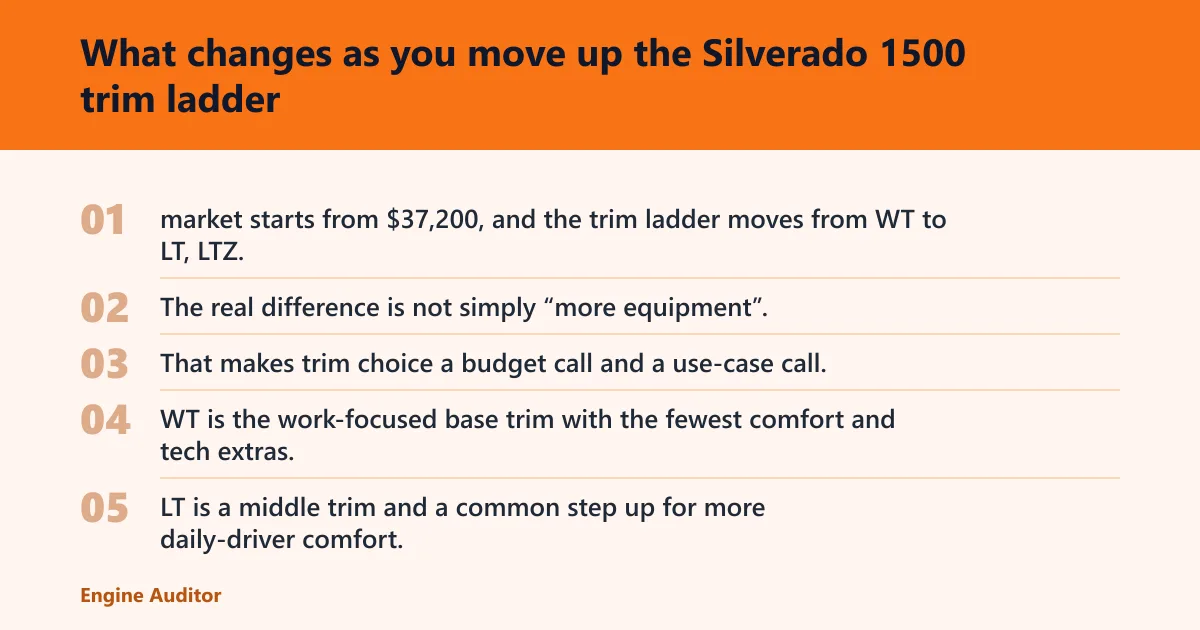


The Chevrolet Silverado 1500 in the U.S. market starts from $37,200, and the trim ladder moves from WT to LT, LTZ, and High Country. The real difference is not simply “more equipment”; it is a shift from work-first durability to daily comfort, then to near-luxury, then to premium commuter status. That makes trim choice a budget call and a use-case call.
WT is the work-focused base trim with the fewest comfort and tech extras. LT is a middle trim and a common step up for more daily-driver comfort. LTZ is an upper-mid trim where leather, convenience, and tech expectations tend to rise. High Country is the top luxury-oriented trim with premium interior and appearance details.
Where each trim sits in the Silverado 1500 lineup
WT is the trim to compare against other work trucks, not against luxury pickups. LT is where many buyers land when they want one truck to do weekday commuting and weekend chores without paying for premium trim content they may never notice. LTZ is the bridge into upscale ownership, and High Country is the trim for buyers who want the cabin to feel expensive every day.
Do not blur Silverado 1500 with Silverado HD. The HD line has its own pricing and trim content, and it starts from $46,200. If you are shopping a heavier-duty truck, that is a separate comparison with different towing and payload logic.
📊 Those trims sit between the lower WT and Custom trims and the higher ZR2 and High Country trims. Source: 2025 Chevrolet Silverado HD Trail Boss: Welcome to the Off-Road….
Which Chevy truck trim is best for work, towing, or daily driving?
WT is best for fleet and jobsite duty, LT is the best value daily driver, LTZ fits buyers who want more comfort without jumping to the top trim, and High Country is for luxury-first owners. Towing and payload depend more on engine, axle, cab, bed, and package choices than on trim name alone, so the “best” trim changes with the task.
WT for fleet and jobsite duty
Choose WT when the truck is a tool first. The value is in a simple cabin, lower purchase price, and fewer features to pay for, scratch, or replace. If the truck spends most of its life on a jobsite, in a fleet, or moving materials, WT usually makes the most financial sense.
LT for the best value daily driver
LT is the trim most buyers should cross-shop first. It usually gives the cleanest mix of comfort, infotainment, and day-to-day usability without moving into premium-trim pricing. If the truck will carry family, commute often, and still tow on weekends, LT is the likely sweet spot.
LTZ for buyers who want more comfort without jumping to the top trim
LTZ is the first trim that often feels meaningfully upscale rather than merely better equipped. Leather, more convenience features, and a higher perceived finish can matter if the truck doubles as a daily commuter. It becomes sensible when the added cabin quality is something you will notice every time you drive.
High Country for luxury-first owners
High Country is for buyers who want the Silverado to feel premium without moving to a different brand or body style. It adds the most polished interior, high-end appearance details, and standard features aimed at comfort. For many shoppers, the premium is worth paying only if the truck is also their everyday vehicle.
Buyer-fit matrix by use case
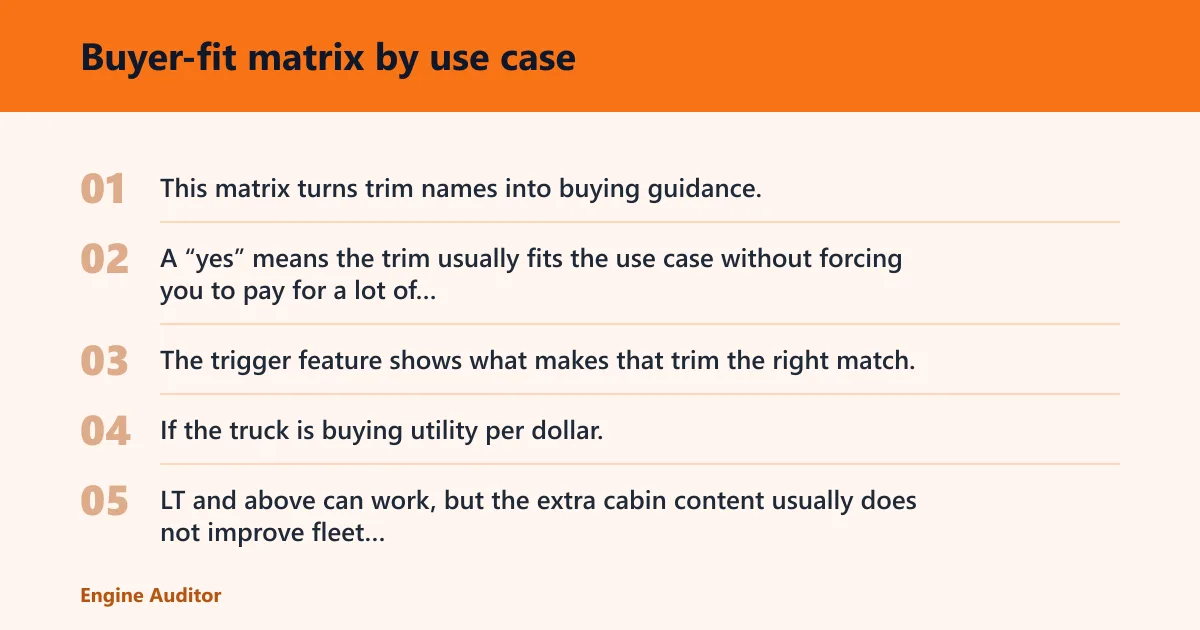
This matrix turns trim names into buying guidance. A “yes” means the trim usually fits the use case without forcing you to pay for a lot of unwanted extras. The trigger feature shows what makes that trim the right match.
| Use case | WT | LT | LTZ | High Country | Must-have trigger feature |
|---|---|---|---|---|---|
| Fleet / work | Yes | No | No | No | Lowest-cost, durable, no-frills cabin |
| Contractor towing | Yes | Yes | Maybe | No | Right engine, axle, and tow package more than trim |
| Family daily driving | No | Yes | Yes | Maybe | Comfortable seats, infotainment, quiet cabin |
| Luxury commuting | No | No | Yes | Yes | Leather, premium finish, advanced driver aids |
| Mixed-use hauling | Maybe | Yes | Yes | No | Balanced cabin comfort and practical storage |
Fleet and work
WT is the clear yes here. If the truck is buying utility per dollar, the lower trim avoids paying for features that do not help productivity. LT and above can work, but the extra cabin content usually does not improve fleet economics.
Contractor towing
WT and LT are the practical picks because towing use depends on the full configuration. A contractor may want LT for better daily comfort, but the drivetrain and tow package matter more than a luxury badge. LTZ can work too, yet it is a value question rather than a towing requirement.
Family daily driving
LT is the default recommendation for family duty. It usually gives enough comfort and technology to keep long drives reasonable without the price jump of LTZ or High Country. If leather and quieter premium trim content are a priority, LTZ can make sense.
Luxury commuting
LTZ and High Country are the right answers. High Country wins if you want the most premium standard content, while LTZ is the better spend if you want leather and a more upscale cabin without paying for the top badge. WT is too bare, and LT is more practical than plush.
Mixed-use hauling
LT is the strongest all-rounder for hauling, errands, and commuting. It keeps costs in check while adding enough comfort to make the truck pleasant outside of work hours. LTZ becomes attractive only when cabin quality matters as much as utility.
What each trim adds in comfort, tech, and cabin finish
WT starts with basic equipment and cloth-first priorities. LT adds convenience and infotainment upgrades that matter in normal daily use. LTZ brings leather, more driver-assist content, and higher perceived quality. High Country adds premium materials, larger tech options, and appearance details that separate it from the rest.
WT: basic equipment and cloth-first priorities
WT is built to be used hard. Expect the least expensive cabin materials, the fewest convenience extras, and the most straightforward tech setup. That is a strength if durability and low purchase cost matter more than comfort.
LT: convenience and infotainment upgrades
LT is the trim where the truck starts feeling modern for everyday use. Buyers should look here for the comfort and infotainment crossover point, especially if the truck will be used as a commuter or family vehicle. It is the first trim that feels like a general-purpose pickup instead of a stripped work tool.
LTZ: leather, more driver-assist content, and higher perceived quality
LTZ is the trim where buyers often stop asking “What did I give up?” and start asking “How much am I willing to pay for this?” Leather and more advanced driver-assistance content are the headline draws. That makes it a serious choice for buyers who want a premium cabin but do not need the top badge.
High Country: premium materials, larger tech options, and appearance details
High Country is the answer for buyers who want the Silverado 1500 to feel fully loaded. The standard adaptive cruise control is one clear marker of that positioning. If you want the most polished interior and the strongest luxury-first presentation, this is the trim that delivers it. (motortrend.com)
Do higher Silverado trims change towing and payload?
Higher trims mostly change comfort, cabin content, and appearance; they do not automatically make the truck tow or haul better. Engine, axle ratio, cab type, bed length, and packages are the real towing and payload levers. A lower trim can be the better tow rig if it is configured correctly.
Why engine and axle choice matter more than trim name
Two trucks with the same badge can tow very differently once their powertrain and axle ratios change. The trim name does not replace the need to check the actual tow rating for your configuration. That is why buyers should shop the exact build, not the trim badge alone.
How cab and bed selection affect work use
Cab and bed choices also shape usefulness. Regular cab, double cab, and crew cab layouts do not all appear the same way across trims, and bed-length availability can narrow as you move up the ladder. If you need maximum cargo flexibility, verify the exact body style before you focus on interior upgrades.
Which towing packages usually matter most
Look at cooling, hitch, axle, and brake-related equipment first. A towing package can matter more than a trim step, especially for contractors and boat or trailer owners. Higher trim content does not replace the need for the correct package.
Picture a buyer who tows a 7,000-pound travel trailer twice a month and commutes the rest of the week. LT may be the better choice than LTZ, because the money can go toward the right tow package and a better cab layout instead of leather the driver barely notices while towing.
How much more does each Silverado trim cost?
Chevrolet does not publish a single “worth it” answer because trim pricing depends on cab, bed, drivetrain, and options. The only firm starting point here is the Silverado 1500 at $37,200. From there, LT usually adds a manageable step up, LTZ asks for a larger premium, and High Country sits at the top of the range.
If you are shopping by budget, set your cap by use case. WT should win if the truck is a tool. LT should win if it is a do-everything truck. LTZ and High Country should be reserved for buyers who will notice and value the extra cabin quality every day.
What trim should I choose if I want leather and advanced tech?
LTZ is the best starting point if you want leather and advanced tech without paying for the top-end badge. High Country is the right choice if you want the most premium standard equipment and the strongest luxury-first presentation. LT is not enough for many leather-first buyers, and WT is aimed elsewhere entirely.
Is LTZ worth the upgrade over LT?
LTZ is worth the upgrade when leather, a more premium cabin, and more driver-assist content are features you will use every day. If you mainly want a truck for commuting and family duty, the step up can be justified. If you only want a nicer seat surface, LT may be the better value.
The right question is not “Is LTZ nicer?” It is whether the added cabin quality is worth the money after you have already covered the practical needs that LT can handle. For many buyers, LT is enough. For buyers who spend a lot of time in the truck, LTZ can feel like money well spent.
What features come standard on High Country?
High Country is the top luxury-oriented Silverado 1500 trim, and it comes with premium interior materials, upscale appearance details, and standard adaptive cruise control. It is aimed at buyers who want the truck to feel fully loaded from the start rather than assembled through options.
That said, High Country is not automatically the best tow rig or work truck. Its value comes from the cabin, tech, and presentation. If those are your priorities, the trim makes sense. If not, LT or LTZ may give you more useful value for the money.
Which Chevy truck trim is best for work, daily driving, or towing?
WT is best for work, LT is best for daily driving, and LTZ is the best compromise if you want more comfort without going all the way to High Country. For towing, the best trim is whichever one gives you the right engine, axle, cab, bed, and tow package at the best price. Trim alone does not decide towing ability.
If the truck is a jobsite tool, choose WT. If it is your main vehicle, choose LT. If it needs to feel nicer every day, choose LTZ or High Country depending on how much premium content you want to pay for.
Which trim gives the best value for most buyers?
LT gives the best value for most Silverado 1500 buyers because it covers the largest number of use cases without pushing into premium pricing. It usually lands in the right place for family use, commuting, and occasional towing. WT is better only if cost control is the top priority.
LTZ becomes the value sweet spot only for buyers who care a lot about leather and cabin polish. High Country is a better emotional purchase than value purchase. That makes LT the trim that fits the most people, even if it is not the cheapest on the sticker.
Choose WT if… / Choose LT if… / Choose LTZ if… / Choose High Country if…
Choose WT if you want the lowest purchase price, a jobsite-first cabin, or a fleet truck that will see hard use. Choose LT if you want the best balance of cost, comfort, and everyday usability. Choose LTZ if leather, more advanced tech, and a more upscale feel matter enough to justify the extra spend. Choose High Country if you want the most premium Silverado 1500 and expect to notice the upgrade every day.
Frequently asked questions
What is the difference between Silverado WT, LT, LTZ, and High Country?
WT is the work-focused base trim, LT is the middle trim with more convenience features, LTZ is the upper-mid trim with more premium comfort, and High Country is the top luxury-oriented trim. The higher you go, the more the truck shifts from utility toward comfort, tech, and appearance.
Which Chevy truck trim is best for work, daily driving, or towing?
WT is best for work, LT is best for daily driving, and towing depends more on the exact engine and configuration than the trim badge. LTZ can be a good daily driver if you want more comfort. High Country is best when the cabin matters more than the work-truck price.
Is LTZ worth the upgrade over LT?
LTZ is worth it if you want leather, more convenience, and a more premium cabin every day. If you only need a comfortable truck with useful tech, LT usually delivers better value. The upgrade makes the most sense for high-mileage drivers and buyers who care about interior feel.
What features come standard on High Country?
High Country adds premium materials, upscale appearance details, and standard adaptive cruise control. It is the most luxury-oriented Silverado 1500 trim in this comparison. Buyers should pick it for comfort and status, not because it is required for towing or work use.
How much more does each Silverado trim cost?
The Silverado 1500 starts from $37,200, but exact trim-to-trim pricing changes with cab, bed, drivetrain, and options. WT is the lowest-cost starting point, LT sits in the middle, LTZ asks for more, and High Country is the most expensive of these four trims.
Do higher trims change towing capability or mostly comfort?
Higher trims mostly change comfort, tech, and appearance. Towing capability depends more on engine, axle, cab, bed, and package choices. A lower trim with the right hardware can tow better than a higher trim that is configured for luxury instead of work.
Products related to this article
Sponsored / affiliate links. As an Amazon Associate I earn from qualifying purchases. I may earn additional commission from eligible campaigns.