Chevy Brake Pedal Feels Soft? Here’s What Could Be Wrong
A Chevy soft brake pedal usually points to air in the hydraulic system, a rear drum-adjuster issue, or an internal master-cylinder leak; if the pedal sinks while you hold steady pressure, stop driving and inspect it now. Ignoring it can lengthen stopping distance fast, and a true hydraulic failure can leave you with little braking. This guide matches pedal feel, recent brake work, warning lights, and brake hardware type to the most likely cause.
Reading the pedal to isolate the failure point
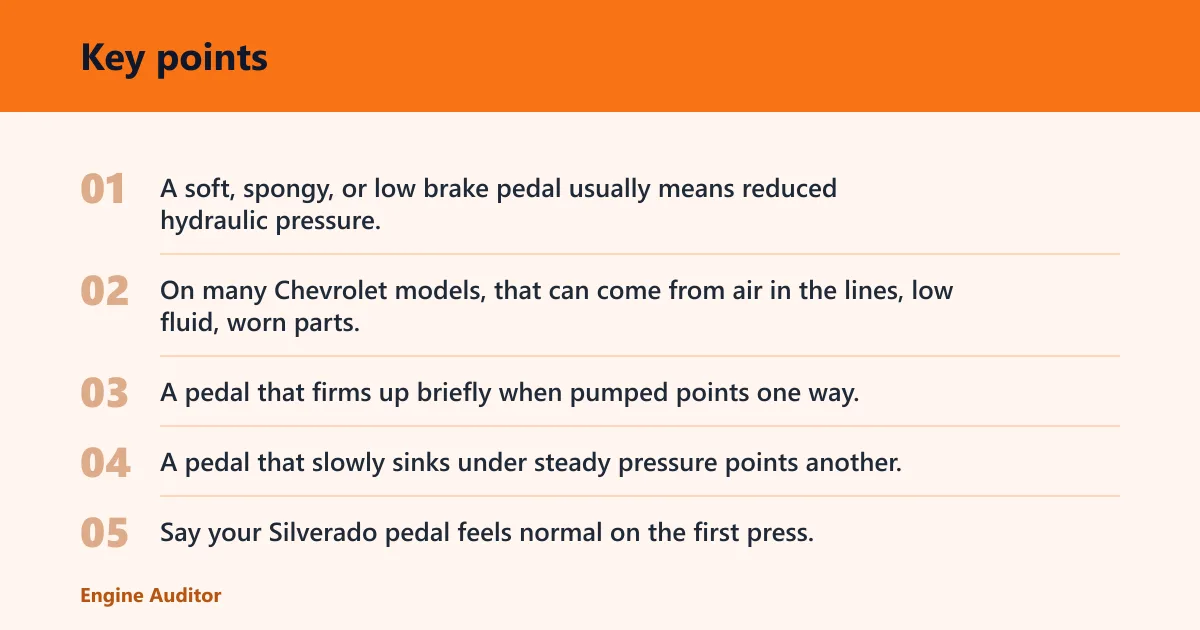


A soft, spongy, or low brake pedal usually means reduced hydraulic pressure. On many Chevrolet models, that can come from air in the lines, low fluid, worn parts, hose expansion, or master-cylinder bypassing; the same symptom can show up differently on Silverado, Malibu, Equinox, Traverse, Tahoe, and Camaro brake setups.
The first clue is pedal behavior. A pedal that firms up briefly when pumped points one way. A pedal that slowly sinks under steady pressure points another.
Brake pedal decision table
| Symptom pattern | Most likely subsystem | First check | Do-not-drive threshold |
|---|---|---|---|
| Pump firms then sinks | Air in hydraulic lines or a marginal hydraulic seal | Check for recent brake service, then bleed the system in the correct order | If stopping distance changes or the pedal keeps dropping, do not drive |
| Slowly sinks while held | Master cylinder | Hold steady pressure with the engine on and watch for gradual drop | Stop driving now if the pedal moves toward the floor |
| Soft only after brake work | Air left in the hydraulic circuit, often after caliper, hose, or line work | Confirm whether the system was opened and whether a bleed was completed | Do not keep driving if the pedal is still spongy after bleeding |
| Soft with low fluid | Leak, worn pads, or fluid loss | Check reservoir level and inspect for wetness before topping off | Do not drive until the leak source is found |
| Soft with visible wetness | Brake line, hose, caliper, wheel cylinder, or master-cylinder seal leak | Look at each corner, fittings, and the booster area for fresh fluid | Immediate stop-driving condition |
| Soft after long storage | Fluid moisture, corrosion, stuck rear adjusters, or aged hoses | Check fluid color and inspect rear brake adjustment and hose condition | If the pedal is low or uneven, do not assume it will improve on its own |
| Soft with pedal vibration | ABS activity, rotor issues, or uneven pad contact | Check for warning lights, rotor condition, and whether ABS is triggering early | Stop driving if braking is unpredictable or the pedal travel changes sharply |
| Soft with brake warning light | Low fluid, hydraulic fault, or ABS-related fault | Check fluid level first, then inspect for leaks and scan stored codes | Do not drive if the light stays on and pedal feel is reduced |
Say your Silverado pedal feels normal on the first press, then drops farther on the second after a pad and caliper job. That pattern fits trapped air better than worn pads, because pad wear changes travel more gradually and usually does not give you a pump-up response.
What the pedal tells you
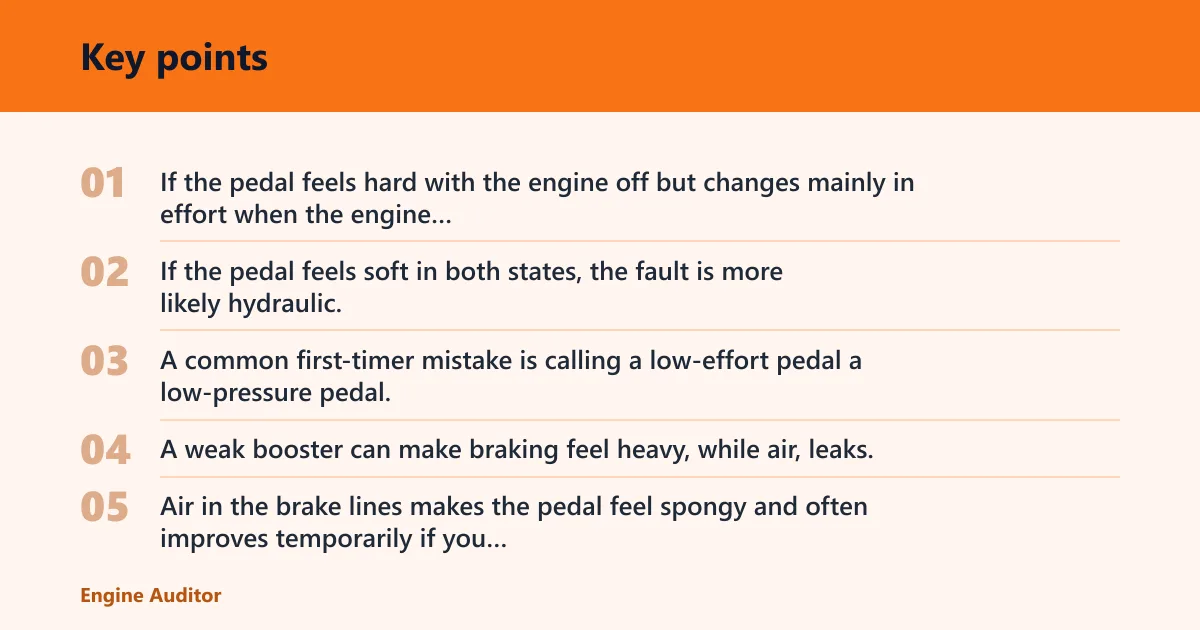
Engine-off and engine-on checks separate assist problems from hydraulic problems. With the engine off, the pedal should become firmer as vacuum assist is depleted. When the engine starts, a healthy booster should cause a slight pedal drop.
Engine off versus engine
If the pedal feels hard with the engine off but changes mainly in effort when the engine runs, the booster or vacuum supply needs attention. If the pedal feels soft in both states, the fault is more likely hydraulic.
A common first-timer mistake is calling a low-effort pedal a low-pressure pedal. Those are not the same. A weak booster can make braking feel heavy, while air, leaks, or internal bypassing change how far the pedal moves.
Why a pump-up pedal points to trapped air or wear
Air in the brake lines makes the pedal feel spongy and often improves temporarily if you pump it. That is a strong clue after brake service. It is less persuasive when the symptom started with a warning light, a fluid loss, or a slow sink under constant pressure.
Brake pads and rotors can add pedal travel when they are worn, scored, rusted, or severely worn. On some older Chevrolet trucks with rear drum brakes, a rear-adjuster issue can also make the pedal low. Normal pad wear alone usually does not create a truly soft pedal feel.
When pedal sink points to the master cylinder
If the pedal slowly sinks while you hold pressure, the master cylinder is a likely suspect. The cylinder can bypass internally without leaving a puddle under the vehicle. That is why a clean driveway does not rule it out.
Brake fluid is the hydraulic medium and should not compress. Many Chevrolet models commonly specify DOT 3 brake fluid. Check the reservoir level and color. Dark, contaminated fluid can signal moisture buildup, degraded seals, or overdue maintenance.
Brake fluid, lines, and leaks
Low fluid can make the pedal feel low or spongy, but low fluid is also a warning to inspect for leaks before topping off. Fluid loss does not fix itself. A topped-off reservoir can hide the reason the pedal went soft.
Check fluid level and color
Start at the reservoir. If the level is below the mark, inspect the system before adding fluid. If the fluid is dark, contaminated, or cloudy, moisture may already be in the system, and the fluid may need replacement rather than a simple top-off.
Can old brake fluid make your Chevy brakes feel soft? Yes. Moisture in the fluid lowers its quality, and contaminated fluid can contribute to a softer, less confident pedal feel over time. It is more likely to be part of the problem than the only cause.
Find wet calipers, hoses, lines, and fittings
Brake lines can leak externally, corrode, crack, or trap air after service. Look at line unions, flex hoses, calipers, wheel cylinders, and the master-cylinder rear seal. A wet backing plate or a damp hose fitting is enough reason to stop and inspect.
Brake hoses can swell under pressure. If a hose bulges when someone presses the pedal, it can absorb force and make the pedal feel soft. That clue matters because a hose can look fine at rest and still expand under load.
When low fluid means you should stop driving
If the reservoir is low and you find fluid on a wheel, frame rail, or inside a tire, do not drive the vehicle. A leak can worsen quickly. Even if the brakes still work, the margin may be thin enough to make one hard stop unsafe.
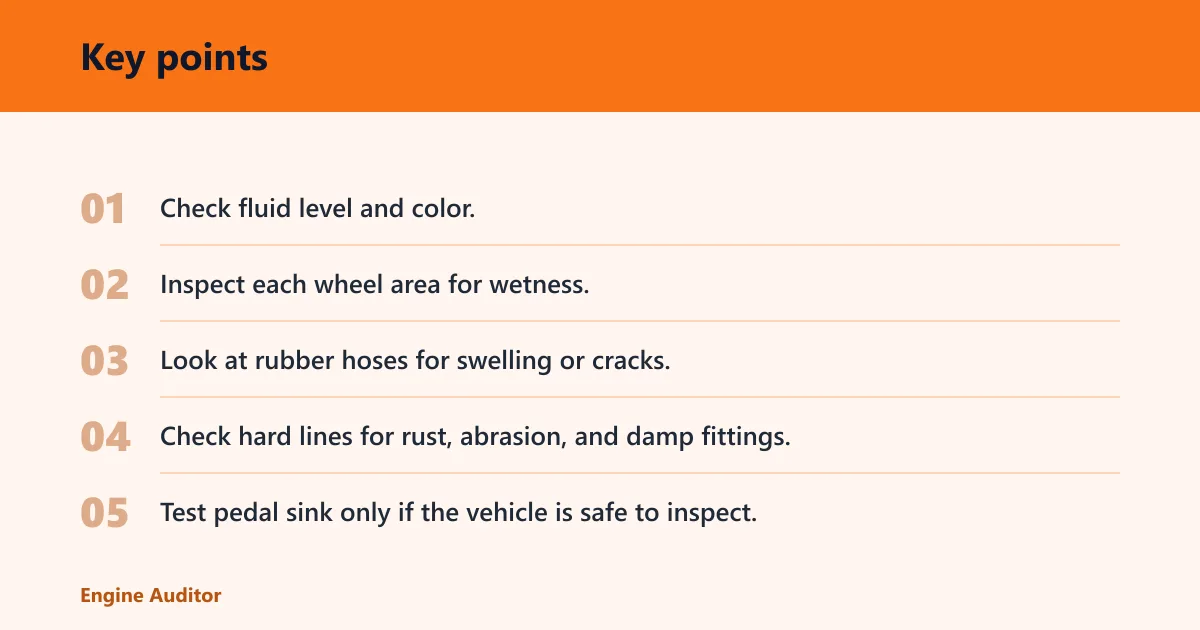
- Check fluid level and color.
- Inspect each wheel area for wetness.
- Look at rubber hoses for swelling or cracks.
- Check hard lines for rust, abrasion, and damp fittings.
- Test pedal sink only if the vehicle is safe to inspect.
- Bleed the system after any opening of the hydraulic circuit.
Could recent brake work be the cause?
Yes. Recent brake work is one of the strongest clues. A soft pedal after caliper, hose, line, master-cylinder, or ABS work often means air remained in the system. If the symptom started right after service, that history matters more than generic guesses.
Air left in the system after caliper, hose, or line work
Whenever the hydraulic circuit is opened, air can enter. A proper brake bleeding procedure removes that air. On many Chevrolet vehicles, the bleed may start at the wheel farthest from the master cylinder, but the exact wheel sequence varies by model, so follow the factory service manual for the specific Chevrolet.
If the pedal firms up and then sinks again, the pump test can reveal air in the lines. That pattern does not prove air by itself, but it strongly supports a bleed issue when the symptom began after service.
Why ABS vehicles may need scan-tool bleeding
If the ABS unit has been opened or serviced, a standard bleed may not remove all air. Some Chevrolet ABS systems need scan-tool activation so fluid can move through the hydraulic unit. That is especially relevant on newer, ABS-heavy trucks and SUVs.
The ABS hydraulic unit is less often the cause than air or leaks, but it can trap air after repairs. If the pedal stayed soft after a normal bleed, the ABS unit should move up the list.
Common service mistakes that leave a soft pedal
A few errors show up often enough to check first: bleeding one wheel only, using the wrong sequence, reusing old fluid, leaving a loose fitting, or stopping before all air is out. Pad replacement alone should not create a hydraulic soft pedal unless the caliper pistons were compressed with an open system or the system was bled poorly.
Picture a Traverse with new front calipers and a pedal that feels normal for the first inch, then goes mushy. If the reservoir stayed full and no fluid is on the ground, a missed bleed is more likely than a pad issue. If the brake warning light is on too, inspect for a leak or ABS fault before driving farther.
Master cylinder and ABS checks
The master cylinder is the source of hydraulic pressure. If it bypasses internally, fluid can move past the seals instead of building pressure. That creates the classic slow-sink pedal with little or no external leak.
Internal bypass in the master cylinder
A pedal that slowly sinks toward the floor may indicate an internal master cylinder bypass. That is one of the clearest warning signs in the system. It is different from a soft pedal caused by trapped air, because the sink often continues while steady pressure is held.
Try the pedal hold test with the engine running and again with the engine off. If the pedal travels farther over time in both cases, the master cylinder moves higher on the list. If it firms after pumping but does not sink, trapped air or hose expansion is more likely.
How ABS hydraulic unit air can stay trapped
When the ABS hydraulic unit contains air, a routine bleed may not clear it. That can leave a pedal that still feels spongy even after fresh fluid and a normal bleed sequence. If the vehicle has recent ABS work, this is worth checking before replacing major parts.
If the pedal sinks steadily, a bleed alone may waste time while the master cylinder or a leak remains unfixed.
When scan data or a shop visit makes sense
If the warning light is on, the pedal is still soft after bleeding, or the symptom came back after a short drive, scan data can help sort ABS faults from hydraulic ones. A shop visit also makes sense when bleeding requires scan-tool activation or when leak location is unclear.
Brake pads, rotors, and hoses
Pad and rotor wear do not usually create the same hydraulic feel as air or leakage. Still, worn friction parts can make the pedal travel farther and the brake response feel vague. That matters on Chevy vehicles with high mileage or neglected rear brakes.
Worn pads and rotor condition
Check pad thickness, rotor scoring, and rust ridge buildup at the rotor edge. Worn pads and rough rotors can add travel and make braking less precise. Worn pads can change feel, but they do not usually mimic a true hydraulic soft pedal.
Rust ridges, scoring, and excess travel
On trucks and SUVs that sit for long periods, rust can form on the rotor surface and at the edges. That can make the first pedal application feel odd or long. If the pedal firms up after a few stops but fluid level and bleed quality are fine, friction hardware deserves a look.
Rubber hose expansion under pedal pressure
Old rubber hoses can expand under pressure and absorb pedal force. If a hose balloons when the pedal is pressed, replace it. That is a hydraulic problem, not a pad problem, and it can be easy to miss if you only inspect the hose at rest.
Frequently asked questions
Why does my Chevy brake pedal feel soft when I stop?
A soft Chevy brake pedal usually means reduced hydraulic pressure from air, a leak, a weak master cylinder, or hose expansion. The exact cause depends on pedal behavior and recent service history. If the pedal sinks while held, stop driving and inspect it now.
Is it safe to drive my Chevy with a soft brake pedal?
Do not drive it. If the pedal sinks, the fluid is low, the warning light is on, or stopping distance changes, do not drive it.
Does a soft brake pedal mean air in the brake lines?
Air in the brake lines is a common cause, especially after brake work, and the pedal often firms up briefly when pumped. But a soft pedal can also come from low fluid, a leak, hose swelling, ABS air, or master-cylinder bypassing.
Can low brake fluid make the brake pedal feel spongy in a Chevy?
Yes. Low fluid can make the pedal feel low or spongy, but it should also send you looking for the reason the fluid dropped. Check for wet calipers, hoses, lines, and the master cylinder before adding fluid, because topping off does not fix a leak.
How do I tell if my Chevy master cylinder is failing?
A failing master cylinder often lets the pedal slowly sink under steady pressure. It may do this without a puddle under the vehicle. If the pedal sinks in a repeated hold test and the fluid level is stable, the master cylinder becomes a likely suspect.
Could recent brake work cause a soft brake pedal on my Chevy?
Yes. Brake work that opens the hydraulic system can leave air trapped inside, especially after caliper, hose, line, or ABS service. A proper bleed is the usual fix, but some ABS-equipped Chevrolet vehicles need scan-tool activation for the air to come out fully.
Can old brake fluid make my Chevy brakes feel soft?
Yes. Brake fluid can absorb moisture over time, and dark contaminated fluid can point to overdue maintenance or degraded seals. Old fluid does not always cause a sudden soft pedal, but it can worsen pedal feel and make other hydraulic problems more likely.
Products related to this article
Sponsored / affiliate links. As an Amazon Associate I earn from qualifying purchases. I may earn additional commission from eligible campaigns.