Chevy Rough Idle on Startup: What to Check First
Start with battery voltage, intake leaks, air filter, and a quick scan for codes. On some Chevy V6/V8 engines, a rough idle that fades in minutes often points to air, fuel, or ignition faults rather than engine damage. Skipping these basics can waste money on parts and miss an easy fix. This guide gives a first-check order from driveway inspections to confirmatory tests.
How the triage order works



Use the symptom pattern first. Startup-only rough idle, rough idle only in gear, and rough idle with no codes do not point to the same next test, and some Chevy throttle strategies can make one fault show up only for about 30 to 60 seconds after a cold start.
Start with checks you can do in a driveway: hiss, hose condition, air filter, MAF contamination, and throttle body carbon. Then move to codes, live data, fuel pressure, ignition checks, and compression if the first layer does not explain the idle.
What you’ll need
- OBD-II scanner or code reader
- Flashlight and inspection mirror
- MAF sensor cleaner
- Throttle body cleaner
- Basic hand tools for hose and intake checks
- Fuel pressure gauge if fuel delivery is suspected
Startup idle triage table
| Symptom pattern | Likely cause | First check | Tool needed | Stop/do-not-drive threshold |
|---|---|---|---|---|
| Startup-only rough idle | Unmetered air leak, dirty MAF sensor, throttle body carbon | Listen for hiss; inspect intake tube, PCV hose, and clamps | Flashlight, mirror | Flash of the check engine light, stalling, or strong fuel smell |
| Rough idle in gear | Unmetered air leak, throttle body carbon, weak ignition | Compare Park to Drive; note if shake gets worse with load | None at first | Severe shake or metal noise |
| Rough idle with no codes | Dirty MAF, plugs, coils, EGR, compression issue | Scan live data before buying parts | OBD-II scanner | Flashing MIL, stalling, or repeated misfire at idle |
| Rough idle with a hiss | Leak from cracked hose, bad PCV valve, or intake manifold gasket | Trace the hiss to the intake path | Flashlight, mirror | Idle unstable enough to stall in traffic |
What should I check first if my Chevy idles rough when I start it?
Check for a hiss, cracked intake ducting, loose clamps, and a dirty air filter before you replace fuel parts. A startup-only rough idle that fades after about a minute often comes from unmetered air, a dirty MAF sensor, or throttle plate carbon, and those are often faster to inspect than injectors or pumps.
- Listen at idle with the hood open.
- Inspect the intake tube, PCV hose, and vacuum lines.
- Open the air box and check the filter.
- Scan for codes and look at idle fuel trim before buying parts.
Say a Silverado shakes for about 40 seconds after a cold start, then smooths out in Drive. That pattern pushes a vacuum leak or throttle body deposit higher on the list than a fuel pump, because the fault shows most when airflow and idle control are most sensitive.
Can a vacuum leak cause a rough idle with no check engine light?
Yes. A vacuum leak lets unmetered air into the engine, and that can roughen idle before the computer sets a light. Common sources include a cracked vacuum hose, a bad PCV valve, or a leaking intake manifold gasket. A hiss near the intake is a useful clue.
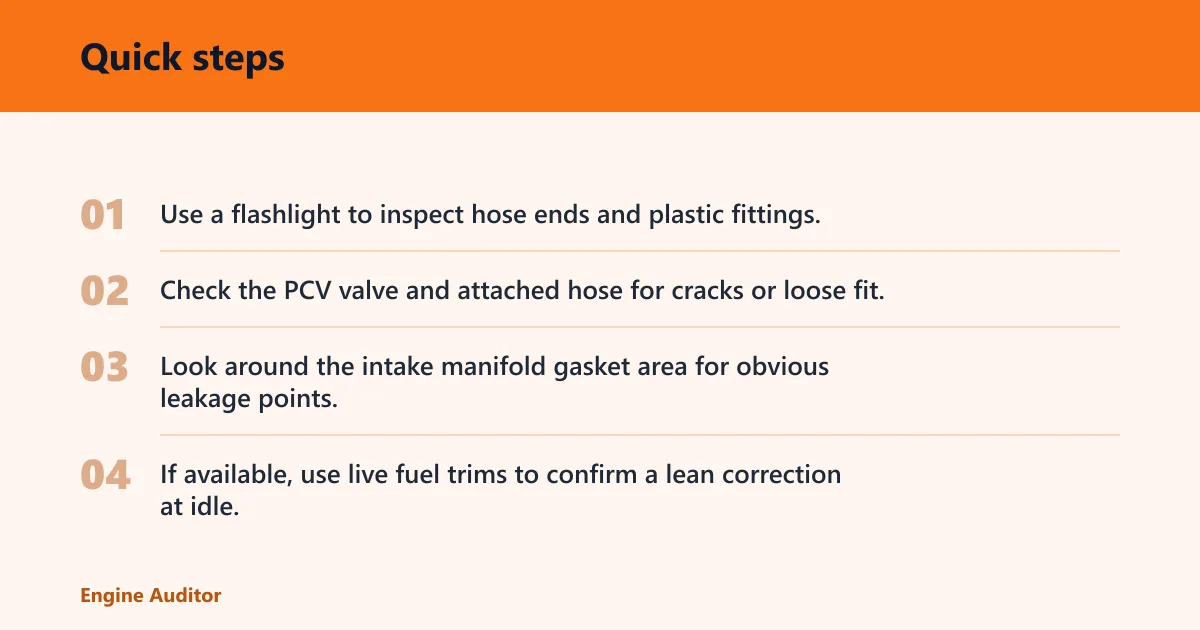
- Use a flashlight to inspect hose ends and plastic fittings.
- Check the PCV valve and attached hose for cracks or loose fit.
- Look around the intake manifold gasket area for obvious leakage points.
- If available, use live fuel trims to confirm a lean correction at idle.
If the idle improves when you lightly pinch or move a hose, treat that as a clue, not proof. The next step is a closer inspection of the same branch, because spray tests and parts swaps can hide the real leak path.
Could a dirty throttle body make my Chevy idle rough after starting?
Yes. Carbon buildup around the throttle plate can restrict airflow at idle, and that matters most on drive-by-wire systems because the computer is trying to hold a very narrow idle target. The symptom can fade once the throttle blade and engine warm up.
- Key off the ignition and remove the intake tube.
- Inspect the throttle bore for black buildup around the plate.
- Clean the bore with throttle body cleaner on a lint-free cloth.
- Reinstall the ducting and relearn idle only if the service manual calls for it.
Do not flood the throttle body with cleaner. Use a controlled wipe, then recheck idle quality after a short drive and another cold start.
Can fuel injectors cause rough idle at startup?
Yes. Dirty fuel injectors can cause a rough idle or intermittent misfire, and weak fuel pressure can show up most clearly at idle. If cruise feels normal but idle is shaky, that pattern fits injector spray issues or a pump that cannot hold pressure consistently.
- Check fuel pressure with a gauge before replacing the pump.
- Review injector-related misfire data with an OBD-II scanner.
- Use injector cleaner only if the system and service guidance support it.
- If the problem stays on one cylinder, plan a professional injector balance or cleaning test.
Suppose the engine idles rough only in Park, then gets worse when shifted into Drive. That points to a marginal fuel or ignition issue under added load, and it is a reason to test pressure and misfire counts instead of replacing the whole fuel system.
Why would my Chevy rough idle go away after it warms up?
Warm-up can mask faults that show cold. A lazy O2 sensor, a stuck-open EGR valve, a dirty throttle body, or a small vacuum leak may look worst right after startup and then fade as fuel control stabilizes. That is why cold and warm idle should be treated as different cases.
- Record whether the rough idle lasts 30 to 60 seconds or continues fully warm.
- Watch live data for short-term fuel trim and idle speed changes.
- Check for an EGR valve that sticks open at idle.
- Inspect O2 sensor behavior if the trim swings oddly after warm-up.
If the symptom disappears only after a longer drive, do not assume the problem is gone. Intermittent faults often return on the next cold start.
What if my Chevy runs rough at idle but there are no codes?
Do not skip diagnosis because the MIL is off. A no-code rough idle still fits unmetered air leaks, dirty MAF data, carboned throttle plates, worn spark plugs, weak coils, dirty injectors, or even low compression. The fix order stays the same: airflow first, then ignition, then fuel, then engine condition.
- Scan live data for fuel trims, misfire counts, and coolant temperature.
- Inspect and clean the MAF sensor with MAF sensor cleaner only.
- Check spark plugs for wear, fouling, oil buildup, and gap issues.
- Swap coils between cylinders if the misfire pattern follows one coil.
- Move to fuel pressure testing, then compression testing if the first checks do not explain it.
A common first-timer mistake is replacing injectors before checking the intake tract. That can turn a cheap leak into an expensive parts list.
Common mistakes
- Replacing fuel parts before checking for unmetered air.
- Cleaning the MAF with the wrong product or touching the sensing element.
- Ignoring a rough idle that only appears cold, in gear, or for 30 to 60 seconds after startup.
- Skipping compression testing after air, fuel, and ignition checks come back normal.
- Driving through a flashing check engine light, stalling, fuel smell, or metal noise.
If that didn’t work, try this next
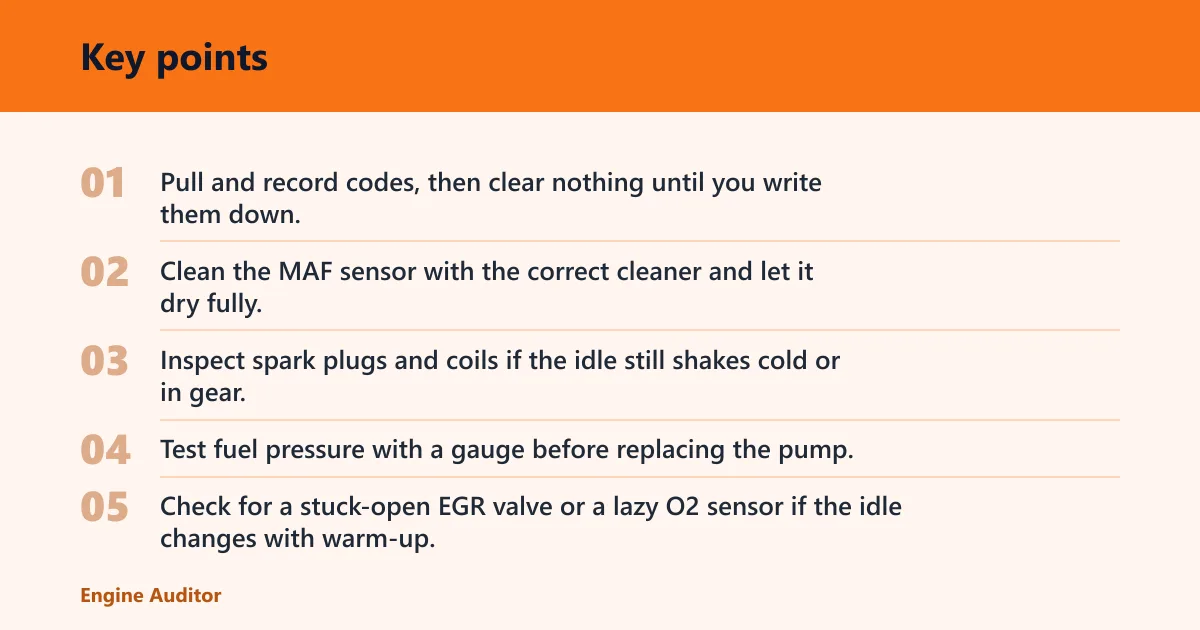
- Pull and record codes, then clear nothing until you write them down.
- Clean the MAF sensor with the correct cleaner and let it dry fully.
- Inspect spark plugs and coils if the idle still shakes cold or in gear.
- Test fuel pressure with a gauge before replacing the pump.
- Check for a stuck-open EGR valve or a lazy O2 sensor if the idle changes with warm-up.
- Run a compression test when airflow, spark, and fuel checks do not find the cause.
Prevention: Keep the air filter clean and replace damaged intake hoses as soon as they split. That simple step prevents many repeat idle complaints on Chevy engines.
Frequently asked questions
How do I tell if spark plugs are causing rough idle on startup?
Pull the plugs and inspect for wear, oil fouling, carbon buildup, or an improper gap. A plug fault can cause an intermittent misfire without a constant code. If one cylinder looks worse than the others, that cylinder is the place to focus next.
Should I check the MAF sensor before replacing fuel parts?
Yes. A dirty MAF sensor can send bad airflow information and affect fuel delivery, so it belongs before fuel pump or injector replacement. Clean it with MAF sensor cleaner only. Do not touch the sensing element inside the housing.
Products related to this article
Sponsored / affiliate links. As an Amazon Associate I earn from qualifying purchases. I may earn additional commission from eligible campaigns.