Chevy Silverado 1500 vs 2500HD: Which One Do You Need?
Choose the Silverado 1500 if your trailer stays around 10,000 pounds or less and you want a truck that is easier to use every day; move to the 2500HD for heavier trailers, higher payloads, or fifth-wheel and gooseneck work. Choosing too little truck can leave you short on payload, hitch capacity, and braking margin. This guide compares towing, payload, ride, fuel cost, and work use so you can match the truck to the job.
This guide is part of our Chevy vehicles guide: models, issues, and buying tips series.
Chevy Silverado 1500 vs 2500HD: the quick answer

The Silverado 1500 is the lighter-duty choice. The Silverado 2500HD is the heavy-duty choice. That difference affects towing, payload, ride comfort, parking, and price, so the right truck depends on the trailer, the cargo in the cab and bed, and how often you drive it empty.
Chevrolet lists the Silverado from $37,200 and the Silverado HD from $46,200, so the heavy-duty truck starts higher before options. Chevrolet’s truck lineup includes Silverado, Silverado HD, and Silverado EV, with Silverado under Trucks and Silverado HD also listed in Commercial.
| Decision factor | Chevy Silverado 1500 | 2500HD | Winner |
|---|---|---|---|
| Daily driving | Usually easier to park, fit in a garage, and live with every day | Bigger, heavier, and less convenient in tight spaces | Chevy Silverado 1500 |
| Towing and hauling headroom | Enough for many light and mid-size jobs when properly equipped | Better suited to heavier trailers and frequent work use | 2500HD |
| Payload flexibility | More likely to hit limits with passengers, cargo, and tongue weight | Usually better for heavier bed loads and hitch weight | 2500HD |
| Purchase price | Lower starting price | Higher starting price | Chevy Silverado 1500 |
| Best-fit use case | Commuting, family use, small trailer duty, mixed driving | Jobsite hauling, bigger campers, fifth-wheel or gooseneck towing | Depends on job |
Daily driving and cost lean toward the 1500
The 1500 wins for commuting because lighter trucks usually feel easier in traffic, in parking lots, and on short errands. It also starts at a lower price, which matters if the truck spends more time carrying people than towing steel or lumber.
Towing and payload lean toward the 2500HD
The 2500HD is built for heavier work. Its advantage is not just maximum trailer weight; it also brings more payload capacity and more stability when the bed, cab, and hitch all carry weight at the same time.
Use case decides the winner
If the truck’s main job is occasional towing and regular driving, the 1500 often makes more sense. If the truck will spend its life pulling large equipment, a big camper, or a fifth-wheel, the 2500HD is usually the better tool.
📊 Chevrolet lists the Silverado from $37,200. Source: Chevrolet Cars, Trucks, SUVs, Crossovers and Vans.
What’s the difference between a Chevy Silverado 1500 and 2500HD?
The Silverado 1500 is generally considered a light-duty pickup, and the 2500HD is a heavy-duty pickup. That means the 2500HD is built with a stronger bias toward towing and hauling, while the 1500 is easier to live with when the truck is also your commuter, family vehicle, or garage-fitter.
The differences show up in frame, suspension tuning, brakes, axle choices, transmission gearing, and available powertrains. Chevrolet also gives buyers multiple cab and bed combinations, so the exact configuration matters as much as the badge on the tailgate.
Class, size, and frame changes
A heavier-duty truck is not always the right answer. The 2500HD’s extra hardware helps under load, but that hardware also brings a larger footprint and more effort in tight turns, narrow driveways, and compact parking spaces.
For many shoppers, the real question is whether the truck will spend most of its time empty or loaded. If it is mostly empty, the extra size can feel like a penalty rather than an upgrade.
Cab, bed, engine, and drivetrain options
Both trucks can be configured in ways that change how useful they are. Cab size affects passenger room and payload. Bed length affects cargo volume and how much trailer tongue weight you can carry before the truck runs out of payload.
Engine and drivetrain choices also matter. Gas V8 options, diesel availability, 4×2 versus 4×4, rear axle ratio, and transmission gearing all change tow ratings and real-world pullability. A higher axle ratio can improve towing behavior, but it may cost some empty-road refinement.
Price and ownership tradeoffs
Chevrolet lists the Silverado from $37,200 and the Silverado HD from $46,200. That gap is only the start; heavier-duty trucks often carry higher operating costs through fuel, tires, and sometimes insurance or registration, depending on the area.
The 1500 is often the better value if the truck will do mixed duty. The 2500HD is the better value when the truck’s work consistently exceeds half-ton limits.
Which Silverado is better for towing?
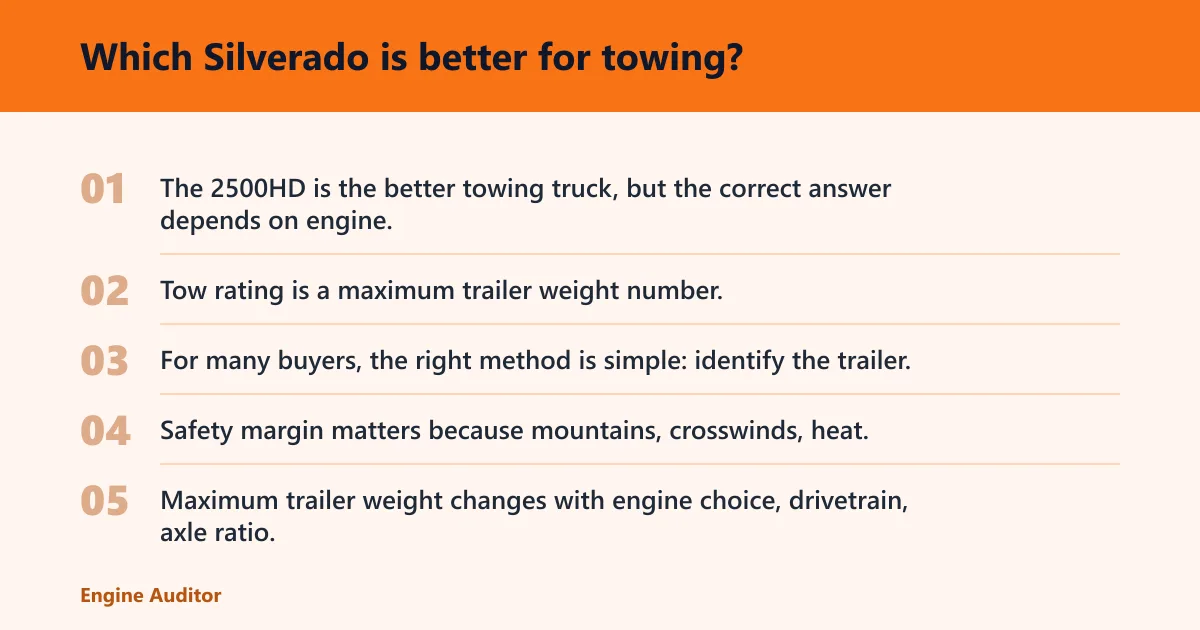
The 2500HD is the better towing truck, but the correct answer depends on engine, axle ratio, tow package, and trailer type. Tow rating is a maximum trailer weight number, not a guarantee that the truck can tow every trailer well once passengers, cargo, and hitch weight are added.
For many buyers, the right method is simple: identify the trailer, then verify the exact tow rating and payload rating on the specific truck. Safety margin matters because mountains, crosswinds, heat, and stop-and-go traffic all demand more from the combination.
Tow rating is engine-dependent
Maximum trailer weight changes with engine choice, drivetrain, axle ratio, and transmission gearing. Two trucks with the same badge can have different tow ratings, so a brochure number is never enough by itself.
GCWR, or gross combination weight rating, also matters. It is the maximum combined weight of truck, people, cargo, and trailer. If the combination is too close to that number, the truck may be within a tow rating and still be a poor match. (motortrend.com)
Trailer type changes the answer
A small utility trailer or light boat trailer is one thing. A travel trailer or horse trailer is another. Fifth-wheel and gooseneck trailers put more weight into the truck bed and demand more from payload and stability.
That is why a trailer’s shape matters as much as its weight. A bumper-pull travel trailer may fit a 1500 setup, while a fifth-wheel often pushes buyers toward the 2500HD because of pin weight and control.
Use a safety margin, not the limit
A common rule of thumb is to leave room below the published maximum, especially if the truck also carries family, gear, or bed cargo. The more weight on the truck, the less comfortable it is to run right at the edge.
Suppose a trailer seems fine on paper, but the family adds four passengers, a cooler, firewood, and a weight-distributing hitch. That extra load can turn a seemingly safe 1500 setup into a payload problem before the trailer even moves.
How payload changes the answer
Payload is often the number that settles the debate. It generally includes passengers, tools, bed cargo, hitch hardware, and trailer tongue weight. If payload runs out first, the truck can be overloaded even when the trailer weight looks acceptable.
Check the door-jamb sticker on the exact truck. That label gives the payload rating for that specific configuration, which can change with cab size, bed length, trim, drivetrain, and options.
Passengers and cargo count against payload
Every person in the cab takes away from what remains for hitch weight and cargo. Heavy accessories do the same. A bed full of landscaping material or a family packed for a road trip can use more payload than buyers expect.
This is why tow rating alone is misleading. A truck can have a healthy trailer rating and still run out of payload when the tongue weight and passengers are added together.
Tongue weight is the hidden limiter
Travel trailers and bumper-pull trailers place part of their mass on the hitch. Horse trailers and equipment trailers can do the same. Fifth-wheel trailers place even more of that load in the bed through the hitch system.
That load counts against payload. A truck that looks strong enough on a brochure may be short on the actual sticker once hitch weight, tools, and passengers are all included.
Is the Silverado 1500 better for daily driving than the 2500HD?
Yes, the Silverado 1500 is often easier to live with every day. It is the better pick for commuting, parking, school runs, errands, and shorter trips, especially if the truck will spend most of its life empty or lightly loaded.
The 2500HD can still be used daily, but its larger size, heavier controls, and tighter maneuvering demands are real tradeoffs. If the truck must fit in a garage or parallel-park often, the 1500 usually makes life simpler.
Ride feel and commute use
Half-ton trucks are generally tuned with more comfort in mind. Heavy-duty trucks are tuned with work in mind. That does not make the 2500HD uncomfortable for everyone, but it does make the 1500 the easier choice for mixed city and highway use.
Parking, garage fit, and turning space
Size is not a footnote. The 2500HD’s larger proportions can create real ownership friction in older garages, tight driveways, and crowded jobsite parking. The 1500 is the safer bet when space is limited.
Fuel cost and trip length
Fuel use depends on configuration, engine, and drivetrain, but the heavier truck usually carries a fuel penalty in daily driving. If most miles are not towing miles, that cost should be part of the decision.
Decision table: what truck fits each ownership scenario
This is the practical filter. Match the truck to the trailer, the cargo, and the way you actually use it. Then verify the exact configuration before you buy.
| Ownership scenario | Recommended truck | Key reason | Capacity check to verify |
|---|---|---|---|
| Commute, errands, family duty | Chevy Silverado 1500 | Easier to park, easier to live with, lower starting price | Confirm payload still covers passengers and any bed cargo |
| Small utility trailer or small boat | Chevy Silverado 1500 | Light trailer weight usually fits a half-ton setup | Check tow rating, payload sticker, and hitch rating |
| Travel trailer for camping | Depends on size; often 1500 for lighter rigs, 2500HD for larger rigs | Tongue weight and cargo can fill payload fast | Use trailer GVWR, not brochure dry weight, and leave margin |
| Horse trailer | 2500HD | Heavier trailer weight and stability demands | Check trailer weight, horse load, hitch weight, and GCWR |
| Jobsite hauling | 2500HD | Better for tools, materials, and repeated payload use | Check payload sticker against tools, passengers, and bed load |
| Fifth-wheel or gooseneck towing | 2500HD | Pin weight usually demands heavy-duty payload and stability | Verify fifth-wheel/gooseneck ratings and rear axle limits |
Say your trailer is a 22-foot camper
Say your trailer is a 22-foot camper that looks manageable at first glance. The decision can change fast once propane, water, battery, camping gear, and passengers are included. A 1500 may still work if the exact numbers stay inside the sticker; a 2500HD gives more room to breathe.
A common first-timer mistake is reading dry weight only
A common first-timer mistake is reading dry weight only. Dry weight leaves out water, food, clothes, tools, and options. That is why the capacity check should start with the trailer’s real loaded weight and then add tongue weight or pin weight to the truck’s payload math.
Choose Chevy Silverado 1500 if… / choose 2500HD if…
Choose the Silverado 1500 if you want easier daily driving, lower starting cost, and towing that stays within the truck’s actual payload and tow ratings. Choose the 2500HD if your trailer, cargo, or job use pushes past half-ton limits, or if you need the stability and payload reserve for heavy loads.
Choose Chevy Silverado 1500 if…
- Your trailer is light enough that the loaded weight and tongue weight stay within the exact truck’s ratings.
- You commute often and care about parking, garage fit, and easier low-speed maneuvering.
- You tow occasionally rather than every week.
- You want the lower starting price Chevrolet lists for Silverado.
Choose 2500HD if…
- Your trailer weight, tongue weight, or pin weight is too close to half-ton limits.
- You haul tools, materials, or equipment often enough that payload becomes a regular issue.
- You are shopping for a fifth-wheel or gooseneck setup.
- You want more reserve for frequent towing and heavier job use.
Cases where either truck can work
Some travel trailers, boats, and utility trailers fit either truck class depending on engine, axle ratio, 4×2 or 4×4 setup, and payload sticker. In those cases, the final answer comes from the exact configuration, not the badge alone.
If two trucks both meet the math, the 1500 usually wins for comfort and cost. If one setup leaves little margin, the 2500HD is the safer pick.
Frequently asked questions
What’s the difference between a Chevy Silverado 1500 and 2500HD?
The Silverado 1500 is a half-ton truck aimed at lighter-duty towing and everyday use. The 2500HD is a heavy-duty truck built for heavier towing, higher payloads, and more demanding work. The key difference is capacity and duty cycle, not just badge and size.
Which Silverado should I buy for towing a travel trailer?
For lighter travel trailers, a properly equipped Silverado 1500 can be enough. For larger campers, higher tongue weight, or more people and gear in the cab, the 2500HD gives more margin. Always check the loaded trailer weight and the truck’s payload sticker before deciding.
Do I need a 2500HD for a camper or boat?
Not always. Many boats and smaller campers fit a properly equipped 1500. A larger camper, heavier travel trailer, or one with significant tongue weight may push you toward the 2500HD. The deciding factors are loaded trailer weight, hitch weight, and how much cargo rides in the truck.
Is the Silverado 1500 better for daily driving than the 2500HD?
Usually yes. The 1500 is easier to park, easier to fit in a garage, and more comfortable for commuting and errands. The 2500HD is the better work truck, but its larger size and heavier feel can be a drawback when the truck is mostly empty.
How much towing capacity do I really need?
You need enough capacity for the trailer’s real loaded weight, plus a safety margin, while staying within payload, GCWR, and hitch limits. Do not size the truck from dry trailer weight alone. Add passengers, cargo, and tongue weight before you decide which Silverado class fits.
What jobs require a heavy-duty truck instead of a half-ton?
Repeated jobsite hauling, heavier equipment trailers, larger horse trailers, and fifth-wheel or gooseneck towing are the usual reasons to move to heavy-duty. If the truck regularly carries heavy payload or tows near the limit, a 2500HD is the more appropriate tool.
Is the 2500HD worth the extra cost and size?
It is worth it when the work demands it. If you need more payload, more towing margin, or fifth-wheel capability, the added size and price are justified. If your trailer and cargo stay well within a half-ton’s ratings, the 1500 usually makes more sense.
Before you buy, verify the exact cab, bed, engine, drivetrain, axle ratio, tow package, and payload sticker on the window sticker or spec sheet. That is the only way to know whether the Silverado 1500 or 2500HD fits your trailer and your daily life.
Products related to this article
Sponsored / affiliate links. As an Amazon Associate I earn from qualifying purchases. I may earn additional commission from eligible campaigns.