Car pedals: usage, problems and fixes by pedal feel
Changed pedal feel points to the system: a sinking brake pedal usually means hydraulic loss, a hard brake pedal means vacuum-assist trouble, a sticking clutch pedal suggests clutch hydraulics or cable trouble, and a dead accelerator pedal points to an electronic throttle fault. Ignore them and you can lose braking, stall in traffic, burn up a clutch, or need a tow. I sort brake, clutch, and accelerator complaints by pedal feel first, because that usually gets me to the right system faster than guessing at parts from the start.
How to use this guide: diagnose pedal problems by feel

The four system buckets behind most pedal faults
Most pedal complaints usually trace back to one of four system types: hydraulic, vacuum-assisted, mechanical, or electronic. Start with the exact feel change under your foot, then match it to the system behind it instead of jumping straight to a part name.
A soft brake or clutch pedal often fits the hydraulic category. A hard brake pedal can point to a loss of vacuum assist. A stiff clutch or accelerator can come from mechanical binding. A laggy or unresponsive accelerator can point to pedal-position or throttle-control electronics.
What to note before inspecting anything
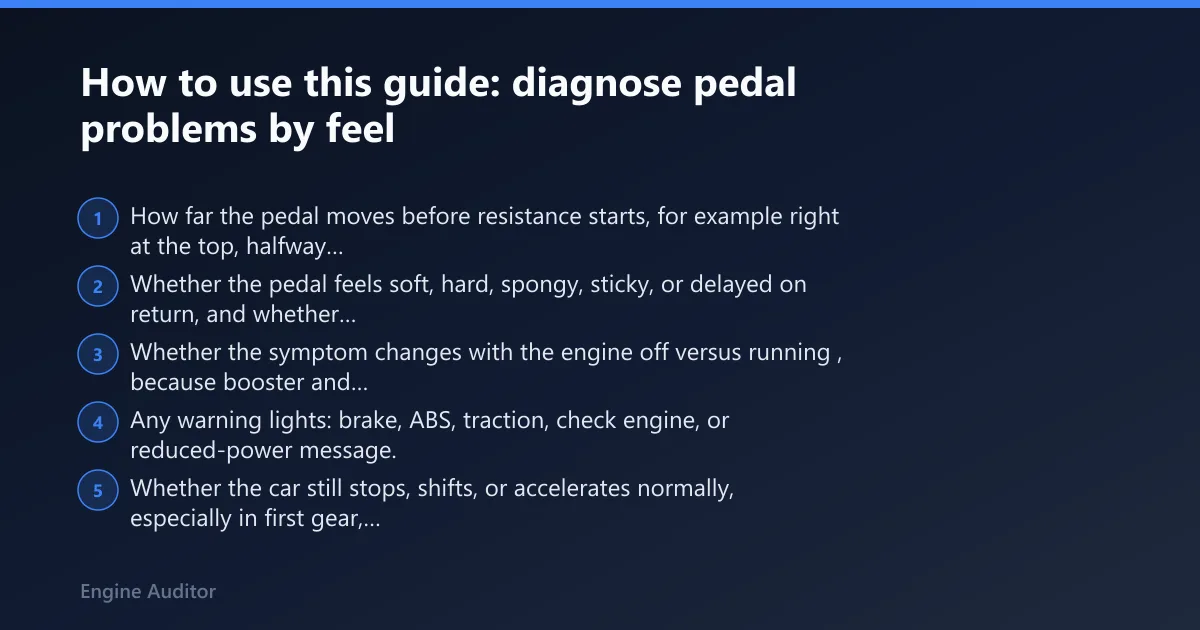
- How far the pedal moves before resistance starts, for example right at the top, halfway down, or only near the floor.
- Whether the pedal feels soft, hard, spongy, sticky, or delayed on return, and whether that feel stays the same on every press.
- Whether the symptom changes with the engine off versus running, because booster and idle effects can shift the diagnosis fast.
- Any warning lights: brake, ABS, traction, check engine, or reduced-power message.
- Whether the car still stops, shifts, or accelerates normally, especially in first gear, reverse, and moderate braking from neighborhood speeds.
- Any fluid loss under the car or near the firewall, wheels, or transmission bellhousing.
Driveable, shop-only, and do-not-drive symptoms at a glance
Do not drive if the brake pedal sinks to the floor, braking force drops sharply, brake fluid is disappearing, the clutch will not disengage enough to shift safely in traffic, or the accelerator sticks open. Drive only to a shop if the brake pedal is mildly soft but stable, the clutch engagement point has moved suddenly, or the accelerator has reduced-power mode with normal idle and no sticking. Monitor briefly only if the symptom is light, repeatable, and there is no warning light, leak, or loss of control.
What normal pedal feel should be like
Brake pedal: free play, firmness, and travel
A normal brake pedal usually has only a small amount of free play before resistance starts. It should feel firm, not wooden and not springy, and it should not keep sinking under steady foot pressure at a stop. With the engine running, the pedal usually feels a bit easier to press because the brake booster adds assist.
Long travel does not always mean air in the lines. I have seen the same complaint come from rear brake adjustment problems, worn pads, hose expansion, and a master-cylinder seal bypass.
Clutch pedal: free play, engagement point, and return behavior
A normal clutch pedal should move smoothly through its stroke and return promptly when released. Free play varies by design, especially between hydraulic and cable systems, but a sudden change matters more than the exact number. The engagement point should stay fairly consistent from day to day.
If engagement moves close to the floor, the clutch may not be releasing fully. If engagement moves very high, wear or adjustment drift may be involved.
Accelerator pedal: smooth movement, steady resistance, and full return
A normal accelerator pedal should start moving without a catch, feel consistent through the stroke, and return to its rest position when you lift off. There should be no dead spots, no gritty binding, and no lag between pedal input and engine response under light throttle. On electronic throttle systems, smooth response depends on the pedal position sensor, wiring, throttle body, and actuator working together.
Pedal symptom-to-system triage table
Symptom-to-system triage
| Pedal feel change | Most likely system | Likely causes | Urgency | First safe check | Second safe check |
|---|---|---|---|---|---|
| Brake pedal soft or spongy | Hydraulic | Air in lines, low fluid, hose expansion, caliper movement, rear brake adjustment | Drive only to a shop if braking force is still normal; otherwise do not drive | Check brake fluid reservoir level | Look for wetness at wheels, hoses, master cylinder, and under car |
| Brake pedal sinks while holding pressure | Hydraulic | Master cylinder internal bypass, active leak, severe rear-wheel or caliper leak | Do not drive | Hold firm pressure with engine running and note pedal drop | Inspect reservoir and wheel areas for fresh fluid loss |
| Brake pedal hard with engine running | Vacuum-assisted | Booster fault, split vacuum hose, bad check valve, low engine vacuum | Do not drive if stopping distance rises | Press pedal several times with engine off, then start engine and note change | Listen for hissing and inspect booster hose connection |
| Brake pulsation only in panic stop on loose or wet road | ABS | Normal anti-lock brake system activity | Usually normal | Note if ABS light is off | Note road surface and whether wheels were near lockup |
| Brake pulsation during routine stops | Mechanical / brake hardware | Rotor thickness variation, hub runout, caliper drag | Shop visit soon | Note if vibration matches wheel speed while gently braking | Check for pull, heat, or burning smell at one wheel |
| Clutch pedal sticks down or returns slowly | Hydraulic or mechanical | Slave or master cylinder bypass, air, leak, cable binding, pivot drag | Drive only if shifting remains safe; otherwise do not drive | Check clutch fluid reservoir if separate or shared with brake reservoir | Look for fluid at firewall, inside cabin near pedal, or transmission area |
| Clutch pedal hard to press | Mechanical or hydraulic | Cable drag, pressure plate issue, release fork binding, hose restriction | Shop visit soon | Compare effort engine off and on | Watch for jerky pedal travel or squeak near pedal pivot |
| Accelerator stiff or sticky | Mechanical or electronic | Floor mat interference, pedal pivot binding, throttle body deposits, return spring issue | Do not drive if sticking open; otherwise shop soon | Check floor mat and pedal travel by hand with engine off | Confirm full pedal return without side rubbing |
| Accelerator laggy or dead with warning light | Electronic | Pedal position sensor fault, throttle actuator fault, wiring issue, limp mode | Drive only to a shop if throttle response is limited but predictable | Check for reduced-power or check-engine message | Note whether idle is stable and pedal has dead spots |
Why does my brake pedal feel soft?
A soft or spongy brake pedal usually points to a hydraulic problem: air in the brake lines, low fluid, moisture-contaminated fluid, hose expansion, caliper movement, or a master-cylinder issue. If the pedal is also getting lower, braking force is dropping, or a warning light is on, the car should not be driven.
Soft versus sinking: what each feel usually points to
Soft means the pedal compresses with a springy or cushioned feel. That often suggests air in the hydraulic lines, old fluid with absorbed moisture, flexible hose swelling, or rear brakes that are out of adjustment. Sinking means the pedal keeps moving downward while steady pressure is held. That pattern points more strongly to a leak or an internal master-cylinder seal bypass.
These are different faults. I have seen plenty of people treat every soft pedal like a simple bleed job and miss low fluid, caliper leaks, or a bypassing master cylinder.
Brake fluid, leaks, and air intrusion checks
Check the brake fluid reservoir first. A low level can come from normal pad wear, but a sudden drop usually means a leak somewhere in the system. Topping it off before finding the source can hide the trail for a while and make the real fault harder to spot later.
Fluid should be near the marked range and should not look muddy or heavily discolored. Then check for wetness at each wheel, along brake hoses and steel lines, around the master cylinder, and under the car after it has been parked.
Master cylinder, caliper, hose, and rear-brake fault patterns
A master cylinder bypass often causes a pedal that feels normal at first, then slowly falls under constant pressure at a stop. A caliper or wheel-cylinder leak often comes with fluid loss and a pedal that worsens quickly. Aging rubber hoses can expand under pressure and give a mushy feel without an obvious external leak. Rear drum brakes that need adjustment can create extra pedal travel before the brakes fully apply.
If a soft pedal comes with a red brake warning light, move it up the urgency scale. Soft pedal plus warning light is not a wait-and-watch condition.
When a soft brake pedal means do not drive
Do not drive if the pedal nearly reaches the floor, braking takes noticeably longer, fluid is low and dropping, one wheel area is wet, or the pedal response changes suddenly within one trip. A mild spongy pedal with normal stopping and no leak still needs attention soon, but it is different from active hydraulic loss.
Why does my brake pedal sink to the floor?
A brake pedal that sinks to the floor often suggests the hydraulic system may not be holding pressure well. Common causes are an external fluid leak, a failed master cylinder that bypasses internally, or severe air intrusion after fluid loss. If this happens, the vehicle should not be driven except to avoid immediate danger.
What the floor symptom means
A pedal-to-floor complaint is more serious than a merely soft pedal. If the pedal drops once and stays low, there may be a sudden fluid loss. If it starts high and then creeps down while held, the master cylinder becomes a stronger suspect.
Mixed symptoms that sharpen the diagnosis
Pedal to floor plus a red brake light points strongly to hydraulic trouble. Pedal to floor plus fluid under one wheel often means a wheel-cylinder, caliper, or brake hose leak. Pedal to floor after recent brake work can suggest trapped air, but recent work should not be assumed unless it actually occurred.
Safe next step
Check the reservoir, look under the car, and arrange towing if the pedal cannot build and hold pressure. Repeated pumping that briefly restores height does not make the car safe. It only confirms that pressure retention is poor.
Can a bad brake booster make the pedal hard?
Yes. A failed brake booster, split vacuum hose, blocked check valve, or low engine vacuum can make the brake pedal feel hard because the driver has lost vacuum assist. The key clue is that pedal effort rises sharply, especially with the engine running, even if the hydraulic system still holds pressure.
How vacuum-assisted braking changes effort
The booster cuts the force needed to apply the brakes. When assist is missing, the pedal often feels firm and high rather than soft, but the car takes much more leg force to slow. Some drivers describe this as “the brakes still work, but barely.”
Engine-off versus engine-running booster check
With the engine off, press the brake pedal several times to remove stored vacuum. The pedal should become firmer and higher. Then hold light pressure on the pedal and start the engine. If the booster and vacuum supply are working, the pedal usually drops slightly as assist comes in. If nothing changes, booster assist may be missing.
This engine-off versus engine-running clue is one of the fastest ways I use to separate hydraulic feel from vacuum-assist loss.
Vacuum hose, check valve, booster, and engine-vacuum clues
A cracked booster hose or leaking check valve can cause a hard pedal and a hissing sound. If the engine also idles rough, stalls easily, or changes speed when the brake pedal is pressed, a vacuum leak becomes more likely. A hard pedal without idle change can still be the booster, hose, or check valve, but the engine clues help narrow it.
Hard pedal versus hard pedal with poor stopping power
A hard pedal with normal stopping is rare and usually short-lived. A hard pedal with weak braking is the common booster complaint. Do not keep driving to see if it clears up if stopping distance has increased.
What causes brake pedal pulsation while stopping?
Brake pedal pulsation can be normal anti-lock brake system feedback during a hard stop on a low-grip surface, or it can point to a brake hardware problem during ordinary stops. The difference comes from when it happens, whether warning lights are on, and whether the steering wheel or body also shakes.
Normal ABS feedback versus abnormal pulsation
ABS, short for anti-lock brake system, rapidly modulates brake pressure to prevent wheel lock. During a hard stop on low-traction surfaces or any near-lockup event, a fast pedal buzz or kickback can be normal. It usually comes with ABS operation noise and lasts only during that hard stop. (en.wikipedia.org)
If the pedal pulses during routine, gentle braking on dry pavement, think beyond ABS.
Rotor thickness variation, hub issues, and caliper drag
Pulsation during normal braking often traces to rotor thickness variation, uneven pad deposits, hub runout, or a dragging caliper that overheats one corner. A steering-wheel shake can point to front brake hardware, while a seat or body shake can suggest rear brake involvement.
If one wheel is much hotter after a short drive, caliper drag moves higher on the list.
What warning lights and road conditions add
An ABS warning light changes the diagnosis. With that light on, anti-lock control may be disabled or reduced, and wheel-speed sensor faults enter the picture. A wheel-speed sensor issue can also trigger traction-control lights. By contrast, normal ABS pulsation usually appears with no warning light and in a genuine low-traction stop.
Why does my clutch pedal stick down?
A clutch pedal that sticks down or returns slowly usually comes from hydraulic pressure not recovering, air in the line, leaking master or slave cylinders, or mechanical binding in a cable or release linkage. If shifting becomes difficult or reverse grinds, the clutch may not be releasing fully and the car can leave the driver stranded.
Hydraulic clutch symptoms: air, leaks, bypass, and slow return
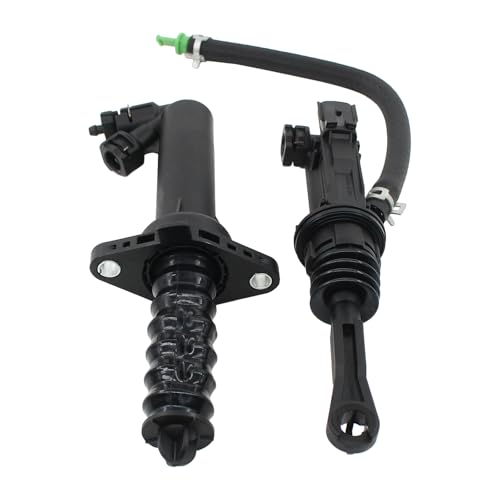
Hydraulic clutch systems often fail in patterns similar to brake hydraulics, though the consequences are different. Air in the line can lower the engagement point and make shifting rough. A master or slave cylinder can leak externally or bypass internally, causing a pedal that sinks, sticks, or returns slowly.
Look for fluid at the firewall near the clutch master cylinder, under the dash above the pedal, and around the slave cylinder or bellhousing area.
Cable-actuated clutch symptoms: binding, stretch, and adjustment drift
Cable clutches fail differently. A fraying or dry cable can make the pedal heavy, jerky, or slow to return. Stretch or adjustment drift can move the engagement point and reduce release travel. Pedal pivots and release forks can also bind and mimic cable trouble.
If the pedal effort is high through the whole stroke with no hydraulic leak signs, mechanical drag becomes more likely.
How pedal feel connects to shifting trouble and engagement point changes
A clutch that sticks down and engages near the floor often is not releasing far enough. That leads to hard shifts, gear clash, or a car that creeps with the pedal fully pressed. A high engagement point with normal return can point more toward clutch wear than hydraulic loss.
When clutch symptoms can leave you stranded
If the pedal stays on the floor, reverse grinds repeatedly, or first gear cannot be selected at a stop, plan for a tow. If the pedal is only slightly slow to return and all gears still engage cleanly, a careful trip to a shop may be possible.
Can air in the clutch line cause shifting problems?
Yes. Air in a hydraulic clutch line reduces how much movement reaches the slave cylinder, so the clutch may not disengage fully. That often causes a low engagement point, difficulty selecting gears at a stop, reverse grind, or a pedal that feels soft and inconsistent from one press to the next.
Why trapped air changes clutch behavior
Fluid transfers motion. Air compresses. When air enters the clutch hydraulic line, part of the pedal travel is spent compressing bubbles instead of moving the release mechanism. The result is incomplete clutch release.
What to check before any bleed procedure is considered
Check fluid level first. Then inspect for leaks at the master cylinder, slave cylinder, hydraulic line connections, and the area inside the cabin where the pushrod enters the firewall. If fluid is low, air may be a symptom of a leak rather than the root problem.
Why is my gas pedal feeling stiff?
A stiff gas pedal usually comes from mechanical interference or binding, though some electronic throttle faults create a delayed or uneven response that drivers describe as stiffness. Floor mat interference, a binding pedal pivot, deposits at the throttle body, or a return-spring issue are common first checks before sensor faults are considered.
Mechanical binding at the pedal versus electronic throttle faults
A truly stiff pedal often has a physical feel change right under the foot. It may resist initial movement, move in steps, or rub against trim or a floor mat. Electronic faults more often feel like normal pedal movement with poor engine response, dead spots, or reduced-power operation.
Pedal position sensor, throttle body, and actuator symptoms
On electronic throttle control systems, the accelerator pedal position sensor tells the engine computer how much throttle is being requested. The computer then commands the throttle body actuator. Carbon around the throttle plate can cause sticky response near closed throttle, while sensor dropouts can create hesitation, surging, or no response at certain pedal positions.
Reduced power mode, warning lights, and dead-pedal behavior
If the check-engine light or a reduced-power warning appears and the car responds weakly no matter how far the pedal is pressed, the system may be in limp mode. Limp mode is a safety strategy that limits throttle opening. It is often tied to pedal position sensor faults, throttle actuator faults, or disagreement between commanded and actual throttle position.
Safe checks before driving farther
Check that the floor mat is anchored and clear of pedal travel. With the engine off, press and release the pedal by hand to confirm smooth movement and full return. If the pedal physically sticks, do not drive until the interference or binding is fixed. If the pedal moves freely but the engine response is delayed, warning lights and scan data matter more than pedal effort alone.
Why does my accelerator pedal not return fully?
An accelerator pedal that does not return fully usually points to mechanical binding, interference from a floor mat or trim, a sticky pedal pivot, or a throttle body that is slow near idle position. Because unintended acceleration risk is involved, any poor return or sticking-open behavior should be treated as unsafe to drive.
Poor return versus laggy response
Poor return is a movement problem. The pedal itself hangs up or comes back slowly. Laggy response is different: the pedal returns normally, but the engine keeps responding late because of electronic throttle or throttle-body faults.
What a driver can safely check
Look at the floor mat, lower dash trim, and pedal side clearance. Then press and release the pedal several times with the engine off. It should spring back to the same rest position every time without scraping, sideways twist, or hesitation.
How do I tell if a pedal sensor is failing?
A failing pedal sensor usually causes inconsistent engine response rather than a physically stiff pedal. Common clues are dead spots, sudden reduced-power mode, warning lights, throttle response that does not match foot movement, or a stable pedal feel with erratic acceleration. Confirmation usually requires scan-tool data rather than guesswork.
Pedal position sensor fault patterns
The accelerator pedal position sensor can send an unstable signal, drop out at one section of travel, or disagree with a second internal signal path. When that happens, the engine computer may limit throttle opening for safety. The car may idle normally but refuse strong acceleration.
What a scan tool can confirm
A scan tool can show pedal position percentages, throttle command, throttle actual position, and related fault codes. That matters because a dirty throttle body, damaged wiring, and a failing pedal sensor can feel similar from the driver’s seat. Sensor faults are one area where symptoms alone often stop short of a sure answer.
What should I inspect before booking a repair?
Brake and clutch fluid reservoir checks
Check the brake fluid reservoir and, if fitted separately, the clutch fluid reservoir. Low fluid can come from pad wear over time, but a sudden drop points more toward a leak. Dark fluid does not prove failure by itself, though neglected fluid can contribute to poor pedal feel and corrosion inside hydraulic parts.
Visible leak points under the hood and at each wheel
For brakes, inspect the master cylinder, line connections, rubber hoses, calipers, backing plates, and the inside edge of each tire. For clutch hydraulics, inspect the master cylinder, firewall area, hydraulic line, and slave cylinder area. Fresh fluid usually looks wet and attracts dirt quickly.
Pedal return, floor-mat interference, and linkage movement
Check that each pedal returns fully and does not catch on trim or a floor mat. A stiff accelerator with delayed return follows a different fault path than a freely moving pedal with reduced-power warning lights. A hard clutch with jerky travel often points to mechanical drag rather than fluid alone.
What warning lights and system clues mean
A red brake warning with soft pedal raises concern for hydraulic loss. An ABS light with pulsation changes the brake diagnosis toward sensor or anti-lock faults. A check-engine or reduced-power message with normal pedal movement points toward the electronic throttle system. A rough idle plus hard brake pedal raises concern for vacuum leakage at the booster hose or check valve.
For context, concerns about pedal control and safety are old. The topic appeared in the scientific article Car pedals and road deaths, published in April 1969. The practical lesson still holds: pedal feel changes deserve prompt attention because they can change stopping, shifting, or throttle control before a complete failure happens.
Frequently asked questions
Can low brake fluid cause a soft brake pedal?
Yes. Low brake fluid can cause a soft pedal if air enters the hydraulic system or if the level has fallen because of a leak. It can also drop slowly as brake pads wear. A sudden low level matters more than a gradual one and should trigger a leak check.
Why does my brake pedal sink to the floor?
A brake pedal that sinks to the floor usually means the system cannot hold hydraulic pressure. The most common causes are an external leak or a master cylinder that is bypassing internally. If braking force is reduced or fluid is missing, the vehicle should not be driven.
Why does my clutch pedal stick down?
A clutch pedal that sticks down usually points to hydraulic trouble, trapped air, a leaking master or slave cylinder, or binding in a cable or release linkage. If the car becomes hard to shift, reverse grinds, or the pedal stays on the floor, it can leave the driver stranded.
Why is my gas pedal feeling stiff?
A stiff gas pedal often comes from floor mat interference, a binding pedal pivot, or deposits affecting throttle movement near closed position. If the pedal moves normally but the engine lags, the issue is more likely electronic throttle control or a pedal position sensor fault than physical stiffness.
What causes brake pedal pulsation while stopping?
Brake pedal pulsation during a hard stop on a slick surface is often normal ABS operation. Pulsation during routine braking on dry pavement points more toward rotor thickness variation, hub runout, or caliper drag. An ABS warning light shifts attention toward wheel-speed sensor or anti-lock system faults.
How do I tell if a pedal sensor is failing?
A failing pedal sensor usually causes uneven throttle response, dead spots, reduced-power mode, or warning lights while the pedal itself still moves freely. It is different from a physically sticky pedal. Scan-tool data comparing pedal input and throttle response is often needed to confirm the fault.
Products related to this article
Sponsored / affiliate links. As an Amazon Associate I earn from qualifying purchases. I may earn additional commission from eligible campaigns.