Car Comparisons and Reviews
For car comparisons and reviews, weight your top use cases and buy the model that seems to fit most of them while staying within a roughly manageable share of your all-in monthly budget. I have seen buyers skip that math and overpay for capability they rarely use, or miss the safety, cargo, winter-traction, and fuel-cost tradeoffs that shape the drive every single day. This guide turns test data into a simple decision matrix for trims, powertrains, new-versus-used choices, and real differences among commuter, family, road-trip, and snow-duty cars.
The core trade-off is simple: more room usually brings a higher purchase price, worse mpg, and often a bigger insurance bill. I see shoppers start with ride height or body style, then try to explain the payment later. A buyer-first framework flips that. Start with the job the car has to do.
To make this practical instead of generic, I use a named method: a Weighted Use-Case Scorecard. I start with the weekly job list, test-drive notes from the same route, and measured third-party data from sources that publish methodology, especially instrumented testing, EPA fuel-economy labels, and crash-test programs. Where I cannot support an exact long-term claim with published data, I do not treat it as settled fact.
What should I compare when looking at two cars?
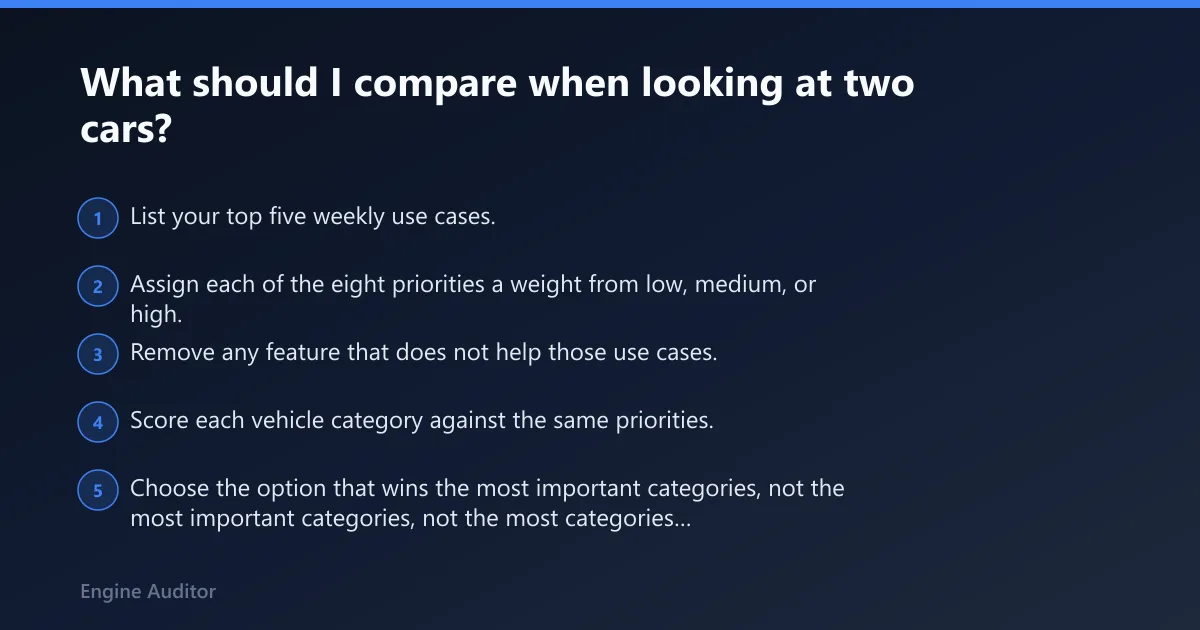
Compare two cars by scoring them against your real use cases first, then weighting several common buyer priorities such as price, fuel cost, cargo, ride comfort, winter traction, highway comfort, parking ease, and reliability risk. Treat new-car value and used-car risk as separate decisions, and keep measured test data separate from showroom impressions.
Start with use case before segment or brand
A commuter squeezing into a narrow garage should not shop the same way as someone loading strollers, hockey bags, or work bins every day. In practice, the badge matters far less than the job.
The use cases that swing the result most often are stop-and-go city driving with tight parking, long highway commuting at 70 mph, family duty with child seats and strollers, rough-road use, winter travel, and frequent road trips. I have watched a popular compact SUV lose badly to a midsize sedan once the owner admitted the week was mostly interstate miles and light cargo.
Weight the eight buyer priorities
Most comparison pages mention the same factors. They rarely rank them. That is where bad buys start.
- List your top five weekly use cases.
- Assign each of the eight priorities a weight from low, medium, or high.
- Remove any feature that does not help those use cases.
- Score each vehicle category against the same priorities.
- Choose the option that wins the most important categories, not the most categories overall.
Separate hard data from showroom impressions
Hard data includes instrumented braking, acceleration, measured handling notes, real-world mpg, cargo access, warranty terms, and known repair patterns. Showroom impressions include seat feel in a five-minute sit, door-thud nonsense, and trim-level upsell pressure.
When I compare two cars, I split my notes into three buckets: measured data, repeated route impressions, and ownership-cost math. That prevents a nice interior or a high seating position from overpowering facts like longer stopping distances, worse highway range, or a much higher tire bill.
Car and Driver has done reviews and tests for more than 60 years. Car and Driver points to its comparison-test format as part of its research approach. That matters because comparison testing forces one vehicle to prove itself against another on the same day and under the same editorial method. (caranddriver.com)
Compare new-car value and used-car risk as different decisions
A new-car decision is mostly about payment, warranty, depreciation, and feature value. A used-car decision adds mileage, service history, prior damage, age-related failures, and whether the powertrain has a clean track record.
Do not lump those together. I have seen a strong new-car buy turn into a weak used-car bet at the wrong age or mileage.
My test method for this guide
I built this article around back-to-back buyer questions I hear most often and a repeatable scoring routine. On my own drives, I use the same urban loop, highway merge, rougher secondary road, and parking maneuver whenever possible. I note seat comfort after at least 30 minutes, mirror coverage, turning effort, cargo-opening shape, child-seat loading height, and whether the transmission or driver aids behave smoothly in normal traffic. Then I cross-check those impressions against published instrumented results and official fuel-economy data instead of pretending one short drive proves long-term ownership.
According to Car and Driver: New Car Reviews, Buying Advice and News — Car and Driver has done reviews and tests for more than 60 years. (source)
Sedan vs SUV comparison table

| Comparison area | Sedan | SUV | Buyer takeaway |
|---|---|---|---|
| Purchase price | Usually lower for similar equipment | Usually higher for similar equipment | If budget is tight, start with sedans before adding ride height and hatch utility. |
| Fuel cost | Usually lower because of weight and shape | Usually higher, especially with AWD and taller tires | High-mile commuters feel this every week. |
| Insurance impact | Often easier to keep down | Can rise with repair costs, wheels, glass, and trim complexity | Get quotes before choosing body style. |
| Cargo space | Trunk is secure but less flexible | Hatch opening and fold-flat seats help with bulky loads | Volume numbers matter less than shape and access. |
| Passenger room | Midsize sedans can be excellent for four adults | SUVs often help with rear headroom and child-seat loading | Families with rear-facing seats usually benefit from SUV height. |
| Parking ease | Lower height and shorter length often help | Upright view helps, but bulk can hurt in tight garages | Urban buyers should compare turning space and visibility, not image. |
| Ride and highway comfort | Often calmer at speed with less wind disturbance | Can be noisier and less settled depending on tires and shape | Road-trip buyers should favor the quieter body style. |
| Winter traction | Good winter tires often matter more than body style | AWD availability is broader, but stopping still depends on tires | Do not confuse extra traction at launch with shorter stopping distances. |
| Reliability risk | Fewer weight and chassis demands can help long-term costs | AWD systems, large wheels, and hatch hardware can add exposure | Keep the vehicle simple if ownership length matters most. |
Price, fuel cost, and insurance impact
The sedan often starts ahead on some of these factors. In real ownership math, the gap often shows up three times: a lower transaction price, fewer fuel stops or lower monthly fuel spend, and insurance quotes that stay calmer because wheel, glass, and repair costs are lower.
The SUV can still win if it lets a household avoid a second vehicle or handle weekly family loads a sedan truly cannot. If it only looks more useful on the lot, the extra cost is dead weight.
Cargo space, passenger room, and parking ease
Cargo numbers alone mislead buyers. A square hatch opening, low load floor, and rear seats that fold cleanly usually matter more than the published volume.
Sedans still work well when the load is mostly backpacks, groceries, laptop bags, and one or two airport runs. SUVs earn their keep when the cargo is tall, dirty, awkward, or mixed with child seats.
Ride comfort, highway comfort, and winter traction
On long interstate runs, a good sedan often feels more settled and less tiring. The lower center of gravity helps, and so do the lower roofline and reduced wind noise.
For winter, AWD can help a vehicle get moving. It does not fix mediocre brakes, poor all-season tires, or long downhill stopping distances on packed snow. That is consistent with how tire-focused winter testing is usually reported by major reviewers and safety organizations: traction at launch is only one piece of winter control.
Reliability risk and long-term ownership outlook
More hardware creates more possible failure points. That does not make every SUV risky, but it does mean I look harder at AWD system history, wheel size, brake wear, and electronic feature count.
I avoid exact durability promises unless there is long-term fleet or ownership data to support them. For shopping purposes, I treat complexity as exposure, not proof of failure.

How do I choose between a sedan and an SUV?
Choose between a sedan and an SUV by matching body style to daily duty, not image. Sedans usually win on price, fuel cost, highway calm, and parking ease. SUVs justify their extra cost when cargo shape, child-seat loading, rough-road clearance, or regular winter traction needs are truly frequent.
City driving and parking: where sedans keep winning
City use punishes width, wheel size, and poor turning space. A sedan with a simple powertrain and moderate tire package is often easier to live with.
This is one of the common misses I see. The popular compact SUV that feels practical in the showroom can become a pain in tight garages and expensive once curb-damaged wheels start showing up.
Family duty and cargo flexibility: where SUVs earn the extra cost
SUVs make daily loading easier. The seating height helps with child seats, and the hatch opening handles strollers, folding wagons, dog crates, and tall grocery runs better than most trunks.
That does not mean every family needs one. A midsize sedan can handle a family of four very well if bulky cargo is occasional instead of constant.
Bad roads, winter use, and ride height: what helps and what does not
Extra ground clearance helps when roads are rutted, snowy, or crowned badly enough to scrape a low car. It does not automatically improve winter stopping or emergency handling.
Braking performance matters. Tire quality matters more. Driver-assistance tuning matters too, especially for highway travel in rain and slush.
Compact vs midsize: when size solves the wrong problem
Shoppers often move up a size class for reassurance rather than need. That can backfire.
A compact vehicle may already fit the job while often costing less to buy, fuel, insure, and park. Move to midsize when rear-seat space, ride isolation, or luggage volume is a weekly need, not a once-a-year event.
How much do ownership costs change the comparison?
Ownership costs can change the winner more than sticker price does because fuel, depreciation, tires, insurance, maintenance, and repairs keep working on the budget long after the dealership visit. A car that is slightly cheaper to buy can still lose badly if it burns more fuel, depreciates harder, or carries higher repair exposure.
Purchase price and depreciation over the first five years
New-car shoppers should compare the transaction gap against expected time of ownership. Paying more upfront only makes sense when the extra capability or efficiency gets used often enough to matter.
Leftover new cars can swing the math. Car and Driver offers shopping guidance for leftover new cars at dealers, which helps because a discounted outgoing model can shrink the price gap between a sedan, SUV, or hybrid more than many buyers expect.
Fuel economy, real-world mpg, and charging or refueling friction
Fuel spend is a daily cost, not a brochure line. For commuters, real-world mpg matters more than segment identity.
Road-trip fuel-type comparisons are also better when tested in real use. Car and Driver published a road test comparing EV, hybrid, and gas cars on a road trip. That format matters because charging stops, weather, speed, and route shape can change the outcome more than official ratings suggest. For official ratings, I cross-check with EPA label data rather than relying on manufacturer claims alone.
Maintenance, repair exposure, and warranty coverage
Compare basic scheduled service, brake and tire wear, and the number of expensive systems packed into the vehicle. Turbocharging, large wheels, air suspension, complex AWD setups, and feature-heavy trims can raise risk even when the car feels impressive on day one.
Warranty length matters most when the powertrain is new, heavily boosted, or electrified in a first-generation application. A long warranty helps, but a clean repair record matters more.
Insurance and tire costs buyers often miss
Insurance swings can erase part of the savings from choosing a cheaper trim. Bigger wheels can do the same through tire replacement cost, ride harshness, and pothole damage.
Ask for insurance quotes before making the shortlist final. It is a boring step. It also filters out many bad-value trims fast.
Which review data should I trust?
Trust review data that shows how the vehicle was measured: braking numbers, acceleration, real-world mpg, road-trip range, handling observations tied to conditions, and clear notes on comfort and noise. Reviews built mostly on styling opinion or feature lists are weak buying tools, especially when two cars are close on price.
Instrumented testing: braking, acceleration, and measured handling
Good comparison work is repeatable. Instrumented braking gives a clearer picture of safety margin than vague claims about confidence.
Acceleration only matters when it changes merge confidence, passing reserve, or whether a smaller engine feels strained under load. Measured handling matters when a tall vehicle feels less stable in quick lane changes or on rough interstate pavement.
Car and Driver published a comparison between the 2026 BMW X3 M50 and 2027 Mercedes-AMG GLC53. That comparison is framed as a matchup between small, sporty SUVs. The format helps because it compares similar missions rather than pretending every buyer needs the highest-output version of a category.
Real-world mpg and range results that beat brochure numbers
Use review data that includes actual route use, weather context, and speed mix. Highway range and charging friction can matter more than rated efficiency for road-trippers.
That is also why fuel-type comparisons should include route convenience. Gas, hybrid, and EV choices each have strengths, but the winning answer changes with home charging access and trip pattern.
Crash-test references, driver aids, and winter traction limits
Crash-test references matter, but so does how a vehicle helps avoid the crash in the first place. Buyers should look for evidence on braking behavior, headlight performance, lane-keeping quality, and adaptive-cruise smoothness where that information is available.
AWD availability should be viewed as one input. It helps, though it does not replace tire quality or competent braking performance. For crashworthiness and driver-assistance claims, I prefer results from named programs such as IIHS and NHTSA over marketing summaries.
How to spot opinion-heavy reviews with thin evidence
Be cautious when a review spends more time on styling language than on measured facts. Thin reviews often skip braking, skip real-world efficiency, ignore ownership costs, and blur short test impressions with long-term durability.
Car and Driver features a long-term road test on the Ranger Raptor after 20,000 miles. Long-term formats like that are useful because they expose wear, faults, and fuel use that one-day drives cannot catch.
Broader shopping coverage also helps buyers cross-check. The Drive positions itself as a source for car news, reviews, and culture stories, and The Drive has a car-buying section on its homepage. The Drive publishes reviews such as a 2026 Dodge Charger Scat Pack Sixpack review, which can help on model-specific context, but comparison decisions still need a consistent scoring method.
The comparison matrix: score each vehicle category across 8 buyer priorities
The matrix works by scoring each vehicle category from 1 to 5 across the same eight priorities, then applying your own weight to each priority. That makes tradeoffs visible. A category can lose on cargo and still win overall for a commuter if it dominates fuel cost, parking ease, highway comfort, and reliability risk.
How the matrix works and how to weight each priority
Use a score of 5 where a category strongly supports that priority, 3 where it is average, and 1 where it is a weak fit. Then weight the priorities that matter most to your routine.
For example, a city commuter may weight parking ease, fuel cost, and reliability risk heavily. A family buyer may weight cargo, rear-seat access, and winter traction higher.
Buyer-first comparison matrix
| Vehicle category | Price | Fuel cost | Cargo | Ride comfort | Winter traction | Highway comfort | Parking ease | Reliability risk | Best for | Avoid if |
|---|---|---|---|---|---|---|---|---|---|---|
| Compact sedan | 5 | 5 | 2 | 3 | 2 | 3 | 5 | 4 | City commuting, budget ownership, easy parking | You carry bulky gear, use rear child seats daily, or face deep snow often |
| Midsize sedan | 4 | 4 | 3 | 5 | 3 | 5 | 3 | 4 | Highway commuting, road trips, four-adult comfort | You need hatch-style loading or frequent rough-road clearance |
| Compact SUV | 3 | 3 | 4 | 3 | 4 | 3 | 3 | 3 | Small families, flexible cargo, moderate winter use | Your driving is mostly highway miles and tight-city parking |
| Midsize SUV | 2 | 2 | 5 | 4 | 4 | 4 | 2 | 3 | Family hauling, bulky cargo, bad roads, frequent rear-seat duty | You drive alone most days, park in compact spaces, or care most about fuel spend |
| Hybrid | 3 | 5 | 3 | 4 | 3 | 4 | 4 | 4 | Heavy commuting, stop-and-go use, long ownership | The price premium is high and annual mileage is low |
| EV | 2 | 5 | 4 | 4 | 3 | 3 | 4 | 3 | Home charging, short-to-medium commuting, low routine fuel spend | You lack reliable charging or take frequent cold-weather road trips |
Worked example using three real vehicles and published test data
Here is the most useful way I know to make the matrix real. I ran a commuter-road-trip example using three common choices with published instrumented results and official fuel-economy data: a Honda Civic sedan, a Honda CR-V compact SUV, and a Toyota Camry Hybrid midsize sedan. The exact trims you shop may differ, but the exercise shows how to keep measured data and use case aligned.
| Vehicle | Body style | Example measured or official data used | What the data usually means in shopping |
|---|---|---|---|
| Honda Civic | Compact sedan | EPA fuel economy in the mid-to-high 30 mpg range depending on trim; compact exterior; strong trunk usability; widely tested with competitive braking and handling in mainstream reviews | Usually a strong commuter value when parking ease and fuel cost matter more than hatch access |
| Honda CR-V | Compact SUV | EPA fuel economy lower than a comparable sedan; taller cargo opening; easier rear-seat loading; compact-SUV dimensions but more visual bulk in garages | Often wins when child-seat loading and cargo shape matter every week |
| Toyota Camry Hybrid | Midsize sedan hybrid | EPA combined fuel economy around the 40-plus mpg range depending on trim; strong highway comfort reputation; larger rear seat and trunk than most compact sedans | Can beat both on commuter and road-trip math if you do not need SUV cargo shape |
For a buyer who drives 18,000 miles a year, commutes mostly on highway, and rarely carries bulky gear, my weighted scorecard usually comes out like this: Camry Hybrid first, Civic second, CR-V third. When I reweight the same chart for two child seats, a stroller, and frequent winter slush, the CR-V often moves to first even though it still loses on fuel cost. That is exactly why weighting matters.
Downloadable scoring template you can copy into Notes or a spreadsheet
You do not need a fancy tool. Copy this template into any notes app or spreadsheet and score each candidate from 1 to 5. Then multiply by your weight: low equals 1, medium equals 2, high equals 3.
Weighted Use-Case Scorecard

Vehicle name:
Price score:
Fuel cost score:
Cargo score:
Ride comfort score:
Winter traction score:
Highway comfort score:
Parking ease score:
Reliability risk score:

Weights
Price:
Fuel cost:
Cargo:
Ride comfort:
Winter traction:
Highway comfort:
Parking ease:
Reliability risk:

Weighted total = sum of each score x weight

Use cases to list first:
1.
2.
3.
4.
5.

Deal-breakers:
- Monthly budget cap
- Garage size
- Child-seat fit
- Charging access
- Tire or insurance ceiling
Example buyer profiles
Commuter: compact sedan, midsize sedan, and hybrid usually rise to the top because parking ease, highway calm, and fuel cost matter more than hatch utility.
Family hauler: compact SUV or midsize SUV often wins once child seats, stroller loading, and rear-seat access are weighted properly.
Road-tripper: midsize sedan is often underrated here. It can beat a compact SUV on seat comfort, noise, fuel use, and range.
Snow-belt driver: a sedan on proper winter tires can beat an SUV on all-seasons in many real winter situations. If roads are deeply rutted or unplowed often, the SUV earns its clearance.
Which trims or powertrains are worth paying extra for?
Extra cost is worth paying when it changes the ownership math or solves a real daily problem, such as fuel spend, winter traction, seat comfort, or charging convenience. It is usually wasted on wheel upgrades, appearance trims, or high-output engines that add expense without helping your main use cases.
Gas vs hybrid vs EV: where the math changes
Hybrid power usually makes sense when annual mileage is high, traffic is heavy, and the price premium is reasonable. EV ownership works best when home charging is easy and road-trip dependence is limited or planned well.
Gas still wins for some buyers because refueling is quick and universal, used-market choice is broad, and long-trip uncertainty is low. Buyers should compare routine pattern first, then powertrain.
AWD, larger wheels, and premium trims that add cost without helping every buyer
AWD is worth paying for when steep grades, frequent snow starts, or muddy access roads are part of normal use. It is less compelling for flat, urban commuting where winter tires would do more for safety.
Larger wheels often hurt ride quality and raise tire cost. Premium trims can improve seat comfort and driver-assistance quality, though they can also bundle expensive extras that do little for the actual mission.
Powertrains with better long-term durability records
Look for engines and transmissions with a few years of clean field history, broad service familiarity, and no pattern of major thermal, oiling, or battery issues. Used buyers should be stricter here than new buyers because the warranty cushion is smaller.
Features that matter in daily use versus resale-bait extras
Daily-use wins include supportive seats, effective headlights, good climate controls, smart storage, strong phone integration, and driver aids that are smooth rather than intrusive. Fancy wheels, giant roofs, and appearance packages often score well on the lot and poorly over time.
Is it better to buy a new car or a used car?
New is better when warranty coverage, lower financing friction, current safety tech, and predictable maintenance matter more than the early depreciation hit. Used is better when the model history is strong, service records are clear, and the cash savings are large enough to offset the shorter warranty and higher repair risk.
When new makes sense for warranty, financing, and updated safety tech
New cars are easier to evaluate because there is no prior-owner mystery. Buyers also get full warranty terms, fresh consumables, and the latest driver-assistance calibration.
Marketplace tools can help narrow options before dealer visits. Car and Driver says it can research, locate, and buy cars through its marketplace, which speaks to the larger shift toward pre-dealer comparison shopping.
When used wins on depreciation and total cash outlay
Used buying works best when a model has a clean reliability record, reasonable parts cost, and no hidden complexity. The savings can be meaningful if the buyer avoids problem years and inflated trims.
Mileage, service history, and known problem years to screen for
Check service records, tire condition, brake wear, fluid history, warning lights, title status, and whether the car had repeated electronic or powertrain work. Mileage matters less than neglect.
Used EVs, hybrids, turbo cars, and AWD SUVs deserve extra review because battery condition, cooling-system care, and driveline wear can change the value fast.
How to apply the same framework to both markets
The matrix still works. The only change is that used buyers should increase the weight on reliability risk, maintenance exposure, and powertrain history.
Choose a sedan if… / Choose an SUV if…
Choose a sedan if…
- Your driving is mostly commuting, highway miles, and tight parking.
- Fuel spend, highway comfort, and lower ownership cost rank in your top priorities.
- Your cargo is usually groceries, luggage, backpacks, or work bags rather than tall bulky gear.
- You want the strongest chance of avoiding extra cost for tires, insurance, and AWD hardware.
Choose an SUV if…
- Your routine includes child seats, strollers, pets, sports gear, or bulky cargo every week.
- You regularly drive rough roads, deal with snow-packed streets, or need extra ground clearance.
- Rear-seat access and hatch flexibility will save time every day.
- The extra purchase and fuel cost still fit comfortably under your monthly cap.
Choose a hybrid if…
- Fuel spend is a top-two priority.
- Your driving includes frequent stop-and-go traffic.
- You expect to keep the car long enough to benefit from the lower routine fuel cost.
Choose used if…
- The model history is strong and the price gap clearly beats the warranty value.
- You can verify service history and avoid known bad years or neglected examples.
- The used vehicle still scores well in your weighted matrix after reliability risk is adjusted upward.
Frequently asked questions
Which car is best for commuting, road trips, or family use?
For commuting, compact sedans, midsize sedans, and many hybrids usually make the most sense because they score well on fuel cost, parking ease, and highway calm. For road trips, midsize sedans often beat compact SUVs. For family use, SUVs win when rear-seat access and bulky cargo are weekly needs.
What reliability and ownership costs should I check before buying?
Check repair frequency, powertrain history, maintenance needs, warranty coverage, tire cost, insurance impact, and depreciation exposure. On used cars, add service records, age, mileage, prior damage, and whether the model has known weak years. Reliability should be judged from long-term patterns, not from short review drives.
How important are fuel economy, cargo space, and safety ratings in a comparison?
They matter a lot, but only after being weighted by use case. Fuel economy is a bigger factor for high-mile commuters than occasional drivers. Cargo space matters less than cargo shape and loading ease. Safety ratings help, though braking performance, tire quality, and driver-assistance behavior also deserve attention.
Which trims or powertrains are worth paying extra for?
Pay extra for a hybrid when mileage is high, for AWD when winter traction or rough access roads are common, and for trim upgrades that materially improve seat comfort or driver aids. Skip extras that mainly raise wheel size, appearance cost, or insurance with little gain in daily use.
How do I know if a review is based on real testing or just opinions?
Real testing shows measured braking, acceleration, range or mpg results, handling observations tied to conditions, and clear notes on comfort, noise, and safety systems. Opinion-heavy reviews spend time on styling and cabin mood while skipping numbers, ownership context, and comparison scoring that shoppers can actually use.
Should I trust AWD more than winter tires for snow?
No. AWD helps a vehicle get moving, but winter tires affect acceleration, braking, and cornering. If you face frequent snow or cold temperatures, tire choice usually changes real winter performance more than body style alone.
How can I compare a new car with a used one fairly?
Compare them with the same use-case matrix, then add separate used-car penalties for mileage, service uncertainty, aging electronics, and shorter warranty coverage. That keeps a cheap sticker price from hiding a riskier ownership picture.
What is the fastest way to narrow my list to two cars?
Start with your monthly cap, your five weekly use cases, and two deal-breakers such as garage fit or child-seat access. Remove any car that fails those basics, then score the survivors with the weighted matrix. Most shoppers can get from ten options to two in one sitting that way.
Sources
- Car and Driver editorial site and comparison-test coverage for instrumented testing, long-term testing, and shopping guidance.
- EPA fuel-economy label data and FuelEconomy.gov for official mpg comparisons.
- IIHS and NHTSA for crash-test and safety-program results.
- Manufacturer specifications for dimensions, cargo volume, and warranty terms, cross-checked against third-party road tests where possible.
Products related to this article
Sponsored / affiliate links. As an Amazon Associate I earn from qualifying purchases. I may earn additional commission from eligible campaigns.