Best electric cars for daily driving: range and value
For many daily driving needs, EVs with around 250 to 300 miles of EPA range can be a good value. A 200 to 250 mile model can work if you can charge at home and usually do not drive long distances. Paying for 350-plus miles often buys convenience, but also heavier batteries and higher prices that can be poor value for commuting and errands. This guide compares range bands, real-world use, charging habits, and total cost so you can pick the right EV for weekday driving and occasional trips.
This guide is part of our Car comparisons and reviews series.
What range do you actually need for daily driving?
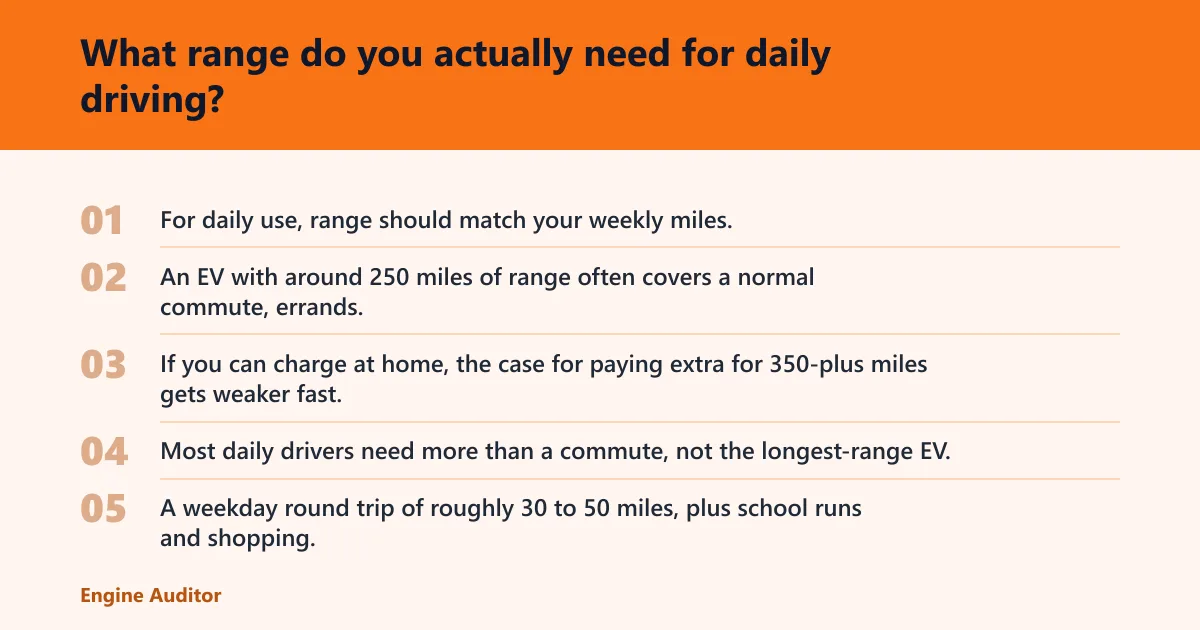
For daily use, range should match your weekly miles, not a theory-only number from a full battery to empty. An EV with around 250 miles of range often covers a normal commute, errands, and some buffer for cold weather or detours. If you can charge at home, the case for paying extra for 350-plus miles gets weaker fast.
How commute length, weekly miles, and home charging change the answer
Most daily drivers need more than a commute, not the longest-range EV. A weekday round trip of roughly 30 to 50 miles, plus school runs and shopping, can often fit inside a 200 to 250 mile range when home charging is available. That changes if you depend on public charging or drive long distances every week.
Home charging matters because it cuts routine charging stops and lets you start most mornings with enough range. Without it, even a car with strong EPA range can feel less convenient if every week requires extra charging stops.
When 250 miles is enough, and when you should aim higher
About 250 miles of EPA range can exceed a typical day’s needs for many households. It is usually enough for one-car suburban use, mixed errands, and moderate commuting. Aim higher if your weekly miles are high, your winters are harsh, or your charging access is limited.
If your round-trip commute is around 46 miles and you add roughly 40 miles of errands most days. A 250-mile EV still leaves room for weather losses, but a 200-mile model may feel tight in January. The difference is direct, it changes how often you need to plug in and how much buffer remains.
📊 Some longer-range electric cars can exceed 400 miles. Source: Electric Car Range And Price Comparison 2026.
How much EV range and price do you get today?
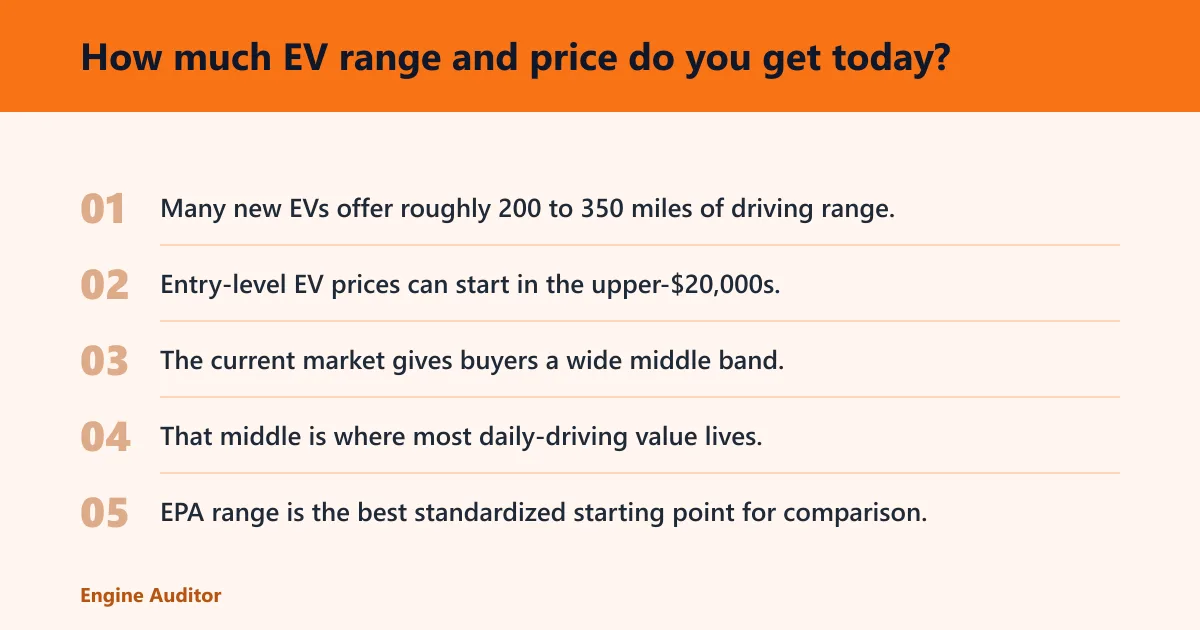
Many new EVs offer roughly 200 to 350 miles of driving range, with some longer-range electric cars able to exceed 400 miles. Entry-level EV prices can start in the upper-$20,000s, while luxury and specialty EVs can cost well into six figures. Price alone does not equal value.
What 200 to 350 miles of EPA range looks like across mainstream models
The current market gives buyers a wide middle band. That middle is where most daily-driving value lives, because 200 to 350 miles is enough for many commutes and weekend errands without paying for the longest-range models.
EPA range is the best standardized starting point for comparison. Real-world range still shifts with highway speed, cold weather, hills, wind, towing, payload, tire choice, and HVAC use. Treat EPA numbers as a comparison tool, not a promise.
Why battery size, drivetrain, and trim can move both range and price
Battery size and drivetrain can change both EPA range and price. A larger battery usually adds range, but it also adds cost and weight. Different drivetrains on the same model can shift efficiency and pricing, so compare exact trims instead of model names alone.
That matters because the same badge can hide very different specs. A rear-drive version may go farther than an all-wheel-drive version. Bigger wheels can trim range. Optional equipment can lift price without improving daily usefulness.
What matters more for value: range, price, or charging speed?
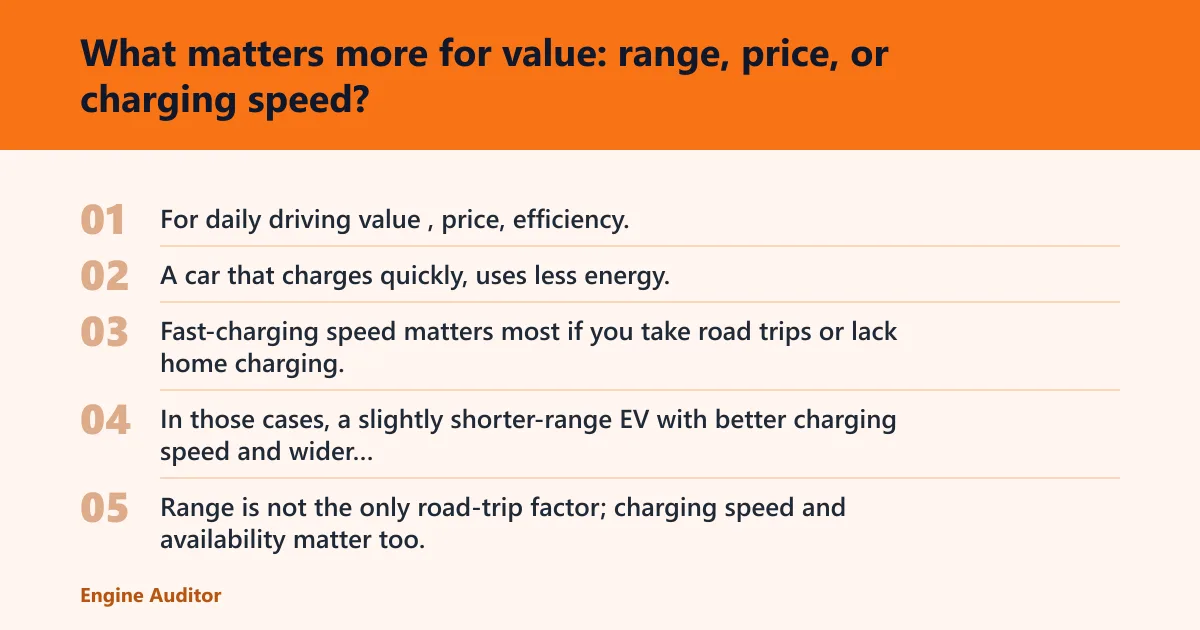
For daily driving value, price, efficiency, and charging speed often matter more than chasing the highest EPA range number. A car that charges quickly, uses less energy, and costs less can beat a longer-range rival that is heavier and much more expensive. Range is only one part of the picture.
When fast-charging speed beats a slightly higher EPA range
Fast-charging speed matters most if you take road trips or lack home charging. In those cases, a slightly shorter-range EV with better charging speed and wider charging availability can be more useful than a longer-range model that takes longer to recover miles on the road.
Range is not the only road-trip factor; charging speed and availability matter too. If a shopper lives in an apartment and depends on public stations, a car with middling range but strong charging performance may fit daily life better than a high-range model with slow DC charging.
Why EV price per mile of range helps separate value from expensive range
EV price per mile of range is a simple way to compare value across trims. Divide the trim price by EPA range to see how much you are paying for each mile of claimed range. It is a sortable chart metric that helps expose expensive extra battery capacity.
This metric is useful because a cheaper EV is not always the one with the longest range. A model can look expensive on sticker price but be stronger value per mile if it offers solid range at a reasonable price. Another can look appealing until the cost per mile of range climbs sharply.
| Value signal | What to check | Why it matters |
|---|---|---|
| EPA range | Compare the exact trim, not the model name | Standardized starting point for range comparisons |
| Trim price | Look at base price and required options | Shows whether extra range is actually affordable |
| Battery size | Check pack size by version | Usually drives both range and cost |
| Drivetrain | RWD, AWD, or other setup | Can change range, traction, and price |
| Charging speed | DC fast-charge peak and curve | Can matter more than extra range for trips |
| Efficiency | Energy use per mile | Higher efficiency can beat a larger battery on value |
Best EV range bands for different daily-use patterns
The best range band depends on how you drive. City-only users can often live with less range than suburban commuters. Mixed-use drivers usually want a bigger buffer, especially if weekend trips or winter conditions are part of the routine. Vehicle type also matters, since cars, SUVs, pickups, and vans fit different use cases.
City-only drivers
City-only driving usually rewards efficiency and lower price over maximum range. Frequent low-speed trips, short parking intervals, and home charging make 200 to 250 miles a practical sweet spot for many drivers. Extra battery capacity often sits unused during normal urban weeks.
Suburban commuters and errand runners
For suburban commuting and errands, around 250 to 300 miles can be a practical balance. It gives enough margin for traffic, school runs, weather swings, and occasional detours without pushing buyers into expensive long-range trims. This is where many mainstream EVs fit best.
Mixed daily use with weekend trips
Mixed-use shoppers who add frequent weekend drives may want 300 to 350 miles, especially without home charging. Beyond that point, the value case often depends more on charging speed than on the next increment of EPA range. More range can help, but it is not always the best spend.
What should you check on exact trims before you compare EVs?
Compare exact trims, not just model names. Range, battery size, drivetrain, wheels, standard equipment, and price can all shift from one version to another. The same vehicle line may contain one trim that is a strong value and another that costs too much for the extra miles it adds.
Battery size, drivetrain, wheels, and efficiency
Battery size and drivetrain are the first trim details to check because they can change both range and price. Wheel size also matters, since larger wheels can reduce efficiency and trim EPA range. A trim with better efficiency may deliver more useful miles than a larger battery with poorer consumption.
Charging speed, standard equipment, and trim price
Fast-charging speed should be compared alongside range. If two trims are close on EPA range, the one that charges faster can be the better daily-driver and trip companion. Standard equipment also matters because a lower price with missing features may cost more in real use than a slightly pricier trim.
How do used EVs change the value equation?
Used EVs can be excellent value, but only if the battery still has healthy capacity and the warranty situation makes sense. Used EV buyers should check battery condition and remaining warranty, because range loss and repair risk can change the economics more than the odometer alone.
Battery condition and expected range loss
Battery health is the main used-EV check. Ask for a battery state-of-health report if available, and compare any range estimate against what the model should reasonably provide. A car with notable degradation may still be usable, but the value drops if it no longer fits your weekly needs.
A common first-timer mistake is buying a used EV for its advertised range and then discovering that the battery has lost enough capacity to make winter commuting awkward. The problem is not just the number on the dash; it is whether the remaining range still matches the real weekly routine.
Battery warranty remaining and charging-speed checks
Check how much battery warranty remains and whether the model still supports the charging speeds you need. Warranty terms vary by model year and trim, so confirm the details before you buy. A strong warranty and healthy battery can make a used EV far better value than a newer but weaker-spec version.
Decision table: pick a range band by weekly use and charging access
Use this table as a simple planning tool. Match weekly miles, commute length, climate, and home charging access to a sensible range target, then compare trims by price, battery size, drivetrain, and charging speed. That keeps you from paying for range you may never use.
| Weekly miles | Commute length | Home charging | Climate | Recommended EPA range band |
|---|---|---|---|---|
| Under 150 | Under 30 miles round trip | Yes | Mild | 200–250 miles |
| 150–250 | 30–60 miles round trip | Yes | Mild to moderate | 250–300 miles |
| 250–400 | 40–80 miles round trip | Yes | Cold or mixed | 300–350 miles |
| Under 250 | Varies | No | Mild | 300+ miles |
| Any | Frequent trips | Limited public charging | Cold or windy | 300+ miles plus strong fast-charging |
- Start with weekly miles, not brochure range.
- Adjust upward for cold weather, hills, headwinds, and HVAC use.
- Check whether you can charge at home or at work.
- Compare exact trims for battery size, drivetrain, and wheels.
- Use price per mile of range to screen out expensive extra capacity.
- For used EVs, verify battery condition, warranty remaining, and charging speed.
Frequently asked questions
What electric car has enough range for daily driving without paying for extra battery capacity?
For many drivers, an EV with 250 to 300 miles of EPA range is enough without paying for the longest-range trim. If you have home charging and a moderate commute, that band usually covers weekday driving, errands, and a useful buffer for weather or detours.
Which EVs give the best value for the money in 2026?
The best-value EVs in 2026 are usually those that balance 250 to 300 miles of EPA range with reasonable trim pricing, good efficiency, and fast charging. Long-range luxury models can cost far more per mile of range, so compare exact versions before deciding.
How much range do most new electric cars offer today?
Many new EVs offer roughly 200 to 350 miles of driving range. Some longer-range electric cars can exceed 400 miles, and one current Lucid benchmark reaches 512 miles. For daily driving, though, the middle band fits most households better than the extreme top end.
Is 250 miles of EV range enough for everyday commuting?
Yes, 250 miles of EPA range is enough for many everyday commutes, especially with home charging. It usually covers a typical workweek plus errands and leaves room for weather or traffic. That said, cold climates, highway use, and no home charging can tighten the margin.
What matters more for daily driving value: range, price, or charging speed?
For most daily drivers, price, efficiency, and charging speed matter as much as range, and sometimes more. A lower-cost EV with solid range and good charging can be better value than a pricier model with a bigger battery that adds little day-to-day benefit.
What should I check when buying a used electric car?
Check battery condition, remaining battery warranty, charging speed, and expected range loss. Those items affect value more than cosmetic wear on a used EV. If the battery has degraded or the warranty is thin, a car with a lower sticker price may be the more expensive choice.
Products related to this article
Sponsored / affiliate links. As an Amazon Associate I earn from qualifying purchases. I may earn additional commission from eligible campaigns.