Best Performance Sedans: Fast Four-Door Options Compared
Best performance sedans: fast four-door options compared
The best performance sedan comes down to one job: quickest launches, sharpest cornering, longest highway legs, or the easiest daily life. Pick wrong, and you pay for speed you will not use, or comfort you give up every day. This guide compares straight-line pace, handling, comfort, practicality, range, charging, and ownership costs. For readers also weighing running expenses, see our EV vs gas ownership cost guide.
How to judge a fast sedan

Separate straight-line speed from everything else. One sedan can hit 60 mph brutally fast and still feel heavy on a tight road. Another can turn in cleanly yet give up launch punch. Your best match depends on where the car will spend most of its miles. If you are still sorting priorities, our best family sedans guide is a useful cross-shop companion.
Straight-line speed versus lap pace
Drag-strip pace rewards traction, power, and launch control. Road pace rewards steering feel, brake consistency, and chassis balance across repeat corners. That is why a Tesla Model 3 Performance can dominate a sprint, while a BMW M3 or Porsche Taycan may feel better on a winding route. For drivers who still want a clutch, our best manual transmission cars roundup covers the stick-shift standouts.
Why comfort and cargo still matter
A performance sedan still has to live with traffic, school runs, and luggage. Rear-seat room, seat padding, visibility, and trunk shape can matter more than a tenth here or there in acceleration. If the ride is too stiff or the cabin wears on you, the speed gets used less often. That is why a quick sedan with decent visibility often feels faster in real life than a louder one that is harder to place in tight traffic.
Gas, hybrid, or EV tradeoffs
Gas sedans usually give familiar refueling, strong highway range, and a wider repair network. Hybrids can add punch with less fuel use, but usually bring less driver engagement than a pure sports sedan. EVs deliver instant response and strong repeatable acceleration, yet charging time, trip planning, and weight deserve attention before you buy. If you are shopping from a broader premium pool, compare against our luxury sedans and EV sedan guides too.
Performance sedan comparison matrix
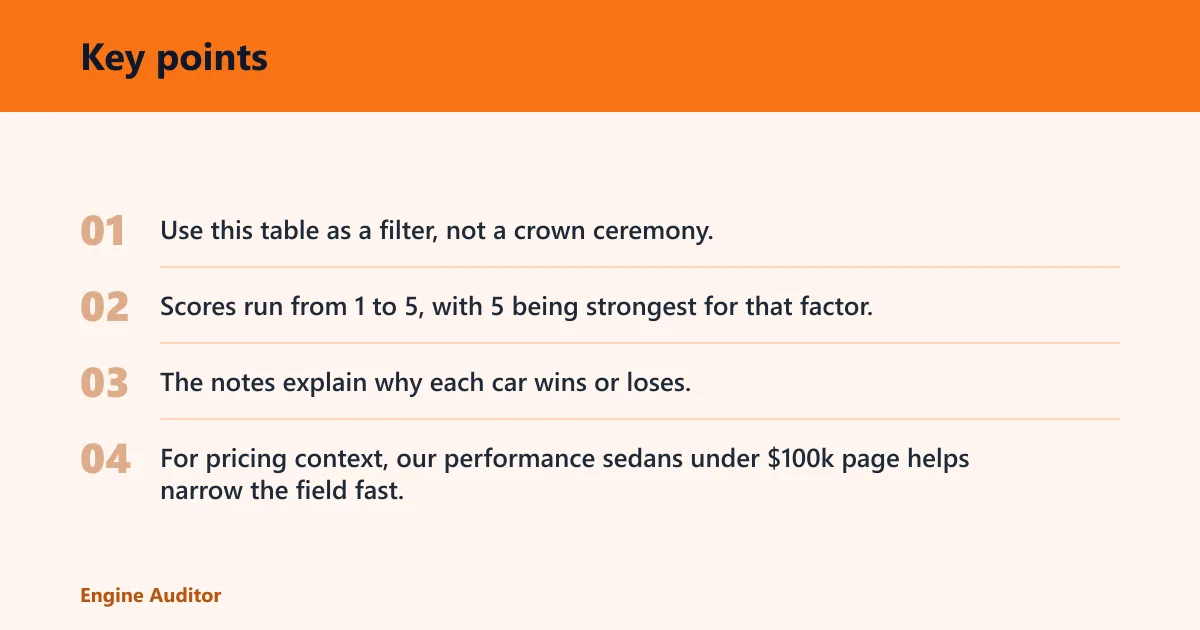
Use this table as a filter, not a crown ceremony. Scores run from 1 to 5, with 5 being strongest for that factor. The notes explain why each car wins or loses, and the best-for and avoid-if fields point to the buyer profile that fits. For pricing context, our performance sedans under $100k page helps narrow the field fast.
| Model | Straight-line speed | Handling | Daily comfort | Road-trip usability | Ownership cost | Best for | Avoid if |
|---|---|---|---|---|---|---|---|
| Lucid Air Sapphire | 5 – 1,234 horsepower, tri-motor AWD, and very hard launch performance; published 0-60 mph testing has varied, so this comparison avoids the disputed 1.89-second shorthand and does not lean on an unverified time claim. | 4 – carbon-ceramic brakes and AWD give serious pace, but its size and mass work against agility compared with smaller sports sedans. | 4 – the cabin is geared for long-distance calm, and the estimated range is over 420 miles. | 5 – range and charging flexibility make it the easiest EV here to imagine on long days. | 1 – exotic hardware, large battery, and premium brake parts point to high running costs. | Drivers who want extreme EV speed with real touring range. | You want the lowest tire, brake, and purchase cost. |
| Cadillac CT5-V Blackwing | 4 – 668-hp supercharged 6.2-liter V8 and a 3.4-second 0-60 mph claim make it brutally quick. | 5 – rear-wheel drive, Magnetic Ride Control, and performance traction management give it a serious chassis edge. | 4 – it keeps the manual option and still rides well enough for regular use. | 4 – strong for long trips if you want a gas car with muscle and stability. | 2 – a powerful V8, wide tires, and premium braking hardware usually mean expensive wear. | Enthusiasts who want a manual V8 sedan with track hardware. | You want quiet efficiency or low fuel bills. |
| Porsche Taycan | 4 – the base car makes 402 horsepower, and the Taycan 4S brings 536 horsepower; turbo versions are much stronger. | 5 – this is one of the sharpest sports-sedan chassis layouts in the class. | 4 – precise controls and low noise help daily use, though ride firmness varies by spec. | 4 – 800-volt architecture and fast-charging capability make it one of the better EV road-trip choices. | 2 – premium hardware and EV tire wear keep ownership costs above average. | Drivers who want a polished EV with excellent steering and charging tech. | You want the cheapest entry price or the longest range in the class. |
| Cadillac CT4-V Blackwing | 3 – the 472-hp twin-turbo V-6 is quick, but it is not the straight-line monster here. | 5 – rear-wheel drive and sport-sedan tuning make it one of the clearest handling picks. | 4 – its composed ride is a major part of the appeal. | 3 – useful enough for regular trips, but less spacious and less plush than larger rivals. | 3 – good value versus the BMW M3, with less power and usually less spending than the bigger V8 Cadillac. | Drivers who want a manual, rear-drive sport sedan at a better price than an M3. | You need a large rear seat or the most outright speed. |
| Tesla Model 3 Performance | 5 – 510 horsepower and a 2.9-second 0-60 mph time make it one of the quickest launches here, as recorded by Car and Driver. | 4 – track-oriented acceleration and low center of gravity help, but steering feel and brake feel are not as textured as the best gas rivals. | 4 – it is easy to drive every day, with simple controls and quiet running. | 3 – road-trip use depends heavily on charging stops and route planning. | 4 – affordable performance is the main draw, though tires and insurance can still add up. | Buyers who want the quickest acceleration for the money. | You value engine sound, manual control, or long-trip flexibility above all else. |
| Dodge Charger Daytona Scat Pack four-door | 4 – a tested 3.3-second 0-60 mph result is strong, and AWD traction helps it leave hard, as reported by MotorTrend. | 3 – it is fast and stable, but this is more muscle sedan than canyon carver. | 4 – family-hauling practicality is part of the pitch, along with an easygoing four-door format. | 3 – the 223-mile EPA range claim and 400-volt system make it less trip-friendly than longer-range EVs. | 3 – EV driveline savings help, but range limits and tire wear still matter. | Drivers who want electric muscle with useful rear doors. | You need long EV range or the sharpest cornering response. |
| BMW M3 | 4 – it sits near the benchmark end of the segment and delivers strong gas-powered pace. | 5 – the chassis is the standard many rivals are measured against. | 4 – it balances performance with enough refinement for daily use. | 4 – this is one of the easier track-capable sedans to live with on the highway. | 3 – pricing and wear are serious, but it avoids the heaviest exotic costs. | Drivers who want the best all-around gas sports sedan. | You want a manual V8 soundtrack or the cheapest entry price. |
| Mercedes-Benz E450 4Matic | 3 – 375 horsepower combined and a 4.7-second 0-60 mph run put it below the hardest-edged sport sedans, but still clearly quick. | 3 – it favors stability and polish over aggressive cornering. | 5 – refinement is the point, with a luxury-sedan focus first and performance second. | 5 – strong highway manners and all-wheel drive make it an easy long-distance car. | 3 – a premium luxury sedan usually lands in the middle on costs, not the low end. | Drivers who want speed without giving up comfort. | You want the most driver-focused chassis in the class. |
Which sedan is quickest in a straight line?
The Lucid Air Sapphire is the most extreme straight-line sedan here, with 1,234 horsepower, a tri-motor electric powertrain, AWD, and an estimated range of over 420 miles. The Tesla Model 3 Performance is the value-speed answer at 2.9 seconds to 60 mph, as tested by Car and Driver, while the Dodge Charger Daytona Scat Pack four-door adds a tested 3.3-second sprint with AWD traction, as recorded by MotorTrend.
Lucid, Tesla, and Dodge in context
The Lucid wins the outright power race, but the shorthand matters: the disputed 1.89-second figure is not used here, and the article sticks to verified attributes instead of a repeatable-but-unchecked headline number. For readers who want verified launch pace without the price or size of the Lucid, the Tesla is the cleanest answer. The Dodge brings the best blend of muscle-car feel and family duty among the EVs here.
Picture a buyer who wants a quick daily sedan and nothing else. The Tesla is the straightforward pick because its acceleration is immediate, repeatable, and priced below the ultra-luxury tier. If that same buyer wants four doors plus more theater and space, the Dodge makes a stronger case. If range and cost are no object, the Lucid is the headline car. If you are cross-shopping ownership costs, revisit the EV vs gas ownership cost guide before deciding.
Which one is best to drive fast on a back road?
The BMW M3 is still the benchmark because its chassis balance, steering, and brake behavior make speed feel tidy rather than forced. The Cadillac CT5-V Blackwing is the choice if you want more torque and a manual V8 character, while the CT4-V Blackwing is the smaller, sharper value play. The Taycan belongs here too because its electric powertrain is paired with excellent sports-sedan handling.
BMW M3 versus the Blackwings
The M3 is the clean reference point: it mixes track-capable balance with enough civility to work every day. The CT5-V Blackwing adds a 668-hp supercharged 6.2-liter V8, a six-speed manual transmission, rear-wheel drive, Magnetic Ride Control, and performance traction management. That makes it the more theatrical choice, even if it asks more from the driver. At a stoplight, the manual Blackwing has the old-school rhythm enthusiasts still like: a light clutch take-up, a long, deliberate shifter throw, and a V8 note that settles into a low, impatient lope before the road opens up.
The CT4-V Blackwing is easier to recommend if value matters. It brings a 472-hp twin-turbo V-6, rear-wheel drive, and manual availability, while keeping a composed ride that helps on rough pavement. If your favorite road has long corners and bumpy surfaces, the smaller Cadillac may feel more natural than the bigger V8 sibling. For shoppers still considering compact sport sedans, our compact performance sedans page is worth a look.
Porsche Taycan on a fast road
The Taycan earns its place here because its sports-sedan handling is not an afterthought. The 800-volt architecture and fast-charging capability matter less on a back road than they do on a trip, but the underlying chassis response is the reason many drivers cross-shop it with gas sports sedans. The base 402-hp car is the mild entry point; the 536-hp Taycan 4S is the better performance pick for most shoppers. If you want a more focused road-trip EV, compare it with our best electric road-trip cars guide.
Which performance sedan works best every day?
The best daily driver depends on how much comfort you want to keep when the road stops being exciting. The Mercedes-Benz E450 4Matic is the calmest answer here, the BMW M3 is the most complete enthusiast answer, and the Lucid Air Sapphire is the long-range EV answer if you can tolerate its size and cost. Rear seat space, trunk use, and visibility matter more than many shoppers admit. For broader luxury-car research, see our luxury sedans guide.
Ride quality and steering feel
The E450 4Matic aims for a quiet, easy commute first, then speed. The M3 adds more steering and chassis feedback without becoming harsh. The CT5-V Blackwing sits between those two, with enough suspension control for hard driving and enough composure for long slogs. If your roads are broken, the composed ride of the CT4-V Blackwing is worth a look. If you care most about the everyday rhythm of a sedan, the best family sedans guide is a smart reality check.
Rear seats, cargo, and visibility
Rear-seat comfort only matters if adults can sit there without complaint. Cargo space and trunk opening shape matter too, especially for a car that may carry luggage, backpacks, or groceries several times a week. Visibility changes the daily experience too; a sedan that feels easy to place in traffic is less tiring than one that makes every lane change work. A performance sedan that is easy to park often gets driven more, which is its own kind of performance win.
Say your commute includes tight parking garages, two adults in the back, and a 40-mile highway loop. A softer luxury sedan or the M3 will be easier to live with than a carbon-ceramic, ultra-powerful flagship that asks for more attention every day. The point is not to avoid performance. It is to buy the kind you will actually use.
Which performance sedan should you buy?
Buy the CT5-V Blackwing if you want a manual transmission and a big, emotional V8. Buy the CT4-V Blackwing if you want the better value play with rear-drive balance. Buy the M3 if you want the safest all-around sports-sedan choice. Buy the Taycan if you want an EV with serious chassis polish and fast charging. Buy the E450 4Matic if comfort matters as much as pace. If you are still weighing powertrain type, our EV sedan guide and performance sedans under $100k guide can help close the loop.
Best for manual-transmission fans
The Cadillac CT5-V Blackwing is the standout because it pairs a six-speed manual with a 668-hp supercharged V8 and real track hardware. The CT4-V Blackwing also deserves attention because it keeps manual availability in a smaller, lighter-feeling package. If rowing your own gears is the deciding factor, these two deserve the first test drive.
Best value for the money
The CT4-V Blackwing is the sharper value pick among the true enthusiast sedans here, especially if you are cross-shopping it against the BMW M3. The Tesla Model 3 Performance is the value pick if your priority is raw acceleration per dollar rather than engine character. Choose the one that matches how often you will actually use the performance.
Best for comfort and speed
The Mercedes-Benz E450 4Matic is the easy comfort-first answer, but the Lucid Air Sapphire is the more extreme speed-and-range option. If you want both long-distance calm and real punch, the Lucid is the most dramatic choice, though ownership costs will sit far above the Mercedes. If your budget is less flexible, the E450 is the safer daily bet.
Best EV for range and charging
The Lucid Air Sapphire leads on estimated range with over 420 miles, and the Taycan is the best charging-tech choice because its 800-volt architecture and fast-charging capability are built for travel. The Tesla Model 3 Performance remains the best value EV sprint sedan. The Dodge Charger Daytona Scat Pack four-door is quick, but its 223-mile EPA range claim makes it the least forgiving on long routes.
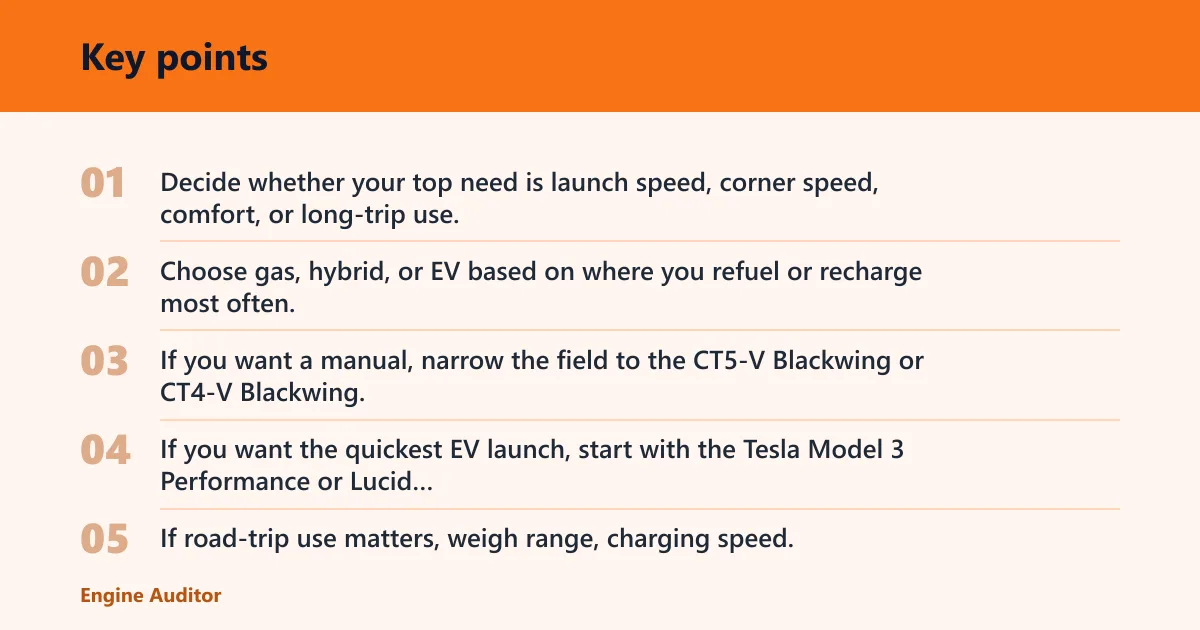
- Decide whether your top need is launch speed, corner speed, comfort, or long-trip use.
- Choose gas, hybrid, or EV based on where you refuel or recharge most often.
- If you want a manual, narrow the field to the CT5-V Blackwing or CT4-V Blackwing.
- If you want the quickest EV launch, start with the Tesla Model 3 Performance or Lucid Air Sapphire.
- If road-trip use matters, weigh range, charging speed, and rear-seat comfort before horsepower.
- Check the manufacturer listing for your model on tire, brake, cargo, and charging details.
Frequently asked questions
What are the best performance sedans right now?
The strongest all-around answers are the BMW M3, Cadillac CT5-V Blackwing, Tesla Model 3 Performance, and Porsche Taycan. The right pick depends on whether you value handling, manual control, acceleration, or EV charging. The Lucid Air Sapphire sits at the extreme top end for speed and range.
Are performance sedans practical for daily driving?
Yes, but only if you match the car to your routine. The Mercedes-Benz E450 4Matic and BMW M3 are easiest to live with, while the CT5-V Blackwing and Lucid Air Sapphire ask more from your budget. Rear seats, trunk use, ride quality, and visibility matter as much as output.
Should I buy a gas, hybrid, or electric performance sedan?
Buy gas if you want familiar refueling and a broad performance-car feel. Buy hybrid if you want a middle path with more efficiency and less charging dependence. Buy electric if you care most about instant acceleration, quiet running, and home charging, while accepting range and trip-planning tradeoffs.
Which performance sedan has the best handling?
The BMW M3 remains the clean benchmark for handling balance, while the Cadillac CT4-V Blackwing is close if you want a smaller rear-drive sedan with a manual option. The Porsche Taycan is also highly credible here because its chassis tuning gives it serious sports-sedan precision. Straight-line speed is not the whole story.
Which sporty sedan still offers a manual transmission?
The Cadillac CT5-V Blackwing still offers a six-speed manual, and the CT4-V Blackwing has manual availability as well. Those two stand out because the rest of this group leans automatic or electric. If manual engagement is the priority, start there before considering anything else.
What is the best performance sedan for the money?
The Cadillac CT4-V Blackwing is the best value-focused enthusiast choice because it gives you rear-wheel drive, a twin-turbo V-6, manual availability, and strong sport-sedan tuning. The Tesla Model 3 Performance is the value pick for buyers who care more about acceleration numbers than engine feel or sound.
How do performance sedans compare on range and charging?
The Lucid Air Sapphire leads with over 420 miles of estimated range, and the Taycan is the charging-tech standout because of its 800-volt architecture and fast-charging capability. The Dodge Charger Daytona Scat Pack four-door has a 223-mile EPA range claim, which is fine for commuting but less forgiving for longer trips.
Products related to this article
Sponsored / affiliate links. As an Amazon Associate I earn from qualifying purchases. I may earn additional commission from eligible campaigns.