New car vs used car: Which is better for your budget?
For most budget-conscious shoppers, a used car is cheaper overall if the plan is to keep it under 5 years; a new car can win when low-rate financing, long ownership, and warranty coverage offset faster depreciation. Miss that math and you can pay more in depreciation, interest, insurance, or repairs. This guide compares purchase price, financing, insurance, depreciation, and repair risk over your planned ownership period.
This guide is part of our Car comparisons and reviews series.
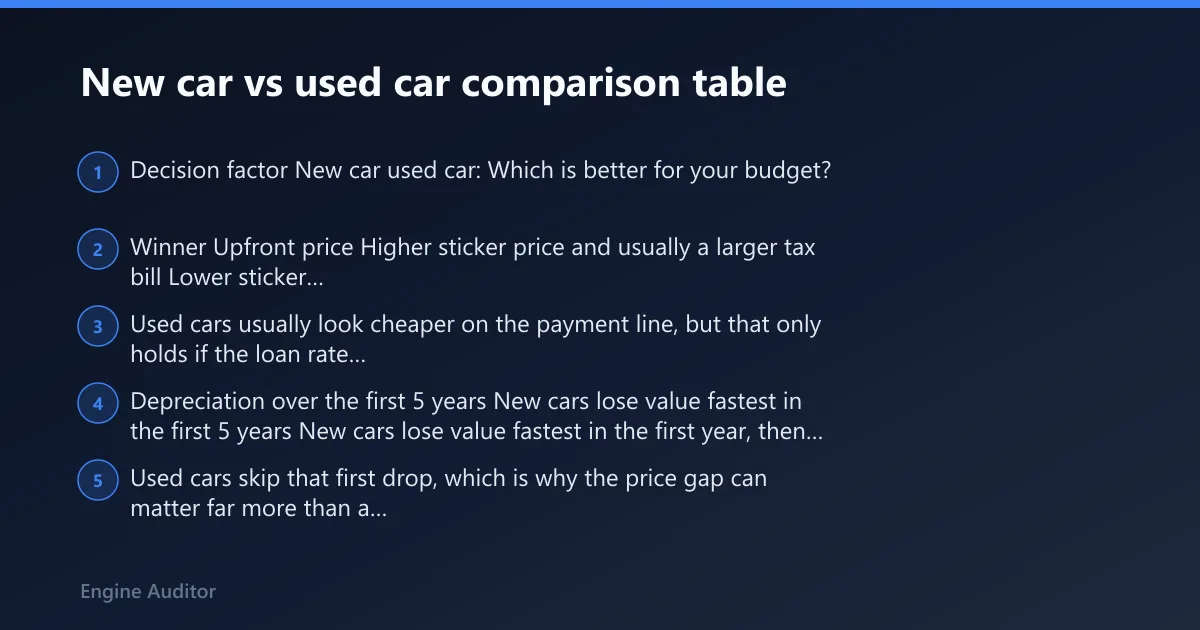
New car vs used car comparison table
| Decision factor | New car | used car: Which is better for your budget? | Winner |
|---|---|---|---|
| Upfront price | Higher sticker price and usually a larger tax bill | Lower sticker price and smaller cash needed at signing | Used car |
| Depreciation over 5 years | Fastest loss happens early, especially in year one | Slower loss because the first owner absorbed the steepest drop | Used car |
| Warranty and early repair exposure | Typical factory warranty coverage, often 3 years/36,000 miles | Less warranty left, unless it is certified pre-owned or very new | New car |
| Insurance and financing | Often lower loan rates, but higher insurance tied to higher value | Loan rates can be higher, but insurance may be lower on many models | Depends on lender and vehicle |
Upfront price and monthly payment
New cars cost more upfront, so the payment usually starts higher before you even add insurance and fuel. Used cars usually look cheaper on the payment line, but that only holds if the loan rate is not much worse and the term is not stretched so long that interest eats the savings.
Depreciation over the first 5 years
New cars lose value fastest in the first year, then the curve slows. Used cars skip that first drop, which is why the price gap can matter far more than a buyer expects over a 5-year hold.
Warranty and repair exposure
A new car’s factory warranty cuts early repair risk. A used car may still have coverage, but once that window closes, the buyer takes on more uncertainty for brakes, tires, sensors, suspension parts, and other age-related repairs.
Insurance, maintenance, and fuel
Insurance often follows vehicle value and repair cost, so many used cars cost less to insure. Maintenance and fuel are more model-dependent than age-dependent, but a newer car can still be cheaper to keep running if it is more efficient or covered by warranty during the first years.
How much does depreciation change the answer?
Depreciation is the biggest reason a new car can lose to a used one on total cost, even when the payment looks manageable. The first year matters most because many cars lose a large chunk of value before the odometer adds much mileage, and that hit is hard to recover when you resell.
Why the first year matters most
The biggest value drop usually happens right after purchase. That means a buyer who trades often pays for the steepest depreciation again and again, while a buyer who keeps a car longer spreads that loss over more years and more use.
How age and mileage shape resale value
Age and mileage both cut resale value. A 2-year-old car with modest miles usually holds value far better than a 5-year-old car with heavy use, even if both are the same model, because buyers pay for remaining life and remaining warranty.
Why some models lose value faster than others
Depreciation is not identical across the market. Luxury sedans, large SUVs, and cars with expensive options often lose value faster than compact economy cars, while strong demand, reliable reputations, and practical trims can keep resale values firmer.

Is a used car actually cheaper once financing is included?
Often yes, but not automatically. A used car’s lower price can be partly or fully erased by a higher auto loan rate, a longer term, or dealer fees, so the true comparison is total interest plus principal, not the sticker alone.
New-car APR vs used-car APR
New-car loans often come with lower rates because lenders may see less risk in newer collateral. Used-car loans often carry higher APRs, especially for older vehicles, high mileage, or weaker credit profiles, and that gap can add meaningful cost over 60 months.
How lender terms affect the monthly payment
Two loans with the same price can still have very different payments if one has a higher APR or a shorter term. A lower used-car price with a higher rate may still win, but the only safe way to know is to compare the full amortized payment, fees included.
When a lower used-car price gets eaten by higher interest
This happens most often on cheap older cars financed at high rates. If the payment savings are small and the repair budget is large, the used-car advantage can disappear fast, especially over a 4- to 5-year ownership window.
Are used cars cheaper to insure and maintain?
Usually yes on insurance, but maintenance is the wildcard. Used cars often cost less to cover because their replacement value is lower, yet older vehicles can bring more wear, more deferred maintenance, and more surprise repairs that a new-car buyer may never face early on.
Insurance cost differences by value and segment
Insurance usually follows vehicle value, repair cost, theft risk, and powertrain type. A used compact sedan is often cheaper to insure than the new version, while a used luxury SUV can still be relatively expensive because parts, labor, and claim severity can stay high.
How much to budget for maintenance and repairs
For a used car, plan a separate line for maintenance and a separate line for repairs. Maintenance includes tires, oil, brakes, and routine service; repairs cover the unexpected. A well-kept newer used car may need very little at first, while an older high-mileage car should be assumed to need more.
When repair risk on older cars outweighs the lower price
If an older used car has weak service records, high mileage, or known trouble spots, the savings can disappear quickly after one major repair. That risk matters most when the buyer has little cash cushion, because one transmission or AC failure can strain the whole budget.
Use the 5-year ownership-cost worksheet
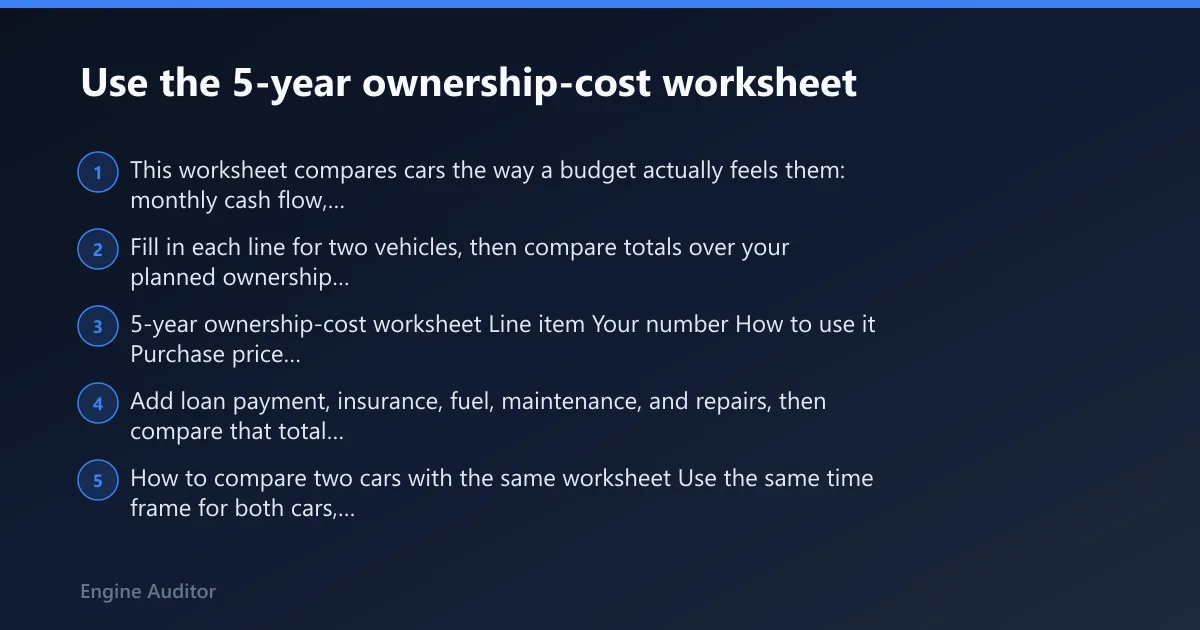
This worksheet compares cars the way a budget actually feels them: monthly cash flow, not wishful thinking. Fill in each line for two vehicles, then compare totals over your planned ownership period, including resale value at the end.
5-year ownership-cost worksheet
| Line item | Your number | How to use it |
|---|---|---|
| Purchase price | __________ | Actual sale price before financing |
| Down payment | __________ | Cash paid up front |
| APR | __________ | Loan rate offered by the lender |
| Loan term | __________ months | Use the real term, such as 60 months |
| Monthly insurance | __________ | Quote for the specific vehicle |
| Monthly fuel | __________ | Estimate from your driving miles and mpg |
| Monthly maintenance | __________ | Oil, tires, brakes, routine service |
| Monthly repairs reserve | __________ | Set aside for unexpected fixes |
| Estimated resale value after 5 years | __________ | What you expect to recover at sale |
How to estimate monthly cost from take-home pay
Start with take-home pay, not gross income. Add loan payment, insurance, fuel, maintenance, and repairs, then compare that total with your monthly net pay to see whether the car fits your budget without crowding out rent, savings, and debt payments.
How to compare two cars with the same worksheet
Use the same time frame for both cars, usually 5 years. If the new car has a higher payment but lower repairs, and the used car has a lower payment but higher service risk, the worksheet makes the trade-off visible instead of leaving it to guesswork.
Car affordability calculator guide
A car affordability calculator should start with take-home pay, then back into a maximum monthly payment and a maximum price. If the payment fits only by stretching the term too far, the car may still be unaffordable because the interest cost is doing too much work.
How much should car expenses be compared with take-home pay?
Keep total car expenses inside a limit that leaves room for housing, food, savings, and debt. A practical budget check is to include the loan payment, insurance, fuel, maintenance, and repairs together, then make sure the total does not crowd out the rest of life.
Budget cap guidance
Many shoppers focus on payment alone, but total car expenses can matter more. A payment that looks fine can still be too high once insurance and fuel are added, especially for younger drivers, commuters, or households carrying other debt.
Total car expenses beyond the payment
Gas, insurance, repairs, and maintenance can change the answer more than the sticker price. A car that is cheap to buy but expensive to run can be worse for the budget than a pricier model with lower ongoing costs.
Choose New car if… / choose used car: Which is better for your budget? if…
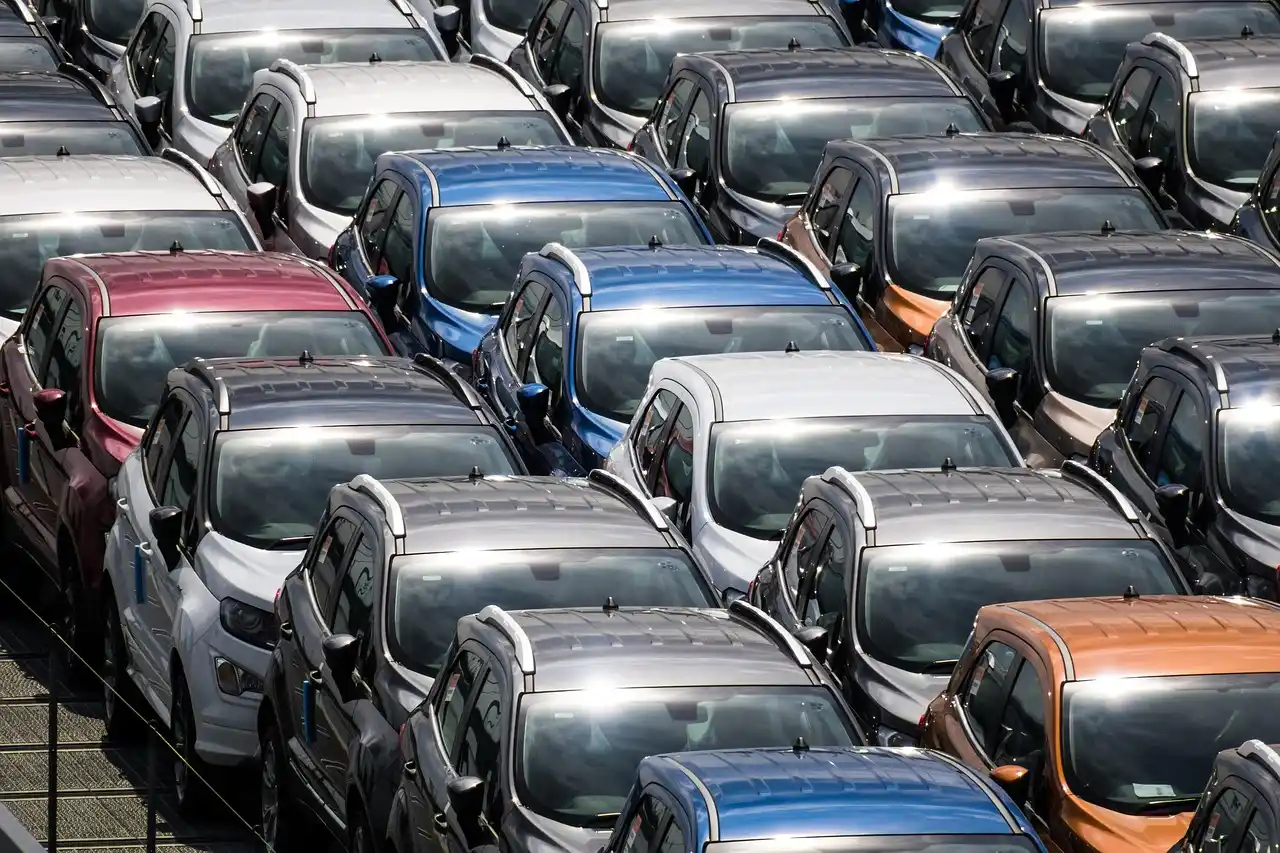
Choose new when you plan to keep the car long enough for the warranty and low early repair risk to matter, and when the APR is attractive enough to offset faster depreciation. Choose used when your main goal is the lowest entry cost and you can handle more uncertainty in repairs and features.
Choose new car if…
Choose new if you want factory warranty coverage, the latest safety and tech features, and the lower early repair exposure that comes with a fresh vehicle. New often makes more sense for compact economy cars when the price gap is small and the financing rate is strong.
Choose used car: Which is better for your budget? if…
Choose used if your budget is tight, you want to avoid the fastest depreciation, and you can inspect the car’s condition and service history carefully. Used often makes more sense for luxury cars, where depreciation can be steep and the same budget can buy a much better vehicle secondhand.
Certified pre-owned and special cases
Certified pre-owned cars often sit between new and regular used cars: usually a higher price than a typical used car, but often better inspection standards and more warranty than a private-party sale. They can be the middle ground when a buyer wants less risk without paying new-car depreciation.
Frequently asked questions
Is it cheaper to buy a new car or used car?
Used is often cheaper overall if the buyer keeps the car for a shorter period, because the first owner has already absorbed much of the initial depreciation. A new car can still win when low APR, long ownership, and warranty coverage offset that loss.
How much depreciation do you save by buying used?
That depends on the model, age, and miles, but the main saving comes from avoiding the sharp first-year drop. The more a car has already aged before purchase, the more of that early loss the first owner has absorbed for you.
What monthly car payment can I actually afford?
Use take-home pay, not gross income, then subtract housing, food, debt, and savings goals before setting a payment cap. A safe payment is the one that still leaves room for insurance, fuel, maintenance, and repairs without forcing the rest of the budget to bend.
Are used cars cheaper to insure than new cars?
Often yes, because used cars typically have lower replacement values, and many insurers price that risk into the premium. But the result depends on the vehicle’s segment, theft risk, repair cost, and how expensive the model is to fix after a claim.
Does a new car warranty offset the higher price?
Sometimes. The warranty reduces early repair risk and can protect a buyer from surprise bills during the first few years, but it does not erase depreciation. It matters most when the buyer keeps the car long enough and values peace of mind more than the lowest entry cost.
How much should I budget for repairs on a used car?
Set aside a monthly repair reserve, even if the car seems fine at purchase. Older vehicles, high-mileage cars, and models with known weak spots should get a larger buffer because one major repair can cost more than several months of normal payments.
Products related to this article
Sponsored / affiliate links. As an Amazon Associate I earn from qualifying purchases. I may earn additional commission from eligible campaigns.
 Auto Car Dent Repair Puller Head Paintless-Dent Repair Removal Kit for Slide Hammer Pulling Tab Adapter Pulling Tabs Car Aluminum-alloy Puller Head Adapter Screw Glue-tabs for Slide Hammer and
 Half Car Cover SUV,Top Cover with Red Reflective Strip, Hail Protector Car Cover with Cotton Liner, Sunroof & Windshield Cover for Ice and Snow, All Weather Car Body Cover for Sun, Rain, Dust