Best Plug-in Hybrid Cars: Who Should Buy One?
A plug-in hybrid makes sense if you can charge about 3-4 times a week and most trips sit inside the car’s electric range, usually around 20-50 miles. Buy one without regular charging, and you often carry extra weight and cost for little fuel saving. This guide explains who PHEVs suit, how they compare with regular hybrids and petrol cars, and what to check before you buy.
What is a plug-in hybrid?
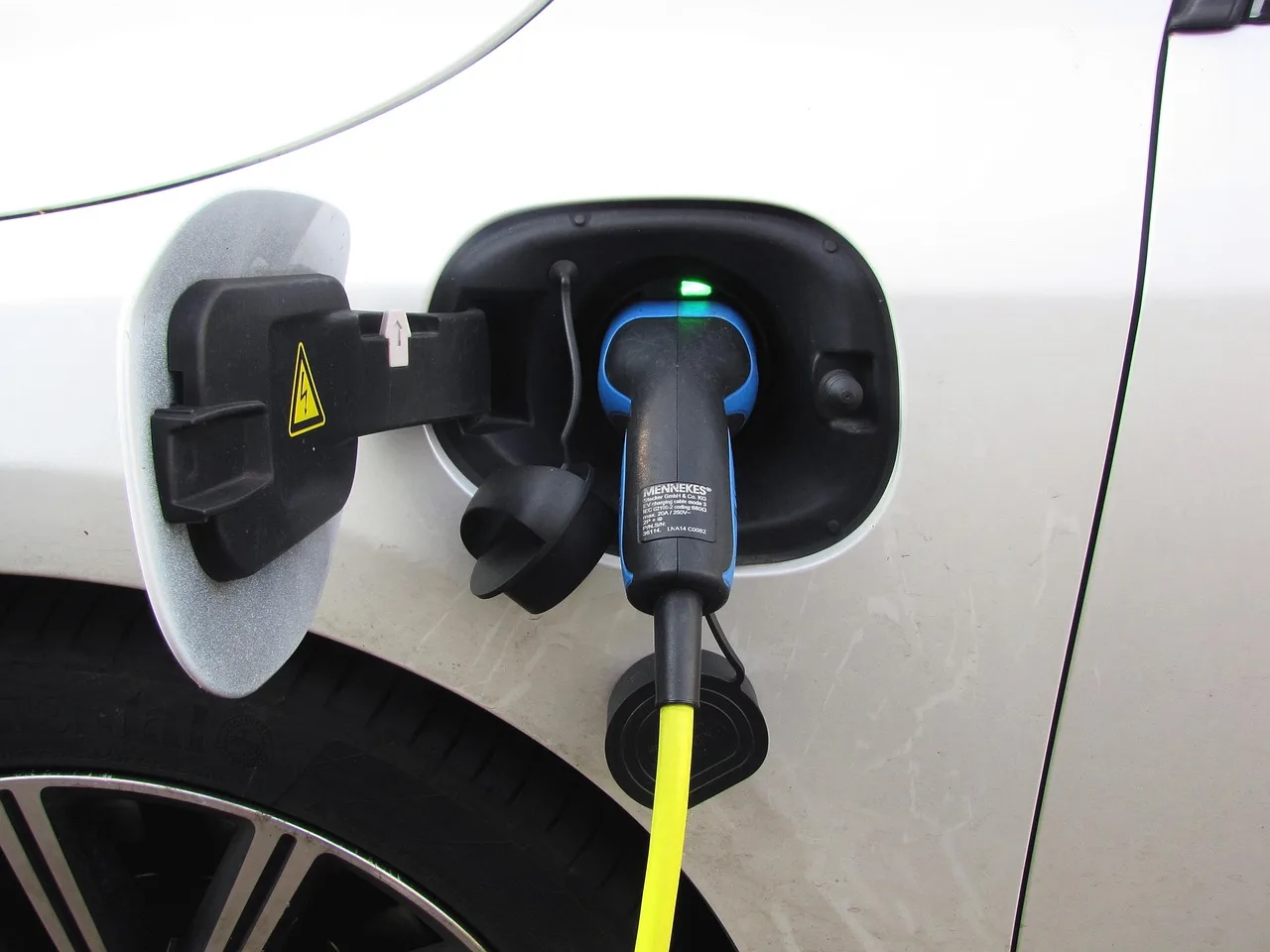
A plug-in hybrid electric vehicle, or PHEV, pairs a petrol or diesel engine with an electric motor and a rechargeable battery you plug in. It can run on electricity alone for short trips, then switch to hybrid operation when the battery is low or the journey is longer.
The battery size matters because it sets how far the car can travel in all-electric mode before the engine joins in. A larger battery can help more with commuting, but it also usually adds price, weight, and sometimes a loss of boot space.
How all-electric mode and hybrid mode work
In all-electric mode, the car uses only battery power for short, low-speed journeys. In hybrid mode, the engine and motor work together, and the car can switch between them automatically. That makes a PHEV useful only when your driving pattern lets the battery do real work regularly.
Plug-in hybrid buyer-fit table
| Commute length | Charging access | Annual mileage | Recommended powertrain choice |
|---|---|---|---|
| Under 20 miles each way | Home or workplace charging available | Up to 10,000 miles | PHEV can work well if you can top up most days |
| 20-40 miles each way | Reliable home charging, or daily workplace charging | 10,000-15,000 miles | PHEV if the electric range covers a large share of the commute |
| More than 40 miles each way | No regular charging or only occasional public charging | 15,000 miles and above | Regular hybrid or efficient petrol car is usually the better fit |
| Mostly short urban trips | Easy overnight charging | Low to moderate mileage | PHEV is strongest here, especially if the car can be charged often |
Top plug-in hybrids to compare by buyer type
The figures below are manufacturer-quoted WLTP electric ranges and AC charging times, with UK list prices and boot capacities that vary by trim and market. Range, charging speed, and luggage space can differ between plug-in hybrid versions of the same model, so always check the exact trim and model year before you buy. WLTP figures are best used as an apples-to-apples guide, while real-world range will move with temperature, speed, load, and tyre choice. (Sources used include manufacturer specification pages, WLTP data, and UK model configurators.)
| Buyer type | Model | Electric-only range | Battery size | AC charging speed | Boot space | List price | Best-fit buyer |
|---|---|---|---|---|---|---|---|
| Company car | Volkswagen Passat eHybrid | Up to 80 miles WLTP | 19.7 kWh | Up to 11 kW AC | About 510 litres | From about £44,000 | Drivers who want a long electric range and low BiK exposure |
| Company car | BMW 330e Touring | Up to 62 miles WLTP | 19.5 kWh | Up to 11 kW AC | About 410 litres | From about £50,000 | Salary-sacrifice users who want an executive estate with tax-friendly electric driving |
| Company car | Mercedes-Benz E 300 e Estate | Up to 64 miles WLTP | 25.4 kWh | Up to 11 kW AC | About 460 litres | From about £65,000 | High-mileage business drivers who want long EV range plus premium refinement |
| Family SUV | Ford Kuga PHEV | Up to 39 miles WLTP | 14.4 kWh | Up to 3.7 kW AC | About 412 litres | From about £38,000 | Families with short commutes and a need for sensible running costs |
| Family SUV | Hyundai Tucson Plug-in Hybrid | Up to 38 miles WLTP | 13.8 kWh | Up to 7.2 kW AC | About 558 litres | From about £42,000 | Buyers who want a roomy SUV with decent electric range and strong practicality |
| Family SUV | Kia Sportage PHEV | Up to 43 miles WLTP | 13.8 kWh | Up to 7.2 kW AC | About 540 litres | From about £40,000 | Families who want a mainstream SUV with good all-round packaging |
| Estate | Skoda Superb Estate iV | Up to 62 miles WLTP | 25.7 kWh | Up to 11 kW AC | About 510 litres | From about £43,000 | Estate buyers who value space, motorway comfort, and useful EV range |
| Estate | Volvo V60 Recharge | Up to 55 miles WLTP | 18.8 kWh | Up to 6.4 kW AC | About 468 litres | From about £56,000 | Drivers who want an estate with premium feel and good electric-only commuting |
| Used value | Mitsubishi Outlander PHEV | Up to 28 miles WLTP | 13.8 kWh | Up to 3.7 kW AC | About 498 litres | Used market only | Shoppers prioritising value, four-wheel drive, and easy family use |
| Used value | MG HS Plug-in Hybrid | Up to 32 miles WLTP | 16.6 kWh | Up to 6.6 kW AC | About 448 litres | From about £31,000 | Budget buyers who want a new or nearly new PHEV at a lower entry price |
Who should buy one?
PHEVs suit drivers whose mileage pattern is predictable and whose charging access is dependable. They work best for short-to-medium commutes, urban driving, and buyers who can charge at home or work often enough to keep the battery in use rather than dragging along a dead one.
Urban drivers with short, predictable trips
If most journeys are school runs, errands, and city commutes, a PHEV can spend a lot of time in electric-only mode. That is where the battery matters most, because short trips let you use the electric range before the engine has to wake up.
Commuters who can charge at home or work
A daily charger matters more than a long electric range on the brochure. If you can plug in overnight or during the day, a PHEV can cover much of a normal commute on electricity and use petrol only for longer weekend trips.
Company-car buyers focused on BiK tax
UK company-car buyers should look at Benefit-in-Kind, because electric range and CO2 output can change the tax bill materially. HMRC company-car tax rates depend on the car’s CO2 band and, for eligible PHEVs, the official electric range bracket, so a longer-range model can sit in a lower tax band than a shorter-range rival. That can make a PHEV attractive for salary sacrifice or fleet drivers, but only if the tax savings outweigh the higher purchase price. (HMRC/company-car BiK guidance)
Used-car shoppers who can verify battery health
A used PHEV can make sense if you can confirm battery state of health, charging history, and warranty cover. Without that evidence, the car may still drive well but lose much of the electric advantage that justifies the extra complexity.
Yes/no buyer checklists
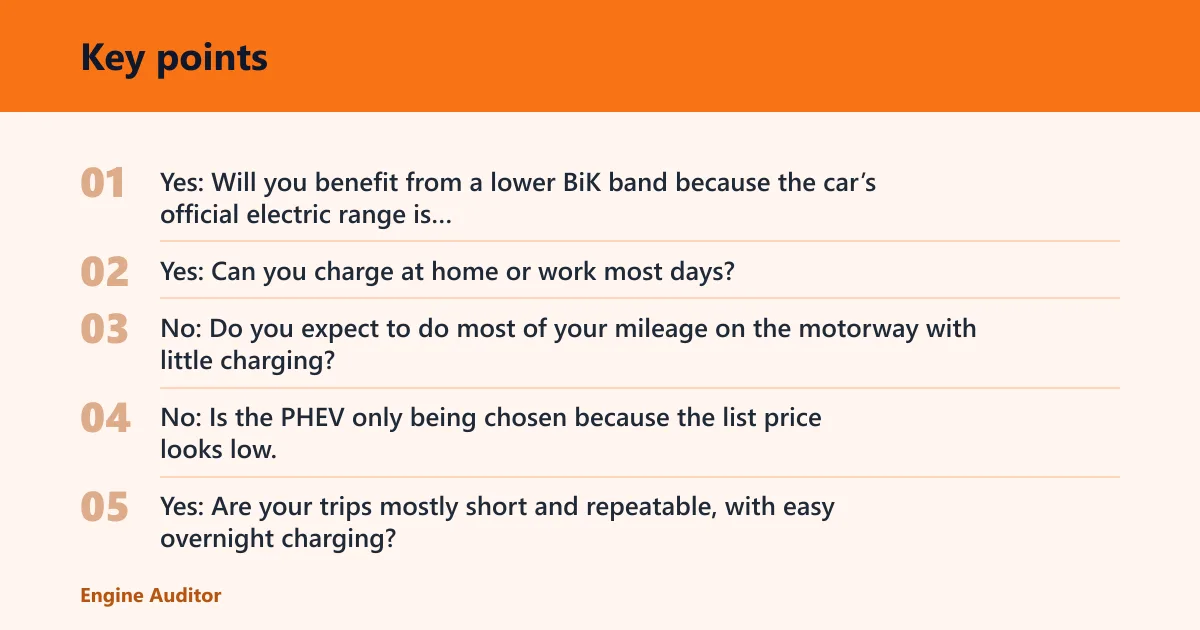
Company-car users: should you choose a PHEV?
- Yes: Will you benefit from a lower BiK band because the car’s official electric range is strong for its class?
- Yes: Can you charge at home or work most days?
- No: Do you expect to do most of your mileage on the motorway with little charging?
- No: Is the PHEV only being chosen because the list price looks low, rather than because the tax position is genuinely better?
Recommendation: If the first two answers are yes and the last two are no, choose a PHEV. If you cannot charge often or mostly do high-speed miles, a regular hybrid is usually safer; for some fleet users, a BEV may be better still if charging is easy.
Urban drivers: should you choose a PHEV?
- Yes: Are your trips mostly short and repeatable, with easy overnight charging?
- Yes: Do most of your miles happen below motorway speeds?
- No: Do you live somewhere with no practical charging access?
- No: Do you regularly carry bulky loads that need maximum boot space?
Recommendation: If you answered yes to the first two and no to the second two, choose a PHEV. If you cannot charge at all, a regular hybrid is usually better; if your driving is very short and urban and you can charge reliably, a BEV may be the strongest option.
Motorway commuters: should you choose a PHEV?
- Yes: Is a large share of your commute at lower speeds or in stop-start traffic?
- Yes: Can you still charge regularly, even if you also do long motorway trips?
- No: Are most of your miles long, steady motorway journeys?
- No: Do you want the simplest ownership case without worrying about plugging in?
Recommendation: If the first two answers are yes, a PHEV can still work. If the third and fourth answers are yes, choose a regular hybrid or petrol car instead, because a PHEV’s electric range is usually least valuable at steady motorway speeds.
Used-car shoppers: should you choose a PHEV?
- Yes: Can you confirm battery warranty status and charging history?
- Yes: Is the price low enough that you are not overpaying for promised electric range?
- No: Is the seller unable to explain how the car has been charged and maintained?
- No: Is the remaining battery warranty too short to give you comfort?
Recommendation: If the first two answers are yes, a used PHEV can be a smart buy. If the last two answers are yes, choose a regular hybrid or petrol car, because the savings from a used PHEV are easy to lose if the battery story is unclear.
How far can a plug-in hybrid go on electric power alone?
Newer plug-in hybrids can offer 50 miles or more of electric-only range, and some can go further in WLTP testing. That number matters most when you compare it with your daily journey, because a car that covers your routine on battery power is far more useful than one with a high mpg claim. WLTP range is the official standard used by manufacturers for comparison, while EPA figures in the US are often lower because they are measured differently.
Why electric-only range varies so much
Battery capacity, vehicle size, aerodynamics, and electric motor efficiency all affect range. A larger battery usually gives more miles, but the car’s weight also rises, so the result is not linear. You should compare the quoted range with your usual commute, not with someone else’s driving pattern.
How weather and speed change range
Cold weather can reduce electric range, and high-speed motorway driving usually cuts it further. Heating, headwinds, and faster cruising all make the battery work harder. A quoted 40-mile range may be enough for a summer commute, yet fall short in winter.
Say your daily round trip is 26 miles, with 12 miles on suburban roads and 14 miles at 70 mph. A PHEV quoted at 30 miles of electric range may still arrive home with the battery nearly flat in January, which means the engine will cover more of the trip than the brochure suggests.
Charging access and battery size
Charging access is one of the clearest buying signals. Home charging is best, workplace charging is a strong second, and public charging is mostly a backup. If you cannot top up overnight or during the day, the PHEV advantage shrinks quickly.
Home charging versus workplace charging
Home charging lets you start most days with a full battery. Workplace charging can work almost as well if the car sits plugged in long enough. Public charging is useful for emergency top-ups, but it rarely supports the regular pattern that makes a PHEV worthwhile.
Battery size, AC charging rate, and charging time
Most PHEVs use a battery measured in kilowatt-hours, and many charge on AC at rates that are slower than full battery-electric cars. Manufacturer-quoted AC charging times commonly range from around 2 hours to around 6 hours, depending on battery size and on-board charger rating. That matters if you want to recharge overnight or between shifts, and it is why an 11 kW charger does not automatically mean the car can use the full rate. (Manufacturer charging-time data)
A common first-timer mistake is choosing a PHEV with a useful range but no place to charge it. The result is a car that weighs more than a regular hybrid and still needs petrol for most of its miles.
Running costs and company car tax
PHEVs can save money on fuel and electricity when they are charged often, but the full picture is broader. Purchase price, insurance, road tax, and depreciation all count. For UK fleet users, Benefit-in-Kind tax can be the biggest swing factor.
Fuel and electricity costs in real use
Real-world fuel economy depends on charging habits, temperature, speed, and journey length. If you rarely plug in, mpg figures can look good on paper and weak in daily use. A charged battery makes short urban trips far cheaper; an empty one turns the car into a heavier hybrid with a larger upfront cost.
BiK tax and why it matters for fleet buyers
BiK depends on CO2 emissions and electric range, so a PHEV with a longer quoted range can sit in a lower tax band than a comparable petrol car. HMRC guidance and company-car tax calculators also show that the tax savings are only meaningful if the car fits the right use case; if it is not charged, the tax advantage does not repair poor energy economics. (HMRC BiK guidance)
When a PHEV costs more than a regular hybrid
If you drive long distances, cannot charge regularly, or keep the car for many years, the extra purchase price may never come back through fuel savings. In those cases, a regular hybrid often makes more sense for drivers who rarely charge, especially once depreciation is included.
| Buyer type | PHEV fit | Main reason |
|---|---|---|
| Urban commuter with home charging | Good | Can use electric mode often |
| Motorway commuter with no charging | Poor | Battery benefit is small and fuel savings fade |
| Company-car user with low BiK band | Good | Tax can outweigh the higher purchase price |
| Family buyer needing maximum boot space | Mixed | Boot and rear-seat packaging may be compromised |
Total-cost-of-ownership scenarios
The scenarios below are simple, transparent comparisons rather than full finance models. They use illustrative UK assumptions so you can see where the savings come from and where they disappear. In all cases, depreciation risk matters as much as fuel, because a PHEV that is poorly matched to the driver can lose value faster than a conventional car.
| Use case | Assumptions | PHEV | Regular hybrid | Petrol | Likely winner |
|---|---|---|---|---|---|
| Urban commuter, 8,000 miles a year | Charges 5 times a week; electricity 28p/kWh; petrol £1.45/l; mostly under 30-mile trips; modest depreciation risk if the battery is used regularly | Lowest energy cost if most miles are electric | Middle | Highest fuel cost | PHEV |
| Mixed family use, 12,000 miles a year | Charges 3 times a week; some school runs, some longer weekend journeys; electricity 28p/kWh; petrol £1.45/l; moderate depreciation risk | Can still win if the commute is short enough to cover much of the week on battery | Often close to the PHEV once motorway miles are counted | Usually weakest on fuel | Depends on charging discipline; often regular hybrid |
| Motorway commuter, 15,000 miles a year | Charges rarely; most miles are at steady high speed; electricity 28p/kWh; petrol £1.45/l; higher depreciation risk because the plug-in system adds cost without much benefit | Usually loses because the battery is underused | Usually best balance of cost and simplicity | Usually more expensive than hybrid, but simpler to own | Regular hybrid |
These scenarios assume you actually charge when the car is parked. If you do not, the PHEV’s fuel use rises toward hybrid territory while the purchase-price premium remains. That is why the ownership-cost answer changes so quickly with charging access and mileage pattern.
Boot space and long-distance use
Boot space is often smaller in a PHEV than in the equivalent petrol or regular hybrid version because the battery takes up room under the floor or in the rear structure. That matters for families, prams, luggage, and holiday trips more than many brochures admit.
Why the battery often cuts luggage room
The battery and charging hardware need space somewhere. On some cars, that reduces boot height; on others, it raises the load floor or limits underfloor storage. You should check the boot against the non-hybrid version if carrying bulky items is part of your routine.
Why frequent motorway driving weakens the case
Frequent motorway use shrinks the value of electric-only range because high speeds drain the battery faster and the engine will do more of the work. If most of your miles are long, steady journeys, a regular hybrid or efficient petrol car may cost less and be easier to live with.
Choose a plug-in hybrid if… / Choose a regular hybrid or petrol car if…
Choose a PHEV if your commute is short enough to sit inside the battery’s real-world range, you can charge at home or work, and your mileage pattern includes a lot of low-speed, repeatable trips. Choose a regular hybrid or petrol car if you drive long distances often, cannot charge consistently, or need every inch of boot space.
Choose a plug-in hybrid if…
- Your daily drive is usually within 20-50 miles.
- You can charge at least 3-4 times a week.
- You are a company-car buyer and BiK tax matters.
- You can accept some boot-space loss for lower fuel use.
Choose a regular hybrid or petrol car if…
- You have no home or workplace charging.
- Your commute is long, fast, or mostly motorway.
- You need maximum cargo space or the cleanest packaging.
- You want simpler ownership without battery-related uncertainty.
What should I check before buying a plug-in hybrid?
Check the electric range, charging speed, battery size, boot space, and warranty before you buy. Then compare those figures with your commute, charging access, and mileage. A good PHEV is one you can charge often enough to make the battery do meaningful work.
- Compare the quoted electric range with your daily round trip.
- Confirm where you will charge: home, work, or neither.
- Check AC charging rate and how long a full charge takes.
- Inspect boot space against the petrol or regular hybrid version.
- For used cars, ask for battery health and service history.
Suppose a family shopper compares two midsize SUVs. One PHEV has a 35-mile electric range and loses 40 litres of boot space; the regular hybrid keeps the full cargo area. If the car will carry two pushchairs on holiday, the hybrid may be the cleaner fit even if the PHEV looks cheaper to run on paper.
Used PHEV battery health and warranty length
Used PHEV battery health should be treated like a core buying check, not a bonus. Ask for the state of health if the seller can provide it, confirm the remaining battery warranty, and look for evidence of regular charging. A weak battery can turn the car into a heavy hybrid with reduced electric range.
Charging history matters because a car that has rarely been plugged in may not have delivered the ownership savings you expect. Replacement cost can be high, so warranty cover is important. If the car has limited documentation, price it as a conventional used hybrid, not as a premium-range PHEV.
Frequently asked questions
What car best plug in hybrid?
The best plug-in hybrid is the one that matches your commute, charging access, and luggage needs. For short daily trips with easy charging, a PHEV with 20-50 miles of real electric range can work well. For long motorway use or no charging, a regular hybrid is usually the better choice.
Are plug in hybrid cars worth it?
They are worth it when you can charge regularly and your journeys fit inside the electric range often enough to use the battery. Without that, the higher purchase price and extra weight can outweigh fuel savings. Company-car tax can tilt the answer for UK fleet buyers.
How often do you need to charge a plug-in hybrid?
Ideally, you should charge a PHEV at least 3-4 times a week, and more often if your commute is short and your charging is easy. The point is to keep the battery doing real work. If you rarely plug in, a regular hybrid usually makes more sense.
Are plug-in hybrids good for long commutes?
They are rarely the best choice for long, high-speed commutes unless you can still charge often and part of the trip is in urban traffic. At motorway speeds, electric range falls faster, and the value of the battery drops. A regular hybrid or petrol car is often simpler and cheaper.
Which plug-in hybrid is best for company car users?
The best PHEV for company-car users is one with a low CO2 figure and a useful electric range, because those details affect Benefit-in-Kind tax. That can cut total ownership cost materially. The exact model matters less than the tax band, charging access, and how much electric driving you will actually do.
Are used plug-in hybrid cars a good buy?
Used PHEVs can be good buys if the battery health is sound, warranty cover remains strong, and the charging history shows regular use. If those details are missing, avoid paying a premium. Depreciation can be steep, but battery uncertainty can erase the bargain quickly.
Sources
- HMRC company-car and Benefit-in-Kind guidance
- UK government guidance on charging and electric vehicles
- Manufacturer UK specification pages and configurators for WLTP electric range, battery capacity, boot space, and charging time
- Independent taxation and total-cost-of-ownership guidance from UK fleet and motoring organisations
Products related to this article
Sponsored / affiliate links. As an Amazon Associate I earn from qualifying purchases. I may earn additional commission from eligible campaigns.