Best Pickup Trucks for Everyday Use (2026): research shows
For daily driving, the Ford Maverick is the top pick for most city and mixed-use buyers because its compact footprint, hybrid availability, and low running costs make it easier to live with than larger pickups. Choose the wrong truck, and you pay for it every day in parking stress, ride harshness, and fuel use.
This guide is part of our Car comparisons and reviews series.
Quick comparison
| Product | Badge | Best for | Price | ||
|---|---|---|---|---|---|
 |
MOSTPLUS 6.5FT Roll-Up Soft Vinyl Truck Bed Tonneau CoverMOSTPLUS | Also great | 6.5FT vinyl tonneau for Ford F-150 | $144.99
Price as of 11 Oct 2026
|
View |
 |
Nexus Hard Folding Truck Bed Tonneau Cover Compatible withNexus-Armor | Upgrade pick | Hard tri-fold cover for Dodge Ram 1500 | $409.99
Price as of 11 Oct 2026
|
View |
 |
Soft Tri-Fold Truck Bed Tonneau Cover for 2015-2026 FordAurorasters | Our pick | Soft tri-fold tonneau for 5.5ft Ford F-150 | $189.99
Price as of 11 Oct 2026
|
View |
 |
Motor Trend Utility Truck Bed Mat – All Weather RubberMotor Trend | Pair with it | Universal 4x6ft heavy-duty rubber truck bed liner | $74.99
Price as of 11 Oct 2026
|
View |
 |
YITAMOTOR Floor Mats for 2015-2026 Ford F-150 Super CrewYITAMOTOR | Pair with it | Custom fit TPE floor mats for Ford F-150 | $75.99
Price as of 11 Oct 2026
|
View |
This comparison centers on errands, commutes, and parking, not peak bragging rights. Small gains in cabin comfort, parking ease, and fuel spend matter more here than headline towing numbers.
How we chose
The ranking weighs five day-to-day factors: commute comfort, parking ease, cargo flexibility, fuel spend, and occasional towing. Consumer Reports groups pickups by small, midsized, full-sized, electric, and hybrid categories, which is a useful starting point for size-aware shopping.
Spec sheets matter when they match real errands. A truck that parks easily, rides well on broken pavement, and does not punish you at the pump is more useful than a bigger model with capacity you rarely touch.
We also separated trucks that are genuinely easy to live with from trucks that are only capable on paper. That difference matters if most of your miles are school runs, grocery runs, job-site detours, and highway commuting.
Daily-use decision matrix
| Truck | Commute comfort | Parking ease | Cargo flexibility | Fuel spend | Occasional towing |
|---|---|---|---|---|---|
| Ford Maverick | Good | Excellent | Good | Excellent | Good |
| Hyundai Santa Cruz | Very good | Excellent | Good | Good | Very good |
| Honda Ridgeline | Excellent | Good | Very good | Fair | Good |
| Toyota Tacoma | Good | Fair | Very good | Fair | Very good |
| Ford Ranger | Good | Fair | Very good | Fair | Very good |
| Chevrolet Colorado | Fair | Fair | Very good | Fair | Very good |
| Ram 1500 | Excellent | Poor | Excellent | Fair | Excellent |
| Ford F-150 Hybrid | Very good | Poor | Excellent | Very good | Excellent |
Ford Maverick: best for city commuting and fuel savings
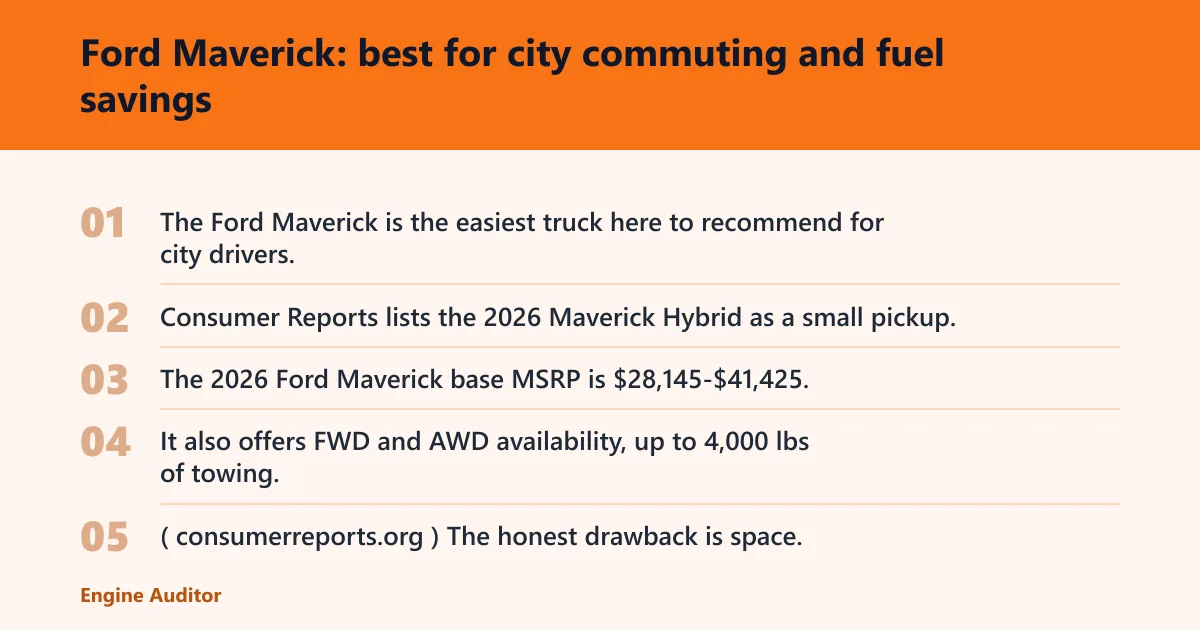
The Ford Maverick is the easiest truck here to recommend for city drivers, solo commuters, and mixed-use buyers who want a bed without stepping into a bulky vehicle. Consumer Reports lists the 2026 Maverick Hybrid as a small pickup, and the EPA-best fuel economy cited at 37 mpg makes it the clear efficiency leader in this group.
The 2026 Ford Maverick base MSRP is $28,145-$41,425. It also offers FWD and AWD availability, up to 4,000 lbs of towing, and up to 1,500 lbs of payload, which is enough for light trailers, home projects, and weekend hauling without demanding a huge footprint. (consumerreports.org)
The honest drawback is space. The Maverick is small, and small works against rear-seat room, bed volume, and long-haul comfort compared with bigger midsize and full-size trucks. If your daily routine includes multiple adults, tall passengers, or frequent heavy towing, you may outgrow it fast.
Say your weekday drive includes a tight apartment garage, two short errands, and a 20-mile commute. That is the Maverick’s sweet spot. It gives you pickup utility without making every parking maneuver feel like a chore.
Honda Ridgeline: best for ride comfort and light-duty use
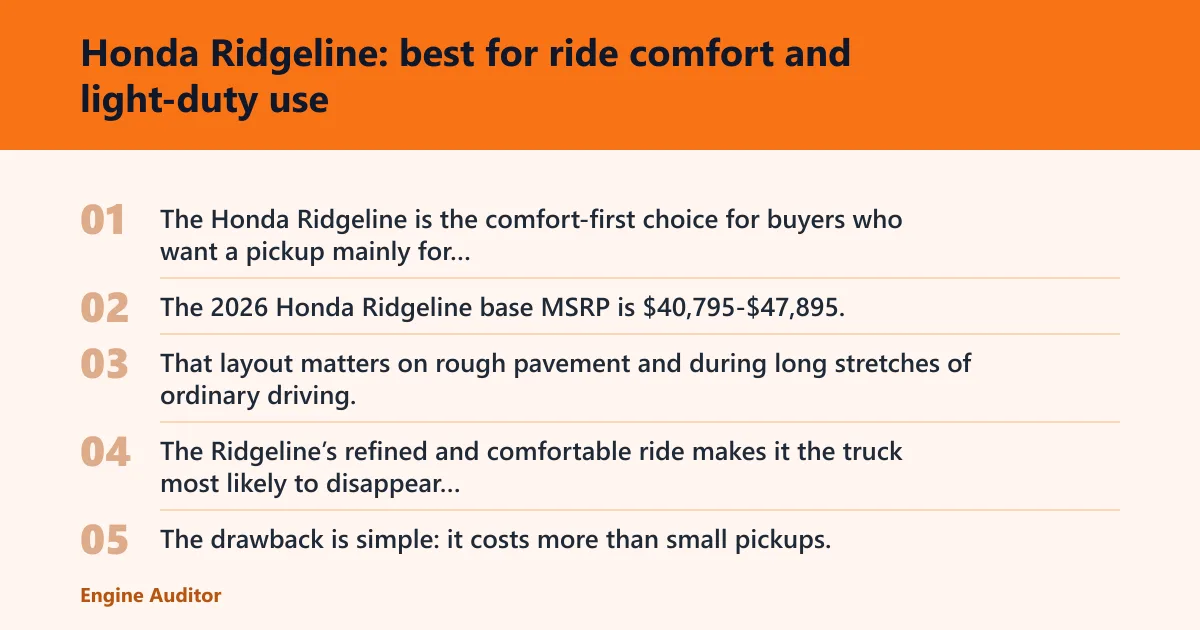
The Honda Ridgeline is the comfort-first choice for buyers who want a pickup mainly for commuting, family duty, and light work. The 2026 Honda Ridgeline base MSRP is $40,795-$47,895, and its unibody construction is a major reason it feels more car-like than a traditional body-on-frame truck.
That layout matters on rough pavement and during long stretches of ordinary driving. The Ridgeline’s refined and comfortable ride makes it the truck most likely to disappear into your routine instead of reminding you that you bought a pickup.
The drawback is simple: it costs more than small pickups, and it does not chase the same work-oriented image as some rivals. If you need a truck for heavy towing or want a more traditional truck feel, the Ridgeline may not match your priorities.
Picture a family that spends most weekdays on school runs and highway commuting, then hauls mulch or bikes on weekends. The Ridgeline fits that pattern well because it keeps daily comfort high while still giving you useful cargo capability.
Is the Toyota Tacoma the best midsize daily driver?
The Toyota Tacoma can be a strong midsize daily driver because it offers broad trim choice, serious utility, and the confidence of a mainstream benchmark. It is not the easiest truck to park or the cheapest to buy in every form, but for many shoppers it lands in the middle ground between commuter friendliness and real truck capability.
The 2026 Toyota Tacoma comes in a broad price range, which shows how wide its lineup is. That range helps because you can shop from simpler daily-driver versions or move into more specialized trims, but it also means the Tacoma can become expensive quickly if you chase equipment you do not need.
Where it works well every day is in suburban and mixed-use driving. It gives you more body control and cargo ability than a small pickup, while staying less imposing than a half-ton full-size truck.
Where it can work against you is size creep and trim inflation. A more capable Tacoma variant can bring more cost, more complexity, and more truck than a commuter really needs.
The best Tacoma buyer wants one truck to do a lot of jobs and does not mind paying for flexibility. If your routine involves commuting all week and towing or carrying gear on weekends, the Tacoma belongs near the top of the shortlist.
Ram 1500: best full-size pickup for everyday comfort
The Ram 1500 is the full-size choice for buyers who want the softest daily-driving experience without giving up half-ton utility. The 2026 Ram 1500 base MSRP is $42,025-$88,800, and its comfort-oriented reputation makes it a serious contender for commuters who still want a big bed and strong capability.
Full-size dimensions are the tradeoff. You get more cabin space, easier child-seat loading, and stronger all-around utility, but you also get more stress in parking garages, tighter lanes, and cramped shopping-center lots.
The Ram makes sense when most of your driving happens on wider roads, suburban arterials, or highways. In that environment, the extra space can feel like a benefit rather than a burden.
The drawback is obvious for city life: size. If you have narrow streets, small parking spaces, or a short commute that includes tight turns and crowded curbside parking, a Ram 1500 can feel like too much truck for the task.
Ford F-150 Hybrid: is a hybrid pickup worth it for daily driving?
The Ford F-150 Hybrid makes sense if you want full-size capability with a stronger fuel-economy story than most traditional half-ton trucks. The 2026 Ford F-150 base MSRP is $37,290-$79,005, and the hybrid powertrain gives daily drivers a better value angle when they need size, towing, and cargo room in one package.
That value comes with a caveat. Full-size trucks still take more space to park, more tires to replace, and usually more insurance than a small or midsize pickup. The hybrid helps fuel spend, but it does not erase the costs that come with a large vehicle.
The best buyer for the F-150 Hybrid is someone who needs a truck for work, family hauling, or towing, but still racks up enough commuting miles for efficiency to matter. It is the right answer when one truck has to do nearly everything.
Consumer Reports also includes hybrid and electric pickup categories, which is useful context for shoppers comparing daily-use costs. Electric pickups can be compelling for some buyers, but for most mainstream daily-driver shoppers, a hybrid half-ton remains the simpler bridge between efficiency and truck utility.
Which one should you buy?
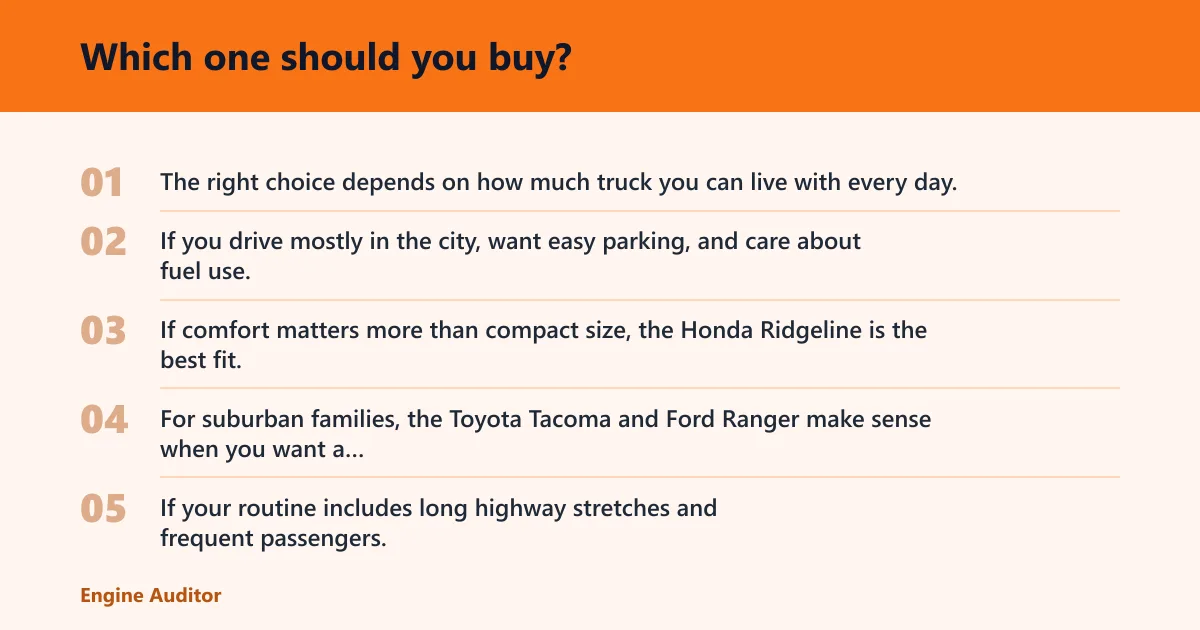
The right choice depends on how much truck you can live with every day. If you drive mostly in the city, want easy parking, and care about fuel use, the Ford Maverick is the cleanest answer. If comfort matters more than compact size, the Honda Ridgeline is the best fit.
For suburban families, the Toyota Tacoma and Ford Ranger make sense when you want a midsize truck that still feels manageable. If your routine includes long highway stretches and frequent passengers, the Ram 1500 is the comfort pick, while the Ford F-150 Hybrid is the smarter full-size choice when fuel spend matters.
If you need occasional towing but still commute daily, start with the Maverick for lighter jobs, the Tacoma or Ranger for stronger midsize capability, and the F-150 Hybrid when towing needs and family duties both stay high. The Hyundai Santa Cruz belongs in the conversation too, especially if you want car-like road manners and up to 5,000 lbs of towing.
Best for city drivers
The Ford Maverick is the easiest truck to park, the easiest to fuel, and the easiest to justify if your errands happen in crowded neighborhoods. Its compact size keeps daily friction low.
Best for suburban families
The Honda Ridgeline offers the most relaxed ride in this group, with enough utility for family life and weekend projects. It is the strongest comfort-first daily driver among the trucks here.
Best for mixed commuting and towing
The Toyota Tacoma is the midsize all-rounder, while the Ford F-150 Hybrid is the better answer if towing needs are higher and daily miles are long. Choose based on how often you really need the extra capacity.
Best budget-friendly choice
The Ford Maverick is the value leader because it starts lower than most rivals and keeps fuel spend in check. The 2026 range of $28,145-$41,425 leaves room to stay near the practical end of the lineup.
Best comfort-first choice
The Ram 1500 is the answer if ride quality and cabin space matter more than parking ease. It feels most at home on highway commutes and in suburban use where size is less of a penalty.
Useful add-ons for everyday truck ownership
MOSTPLUS 6.5FT Roll-Up Soft Vinyl Truck Bed Tonneau Cover: best for Ford F-150 owners who want easy bed access
This cover suits F-150 buyers who want a low-cost way to protect cargo without giving up fast access to the bed. The roll-up design is useful for mixed daily use, where you may switch between groceries, tools, and taller items in the same week.
The no-drill installation and waterproof vinyl are strong everyday advantages. The drawback is that soft covers are easier to cut or flex than hard covers, so security and long-term toughness are not the same as a rigid lid.
Nexus Hard Folding Truck Bed Tonneau Cover: best for Ram 1500 owners who want tougher cargo protection
This hard tri-fold cover fits Ram 1500 drivers who want more protection from weather and a more secure-feeling bed for daily cargo. The tri-fold layout also makes it easier to open part of the bed without removing the whole cover.
It supports up to 450 lbs of evenly distributed static weight, which adds utility. The drawback is price and bulk; hard covers cost more and are heavier to handle than soft options.
Soft Tri-Fold Truck Bed Tonneau Cover: best for Ford F-150 5.5FT beds on a moderate budget
This cover is aimed at F-150 owners who want bed protection and some structure without moving to a hard lid. The triple-layer build and built-in crossbars help it stay more stable than very basic soft covers.
The drawback is the tradeoff that comes with most soft tri-fold designs: it gives you less theft resistance than a hard cover, and full-bed access still takes a bit of folding and handling.
Motor Trend Utility Truck Bed Mat: best for universal bed protection
This mat makes sense if your priority is keeping the bed from getting scuffed by loose cargo, dirty gear, or wet items. It can also help in vans and SUVs, which makes it a flexible everyday-use accessory rather than a truck-only purchase.
The drawback is that a universal mat is not a custom fit. You may need to trim it, and it will not do the same job as a molded bed liner in every truck bed shape.
YITAMOTOR Floor Mats for 2015-2026 Ford F-150 Super Crew Cab: best for keeping the cabin clean
This set is for F-150 SuperCrew owners who want better protection from mud, rain, and everyday mess inside the cabin. If your truck doubles as a family hauler, floor mats matter as much as bed accessories.
The drawback is fitment specificity. These are made for a particular cabin layout, so they are useful only if your truck matches the stated configuration.
Frequently asked questions
What is the best pickup truck for everyday driving?
The Ford Maverick is the best everyday pickup for most buyers because it combines compact size, strong fuel economy, and real utility. It is easier to park than midsize and full-size trucks, and its hybrid setup helps keep daily running costs down.
Which pickup truck is most comfortable for commuting?
The Honda Ridgeline is the comfort leader for commuting because its unibody construction helps it ride more like a crossover than a traditional truck. The Ram 1500 is also a strong choice if you want full-size comfort and can live with the added size.
What pickup truck gets the best fuel economy for daily use?
The Ford Maverick stands out here, with EPA-best fuel economy cited at 37 mpg. That makes it the easiest truck in this group to live with if fuel spend matters every week, not just at purchase time.
Is a midsize pickup better than a full-size truck for everyday use?
For many drivers, yes. A midsize truck usually balances capability and maneuverability better than a full-size model, which helps in parking lots, tight streets, and daily errands. Full-size trucks make sense when you need more cabin room or stronger towing and hauling.
Which pickup trucks are easiest to park in the city?
The Ford Maverick and Hyundai Santa Cruz are the easiest to park because they are smaller than midsize and full-size trucks. Their car-like footprint helps in tight curb spaces, narrow lanes, and crowded store lots where larger trucks become a hassle.
Are hybrid pickup trucks worth it for daily driving?
Yes, if you drive enough miles for fuel savings to matter and still need truck utility. The Ford Maverick Hybrid and Ford F-150 Hybrid show why hybrids work: they cut fuel spend without forcing you to give up a bed, tow rating, or everyday usefulness.
What truck is best if I need towing but still drive it every day?
If towing is occasional rather than constant, the Hyundai Santa Cruz, Toyota Tacoma, or Ford F-150 Hybrid are sensible choices depending on your size needs. The right answer depends on how much of your week is spent commuting versus actually towing.
Products related to this article
Sponsored / affiliate links. As an Amazon Associate I earn from qualifying purchases. I may earn additional commission from eligible campaigns.