Best cars for road trips: Comfort, cargo, and range reviewed
For most road trips, I’d pick a large wagon or midsize SUV, and EV shoppers should aim for 300+ miles of EPA range if they want fewer charging stops and fewer detours. Pick wrong and you buy back pain, cramped luggage, extra fuel or charging stops, and tired passengers by mile 200. This guide matches car types to couples, small families, large families, and EV road trippers using comfort, cargo space, and how often you have to stop.
Top pick: the best road-trip car for most buyers



The Toyota Sienna Hybrid is the best all-around road-trip choice for most families because it mixes easy passenger access, strong cargo packaging, and 2026 Toyota Sienna Hybrid starts at $42,915 pricing with fewer fuel stops than a gas-only van. It is the kind of vehicle that makes luggage decisions simpler instead of harder.
Why this model rises above the rest on highways
A minivan layout helps where road trips get messy. The Sienna’s cabin is easier to load than an SUV, rear passengers sit lower and more naturally, and the sliding doors make child-seat duty far less awkward in tight parking lots. I care about that more than badge value when the trip includes rest stops, snacks, and two hours of back-seat traffic.
It also fits the road-trip checklist better than many crossovers. The floor is flat, the cargo bay is boxy, and folded seats usually leave less wasted space than a sloped SUV tailgate. For families carrying a stroller, cooler, two checked bags, and extra carry-ons, that shape is worth more than a few extra horsepower.
Who should buy it, and who should skip it
Buy it if the trip includes kids, frequent packing changes, and a need to keep fuel stops under control. Skip it if the vehicle must do double duty as a style-first commuter, or if the owner wants a lower, more carlike driving position with sharper handling on empty roads.
According to Best Cars for Road Trips, Ranked – Car and Driver — Car and Driver ranks road-trip cars using roughly 200 data points. (source)
Quick picks by trip type
- Best for couples: 2026 Toyota Camry, 43–51 combined mpg, easy on fuel, simple to park, and strong for two bags plus a weekend cooler.
- Best for small families: 2026 Kia Carnival Hybrid, 32 mpg combined and van-like space without SUV cargo compromises.
- Best for large families: 2026 Toyota Sienna Hybrid, sliding doors, family-friendly access, and better packaging than most three-row SUVs.
- Best for EV road trips: 2026 Hyundai Ioniq 5, up to 318 miles of range and very fast recharge behavior.

Which car is most comfortable for long highway drives?
The most comfortable highway car is the one that keeps the driver fresh, the cabin quiet, and the suspension from fidgeting over broken pavement. In practice, that means supportive seats, calm steering, steady ride quality, and driver-assist systems that cut down the constant little corrections that wear me out after a few hours.
Seat support and driving position
A good road-trip seat supports the thighs without pressure points and holds the torso steady without pinching. Sedans and wagons often do this better than tall SUVs because the seating position is lower and the body does less leaning in corners or crosswinds. The Mercedes-Benz E-Class is a useful reference here; 2026 Mercedes-Benz E-Class starts at $65,150, and it sits squarely in the long-distance comfort lane.
Ride quality and cabin quietness
Highway ride matters more than city softness. A vehicle that feels plush at 25 mph can still tire occupants if it drums on expansion joints at 75 mph. The 2026 Mercedes-Benz S-Class is rated at 20–23 combined mpg, which tells you little about comfort by itself, but the segment exists for buyers who value isolation, calm surfaces, and reduced road noise above all else.
Driver-assist tech that reduces fatigue
Adaptive cruise control and lane centering make a real difference on long interstate days. Hands-free highway systems can help, but they should be treated as fatigue reducers, not drivers. They matter most in steady traffic, where small steering inputs and speed changes pile up and wear on you by the third fuel stop.
How much cargo space do you need for a road trip?
Cargo needs are easier to judge by luggage than by brochure volume. Two adults with two carry-ons and a cooler fit very differently from four people carrying hard-shell suitcases, a stroller, and sports gear. The right body style depends on how often seats must fold and whether baggage must stay inside the cabin.
Carry-ons, suitcases, coolers, and strollers
For couples, a sedan trunk often works if it can swallow two carry-ons, a medium suitcase, and a soft cooler. Small families usually need rear-seat folding flexibility for a stroller and extra bags. Large families need either a minivan or a very efficient three-row layout, because third-row seats often steal the space needed for real luggage.
Folding seats, split-fold layouts, and liftgate openings
Split-fold rear seats matter when the trip mixes passengers and cargo. A 60/40 bench helps, but a flat load floor is more useful when loading oddly shaped bags. Wide liftgate openings beat shallow ones because they let coolers and duffels slide in without gymnastics. This is where minivans beat many SUVs outright.
Roof rails, roof boxes, and when a wagon helps more than an SUV
Roof storage solves overflow, but it adds drag, noise, and loading hassle. The Subaru Outback is a useful example because MotorTrend notes the Subaru Outback has a 220-pound dynamic roof load capacity. That makes it a practical wagon for bikes, boxes, or extra bags when the cabin is already full. For couples and small families, wagons can beat SUVs by keeping the load low and the drive calmer.
Why minivans and wagons beat SUVs for some trips
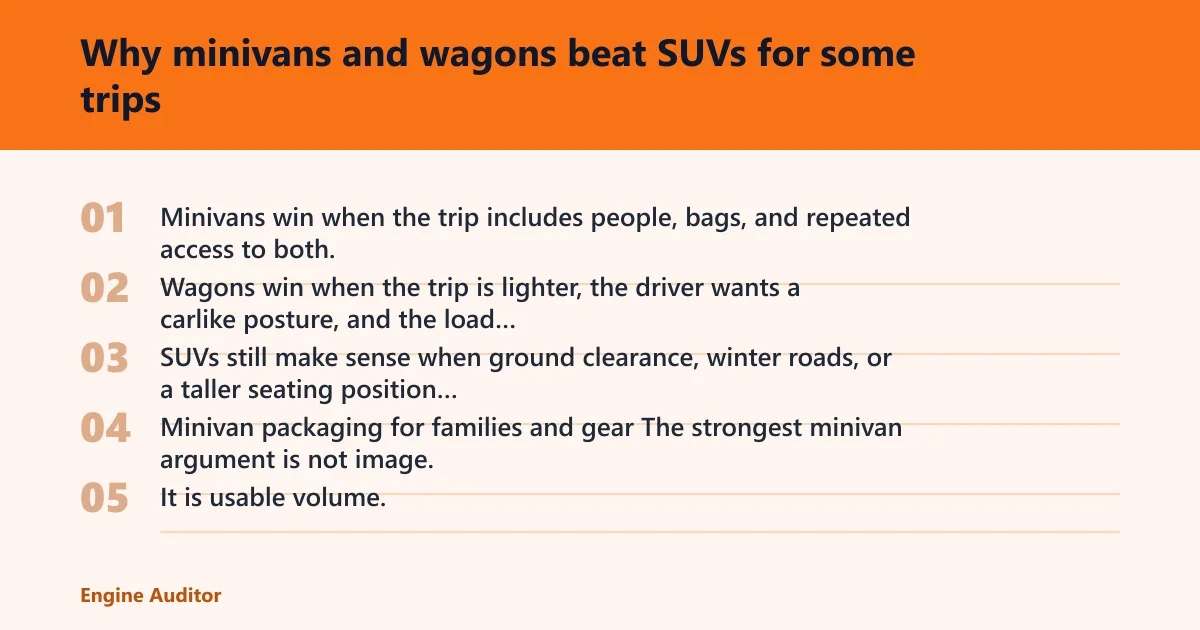
Minivans win when the trip includes people, bags, and repeated access to both. Wagons win when the trip is lighter, the driver wants a carlike posture, and the load must stay inside a lower, more efficient shape. SUVs still make sense when ground clearance, winter roads, or a taller seating position matter more than packaging efficiency.
Minivan packaging for families and gear
The strongest minivan argument is not image. It is usable volume. Sliding doors, flat floors, and easy third-row access make child seats and bag shuffling simpler. The 2026 Kia Carnival Hybrid gets 32 mpg combined, which makes the fuel bill easier to live with for a big-family road trip.
Wagon advantages for couples and small families
Wagons offer long cargo floors, easier roof loading, and better highway feel than many crossovers. They also tend to handle crosswinds and toll-road lane changes with less body motion. When a couple wants one vehicle for daily duty and trip duty, a wagon is often the cleaner answer.
Where SUVs still make sense
An SUV earns its keep when the route includes rough pavement, snow, or a need for higher seating and easier entry. Some families also prefer the social layout of a tall cabin. But if the trip is mostly pavement and luggage, a minivan or wagon often gives more usable space with less fuel burn and less loading drama.
Proof table: matching traveler type to body style and models
| Traveler type | Luggage load | Daily miles | Fueling or charging tolerance | Body-style recommendation | Model choices | Why it wins |
|---|---|---|---|---|---|---|
| Couple | 2 carry-ons, 1 cooler, 1 soft bag | 250 to 400 | One fuel stop or one short charge stop | Wagon or sedan | 2026 Toyota Camry; Mercedes-Benz E-Class; Subaru Outback | Low noise, easy parking, good fuel economy or calm highway manners, and enough room without unused seats. |
| Small family | 2 adults, 1 child seat, stroller, 3 to 4 bags | 250 to 500 | Two brief stops | Wagon or midsize SUV | Subaru Outback; Hyundai Ioniq 5; Toyota Camry | Good split-fold flexibility, child-seat access, and easier loading than a full-size SUV. |
| Large family | 3 rows occupied, 4 to 6 bags, cooler, extras | 200 to 450 | Frequent stops are acceptable if boarding is easy | Minivan | 2026 Toyota Sienna Hybrid; 2026 Kia Carnival Hybrid; Chrysler Pacifica Hybrid | Best passenger access, real third-row usability, and cargo space that stays practical even with people aboard. |
| EV road-tripper | 2 to 4 bags, charging kit, cabin snacks | 200 to 350 | Will plan route and charge stops | EV crossover or sedan | 2026 Hyundai Ioniq 5; Cadillac Escalade IQ; Tesla Model Y | Fast charging, strong range, and access planning that matches the route instead of fighting it. |
| Large-load hauler | Heavy gear, bikes, or camping kit | 200 to 400 | Fuel stops are fine; bed security matters | Pickup or SUV | 2026 Ram 1500; full-size SUV; Subaru Outback with roof load | Useful only when cargo shape or towing matters more than cabin efficiency and quiet. |
What is the best fuel economy for a road trip car?
The best road-trip fuel economy is the level that cuts stops without forcing a bad vehicle choice. For gas and hybrid shoppers, high combined mpg matters most on mixed routes. For EV shoppers, highway range and charging speed matter more than the sticker range alone.
Fuel economy for gas and hybrid cars
The 2026 Toyota Camry is rated at 43–51 combined mpg, which makes it an excellent pick for couples and light-packing travelers. The 2026 Kia Carnival Hybrid gets 32 mpg combined, which is strong for a family van and much easier to live with than a thirsty three-row SUV.
Why highway testing matters
High-speed range and fuel economy often differ from brochure numbers. A car that looks efficient on paper may disappoint at 75 mph with a full cabin and roof box. That is why road-trip reviews should include real highway testing, not just city and combined figures.
When a pickup is the wrong answer
A pickup can be useful for a trip with outdoor gear, but it is usually a poor default for family travel. Bed security is weaker, wind noise is higher, and ride quality can be harsher than a wagon or minivan. The 2026 Ram 1500 starts at $44,820, which may tempt buyers, but it should be chosen for truck duty first and road-trip comfort second.
What range do you need for an electric road-trip car?

In my experience, EV road trips go more smoothly when the car can cover a decent highway stretch and recharge quickly enough to fit meals or restroom breaks. A 300-mile EPA number is a useful target, but real trip range depends on speed, weather, hills, and how much detour is needed to reach a charger.
Highway range versus EPA range
EPA range is only the starting point. At sustained highway speeds, range usually drops, and cold weather cuts it further. The 2026 Hyundai Ioniq 5 is rated at up to 318 miles of range, which gives it a useful buffer for long intercity drives when conditions are favorable.
Fast-charging rate and route planning
Charging speed matters as much as battery size. MotorTrend says the Hyundai Ioniq 5 can recharge from 5 to 80 percent in as little as 22 minutes, which is the kind of stop time that works on a lunch break. Shorter charging windows reduce the penalty for taking the EV instead of a gas car. (motortrend.com)
NACS compatibility and Supercharger access
Charging access is part of the car choice now. Buyers should check whether the model supports NACS compatibility, whether it has Tesla Supercharger access, and how the trip route lines up with high-speed chargers. A good EV road-trip car is only as useful as the charging map around it.
Cold-weather range loss and extra stop planning
Winter trips need reserve. Cold weather, headwinds, and a full cabin can turn a comfortable 300-mile plan into a much shorter practical leg. That means the driver should expect extra stops, slower arrival times, and a backup charging option if the first station is busy or offline.
How to choose the right road-trip vehicle
Start with trip pattern, not brand loyalty. Match fuel economy or range to daily miles, passenger count to seat access, and cargo needs to the number of bags that actually travel. Then decide whether the route rewards a lower wagon, a van, an SUV, or an EV with fast charging.
Fuel economy, range, and stop frequency
If the trip is long and the route is straightforward, fewer stops matter most. Gas and hybrid buyers should look at combined mpg and how that translates into highway stop spacing. EV buyers should look at real charging time, not just peak charging speed on a spec sheet.
Passenger count and seat access
Adults need usable legroom, not just a bench with belts. Children need easy latch access and simple door openings. Third rows are often acceptable for occasional use, but they are rarely the best place for adults on a full day’s drive unless the vehicle is a well-packaged minivan or large SUV.
Noise, ride, and fatigue on long days
Cabin quietness matters more after the sixth hour than the first. Smooth ride quality, low wind noise, and stable steering help reduce fatigue. Driver-assist tech such as adaptive cruise and lane centering can also cut the small corrections that wear a driver down.
Towing, cargo, and ownership costs that matter on trips
Tire wear, fuel stops, toll-road manners, and load security all affect trip cost. A vehicle that drinks fuel, chews tires, or forces bags onto the roof may be cheaper to buy than to run. That is why the right road-trip pick depends on how often it will be packed, not just what the badge says.
Frequently asked questions
What are the best cars for road trips?
The best cars for road trips are usually wagons, minivans, and efficient SUVs that match the actual passenger count and luggage load. For couples, a Camry or E-Class can work well. For families, the Sienna Hybrid and Carnival Hybrid are stronger because they package people and bags with less compromise.
Which car is most comfortable for long highway drives?
A comfortable long-distance car is usually one with supportive seats, a quiet cabin, and calm highway ride quality. Luxury sedans often do this best, but a well-tuned wagon or minivan can be more useful for travel if the trip includes luggage, children, or frequent stopovers.
How much cargo space do you need for a road trip?
Two adults can often get by with a trunk and one extra bag area. Add children, and the plan changes fast. A stroller, cooler, and several suitcases usually push buyers toward a wagon, minivan, or three-row SUV with split-fold seats and a wide cargo opening.
What is the best fuel economy for a road trip car?
For gas and hybrid vehicles, higher combined mpg usually means fewer fuel stops and lower trip cost. The 2026 Toyota Camry at 43–51 combined mpg is excellent for light loads, while the 2026 Kia Carnival Hybrid at 32 mpg combined is a strong family choice when space matters more than absolute efficiency.
Are minivans or SUVs better for road trips?
Minivans are better when the trip involves people, strollers, child seats, and heavy luggage. SUVs make more sense when the route is rough, snowy, or height and ground clearance matter. For pure packing and passenger ease, minivans usually win. For winter duty and mixed terrain, some SUVs justify their tradeoffs.
Which EVs are good for road trips with fast charging?
EVs with strong range and quick DC fast charging work best. The 2026 Hyundai Ioniq 5 is a clear example, with up to 318 miles of range and a 5 to 80 percent recharge in as little as 22 minutes. Buyers should also check charger access along the planned route.
What range do you need for an electric road-trip car?
Around 300 miles of EPA range is a helpful target for easier planning, especially if the route includes cold weather or fast highway speeds. More range gives more flexibility, but charging speed and charger availability still matter. A shorter-range EV can work if the driver plans stops carefully and accepts longer breaks.
What car is best for a long road trip with kids and luggage?
A minivan is usually the best answer because it makes child-seat loading, third-row access, and luggage stacking easier than most SUVs. The 2026 Toyota Sienna Hybrid is especially strong for this use. It reduces packing friction, which matters more than badge prestige after the first 300 miles.
Products related to this article
Sponsored / affiliate links. As an Amazon Associate I earn from qualifying purchases. I may earn additional commission from eligible campaigns.