How to Compare Two Cars Before Buying
A common comparison method is to score two cars on a 100-point sheet: about 40 for must-haves, 30 for ownership costs, 20 for safety and practicality, and 10 for test-drive feel. Skip that structure, and the lower sticker can hide higher fuel use, insurance, repairs, or daily annoyance. This guide shows how to weight the factors, compare new and used options, and separate paper specs from road behavior.
Start with your must-haves
Begin by deciding which requirements are non-negotiable, then compare only the cars that clear those filters. Consumer Reports says the first step is deciding whether buying new or used is right for you. After that, narrow by body style, budget ceiling, seat count, cargo need, drivetrain, and any feature you will not compromise on. (Consumerreports)
Separate needs from wants
List five to seven must-have features, then treat everything else as a trade-off. Faye Giles recommends that range because it keeps the decision tight enough to score honestly without turning the process into a wish list.
Good must-haves are concrete: all-wheel drive, a power liftgate, Android Auto or Apple CarPlay, a rear-seat anchor setup, or a specific towing rating. Vague goals such as “nice interior” are too broad to score well.
Set your price ceiling and body-style boundary
Set the highest total outlay you can accept, not just the sticker number. Then choose the body style you will compare, such as sedans, compact SUVs, or another pair in the same class. A hatchback and a three-row SUV can be compared, but only if you score cargo room, seat access, and ownership cost on the same terms.
- Write down your must-haves.
- Choose a body style and size class.
- Set a hard budget ceiling.
- Eliminate any car that fails a must-have.
- Score the remaining cars on the same scale.
📊 Consumer Reports says it tests cars through more than 50 tests. Source: Consumerreports.
Compare the total cost of ownership
Use the window sticker as the starting point, not the finish line. MSRP is the manufacturer’s suggested retail price, and it is the baseline for new-car pricing comparisons. From there, add discounts, dealer add-ons, APR, fees, depreciation, insurance, fuel, and maintenance so you compare the whole cost picture.
Use MSRP and discount as the starting point
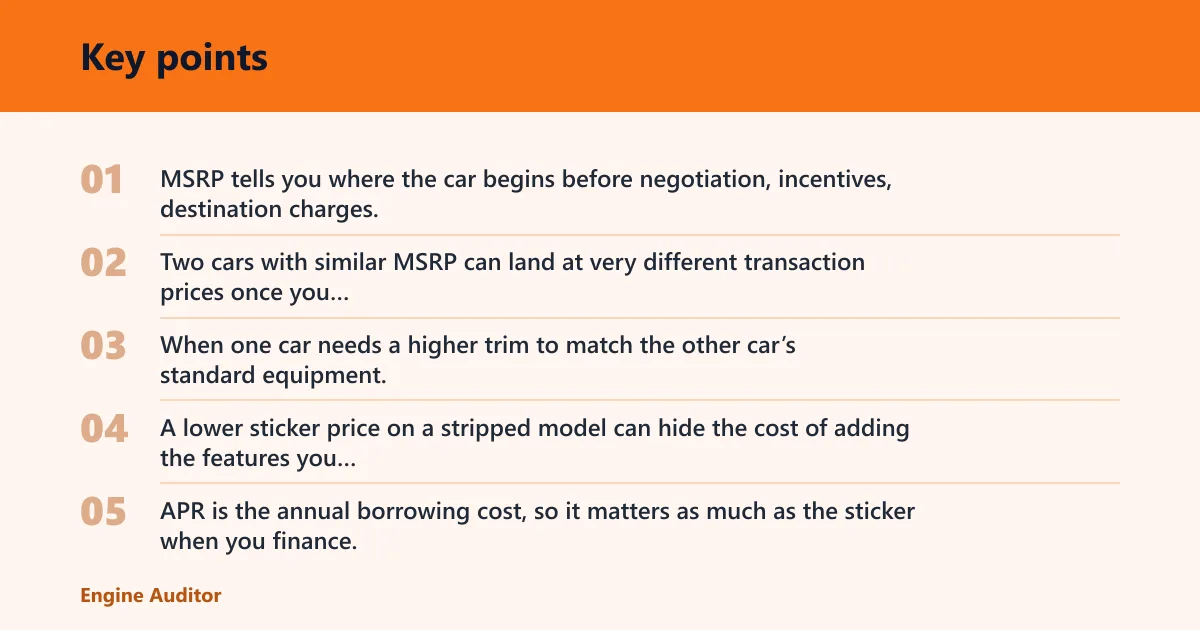
MSRP tells you where the car begins before negotiation, incentives, destination charges, and dealer extras. Two cars with similar MSRP can land at very different transaction prices once you account for trim content and markups.
When one car needs a higher trim to match the other car’s standard equipment, compare those trims directly. A lower sticker price on a stripped model can hide the cost of adding the features you actually want.
Add APR, fees, and loan length
APR is the annual borrowing cost, so it matters as much as the sticker when you finance. Compare the loan term, the rate, and any financing fees together. A lower monthly payment can hide a longer loan that costs more overall.
For a fair comparison, use the same down payment, same term length, and same credit assumptions for both cars. If one dealer rolls extra fees into the loan, that car’s true cost rises even if the advertised payment looks similar.
Factor in depreciation, insurance, fuel, and maintenance
Depreciation is the vehicle’s value lost over time and miles, and it is a major part of true cost of ownership. Insurance and registration vary by model, trim, safety equipment, repair cost, and local rules. Fuel and maintenance can swing the result even when the purchase prices are close.
Suppose one compact SUV costs $2,000 less upfront but uses more fuel, carries higher insurance, and loses value faster. The cheaper sticker may still be the more expensive car after three or five years.
What should you compare on the window sticker?
Start with the trim name, engine, drivetrain, transmission, and standard equipment on each sticker. Then compare fuel-economy ratings and any package content that changes the ownership equation. The goal is not to memorize specs; it is to verify that both cars are being compared at the same equipment level.
Check trim-level equipment differences
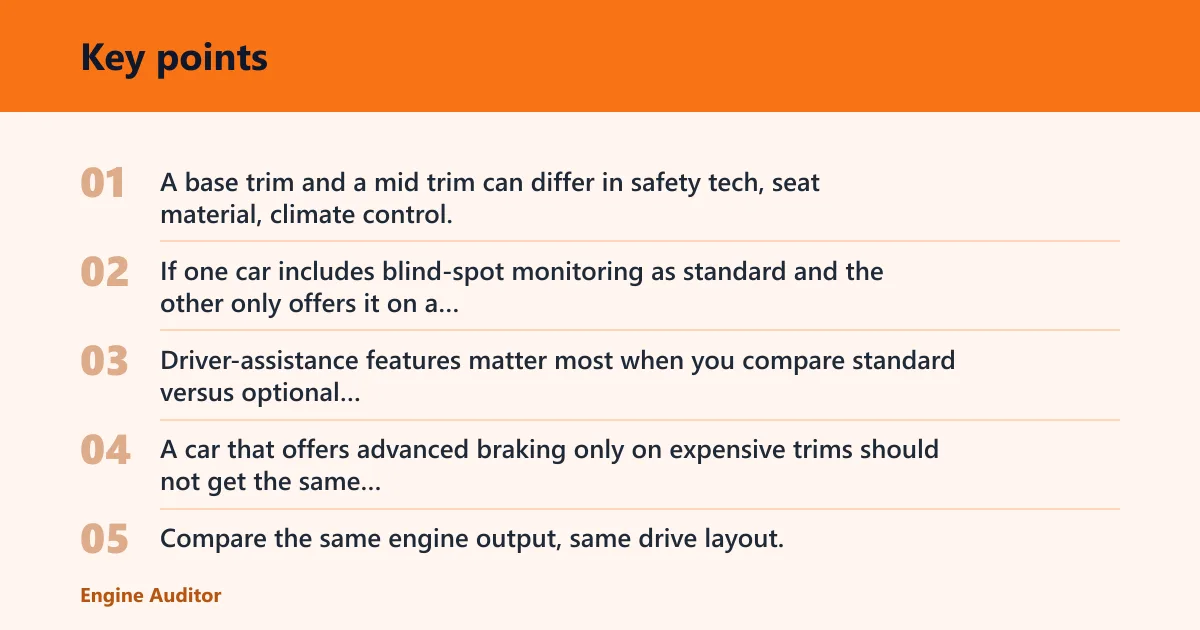
A base trim and a mid trim can differ in safety tech, seat material, climate control, and infotainment hardware. If one car includes blind-spot monitoring as standard and the other only offers it on a higher trim, note that gap before you score safety or tech.
Driver-assistance features matter most when you compare standard versus optional equipment. A car that offers advanced braking only on expensive trims should not get the same safety score as a rival that includes it lower in the lineup.
Match engine, drivetrain, and transmission
Compare the same engine output, same drive layout, and same transmission type whenever possible. All-wheel drive, front-wheel drive, and rear-wheel drive can change fuel use, traction, and price. A hybrid version should not be compared directly with a gasoline-only version unless you separate the powertrain category from the rest.
Use fuel-economy numbers the same way for both cars
Compare city MPG, highway MPG, and combined MPG for each vehicle. Toyoland says its comparison tool includes those three figures, along with efficiency data for new cars, used cars, and trims of the same model. If one car is electric or hybrid, compare the equivalent efficiency figure the same way you would compare MPG.
Crash-test ratings and safety features
Use crash-test ratings as a filter, not as a shortcut. Consumer Reports bases its safety rating partly on crash tests from IIHS and NHTSA, and it also says it tests cars through more than 50 tests. Compare the ratings, then check whether the trim you want includes the safety hardware that supports those ratings.
Read IIHS and NHTSA ratings correctly
IIHS and NHTSA do not measure the same thing in the same way, so read both. A strong result in one system does not cancel a weaker result in the other. Focus on the specific crash categories, not just a broad safety headline.
Compare standard versus optional driver-assistance tech
Look for automatic emergency braking, lane-keeping support, blind-spot monitoring, rear cross-traffic alert, and adaptive cruise control. Then confirm whether each feature is standard, optional, or bundled into a higher trim. The same source says its comparison tool covers driver-assistance features and crash-test context.
Look for trim-specific safety gaps
Two trims of the same model can score differently in practical safety because one trim lacks a camera system, parking sensors, or a better headlight package. Do not assume every trim carries the same equipment. Read the exact trim line before you score safety.
How do you compare driving feel?
Compare ride comfort, steering, braking, visibility, and cabin noise on the same route if possible. A car can win on paper and still feel tiring in traffic or on the highway. The same source recommends judging steering responsiveness, brake confidence, ride smoothness, and cabin noise during test drives.
Judge ride comfort and cabin noise
Ride comfort matters most over rough pavement, expansion joints, and speed bumps. Listen for tire noise, wind noise, and engine drone at city and highway speeds. A quiet cabin reduces fatigue, especially if you drive long distances or carry passengers often.
Check steering, braking, and visibility
Steering should feel predictable, not vague or nervous. Brakes should inspire confidence without feeling grabby. Visibility matters in parking lots, merging, and lane changes, especially if one car has thicker roof pillars or a taller beltline than the other.
Picture two crossovers with similar MPG. One turns in cleanly and stops with a firm pedal; the other feels floaty and has a rear window that is hard to judge while backing out of a space. The second car can lose the comparison even if its spec sheet looks better.
Note low-speed and highway behavior
Check both slow-speed maneuvering and highway stability. Some cars feel fine at 25 mph but get loud, busy, or unsettled at 70 mph. If one car needs more steering correction on center, mark that against it in your scorecard.
Two cars table
Use the same scorecard for both cars and keep the categories visible while you shop. The same source says its comparison tool shows specs, performance, safety, fuel economy, value, dimensions, cargo space, and driver-assistance features, and that it works for new cars, used cars, and different trims of the same model. A simple text comparison can do the same job if you score it consistently.
| Category | Weight guide | Must-have filter | Car A | Car B | Winner |
|---|---|---|---|---|---|
| Price | 10 | Within budget ceiling | MSRP $31,500; transaction $30,200 | MSRP $33,000; transaction $31,100 | Car A |
| Financing | 10 | APR and term fit your plan | 6.2% APR, 60 months, $495 fees | 5.4% APR, 72 months, $695 fees | Car B |
| Depreciation | 10 | Resale outlook acceptable | Expected moderate loss | Expected lower loss | Car B |
| Fuel economy | 10 | City, highway, combined all acceptable | 27 / 34 / 30 MPG | 31 / 38 / 34 MPG | Car B |
| Insurance | 10 | Premium fits monthly budget | Estimated lower premium | Estimated higher premium | Car A |
| Reliability | 10 | No known major trouble pattern | Average history, few common issues | Mixed history, one known issue area | Car A |
| Safety | 10 | Strong IIHS and NHTSA context | Good ratings, standard AEB | Good ratings, AEB optional on trim | Car A |
| Cargo/passenger room | 10 | Fits people and daily gear | 39.2 cu ft cargo, tighter rear seat | 37.8 cu ft cargo, better rear seat | Car B |
| Tech usability | 10 | Easy menus, good phone integration | Clear layout, faster response | Slower menus, more taps | Car A |
| Driving feel | 10 | Ride, steering, braking, noise acceptable | Quieter, firmer steering | Softer ride, less precise feel | Car A |
| Total score | 100 | Pass/fail filters met? | 84 | 79 | Car A |
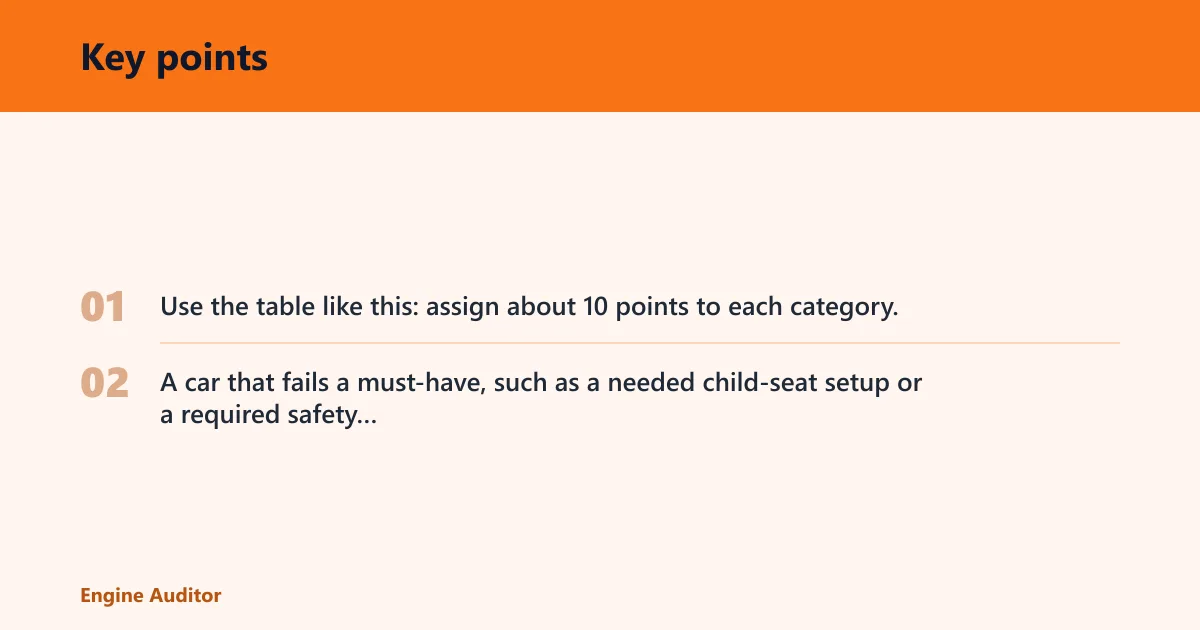
Use the table like this: assign about 10 points to each category, then lower the score if a car misses a detail that matters to you. A car that fails a must-have, such as a needed child-seat setup or a required safety feature, should be removed before you total the points.
New vs used, and when each makes sense
New and used cars solve different problems. New cars usually offer the latest features, full warranty coverage, and no prior wear. Used cars often reduce depreciation pain and may let you move up a trim or body style for the same budget. The same source says the new-versus-used decision should be made first, because it changes every other comparison.
Weigh warranty coverage against depreciation
A new car may cost more up front, but it can bring fuller warranty coverage and cleaner service history. A used car may absorb much of the initial depreciation already, which can improve value if the model has a strong reliability record and a good maintenance history.
Compare feature content across model years
Older model years may lack current driver-assistance tech, better infotainment, or revised safety equipment. Compare trims across years, not just badges. A used higher trim can be a smarter buy than a new base trim if the equipment difference matters to you.
Check service history and known problem areas
Reliability history should include predicted reliability, common trouble-area data, and owner experience signals. A model with a strong reputation can still have a weak trim, a troublesome transmission, or a problem year. Check the exact year and engine before you score reliability.
Suppose a used midsize sedan is $4,000 cheaper than a new compact SUV. If the sedan needs premium tires, has higher insurance, and lacks the safety tech you want, the lower purchase price may not make it the better buy.
Frequently asked questions
How to compare safety ratings between two cars
Check both IIHS and NHTSA results, then confirm the trim’s standard safety equipment. A broad good rating does not mean every trim has the same driver-assistance hardware. Compare the exact crash categories and the exact trim before you call one safer.
How to compare maintenance costs between car models
Compare routine service intervals, tire size, brake wear, and known problem areas for the exact model and trim. Add those costs to fuel, insurance, and depreciation instead of treating them as separate topics. A car with cheap service visits can still cost more overall if it depreciates faster.
Buying used car vs new car
Choose new if warranty coverage, current safety tech, and feature content matter more than the first few years of depreciation. Choose used if you want lower up-front cost and can verify service history, accident history, and known trouble areas. The better answer depends on total ownership cost, not sticker price alone.
Can you buy two cars at once?
Yes, but compare them separately and verify the combined payment, insurance, registration, and maintenance burden before you sign. Two cars can work if one is a daily driver and the other fills a special role. For most buyers, the better question is whether one car can meet both needs well enough.
Products related to this article
Sponsored / affiliate links. As an Amazon Associate I earn from qualifying purchases. I may earn additional commission from eligible campaigns.