How to Compare Car Reviews from Multiple Sources Better
Compare car reviews by converting every score to a 10-point scale, matching the exact trim and model year, and weighting evidence 50% expert reviews, 25% safety data, and 25% owner/ownership data. Skip that, and you can overpay for a trim with worse equipment or miss a year-to-year change that affects reliability. This guide shows a repeatable comparison method, how to spot trim mismatches, and how to combine expert opinions, owner feedback, safety scores, and ownership costs.
This guide is part of our Car comparison guide series.
Match Configurations and Normalize Scores
Start with the same vehicle configuration, not the same model name. Convert each source to a 10-point baseline, separate test data from opinions, and check whether the review covers the base engine, a higher trim, or a different model year. If the configurations do not match, the ratings do not mean the same thing.
Separate impressions, test data, and ownership data
Professional reviews often mix road-test impressions, instrumented testing, and feature checks. Owner reviews reflect long-term use, but they also bring selection bias and a wider spread of trim and engine combinations. Safety, reliability, fuel economy, and ownership costs belong in their own buckets, because each one answers a different question.
Say your shortlist includes a compact SUV with a base engine, a turbo upgrade, and available all-wheel drive. A 7.8/10 review of the turbo model should not be treated as a 7.8/10 score for the base engine with front-wheel drive. That mistake can change acceleration, fuel economy, insurance cost, and even brake wear.
Convert every score to one common scale
Normalization keeps mixed formats comparable. A 4/5-star score is roughly 8/10. An 87/100 converts to about 8.7/10. A letter grade needs a fixed conversion rule before you compare it with other sources. Keep the original score next to the converted score so the math stays visible.
Which review sources should you trust most?
The best source depends on the question. Professional reviews are strongest for test method, safety equipment, ride and handling, and cabin layout. Owner reviews are useful for long-term patterns, but only after you check sample size, recency, and whether complaints cluster around one trim or powertrain. Safety, reliability, and fuel economy databases are best when you need standardized data.
Professional reviews and their test methods
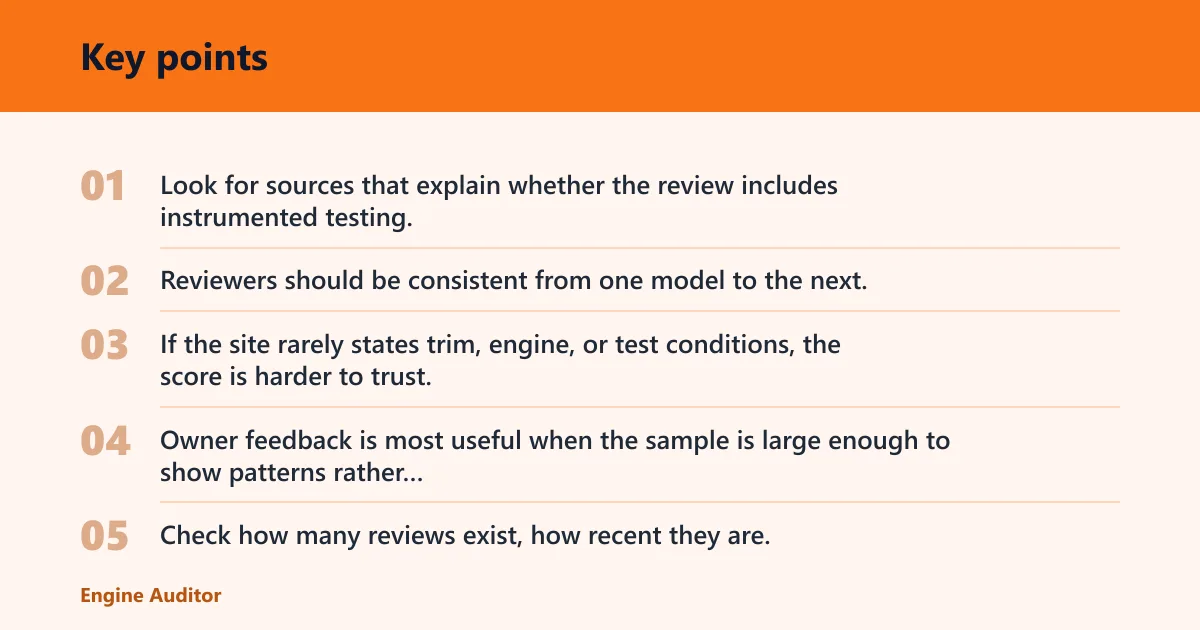
Look for sources that explain whether the review includes instrumented testing, measured braking, acceleration, or fuel economy, or only subjective impressions. Reviewers should be consistent from one model to the next. If the site rarely states trim, engine, or test conditions, the score is harder to trust.
Owner reviews and sample-size limits
Owner feedback is most useful when the sample is large enough to show patterns rather than isolated anger or praise. Check how many reviews exist, how recent they are, and whether the comments mention the same failure mode across multiple posts. One transmission complaint means little; twenty similar reports on the same model year matter more.
Safety, reliability, and fuel economy databases
Safety ratings from IIHS and NHTSA are valuable because they use repeatable categories, including crash tests and active safety features. Reliability databases should separate repair frequency from repair severity, and they should show model-year differences. EPA fuel-economy numbers give a standard baseline, but real-world driving often varies with traffic, terrain, tires, and drivetrain.
How do I compare ratings that use different scales?

Convert stars, points, grades, and percentages to 10 points before comparing them. Then weight the categories by your use case and keep the original source score beside the converted score. That avoids mixing a 4-star family-hauler review with an 8.7/10 sport-sedan review as if the sites used the same rubric.
| Source score | Conversion rule | 10-point score | Example note |
|---|---|---|---|
| 4/5 stars | Score × 2 | 8.0 | Common on consumer and editorial sites |
| 8.7/10 | Already on a 10-point scale | 8.7 | Use as written |
| 87/100 | Divide by 10 | 8.7 | Keep one decimal place |
| B+ | A=10, B=8, C=6, D=4, F=0; add 0.5 for plus, subtract 0.5 for minus | 8.5 | Use the same rule for every grade-based source |
| 78% | Divide by 10 | 7.8 | Useful for database-style summaries |
Weight review categories by your use case
A family car buyer may weight safety at 35%, reliability at 25%, ownership cost at 20%, comfort at 10%, fuel economy at 10%. A commuter may shift more weight toward fuel economy and maintenance cost. A used-car shopper often should raise reliability and repair-severity concerns above styling or infotainment comments.
Keep the original source score beside the converted score
Do not erase the source’s native rating. The original score tells you how the site frames its editorial judgment. The converted score lets you compare across sources. Both matter, especially when a site is known for harsher scoring or unusually generous grades.
Check trim, engine, and model-year details first
Trim, engine, and model-year mismatches are one of the fastest ways to misread car reviews. A base model can have different seats, tires, brakes, wheels, driver-assistance features, or sound insulation than a higher trim. Refreshes and software updates can also change behavior without changing the name on the tailgate.
Base model versus higher trim
Read the exact trim in each review. A review of a loaded trim with leather, adaptive suspension, and upgraded audio can sound much better than a base car with cloth seats and smaller wheels. That does not mean the lower trim is bad; it means the review was about a different product.
Refreshes, software updates, and hardware changes
Published date matters because a midcycle refresh can bring new engines, a revised transmission, improved driver-assist software, or deleted features. A review from last year may no longer match what a dealer sells today. For EVs, software updates and battery changes can alter range, charging behavior, and infotainment quality.
Used versus new vehicle differences
Used-car reviews should be checked against model-year change logs and known problems for that year, not just the current lineup page. A 2021 version of a sedan may differ from a 2024 version in infotainment, safety tech, and transmission tuning. If buying used, prioritize year-specific reliability and repair data over a current model review.
How do you spot bias and weak evidence?
Bias is not always deception. It can come from affiliate incentives, test procedures, editorial preferences, or owner selection bias. A source is stronger when it states how it tested the vehicle, separates facts from opinion, and stays consistent from one vehicle to the next. Weak evidence usually hides in vague praise and thin samples.
Affiliate incentives and editorial incentives
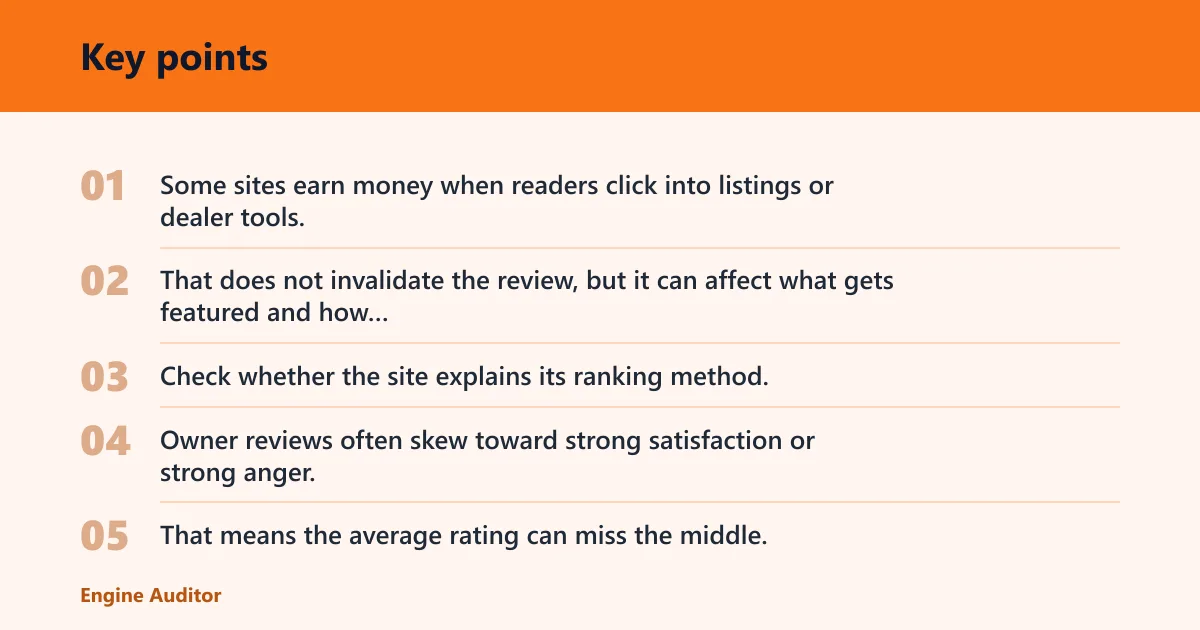
Some sites earn money when readers click into listings or dealer tools. That does not invalidate the review, but it can affect what gets featured and how quickly a page is updated. Check whether the site explains its ranking method, whether paid placements are clearly labeled, and whether the editorial scoring is separate from commerce pages.
Owner-review selection bias and complaint clusters
Owner reviews often skew toward strong satisfaction or strong anger. That means the average rating can miss the middle. Search for repeated complaints about one system, such as transmission hesitation, infotainment freezes, or premature tire wear. A cluster across many owners is more informative than one dramatic story.
When a source is consistent enough to trust
Consistency matters more than perfection. A source that scores comparable vehicles with similar criteria, states its test method, and uses the same terminology from model to model is easier to interpret than a site that changes standards every year. If the source cannot explain its scoring, treat its number as a rough opinion rather than a precise measure.
A common first-timer mistake is treating an owner rating and a professional rating as if they answer exactly the same question. They do not. The professional review asks how the car performs in a structured test; the owner review asks how the car behaves after months of commuting, school runs, road trips, and repair visits.
How do I use multiple car review sites without getting overwhelmed?
Use a worksheet and give each source one role. Pick one professional review, one owner-review source, one safety source, one reliability source, and one fuel-economy or ownership-cost source. That keeps the process manageable while still giving you enough evidence to compare trims, years, and use cases.
Printable car-review comparison worksheet
- Write the exact year, model, trim, engine, drivetrain, and option package.
- List each source, published date, and original score.
- Convert every score to a 10-point scale.
- Record the source type: professional, owner, safety, reliability, fuel economy, or ownership cost.
- Add notes on trim match, model-year match, and any refresh or update mentioned.
- Rate safety, reliability, comfort, fuel economy, and ownership cost from 1 to 10 for your use case.
- Mark a bias check: affiliate, sample size, recency, or complaint clustering.
- Write a final note: buy, keep researching, or remove from shortlist.
| Source | Type | Original score | 10-point score | Trim/year match? | Bias check |
|---|---|---|---|---|---|
| Editorial review A | Professional | 8.4/10 | 8.4 | Yes, base trim, current year | Method explained; instrumented tests included |
| Owner reviews B | Owner | 4.2/5 | 8.4 | No, mixed trims and years | Large sample, but complaint clustering on infotainment |
| Safety data C | Safety | Good overall | 8.0 | Yes, same model year | Includes crash categories and active safety details |
| Reliability data D | Reliability | 72/100 | 7.2 | Yes, prior year included for comparison | Shows repair frequency and repair severity separately |
How should I resolve conflicting reviews?
When sources disagree, give more weight to the evidence that matches your use case and the exact vehicle configuration. Then look for repeated patterns across independent sources. If a professional review praises ride comfort but owners report harsh tires on the same trim, the trim or wheel package may explain the split. If not, keep researching.
Compare professional road tests with owner feedback
Professional road tests are useful for braking, handling, cabin noise, and seat support under controlled conditions. Owner feedback is better for long-term wear, infotainment glitches, and maintenance patterns. If they disagree sharply, ask whether the difference comes from the test method, the trim level, or the time horizon.
Give more weight to the source that matches your use case
A daily commuter may care more about fuel economy, warranty coverage, and seat comfort than lap-time figures. A family buyer may care more about crash-test results, rear-seat access, and cargo volume. A used-car shopper should care more about repair patterns and model-year changes than launch-day styling opinions.
Look for repeated patterns across independent sources
One review can be wrong. Three independent sources pointing to the same issue deserve attention. If multiple reviews mention weak brake feel, poor rear visibility, or expensive tires, treat that as a pattern. If one source alone complains, inspect the trim and model year before deciding it is a true flaw.
How many reviews should I read before buying a car?
Read enough to cover the major evidence types, not a random pile of opinions. A practical minimum is one professional review, one owner-review source with a decent amount of volume, one safety source, one reliability source, and one fuel-economy or ownership-cost source. Add more only when the first set reveals a disagreement or trim mismatch.
Use a small, balanced set of sources
Too many sources can blur the decision instead of clarifying it. Start with a tight set, then expand only if the evidence conflicts. Most shoppers do better with five focused sources than with twenty mixed pages that repeat the same summary or rank vehicles by different standards.
What matters most when comparing car reviews for a family car?
For a family car, safety, rear-seat usability, cargo space, reliability, and ownership cost usually matter more than peak acceleration or steering feel. Check crash-test results, active safety features, rear-seat anchor points, child-seat access, warranty coverage, and model-year reliability before giving much weight to styling opinions.
Family priorities should drive the weights
A minivan with average driving excitement can still be the better family choice if it has better seat access, more useful cargo space, and stronger safety results. A three-row SUV with flashy features may look appealing, but if the third row is cramped and the ownership cost is high, the review score may mislead.
How do I weigh safety, reliability, and comfort reviews together?
Use a weighted score that matches how you will use the vehicle. Safety should come from crash-test categories and active safety features. Reliability should come from repair frequency, repair severity, and year-specific consistency. Comfort should come from ride quality, seat support, noise levels, and interior layout. Add the weights, then compare the totals.
Simple weighting formula you can reuse
Multiply each category score by its weight, then add the results. For example, using one possible set of scores and weights can produce a total in the high 7s. That number means more than a raw star rating because it reflects your priorities.
Are car review ratings from different sites comparable?
Only after conversion. A 4-star rating on one site and an 8.7/10 on another are not directly comparable until you translate them to the same scale and confirm they refer to the same trim and model year. Even then, methodology differences can make one site more conservative than another.
Why side-by-side comparison helps
Side-by-side comparison makes hidden differences visible. It shows whether one site reviewed a base model while another reviewed a loaded trim, whether one source used measured testing, and whether one review was written before a refresh or software update. That context matters as much as the number.
How do I spot bias in car reviews?
Check who benefits from the page, how the score is produced, and whether the sample is representative. Affiliate links can shape presentation. Editorial testing can favor a certain driving style. Owner reviews can overrepresent extreme satisfaction or frustration. Bias is not always fatal, but it should change how much weight you give the source.
Bias-check column for each source
Use three questions: Is the scoring method stated? Is the sample large enough and recent enough? Does the source focus on the exact trim and year? If the answer is no to two of those, reduce the weight of that source in your final decision.
Should I trust owner reviews or professional reviews more?
Trust neither alone. Professional reviews are usually better for structured comparison, measured performance, and trim-by-trim feature analysis. Owner reviews are better for long-term issues, repair pain, and recurring annoyances that appear after the honeymoon period. The best answer comes from combining both.
Use each source for the question it answers best
Professional reviews answer, “How does this car perform now?” Owner reviews answer, “How does this car hold up after months or years?” If the same issue appears in both places, it deserves attention. If they disagree, check trim, year, and sample quality before making a call.
How do I compare two car reviews that disagree?
First, verify that both reviews cover the same trim, engine, drivetrain, and model year. Then compare their methods. A disagreement based on measured testing versus subjective impressions is often less serious than it looks. If the conflict remains after the configuration check, treat it as a cue to gather more sources.
Use the disagreement as a diagnosis tool
Strong disagreement can reveal hidden differences. One review may reflect base-model tires, while another uses a higher trim with larger wheels. One may be pre-refresh; the other post-refresh. One may focus on daily comfort, while the other rewards sporty handling. The disagreement itself can be useful.
Frequently asked questions
How do I compare car reviews from multiple sources?
Match the exact trim, model year, engine, and drivetrain first. Then convert every rating to a 10-point scale, separate expert tests from owner feedback, and weigh safety, reliability, comfort, fuel economy, and cost by your use case. That method keeps mixed reviews from distorting the buying decision.
Which car review sources are most reliable?
The most reliable sources are the ones that explain their method and stay consistent. Professional reviews are strongest for test data and trim-specific impressions. Safety agencies such as IIHS and NHTSA are strongest for crash results. Reliability and fuel-economy databases matter most when you need standardized, repeatable numbers.
Products related to this article
Sponsored / affiliate links. As an Amazon Associate I earn from qualifying purchases. I may earn additional commission from eligible campaigns.