Best Used Cars Under $15,000: Smart Buys Compared
The best used cars under $15,000 are usually a Toyota Corolla, Honda Civic, Mazda3, or Ford Fusion if you buy the cleanest, lowest-risk example you can find, not the newest badge. Buy the wrong one and repairs, poor fuel economy, or bad winter traction can erase the savings fast. This guide ranks smart buys by total ownership value, including reliability, mileage, maintenance risk, fuel economy, practicality, and resale value.
What matters most under $15,000

Price matters, but risk matters more. Under this budget, the cheapest car is often the one with the most deferred maintenance, the roughest tires and brakes, and the weakest paper trail. A slightly pricier car with clean records can cost less over the next 12 to 24 months.
Price versus risk: why the cheapest car is often the worst deal
A low asking price can hide overdue fluids, worn suspension parts, weak batteries, and transmission neglect. Those items are not cosmetic. They affect starting, stopping, highway stability, and the next round of repairs you will face soon after purchase.
That is why ownership value beats sticker price. A car around $12,500 with documented service and fresh consumables can be a smarter buy than a car around $9,000 that needs tires, brakes, a battery, and a major service in the first month.
Mileage bands: where higher miles can still be the better buy
The usual sweet spot is 40,000 to 90,000 miles, with 3 to 5 years old often giving the best balance of price, condition, and remaining life. That said, a higher-mileage car with complete service records can beat a lower-mileage car that missed oil changes and sat on old fluids.
Say your choice is a 2015 sedan with 75,000 documented miles versus a 2012 example with 58,000 miles and no records. The higher-mileage car can be the safer buy if the service history is solid and the inspection shows normal wear rather than hidden neglect.
How ownership costs change after purchase
Purchase price is only the first bill. After that come tires, brakes, fluids, filters, registration, insurance, and any catch-up work the seller did not handle. On some cars, transmission service or timing-belt service can turn a bargain into a project.
Used-car buyer matrix
This matrix ranks common budget picks by total ownership value and risk, not badge reputation alone. The score reflects how much money and uncertainty you are likely buying with the car, assuming a clean title and an inspection before purchase.
| Model | Purchase price and typical mileage | Repair-risk zones and likely catch-up maintenance | Best use case and total-value score |
|---|---|---|---|
| Toyota Corolla | Common in the lower half of the budget; often 40,000 to 90,000 miles in this range | Watch for suspension wear, brakes, battery age, and overdue fluids; the Corolla entry puts basic service at about $250 to $350 annually and major service at $600 to $900 | Best for commuters who want low ownership cost and simple upkeep; score: 9/10 |
| Honda Civic | Some budget examples fall in the 40,000 to 90,000-mile band. | Check CVT service history on applicable trims, plus brakes, tires, and cabin wear | Best for buyers who want comfort, good highway behavior, and strong everyday value; score: 8.5/10 |
| Mazda 3 | Usually a little higher in asking price for comparable miles because of demand | Inspect for worn suspension components, infotainment glitches, and tire wear from spirited driving | Best for drivers who want sharper handling and strong resale value; score: 8/10 |
| Hyundai i30 | Often strong value-for-money, especially in older hatchback examples | Check service records closely, along with brakes, mounts, and electronics | Best for buyers who want equipment, ride comfort, and lower purchase price; score: 7.5/10 |
| Honda Accord | Usually a larger sedan at a similar or slightly higher price point; fleet cars can be good value if maintained | Look for timing-belt or cooling-system service where applicable, plus transmission history on older examples | Best for long highway trips and buyers who want midsize space; score: 8/10 |
| Toyota Camry | Commonly sits in the upper half of the budget for clean examples | Watch for wear on brakes, tires, and suspension; verify fluid changes and timing service where relevant | Best for family sedan buyers who want low stress ownership; score: 8.5/10 |
| Honda CR-V | Often near the budget ceiling when clean and well kept | Check AWD system service, brakes, tires, and rear suspension wear | Best for cargo, family use, and easy loading; score: 8/10 |
| Toyota RAV4 | Used-market demand keeps clean examples expensive for the mileage | Inspect suspension, brakes, and service history carefully; pay close attention to how much maintenance is documented | Best for buyers who want SUV practicality and strong resale value; score: 8/10 |
Which used cars under $15,000 are the safest bets?
The safest bets are the Toyota Corolla, Honda Civic, Mazda 3, and Toyota Camry when the service history is clean and the inspection is clean. The Corolla leads on reliability and low ownership costs, the Civic adds comfort, and the Camry gives you a larger family sedan without a big jump in risk.
Toyota Corolla versus Honda Civic
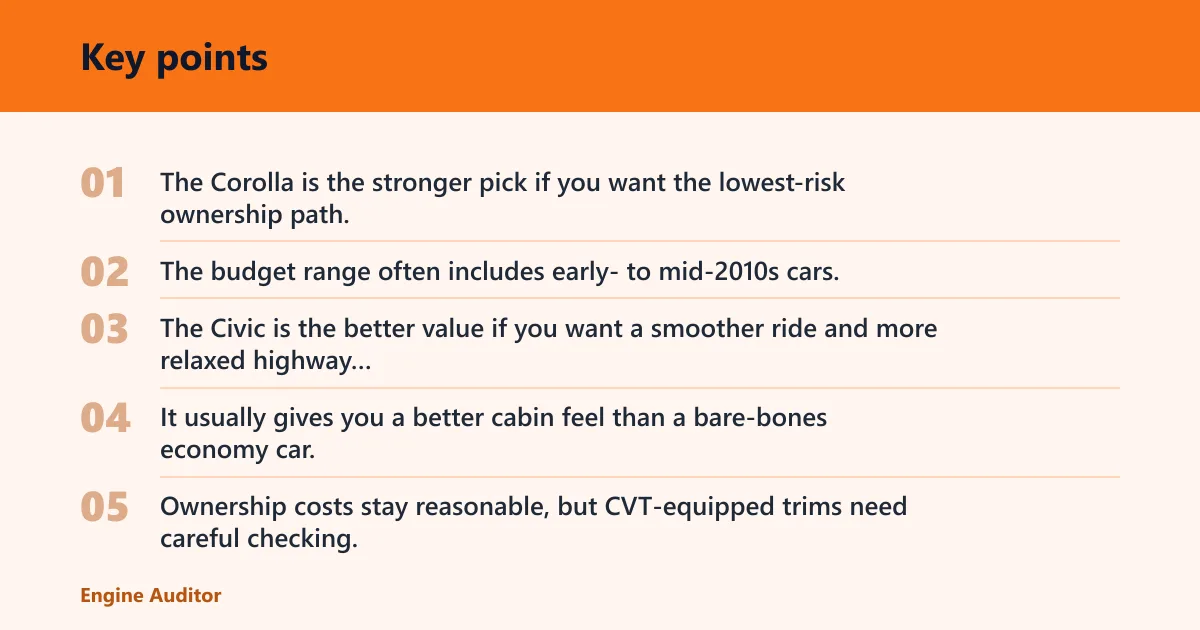
The Corolla is the stronger pick if you want the lowest-risk ownership path. The budget range often includes early- to mid-2010s cars, and the Corolla’s reputation is backed here by the 2007 Toyota Corolla sedan reference, a 4 out of 5 ANCAP safety rating, and annual service costs of about $250 to $350 for basic service.
The Civic is the better value if you want a smoother ride and more relaxed highway behavior. It usually gives you a better cabin feel than a bare-bones economy car, with good cargo or cabin practicality for a compact sedan or hatchback. Ownership costs stay reasonable, but CVT-equipped trims need careful checking.
| Model | Strength | Watch first | Ownership note |
|---|---|---|---|
| Toyota Corolla | Reliability and low running costs | Suspension wear, basic service gaps | Lower-risk choice for commuters |
| Honda Civic | Comfort and highway behavior | CVT service history, tire wear | Better all-rounder if records are strong |
Mazda 3 versus Hyundai i30
The Mazda 3 is the sporty choice. It usually feels sharper through corners, holds resale value well, and still returns good fuel economy. Trim differences matter: higher trims tend to bring better infotainment, better materials, and more safety gear, while base trims can be simpler but less desirable.
The Hyundai i30 is the value-for-money pick. It often brings good safety features, a comfortable ride, and lower buy-in cost than equivalent Japanese rivals. Running costs are usually manageable, but the car should be inspected for evidence of regular servicing and any electrical oddities.
Toyota Camry versus honda Accord
The Camry is the family sedan for buyers who want easy ownership and a calm ride. Clean examples in the budget usually come from older generations, so year fit matters: choose the best-documented car rather than the newest-looking one. The Accord is the better highway cruiser and can be a smart buy, especially if sourced from fleet or private-party ownership with records.
A 2015 Honda Accord with 75,000 documented fleet miles can be a smart buy when the maintenance file is complete. That kind of example often beats a cheaper private-party car with a vague service story. The trade-off is simple: the Accord offers more space and road comfort, while the Camry tends to ask less of your repair budget.
Which used SUV makes the smartest family buy?
The smartest SUV buy depends on whether you need cargo space or just like the higher seating position. The Honda CR-V and Toyota RAV4 both make sense for families, but they cost more to run than a comparable sedan because of tires, brakes, and fuel use. Buy an SUV only when the extra space will be used often.
Honda CR-V versus Toyota RAV4
The CR-V is the practical family pick. It gives you strong cargo space, easy access, and enough room for child seats, strollers, and groceries without feeling oversized. The RAV4 is the reliability-and-demand pick, with strong used-market demand and family-friendly packaging that keeps resale value high.
The competitor price band places SUVs such as the Honda CR-V and Toyota RAV4 in the $7,000 to $10,000 range for many used examples, though cleaner later examples can climb higher. That price range can still be useful if you are willing to shop older and verify maintenance carefully.
Cargo space, ride comfort, and fuel use
Compared with a sedan, an SUV usually costs more in tires and brakes and can use more fuel. In return, you get a larger cargo hold and a cabin that is easier to load. For a young family or a driver who hauls bulky gear, that trade can be worth it.
For a solo commuter, it often is not. A Corolla or Civic can deliver lower running costs and easier parking. If you do not need the extra height or cargo room every week, the sedan usually wins on total value.
When an SUV is worth the extra running cost
Choose an SUV when you need all-weather confidence, frequent cargo hauling, or a rear seat that has to handle child seats and luggage at the same time. In winter states, the higher seating position and available all-wheel drive can also matter more than small differences in fuel economy.
What mileage is acceptable on a used car under $15,000?
Mileage is acceptable when it matches maintenance, wear, and the body style you need. The best balance zone is often 40,000 to 90,000 miles, but a higher-mileage car with proof of regular oil changes, brake work, and transmission service can be smarter than a lower-mileage car with gaps in the record.
Low-mileage cars with neglected service
Low mileage does not erase age. Rubber parts dry out, coolant ages, batteries weaken, and brake fluid absorbs moisture. A 10-year-old car with about 55,000 miles and no service records can still need immediate work that may wipe out the savings from the low odometer reading.
High-mileage cars with documented maintenance
High miles are more acceptable when the car has proof of what was replaced and when. Look for oil change intervals, transmission service, spark plugs, coolant work, brake service, and tires. Documentation tells you whether the car was maintained or merely driven lightly.
A hatchback with about 92,000 miles, fresh tires, recent brake pads, and a stamped service book can be a stronger pick than a lower-mile example with missing records. That car can be a better buy than a 68,000-mile example with two missing years of records and uneven tire wear. The mileage is higher, but the risk is lower.
Mileage bands by body style and buyer type
For commuters, a compact sedan around 50,000 to 90,000 miles is often the safest budget zone. For families, a midsize sedan or SUV with documented maintenance can remain a good buy even at higher miles. First-time buyers should lean toward the cleanest records, not the lowest odometer reading.
Model-family weak points to check first
Each model family has a few weak points that matter more than badge reputation. You want to inspect those items first, because they are the ones most likely to turn into early repair bills or a tough negotiation.
Transmission and CVT concerns
CVT-equipped cars need proof of fluid service and smooth acceleration under load. Hesitation, shudder, or flare on takeoff deserves attention. Older automatics should still shift cleanly without delay, harsh engagement, or slipping under throttle.
Timing belts, water pumps, and cooling-system wear
Some older Accord and Camry examples may need timing-belt-related service depending on engine and year. Ask for documentation on belts, tensioners, and water pumps. Cooling-system neglect can be expensive, so check for leaks, crusty hose ends, and temperature issues on the test drive.
Infotainment, suspension, and brake wear
Mazda 3 and Hyundai i30 shoppers should verify infotainment behavior, screen function, and warning lights. Across all families, clunks over bumps, steering vibration, and uneven brake wear point to parts that will soon need money. These are not minor nuisances in a budget car.
Choose Toyota Corolla if… / Choose Honda Civic if…
Choose the Corolla if your priority is the lowest-risk ownership path, the clearest reliability reputation, and predictable running costs. Choose the Civic if you want a more comfortable cabin, better highway behavior, and a car that still feels practical for daily use. Both can work well under $15,000, but they suit different buyers.
Commuter priorities: economy, comfort, and highway behavior
The Corolla fits the buyer who wants fuel economy, easy maintenance, and low ownership stress. It is the safer default when records are incomplete but the inspection still passes. The Civic is better if you spend more time on highways and want a smoother, quieter commute.
Cabin space, cargo use, and ownership costs
The Civic usually gives you a friendlier cabin and stronger cargo flexibility, especially in hatchback form. The Corolla counters with simpler ownership and lower long-term cost pressure. If your budget must cover repairs after purchase, the Corolla leaves more room for that reserve.
Which one tends to fit first-time buyers better?
First-time buyers usually do best with the Corolla unless the Civic has a clearly better service file and a stronger inspection result. Simpler ownership matters when you do not want a surprise transmission bill or a long list of catch-up items in the first month.
What should you verify before you buy?
Before you buy, verify the car’s history, maintenance records, and mechanical condition, then use any fault you find to renegotiate. A good inspection reduces repair risk and can expose problems the seller has already priced into the ad. A typical pre-purchase inspection often costs about $100 to $200, and that is small compared with one bad repair.
Vehicle history and service records
Good documentation lowers ownership risk. You want evidence of oil changes, brake work, tire replacement, coolant service, and major repairs. Missing gaps are not always a deal-breaker, but they should lower your price target and raise your caution level.
Pre-purchase inspection and typical cost
Ask for a mechanical inspection that includes the engine, transmission, brakes, suspension, tires, steering, fluids, warning lights, and evidence of leaks or accident repair. If the seller resists, treat that as a warning sign. Inspection money is cheap compared with a hidden transmission fault.
- Check the title, mileage consistency, and service records.
- Inspect tires, brakes, glass, lights, and body panels for uneven wear or repair clues.
- Start the engine cold and watch for warning lights, smoke, or rough idle.
- Test drive at city and highway speeds, then listen for clunks, shake, or transmission hesitation.
- Review the inspection report and subtract overdue maintenance from your offer.
Negotiation points created by wear, leaks, and overdue service
Use tire age, worn brake pads, leaking seals, overdue fluids, and noisy suspension parts as negotiation points. Each one has a repair cost attached. The seller is either absorbing that cost before sale or discounting the car enough for you to handle it after purchase.
Frequently asked questions
What are the best used cars under $15,000 right now?
The strongest all-around picks are the Toyota Corolla, Honda Civic, Mazda 3, and Toyota Camry, with the Honda Accord close behind for buyers who want more size and highway comfort. If you need an SUV, the Honda CR-V and Toyota RAV4 are the familiar choices, but they usually cost more to run.
Which used car under $15,000 is the most reliable?
The Toyota Corolla is the safest reliability bet in this group, especially when the maintenance record is complete and the inspection is clean. It is also the strongest choice for low ownership costs, which matters as much as the nameplate when you are shopping near the budget ceiling.
Should I buy a sedan, hatchback, or SUV under $15,000?
Buy a sedan if you want lower running costs and simpler upkeep. Choose a hatchback if you want easier cargo loading and flexible space. Pick an SUV only if you truly need the cargo room, ride height, or winter-use advantages, because fuel, tires, and brakes usually cost more.
What mileage is acceptable for a used car under $15,000?
A clean car in the 40,000 to 90,000-mile range is usually the easiest value zone to shop. Higher mileage can still be fine if the service history is complete and the inspection is strong. Mileage alone should never beat maintenance records and wear condition.
Which used cars under $15,000 are cheapest to maintain?
The Corolla and Civic are usually the safest maintenance bets because parts are common and the cars are well known to independent shops. The Corolla has the edge on total ownership cost, while the Civic can still be economical if the CVT and service history check out cleanly.
Are used cars under $15,000 still worth buying in 2026?
Yes, if you shop by condition rather than by the lowest price tag. Used cars in this range can still be a good value because depreciation has already hit hard, but you need documentation, a proper inspection, and a repair reserve. Cheap examples without records remain risky.
Which used cars under $15,000 have the best resale value?
The Mazda 3 is the sporty choice with strong resale value, and the Toyota Corolla and Toyota RAV4 also tend to hold demand well. Resale is strongest when the car has clean records, ordinary colors, no accident history, and mileage that matches the rest of the package.
Products related to this article
Sponsored / affiliate links. As an Amazon Associate I earn from qualifying purchases. I may earn additional commission from eligible campaigns.