Sedan vs SUV: Which Body Style Makes More Sense for You?
Choose a sedan if you drive mostly solo or with one passenger, park in tight spaces, and care most about cost. Choose an SUV if you regularly carry 3+ people, bulky cargo, or need higher winter clearance. Pick the wrong one and you pay in fuel, tires, parking stress, and daily annoyance. This guide weighs commuting, family use, cargo, winter driving, parking, and total ownership cost with a practical decision matrix.
Sedan vs SUV: the real trade-off
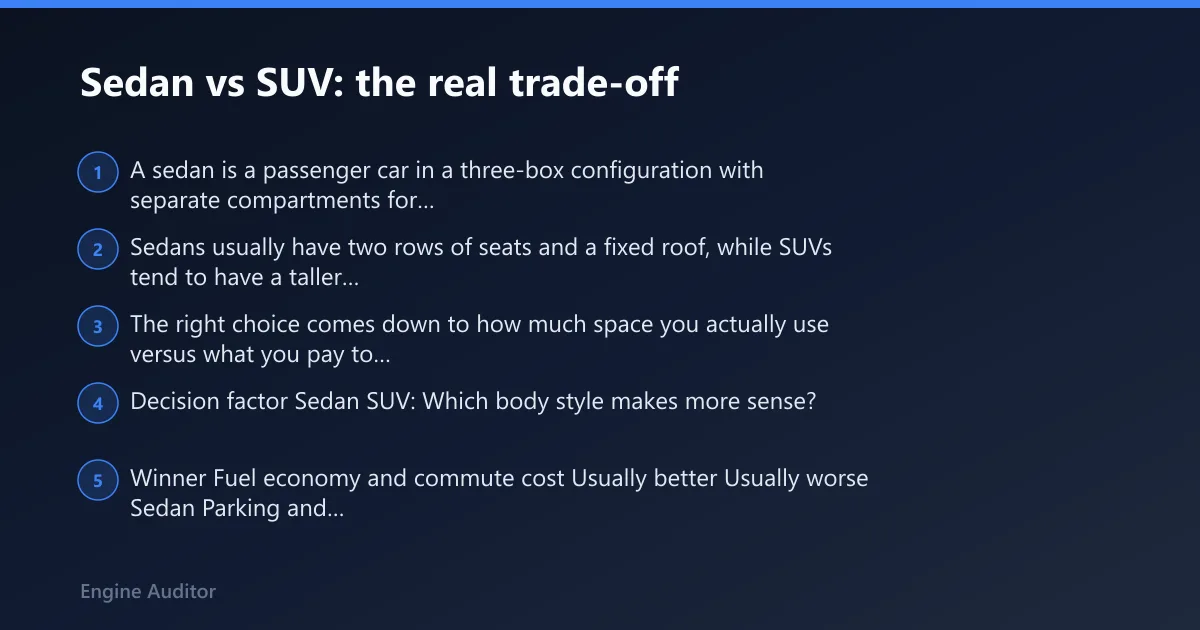
A sedan is a passenger car in a three-box configuration with separate compartments for engine, passengers, and cargo. Sedans usually have two rows of seats and a fixed roof, while SUVs tend to have a taller body, more cargo flexibility, and sometimes more seating capacity. The right choice comes down to how much space you actually use versus what you pay to carry around every day.
| Decision factor | Sedan | SUV: Which body style makes more sense? | Winner |
|---|---|---|---|
| Fuel economy and commute cost | Usually better | Usually worse | Sedan |
| Parking and maneuverability | Easier in tight spaces | More space needed | Sedan |
| Passenger and cargo flexibility | Good for small households | Stronger for families and gear | SUV |
| Insurance, tires, and maintenance | Often lower | Often higher | Sedan |
| Winter clearance, AWD, and towing | Limited by model | More likely to fit the need | SUV |
Fuel economy and commute cost
Sedans win here because they weigh less, sit lower, and often use smaller engines. That matters most when the commute is long, because extra MPG gaps compound every week. A 10-mile round trip and a 60-mile round trip do not punish fuel use the same way.
For daily driving, the spread is often felt in the wallet before anywhere else. If a car spends most of its life on pavement and never carries much cargo, hauling a larger body around becomes a fixed tax on every mile.
Parking and maneuverability
Sedans are easier to park and maneuver because they take up less space and usually have a lower hood and roofline. That matters in garages, older city blocks, crowded lots, and narrow driveways. The smaller footprint also reduces the stress of daily errand driving.
SUVs ask more from the driver. They need more turn-in room, more clearance at the curb, and more attention when swinging into tight spaces. If a vehicle spends a lot of time downtown, size is not a theory; it is a daily task.
Passenger and cargo flexibility
SUVs offer more cargo room and more seating flexibility, which is why families and gear-heavy drivers gravitate to them. Longo Toyota of Prosper says SUVs can carry up to eight people, while sedans are better for everyday commutes and errands. That is the real split: passenger load and cargo frequency.
For groceries, a stroller, two suitcases, or sports bags, many sedans are fine. Once the routine turns into folded seats, bulky coolers, child gear, and weekend luggage, the SUV starts paying for its extra size.
According to Best Sedans for 2026, Tested – Car and Driver — Car and Driver ranks sedans using roughly 200 data points. (source)
Which one fits your daily driving?

The better choice is the one that matches your commute pattern, not your wish list. If most miles are solo, the sedan fits better because fuel, parking, and daily handling matter more than extra cabin volume. If the car spends its days carrying people or gear, the SUV can justify its size.
Commute miles and fuel cost
Fuel economy matters most when mileage is high. A short errand run barely moves the needle, but a long commute makes MPG differences show up every month in a way that is hard to ignore. Vehicle weight and engine size both affect that spend.
That is why a sedan often makes more sense for high-mileage drivers. The savings repeat every tank, and they do not require any behavioral change.
City parking, maneuverability, and turn-in space
City drivers should think about parking stress as part of ownership cost. A sedan’s smaller footprint usually means fewer awkward three-point corrections, fewer curb kisses, and less time searching for a space that fits without drama. SUVs can be fine in the city, but they ask for more patience.
If street parking, tight garages, or crowded school pickup zones are part of the routine, sedan ownership tends to feel easier. The benefit is practical, not theoretical.
Highway comfort and long-distance stability
On the highway, both body styles can be comfortable, but sedans often feel calmer at speed because they sit lower and usually cut through air more easily. That can help fuel economy and reduce the feeling of being pushed around by crosswinds.
SUVs can be excellent road-trip vehicles too, especially when passengers want an upright seating position and more cargo room. The better answer depends on whether the trip is mostly people, mostly bags, or both.
How much space do you really need?
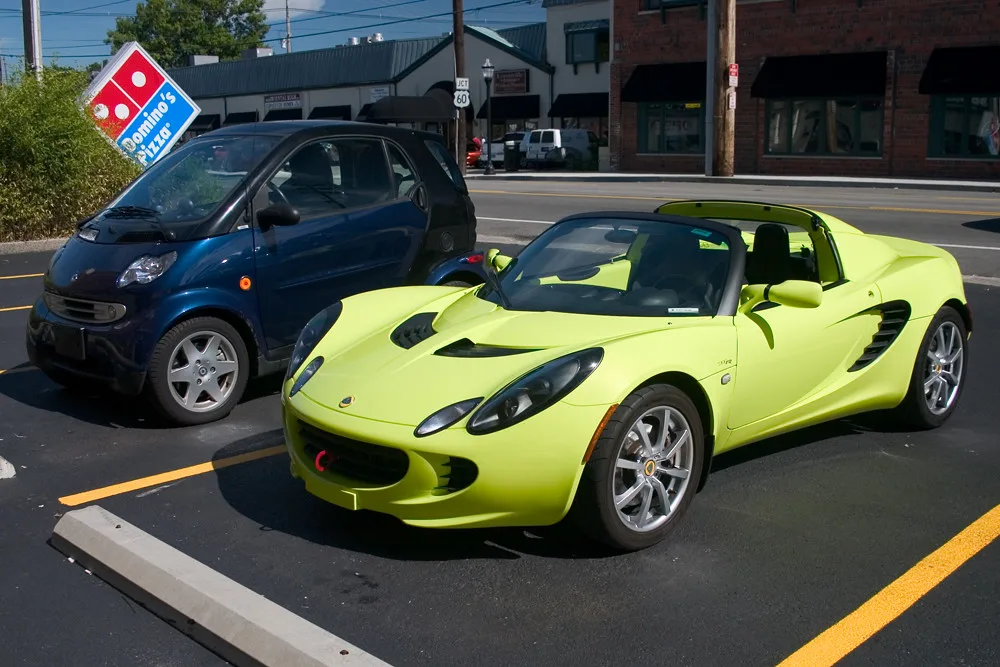
Passenger count and cargo frequency should drive this decision before badge image does. A two-row sedan can work very well for a couple, a solo driver, or a small family with light gear. An SUV becomes more sensible when the rear seat is used often and the cargo area is not just occasional overflow.
Passenger count and row count
Sedans typically have two rows of seats for passengers. That is enough for many households, especially if the back seat is used part-time. It is not enough when carpooling becomes routine or when adults sit in the second row every day. (en.wikipedia.org)
SUVs bring a stronger case when three or more people ride together often. Some models add a third row, which helps for larger families, though that extra row is not free space; it trades cargo room for seats.
Cargo space for groceries, strollers, luggage, and gear
Cargo space is where many shoppers overestimate how much SUV they need. A sedan trunk handles groceries, work bags, and luggage well enough for many drivers. Once the cargo list includes strollers, sports equipment, or camping bins, the extra square footage starts to matter.
Fold-down seats make SUVs more flexible than fixed trunk space. That flexibility is useful, but only if it gets used often enough to justify the added size, weight, and cost.
Which is cheaper to own over time?
Sedans often cost less to own because they may use less fuel, smaller tires, and less overall vehicle mass. Insurance and repair quotes can also differ by body style, trim, and parts cost. The smartest buyer compares total ownership, not just sticker price.
Fuel economy and monthly spend
Fuel economy affects the monthly budget every time the tank is filled. MPG, vehicle weight, and engine size all feed into that spend. A heavier SUV with a larger engine often uses more fuel than a lighter sedan in the same commute cycle.
For budget-conscious shoppers, this is one of the easiest differences to measure. Estimate weekly miles, then ask which body style burns less money while doing the same job.
Insurance quotes by body style
Insurance cost can vary by vehicle type, trim, repair cost, and theft risk. Two similarly priced vehicles can still produce different quotes. That is why a buyer should compare actual insurance numbers before choosing based on habit or image.
In practice, a sedan often has the easier insurance bill, but the real answer comes from the quote. The right comparison is the number on the policy, not the assumption in the showroom.
Maintenance, repairs, and tire costs
Maintenance and tires can cost more on larger vehicles because the parts are larger and the loads are higher. Bigger tires usually mean bigger replacement bills. Brakes and suspension parts can also trend higher when the vehicle itself weighs more.
That difference matters most over years, not weeks. If ownership is a long game, the sedan’s simpler cost structure often shows up in the service folder.
Do SUVs really win on safety and visibility?
SUVs often give a higher seating position and easier outward visibility, but that does not automatically make them the safer choice. Safety is a mix of crash performance, driver-assist tech, vehicle mass, and how well the vehicle fits the driver’s routine. A larger vehicle can also create bigger blind spots and harder parking judgment.
Ride height and outward visibility
CarBuzz notes SUVs have a higher ride height and are easier to get in and out of. That height can help with visibility over traffic and with entry and exit. It can also help drivers feel less boxed in during bad weather or in busy traffic.
Still, height is not the whole story. A taller vehicle may see farther, but it also needs more space to move and more care in tight surroundings.
Crash ratings, driver-assist tech, and vehicle mass
Safety should not be reduced to “big equals safe.” Modern sedans can have strong crash structures and useful driver-assist systems, while SUVs may bring mass advantages in some collisions but also more rollover-related design tradeoffs. The real comparison is the whole safety package.
That is why Car and Driver ranks sedans using roughly 200 data points, including acceleration, handling, comfort, cargo space, fuel efficiency, value, and enjoyment. A broad evaluation catches tradeoffs that one simple metric misses.
When a smaller sedan can still be the smarter safety pick
A smaller sedan can be the smarter safety pick when it is easier to park, easier to place in traffic, and less fatiguing to drive every day. A vehicle that fits the task well can be safer in real life than a bigger vehicle that creates stress and bad decisions.
This is especially true for short urban trips, tight school lots, and drivers who value clear handling over size.
AWD, ground clearance, and towing: when they matter
AWD and 4WD matter when traction is part of the job, not just part of the sales pitch. Ground clearance matters when roads are rough, curbs are high, or snow piles up. Towing capacity matters only if there is an actual trailer, boat, or caravan to pull.
AWD and 4WD for snow, rain, and rough roads
AWD/4WD availability on some SUVs can be a real benefit for drivers who face snow, heavy rain, gravel, or soft shoulders. It can improve traction and confidence when the road changes under the tires. But if the car lives on clean pavement, those systems may be extra weight you never need.
Some sedans also offer AWD, which changes the old rulebook. That is one reason body style alone should not decide winter use.
Ground clearance for curbs, potholes, and driveways
Higher ground clearance can help with steep driveways, speed bumps, potholes, and winter slush. It also makes getting in and out feel easier for many drivers. That said, clearance is most useful when the route demands it.
For smooth suburban roads, clearance may not matter enough to justify the SUV’s extra size and cost.
Towing capacity for trailers, boats, and caravans
If towing is part of life, the SUV often has the edge. That said, towing should be treated as a real requirement, not a hope. A vehicle that only occasionally pulls a small load does not need to be oversized the rest of the year.
If towing is rare, it may be better to choose the body style that fits the other 99% of driving instead.
Use the sedan-vs-SUV scorecard
This checklist helps turn vague preferences into a decision. Score each item on a small scale, such as 1 to 5, for how much it matters to your life, then total the points. The body style with the higher total is usually the better fit for daily use.
Simple scorecard
| Factor | Your number | Sedan score | SUV score | Winner |
|---|---|---|---|---|
| Daily commute miles | ______ | 1 to 5 | 1 to 5 | ______ |
| Parking tightness | ______ | 1 to 5 | 1 to 5 | ______ |
| Passenger count | ______ | 1 to 5 | 1 to 5 | ______ |
| Cargo frequency | ______ | 1 to 5 | 1 to 5 | ______ |
| Fuel cost | ______ | 1 to 5 | 1 to 5 | ______ |
| Insurance quote | ______ | 1 to 5 | 1 to 5 | ______ |
| Tire and maintenance cost | ______ | 1 to 5 | 1 to 5 | ______ |
- Write down your average daily commute miles.
- Mark whether parking is easy, moderate, or tight.
- Count how many people ride with you most weeks.
- List how often you carry bulky cargo.
- Estimate fuel, insurance, and tire costs from quotes and spec sheets.
- Circle the body style with the lower total cost and the better fit.
Choose sedan if… / choose SUV if…
Choose a sedan if you commute alone or with one passenger, park in tight spaces, want lower fuel use, or care most about keeping ownership costs down. Sedans also fit small households well when cargo needs are modest and daily driving is mostly pavement.
Choose an SUV if you regularly carry three or more people, haul bulky gear, need easier entry and exit, want higher ride height, or need AWD, rough-road clearance, or towing flexibility. SUVs also make more sense when the cargo area gets used every week, not just on vacation.
Borderline case: if you want winter traction and a practical daily car, compare AWD sedans and small SUVs before assuming the SUV wins. If your routine is mostly city driving and light errands, the sedan often comes out ahead on cost and convenience.
Frequently asked questions
Is a sedan or SUV better for my family?
The better family vehicle depends on how many people ride most days and how much gear you carry. A sedan is usually enough for a small family with light cargo, while an SUV makes more sense for frequent child seats, carpool duty, strollers, and weekend equipment.
Which is cheaper to buy, insure, and maintain: a sedan or SUV?
Sedans often cost less to run because they may use less fuel, need smaller tires, and can have lower repair and insurance bills. That is not guaranteed on every model, so quotes matter. Still, the sedan usually has the cost advantage over time.
Do SUVs get better safety and visibility than sedans?
SUVs often offer a higher seating position and easier outward visibility, but that does not automatically make them safer. Safety depends on crash performance, driver-assist tech, mass, and how the vehicle fits the driver’s environment. A well-chosen sedan can be the smarter safety pick.
Which body style is better for city parking and commuting?
Sedans usually win in the city because they are easier to park, easier to place in traffic, and less stressful in tight spaces. For crowded lots, garages, and street parking, the smaller footprint is a real advantage. SUVs can work, but they take more effort.
How much cargo space do you really get in an SUV vs sedan?
SUVs offer more cargo room and more flexible folding-seat layouts, which helps with luggage, sports gear, and bulky family items. Sedans still handle groceries and regular luggage well. The difference matters most when cargo is frequent, not occasional.
Are sedans still a good choice now that SUVs are so popular?
Yes. Sedans still make strong sense for commuters, city drivers, and budget-focused buyers because they often cost less to fuel, insure, and maintain. Popularity does not change the math for someone who mostly drives alone and parks in tight places.
Products related to this article
Sponsored / affiliate links. As an Amazon Associate I earn from qualifying purchases. I may earn additional commission from eligible campaigns.