Best Cars for Parking in Tight Spaces: Small Models Ranked
Toyota Aygo X is the best all-round pick here. It stays short, keeps a narrow footprint, and is often sold with the parking aids that matter most in cramped streets and multi-storey car parks.
It is not the smallest car in this group. That trade-off suits many buyers because the higher seating position helps with kerbs and bay edges, while camera and sensor availability is usually better than on older city cars.
Top pick for tight parking
Why this model leads the ranking
The Aygo X balances three things that matter in parking: a 3,700 mm body, a tight turning circle, and decent forward visibility. That combination helps in parallel spaces, narrow supermarket aisles, and low-speed turns into tight ramps.
It also avoids one common problem with tiny cars: good outside size but poor hardware. A small car without sensors, a rear camera, or useful guidelines can still be awkward in a narrow garage bay.
Where it still loses points
Its higher ride height can make the rear view feel less precise than a very low hatchback with thin pillars. Some trims also rely on options for the best camera setup, so you need to check the exact version, not just the badge.
Quick picks
Use these if you want the shortest route to a decision. The right answer depends on where you park most often: on-street, in a ramp, or in a home garage.
- Best overall for tight streets: Toyota Aygo X
- Best for visibility: Fiat 500
- Best for garage parking: Renault Clio
- Best compact SUV option: Toyota Aygo X
Say your street only leaves room for a short nose-in slot between two vans. A car with a 3.7-metre body and a tight turn makes the second manoeuvre far easier than a taller SUV with a wider stance and a longer rear overhang.
Suppose your home garage has a narrow doorway and a pillar on one side. Width and mirror clearance matter more than badge prestige, because a car that fits on paper can still scrape mirrors or force awkward steering corrections at the last metre.
Parking scorecard
This table compares body length, mirror width, turning circle, rear visibility, and parking aids. The scores are for parking confidence, not road comfort or resale value.
| Model | Length | Width with mirrors | Turning circle | Rear visibility | Camera / sensors | Parallel | Ramp | Garage |
|---|---|---|---|---|---|---|---|---|
| Toyota Aygo X | 3,700 mm | About 1,940 mm | About 9.4 m | Good | Camera and sensors available; varies by trim | 5 | 4 | 4 |
| Fiat 500 | 3,571 mm | About 1,900 mm | About 9.3 m | Fair to good | Camera and sensors often optional or trim-led | 5 | 4 | 5 |
| MINI 3-Door | 3,876 mm | About 1,930 mm | About 10.7 m | Fair | Camera and sensors available; often trim-led | 4 | 3 | 4 |
| Citroën C3 | 3,996 mm | About 1,980 mm | About 10.6 m | Good | Camera and sensors commonly available | 4 | 3 | 4 |
| Renault Clio | 4,053 mm | About 1,990 mm | About 10.4 m | Fair to good | Camera and sensors widely available | 4 | 4 | 3 |
| Volkswagen Polo | 4,074 mm | About 1,960 mm | About 10.6 m | Fair | Camera and sensors widely available | 4 | 3 | 3 |
| Honda Jazz | 4,089 mm | About 1,970 mm | About 10.9 m | Good | Camera and sensors available; some trims add parking aids | 3 | 3 | 3 |
The scores separate three real use cases. Parallel parking rewards short length and a tight turning circle. Multi-storey ramps punish wide bodies, poor visibility, and awkward steering lock. Garage use is about mirror clearance, rear overhang, and how well the camera helps you stop before a wall.
Which small car parks easiest?
The easiest small car to park is usually the one with the shortest body, the tightest turning circle, and the clearest rear view. In this group, the Fiat 500 and Toyota Aygo X are the strongest choices for tight urban parking, with the Fiat edging the size race and the Aygo X adding better all-round parking confidence.
City cars versus small hatchbacks
City cars are usually easier to park than small hatchbacks because they are shorter and simpler to place at low speed. That matters most in parallel parking and on narrow streets where every extra centimetre affects whether you can straighten the car without a second pull.
Small hatchbacks can still be very manageable, but they usually add length, width, and sometimes a longer rear overhang. That makes the rear corner harder to judge when you are reversing toward a kerb or aligning with a tight bay line.
Why turning circle matters in real bays
Turning circle affects how many shuffles you need. A car with about 9.3 to 9.5 metres of turning circle can often fit into a slot with less back-and-forth than one closer to 10.8 or 10.9 metres.
That difference matters most in narrow streets, angled underground parking, and places where a parked car blocks part of the entry. It also helps with U-turns, because a smaller sweep reduces the chance of needing a three-point turn.
Best city cars for tight spaces
City cars win when the parking space is truly tight. Their short length, small footprint, and low-speed agility make them the easiest type to place into small bays, especially where curb space is limited and the road behind you is busy.
Shortest body dimensions to look
If parking is the main job, a body under about 4.0 metres often gives more room to correct your angle without crossing into the next bay or blocking traffic. Shorter is still better, but length alone is not enough if the mirrors are wide or the rear view is poor.
The Fiat 500 is the shortest of the cars listed here. The Aygo X is still compact, but it brings a slightly longer body in exchange for a more practical cabin and stronger parking tech coverage.
Visibility and mirror width advantages
Thin rear pillars, a lower beltline, and a smaller rear quarter window make a big difference when you are judging the last 30 centimetres into a bay. High tailgates and chunky pillar designs can hide a bollard or low wall exactly when you need to see it.
Mirror width matters as much as body width in garages and narrow lanes. A car can have a small body but still feel awkward if the mirrors sit wide and the driver must fold them in just to pass the doorway.
Parking tech that often comes standard
Parking sensors are useful when you are creeping toward a wall or another car, because they give distance alerts front and rear. They are less useful for low posts, thin poles, or kerbs that sit below the sensor beam.
A rearview camera is better for seeing the exact line of the bay and the shape of the space behind you. Guidelines help, but only if the camera image is clear and the lens is not blocked by rain or road film.
Best small hatchbacks for parking
Small hatchbacks are a strong middle ground if you want parking ease without giving up rear-seat space or boot flexibility. They are usually a little larger than city cars, but they often offer better cameras, more sensors, and more useful trim-level choice.
Rear visibility and glass area
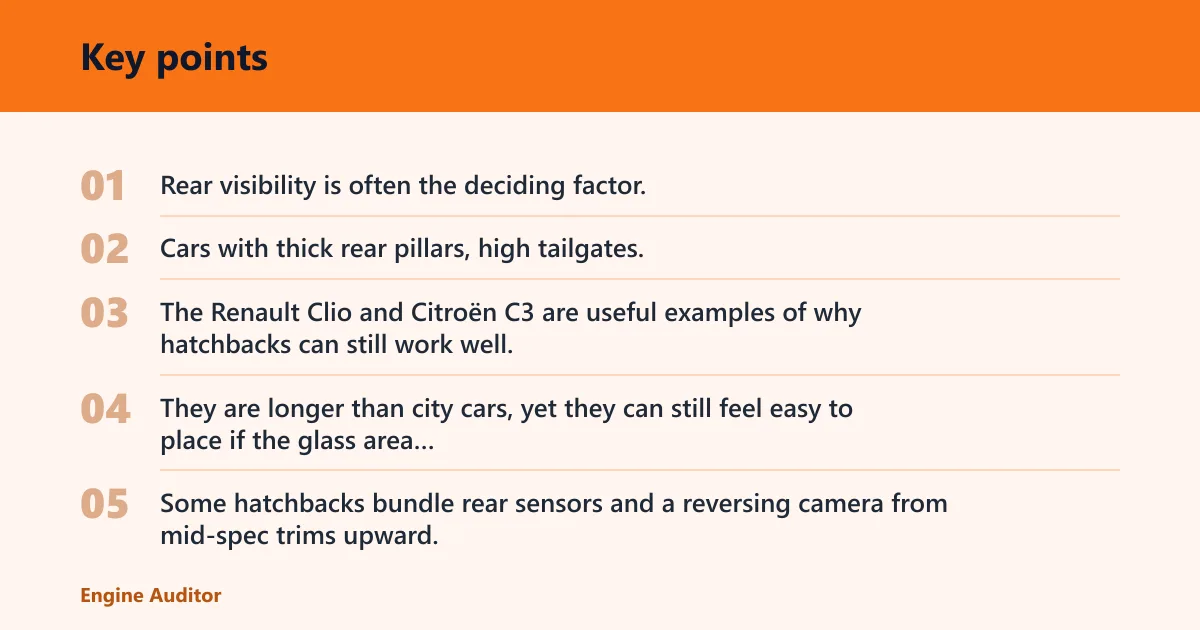
Rear visibility is often the deciding factor. Cars with thick rear pillars, high tailgates, and small rear windows can feel awkward even when the dimensions look sensible on paper.
The Renault Clio and Citroën C3 are useful examples of why hatchbacks can still work well. They are longer than city cars, yet they can still feel easy to place if the glass area is good and the camera image is clean.
Sensors, cameras, and trim-level traps
Some hatchbacks bundle rear sensors and a reversing camera from mid-spec trims upward. Others hide the camera behind an option pack or only on automatic versions. That matters because a good parking score on a brochure may depend on the exact trim you buy.
Check whether the car has front and rear sensors, not rear only. Front coverage matters in short parking bays and at steep ramps, where the nose can sit very close to a wall before the driver can see it from the seat.
Who should choose a hatchback over a city car?
Choose a small hatchback if you split time between street parking and longer drives, or if you need a more usable boot. The extra length is easier to live with when the car also gives you better seat support, more stable motorway manners, and stronger visibility equipment.
A hatchback also makes sense if you park in a home garage more often than on the street. The slightly longer body can be a fair trade for easier loading and better rear-seat room, provided the mirrors are not too wide for the garage opening.
Are compact SUVs harder to park?
Compact SUVs are usually harder to park than hatchbacks because they are taller, often wider at the mirrors, and less transparent through the rear glass. They can still work for tight parking, but they demand better cameras and more care in narrow spaces.
Width, height, and rear visibility trade-offs
A taller body does not automatically make parking worse, but it often comes with a higher tailgate and a smaller rear window. That combination makes distance judgement harder when reversing toward a wall or into a short bay.
Width is the bigger problem in tight streets. A car that feels fine in open traffic can become annoying if the mirrors sit close to both sides of a narrow lane or if the bay markings leave little room for error.
When a small SUV still makes sense
A compact SUV can still be the right choice if you regularly deal with kerbs, steep driveways, or poor road surfaces. The higher seating position and better approach angle help more than a hatchback in those cases.
For pure city parking, though, a compact SUV is rarely the easiest answer. It belongs near the bottom of a parking-focused shortlist unless the driver needs the extra ride height for a specific access problem.
What features make a car easier to park in the city?
The best parking features are a short body, a tight turning circle, clear rear visibility, front and rear sensors, and a rear camera with useful guidelines. Park assist can help with steering, but it does not replace space judgement in a tight bay.
Turning circle and low-speed maneuvering
Turning circle is the simplest measurable clue to parking ease. A tighter circle helps with U-turns, tight junctions, and pulling into narrow spaces without repeated corrections.
Low-speed steering feel matters too. Some cars are easy to move but slow to respond near full lock, which can make the final part of a parking manoeuvre feel vague.
Parking sensors versus rear camera
Parking sensors give distance alerts, usually with audible beeps and sometimes a visual scale. They are good for walls, other bumpers, and garage stops. They do not always detect low obstacles, thin posts, or a jutting kerb.
A rear camera helps with line placement and can make a narrow bay much easier to judge. It is most useful when the display is clear and the guidelines reflect the steering angle accurately.
Park assist limits in tight bays
Park assist can steer the car into a space, but it still needs enough room to work. If the bay is very short, the lane is crowded, or the space is marked poorly, the driver still has to decide whether the gap is usable.
A common first-timer mistake is trusting the system to solve a space that is already too tight. Park assist can reduce effort. It cannot create room that is not there.
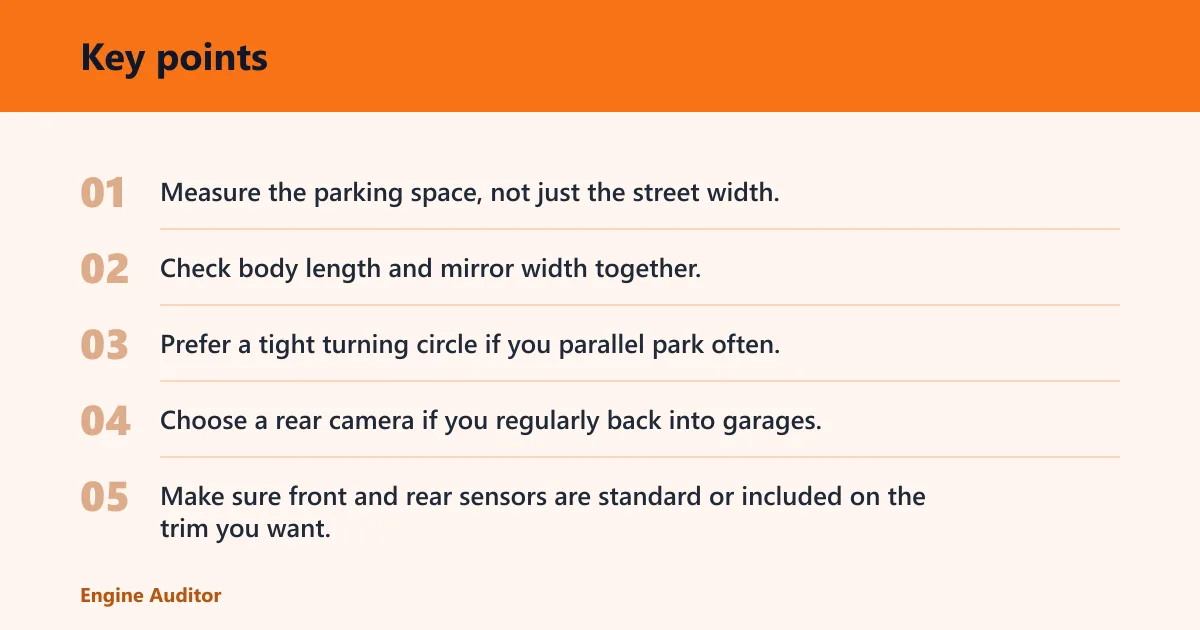
- Measure the parking space, not just the street width.
- Check body length and mirror width together.
- Prefer a tight turning circle if you parallel park often.
- Choose a rear camera if you regularly back into garages.
- Make sure front and rear sensors are standard or included on the trim you want.
For street parking, prioritise a short body and the smallest turning circle you can get. For multi-storey ramps, add good side visibility and mirrors that do not stick out too far. For a home garage, width with mirrors and rear camera quality matter more than badge size.
Frequently asked questions
What are the best small cars for parking in tight spaces?
The best small cars for tight parking are the Fiat 500, Toyota Aygo X, and several small hatchbacks with cameras and sensors. The key is not only size. You also want a short body, a tight turning circle, and rear visibility that lets you judge the last metre accurately.
Which small car has the easiest parking and turning circle?
The Fiat 500 is one of the easiest small cars to place in tight spaces because of its very short body and tight turning circle. The Toyota Aygo X is close in practical use and is often the better all-round choice if you want more parking tech and a slightly more modern cabin.
Are city cars easier to park than hatchbacks?
Usually yes. City cars are shorter and simpler to position, which helps in parallel parking and narrow streets. Hatchbacks can still be easy to park, but they often add length and rear overhang, so they need a little more room and a better rear camera or sensor setup.
What car size is best for tight parking spots?
A car under about 4.0 metres long is a sensible target for tight parking. That size usually gives you enough cabin space for daily use while keeping the car easy to swing into a bay, turn around in a narrow street, or reverse into a small garage opening.
Which small cars have parking sensors or a rear camera?
Many small cars offer sensors and a rear camera, but fitment varies by trim. The Toyota Aygo X, Renault Clio, Volkswagen Polo, and Citroën C3 commonly offer these features, while some versions make them optional. Always check the exact trim, not just the model name.
Is a small SUV harder to park than a hatchback?
Usually yes. A small SUV is often wider at the mirrors, taller at the rear, and less easy to judge when reversing. That does not make it impossible to park, but it does mean a hatchback is usually the simpler choice if tight city parking is your main concern.
Products related to this article
Sponsored / affiliate links. As an Amazon Associate I earn from qualifying purchases. I may earn additional commission from eligible campaigns.