Best Small SUVs for Families (2026): we compared
The best small SUV for families here is the 2026 Hyundai Tucson. It gives the widest family spread: strong cargo room, a high U.S. News rating, useful cabin tech, and enough trim choice for budget buyers and shoppers who want more equipment.
This guide is part of our Car comparisons and reviews series.


Quick comparison
| Product | Badge | Best for | Price | ||
|---|---|---|---|---|---|
|
Orzbow Padded Car Seat Travel Bag for Airplane, CarseatOrzbow | Our pick | Padded carry bag · Universal fit | $28.99
Price as of 7 Oct 2026
|
View |
|
Jogtlyer Portable Car Seat Dolly for Airport,FoldableJogtlyer | Budget pick | Foldable dolly · No assembly | $30.39
Price as of 7 Oct 2026
|
View |
For most families, the Tucson is the safest all-round shortlist starter because it combines the best cargo shape with the strongest overall family balance. The Rogue makes more sense if you care most about relaxed commuting and fuel use, while the Sportage is the smart value pick if warranty coverage matters more than cargo volume.
How we chose
This roundup is built around family use, not badge prestige. The main filters were rear-seat fit, cargo space for real child gear, family tech, ride comfort, and the ownership tradeoff that often decides a purchase: fuel use, warranty coverage, or purchase price.
I also split the answers by use case. A stroller-first family does not need the same SUV as a road-trip family, and an EV buyer needs a different decision path again.
Where the data are concrete, I state them plainly. Where a model’s value depends on trim choice or drivetrain choice, I call that out rather than flattening every version into one generic recommendation.
Which small SUV is best for a family of four?
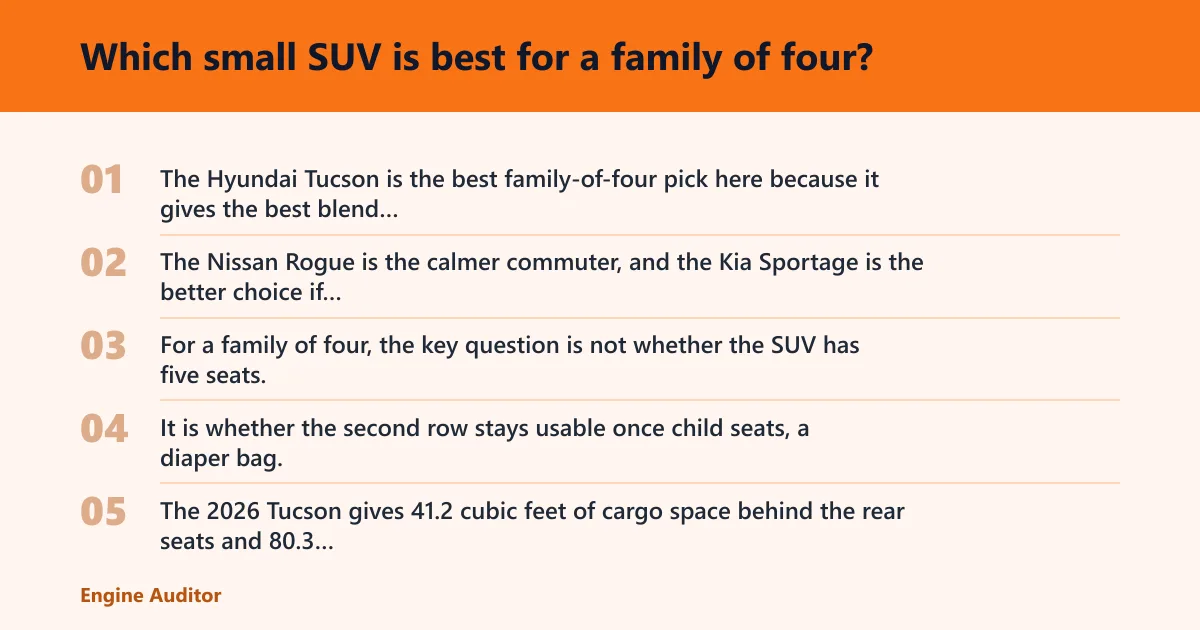
The Hyundai Tucson is the best family-of-four pick here because it gives the best blend of rear-seat usability, cargo room, and family tech without forcing buyers into a top trim. The Nissan Rogue is the calmer commuter, and the Kia Sportage is the better choice if warranty coverage is the deciding factor.
For a family of four, the key question is not whether the SUV has five seats. It is whether the second row stays usable once child seats, a diaper bag, and a folded stroller all enter the picture.
Why the Tucson fits this use case
The 2026 Tucson gives 41.2 cubic feet of cargo space behind the rear seats and 80.3 cubic feet with the rear seats folded. That matters because many families need to carry a stroller plus school bags without emptying the cabin every time they shop or travel.
Its hands-free liftgate and rear-seat alert are the sort of features that matter on school-run mornings. The Wi-Fi hotspot is useful when a rear-seat passenger needs entertainment on a long drive.
The drawback is price spread. The Tucson runs from $29,200 to $40,675, so the better-equipped trims can climb quickly if a buyer wants everything at once.
Why the Rogue fits a different family
The 2026 Rogue starts at $29,090 and returns 32 mpg combined, which makes it attractive for families that rack up commuting miles. It also includes tri-zone climate control and rear sunshades, which are practical when a child rides in the back seat all year.
The tradeoff is that it is more of a comfort-and-efficiency pick than a cargo-first one. Families who prioritize stroller space and weekend luggage usually find the Tucson easier to live with.
Which one has the most rear-seat space and stroller room?
The Hyundai Tucson is the strongest stroller-and-cargo choice in this group because its cargo area is easier to use around child gear than the numbers alone suggest. The Nissan Rogue is comfortable in the back and has family-friendly climate control, while the Skoda Kamiq can still work well if the family is smaller and city parking matters more than load volume.
Rear-seat space is only half the story. Families also need easy door openings, a boot floor that handles a stroller without awkward lifting, and enough leftover room for the diaper bag and grocery runs.
How the cargo space translates in practice
With 41.2 cubic feet behind the rear seats, the Tucson is the one most likely to take a stroller and still leave room for a couple of soft bags. Fold the rear seats and the 80.3 cubic feet figure gives it enough room for bulkier weekend luggage or a flat-pack run.
The Rogue is less cargo-focused than the Tucson but still well suited to daily family hauling. The Sportage sits in a useful middle ground, but its value argument is more about equipment and warranty than outright boot size.
The Kamiq earns its place because not every family needs a big footprint. For one-child households, or for families who mostly use the car for school runs and supermarket trips, a smaller SUV can be easier to park and easier to load.
Family-use scenario table: what each SUV fits in real life
| Model | Rear-seat fit | Cargo fit for stroller and bags | Fuel, range, or charging note | Warranty or value note | Best for |
|---|---|---|---|---|---|
| Hyundai Tucson | Best for a family of four that needs a usable second row with child seats | 41.2 cubic feet behind rear seats; 80.3 cubic feet folded, so it handles stroller-plus-bags duties well | Best for mixed driving where fuel economy matters but charging access is not the main issue | Wide trim spread from $29,200 to $40,675 gives buyers room to shop without jumping straight to the top end | All-round family duty |
| Nissan Rogue | Comfortable for rear passengers, helped by tri-zone climate control and rear sunshades | Good for everyday family cargo, though not the most generous here | 32 mpg combined suits high-mileage commuting | Starts at $29,090 to $38,990, with a value case built around comfort and efficiency | School runs and commuting |
| Kia Sportage | Family-friendly and easy to live with, especially if tech matters | Enough for typical family gear, but buyers should check trim-specific packaging | Best if you want a conventional family SUV without chasing electrification | 10-year/100,000-mile powertrain warranty is the headline ownership advantage | Warranty-led buyers |
| Dacia Duster | Practical for smaller families; less generous than the bigger mainstream rivals | Useful for everyday shopping and one-child loads; less suited to bulky weekend kit | Hybrid engine available; over 55 mpg in testing makes it appealing for low running costs | Priced from around £19,000, so it cuts entry cost hard | Budget buyers and rough-road use |
| Kia EV3 | Best when a family wants EV running and can live with charging planning | Fine for day-to-day family items, but range planning matters more than boot bragging | Up to 372 miles of range from the bigger 81kWh battery; 58kWh and 81kWh options available | Around £36,000 starting price; value depends on home charging and tariff setup | EV households and long-range commuting |
| Skoda Kamiq | Works for smaller families that value a compact footprint | Practical, but buyers should not expect Tucson-sized loading ease | Conventional family-SUV choice suited to urban and suburban use | VW Polo/Fabia platform roots, practical layout, and rugged-looking body help its case | One-child families and city use |
Hyundai Tucson: best for the broadest family balance
The Tucson is the best all-round family small SUV here because it pairs the strongest cargo room with a high U.S. News rating, useful family tech, and a wide trim spread. It is the easiest recommendation when the brief is vague or when one car has to cover school runs, shopping, and longer trips.
The cargo figures matter in real life. 41.2 cubic feet behind the rear seats means less compromise when the stroller stays in place and the family still needs room for bags. Fold the seats and 80.3 cubic feet gives it proper weekend-haul ability.
The Tucson also includes a hands-free liftgate, rear-seat alert, and Wi-Fi hotspot. That mix speaks directly to family use, because it helps with loading, avoids leaving gear behind, and keeps passengers occupied.
The drawback is that the best-equipped Tucson trims sit near the upper end of the price range. Buyers who want the most equipment for the money may need to be disciplined about not chasing every option.
Kia Sportage and Nissan Rogue: best for value and comfort
The Kia Sportage is the value-and-equipment choice, while the Nissan Rogue is the calmer daily driver for families who care about comfort and fuel use. Both work well, but they solve different problems.
Kia Sportage: warranty and tech value
The Sportage starts at $28,690 and tops out at $39,590, so it sits in the useful middle of the mainstream pack. Its 10-year/100,000-mile powertrain warranty is the ownership hook, and the 12.3-inch touch screen with wireless Apple CarPlay and wireless Android Auto makes it easy to recommend to parents who hate cable clutter.
Adaptive cruise control also matters if the family does regular motorway or ring-road mileage. The main drawback is that trim choice can move quickly from good-value to expensive if buyers want the nicer cabin and extra driver aids.
Nissan Rogue: mpg and calm commuting
The Rogue’s 32 mpg combined is the figure that will matter to high-mileage families. Add tri-zone climate control, driver-attention monitoring, and rear sunshades, and it becomes the best fit for households that do long commutes with children in the back.
The drawback is that it is not the cargo champion here. Families with big strollers or frequent luggage loads will likely find the Tucson easier to live with.
Dacia Duster, Kia EV3, and Skoda Kamiq: best for budget, electric, and smaller-family buyers
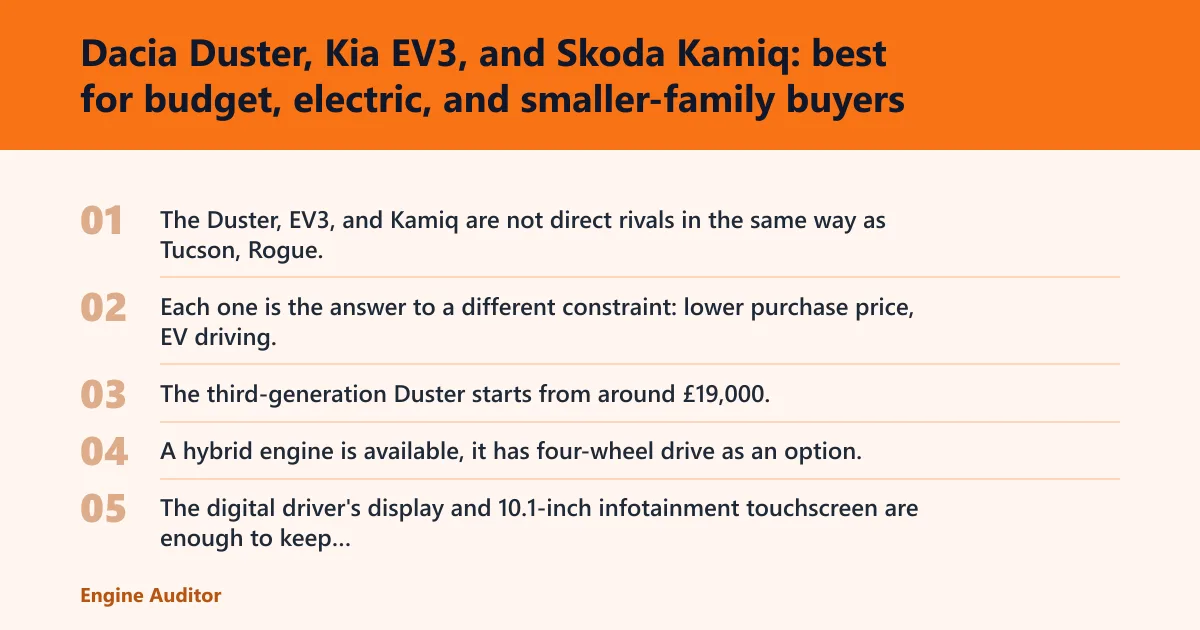
The Duster, EV3, and Kamiq are not direct rivals in the same way as Tucson, Rogue, and Sportage. Each one is the answer to a different constraint: lower purchase price, EV driving, or a smaller footprint for city life.
Dacia Duster: low price and rough-road sense
The third-generation Duster starts from around £19,000, which makes it the budget standout. A hybrid engine is available, it has four-wheel drive as an option, and Carbuyer says it averaged over 55 mpg in testing. The digital driver’s display and 10.1-inch infotainment touchscreen are enough to keep it current.
This is the SUV for families who care more about value and dirt-road usefulness than plush materials. The downside is cabin polish and outright rear-seat generosity; it is honest, not fancy.
Kia EV3: best if charging is easy
The EV3 is the electric family answer for buyers with home charging or easy workplace charging. It costs from around £36,000, offers 58kWh and 81kWh battery options, and the bigger pack can manage up to 372 miles of range. The 201bhp motor and soft suspension suggest a relaxed, family-first tune.
The drawback is that EV ownership only works cleanly when charging access is dependable. If the family does long, unplanned trips or cannot charge at home, the maths becomes less attractive.
Skoda Kamiq: small footprint, sensible packaging
The Kamiq is the compact choice for urban families who still want a practical small SUV. Its VW Polo/Fabia platform relationship is useful because it usually means tidy packaging, predictable controls, and a sensible cabin layout rather than flashy design.
The tradeoff is size. It works best when the family does not need Tucson-level cargo room, or when parking and maneuvering matter more than maximum rear-seat generosity.
Which one should you buy?
Buy the Tucson if you want the safest all-round shortlist pick and the most family-friendly cargo shape. Buy the Rogue if your driving is mostly commuting and fuel economy matters more than maximum boot flexibility. Buy the Sportage if warranty coverage and cabin tech carry more weight than the last word in cargo space.
Choose the Duster if price is the first filter and you value a low starting point with hybrid and four-wheel-drive options. Choose the EV3 if you can charge at home and want an electric family SUV with serious range. Choose the Kamiq if you want a smaller, easier-to-place SUV for one-child or city-led family life.
How to choose
Start with the family loadout, not the badge. A stroller, two child seats, and weekly shopping will expose a small boot quickly, while one child seat and a lighter city routine can make a smaller SUV feel perfectly adequate.
- Decide whether cargo room or rear-seat comfort matters more on an average week.
- Match the powertrain to your driving pattern: hybrid for mixed mileage, gas for simple refueling, EV only if charging access is settled.
- Check whether the trim you want keeps the useful family kit, not just the screen size.
- Look at the warranty before chasing a lower sticker price.
- If you carry a stroller often, prioritize boot shape and liftgate convenience over brochure horsepower.
That order avoids the most common mistake. Too many buyers choose by price alone, then discover the back seat is tight, the cargo floor is awkward, or the tech package they wanted sits too far up the trim ladder.
Which small SUV has the best warranty and family features?
The Kia Sportage has the best warranty story here, thanks to its 10-year/100,000-mile powertrain warranty. For family features, the Hyundai Tucson is stronger overall because the hands-free liftgate, rear-seat alert, and Wi-Fi hotspot are directly useful in daily family life.
That leaves a clear split. Choose the Sportage if warranty coverage is the main comfort blanket. Choose the Tucson if you want the more convincing family package without giving up on price discipline.
Which small SUVs are safest for families?
The safest-feeling choices are the ones with strong driver-assistance tech, useful alert systems, and the least day-to-day distraction. The Tucson stands out with a rear-seat alert, the Rogue adds driver-attention monitoring, and the Sportage brings adaptive cruise control alongside its strong warranty case.
Safety is not only about crash tests. For parents, it is also about the systems that stop a mistake before it becomes a problem, such as alerts, monitoring, and calm lane-and-speed control on busy roads.
Which small SUVs get the best gas mileage?
The Dacia Duster and Nissan Rogue are the fuel-economy standouts in this group, but they solve different problems. The Rogue’s 32 mpg combined is the easiest concrete number for everyday mixed driving, while the Duster’s hybrid setup and over 55 mpg testing result make it the economy pick if UK pricing and usage fit.
For families, the real choice is between simple fuel stops and lower running costs. If charging is easy, the EV3 changes the equation again, because range becomes the issue instead of mpg.
Is a compact SUV big enough for a growing family?
Yes, but only if the family is honest about gear volume and child-seat count. A compact SUV is fine for one child or two younger children with modest luggage, but it can feel tight once a stroller, school bags, and a weekly shop all compete for the same boot space.
For a growing family, the Tucson is the safer bet in this group. The Kamiq can still work, but it asks for more compromise.
Which small SUV rides best on rough roads?
The Kia EV3 and Dacia Duster make the strongest rough-road cases, though for different reasons. The EV3’s soft suspension should suit families who want a calmer ride, while the Duster’s available four-wheel drive and value-led setup make it the more obvious pick for poorer roads or occasional gravel use.
The Rogue and Tucson are more about everyday polish, while the Kamiq suits urban roads more than broken back lanes. Ride quality matters most when children are asleep in the back or when school runs happen on patched surfaces every day.
Should I choose a hybrid small SUV for family use?
A hybrid makes sense if you do mixed urban and motorway mileage and want lower fuel use without relying on charging. The Duster’s hybrid option is the budget-friendly route, while hybrid versions in this class usually suit families that keep cars for long periods and want fewer fuel stops.
If you can charge at home, an EV can be better for short daily trips. If you cannot, a hybrid is usually the safer bet than a plug-in or full EV.
Which small SUV is best for stroller and cargo storage?
The Hyundai Tucson is the best stroller-and-cargo choice because its cargo volume is the easiest fit for family life, not just luggage figures. A stroller, a diaper bag, and a couple of soft bags are much easier to manage when the boot starts with 41.2 cubic feet behind the rear seats.
The Rogue is usable, and the Sportage is sensible, but the Tucson is the one most likely to avoid boot-packing frustration on busy days.
Which small SUV offers the best value for money?
The answer depends on what “value” means. The Dacia Duster is the cheapest entry point at around £19,000. The Sportage is the best warranty value, and the Tucson is the best broad-value choice when a family wants strong everyday usability without chasing the top trim.
If value means total usefulness per pound or dollar, the Tucson usually wins. If it means the lowest sticker price, the Duster takes it.
Frequently asked questions
What is the best small SUV for a family of four?
The Hyundai Tucson is the best small SUV for a family of four here because it balances rear-seat usability, cargo room, and family tech better than the others. The Rogue is close if commute comfort matters more, while the Sportage is the better warranty-led alternative.
Which small SUV has the most rear-seat space?
The Tucson is the safest answer in this comparison because its overall packaging works best for child seats and daily family use. The Rogue is comfortable in the second row too, but the Tucson’s cargo space gives it the stronger family case once the car is loaded up.
Which small SUV is best for stroller and cargo storage?
The Tucson is the best pick for stroller storage because its boot is large enough to stay useful after the stroller goes in. Families that travel with extra bags, weekly shopping, or holiday luggage will find it less frustrating than the smaller options.
Which small SUVs are safest for families?
The safest-feeling choices are the Tucson, Rogue, and Sportage because each has family-oriented driver-assistance or alert features. The Tucson’s rear-seat alert, the Rogue’s driver-attention monitoring, and the Sportage’s adaptive cruise control all help reduce everyday mistakes.
Which small SUVs get the best gas mileage?
The Rogue is the clearest mpg choice for standard petrol-family use, with 32 mpg combined. The Duster’s hybrid option and over 55 mpg testing result make it a strong economy choice in its market, while the EV3 shifts the question from mpg to charging access and range.
Should I choose a hybrid small SUV for family use?
Choose a hybrid if you drive a mix of city and motorway miles and want lower fuel use without depending on charging. The Duster’s hybrid option makes sense for budget buyers, while families with home charging and short daily trips may be better served by the EV3.
Products related to this article
Sponsored / affiliate links. As an Amazon Associate I earn from qualifying purchases. I may earn additional commission from eligible campaigns.