Best gas mileage cars for budget buyers: top contenders
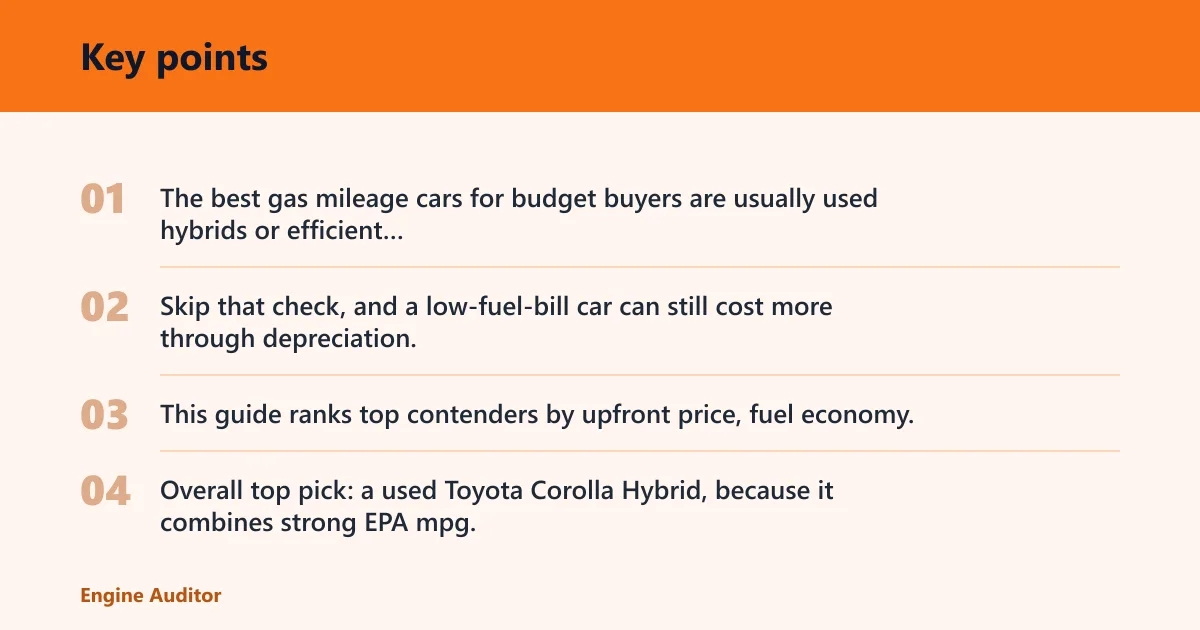
The best gas mileage cars for budget buyers are usually used hybrids or efficient compacts with real-world combined ratings around 40 mpg or higher, but the cheapest-to-own pick is often the one with the lowest purchase price plus strong reliability, not the highest window-sticker mpg. Skip that check, and a low-fuel-bill car can still cost more through depreciation, repairs, or financing. This guide ranks top contenders by upfront price, fuel economy, and ownership risk so you can choose the cheapest car to live with.
Overall top pick: a used Toyota Corolla Hybrid, because it combines strong EPA mpg, simple ownership math, and a used-market price that is often still reachable without stepping into luxury-car repair risk.
Top Picks For Different Drivers


Quick picks by buyer type
| Best for | Model | Why it stands out | Typical price band |
|---|---|---|---|
| Lowest running cost | Toyota Prius | Highest mpg here, low fuel bill, strong hybrid reputation | Used: about $18,000 to $30,000 |
| Balanced budget value | Toyota Corolla Hybrid | Low fuel use with a smaller price gap than many hybrids | Used: about $19,000 to $27,000 |
| Cheapest to buy used | Hyundai Elantra gas | Low upfront cost and solid mpg for a gas sedan | Used: about $14,000 to $22,000 |
| City parking and errands | Honda Fit or Kia Rio hatch | Easy to place in traffic, flexible cargo space, lower tire cost than bigger cars | Used: about $10,000 to $18,000 |
| Highway commuter | Honda Civic sedan | Efficient gas mileage without a hybrid premium | Used: about $15,000 to $26,000 |
Fuel cost versus price: the tradeoff that changes the winner
A lower sticker price can beat a higher-mpg car if the premium takes too long to pay back. That is why the cheapest car to own is not always the car with the best EPA label; it is the one whose purchase price, fuel use, and repair risk line up with your yearly miles.
Why a cheaper gas car can beat a pricier hybrid
EPA ratings are useful, but they are only one part of the bill. A gas sedan that costs $4,000 less than a hybrid can save years of fuel money before the hybrid catches up, especially if you drive fewer than 10,000 miles a year.
Real-world mpg also matters. City traffic, cold weather, short trips, heavy loads, and fast freeway speeds can all pull mpg below the EPA combined label. The official EPA test cycle gives you a standard comparison point, not a promise.
Mileage thresholds that can justify a hybrid premium
For this guide, fuel cost is calculated at $3.50 per gallon and rounded to the nearest dollar. That is an estimate, not a quote.
As a general rule of thumb, a hybrid premium can make sense faster when the gas alternative is about 8 to 15 mpg less efficient combined and you drive roughly 12,000 to 15,000 miles a year. If the price gap is small, the payback is quicker. If the hybrid costs several thousand more, the break-even point can stretch past 100,000 miles.
Comparison table: mpg, price band, and annual fuel cost
The table below separates used-market price bands from operating cost. The payback mileage estimates assume the hybrid is compared with a close gas-only sibling in the same model line, using the same $3.50-per-gallon fuel assumption.
| Model | Type | EPA city/highway/combined mpg | Used-price band | Annual fuel cost at 10,000 miles | Annual fuel cost at 15,000 miles | Hybrid premium payback mileage |
|---|---|---|---|---|---|---|
| Toyota Prius | Hybrid | 57/56/57 | $18,000 to $30,000 | $614 | $922 | N/A |
| Toyota Corolla Hybrid | Hybrid sedan | 53/46/50 | $19,000 to $27,000 | $700 | $1,050 | About 100,000 miles versus Corolla gas if the hybrid premium is $3,000 |
| Hyundai Elantra Hybrid | Hybrid sedan | 49/52/54 | $18,000 to $26,000 | $648 | $972 | About 108,000 miles versus Elantra gas if the hybrid premium is $3,500 |
| Honda Civic sedan | Gas sedan | 31/40/35 | $15,000 to $26,000 | $1,000 | $1,500 | N/A |
| Hyundai Elantra gas | Gas sedan | 32/41/35 | $14,000 to $22,000 | $1,000 | $1,500 | N/A |
| Honda Fit | Subcompact hatchback | 29/36/32 | $10,000 to $18,000 | $1,094 | $1,641 | N/A |
Which gas mileage cars are cheapest to buy used?
The cheapest used fuel-sippers are usually gas sedans and older subcompact hatchbacks, because they avoid hybrid battery pricing and often sit lower on the market than comparable hybrids. A used Hyundai Elantra, Honda Civic, Toyota Corolla gas model, or Honda Fit can be much easier on the budget than a newer hybrid with a similar miles count.
What to look for in mileage and service records
Used-car condition matters as much as mpg. A clean service history, proof of oil changes, transmission service where required, and no accident history are worth more than a slightly lower odometer reading with no records.
For hybrids, ask for battery health information if the seller has it. A hybrid battery does not need to be new to be fine, but a weak pack can turn a cheap purchase into an expensive repair.
- Check the title status and accident history.
- Compare odometer miles with service dates and tire age.
- Look for even brake wear, matching tires, and clean coolant and oil service records.
- For hybrids, watch for warning lights, erratic state-of-charge swings, and weak air conditioning at idle.
- Get a pre-purchase inspection before money changes hands.
Inspection checks for prior damage and wear
Look closely at uneven panel gaps, mismatched paint, steering pull, brake vibration, and curb rash on wheels. Those clues can point to prior damage or hard use. A cheap used car with unresolved body or suspension issues is rarely cheap for long.
Best compact sedans for low running costs
Compact sedans are often the sweet spot for budget buyers because they seat five, return strong mpg, and usually cost less to insure and tire than larger cars. The best ones are efficient enough to cut fuel bills without carrying hybrid battery risk or a large purchase premium.
Toyota Corolla gas and Corolla Hybrid
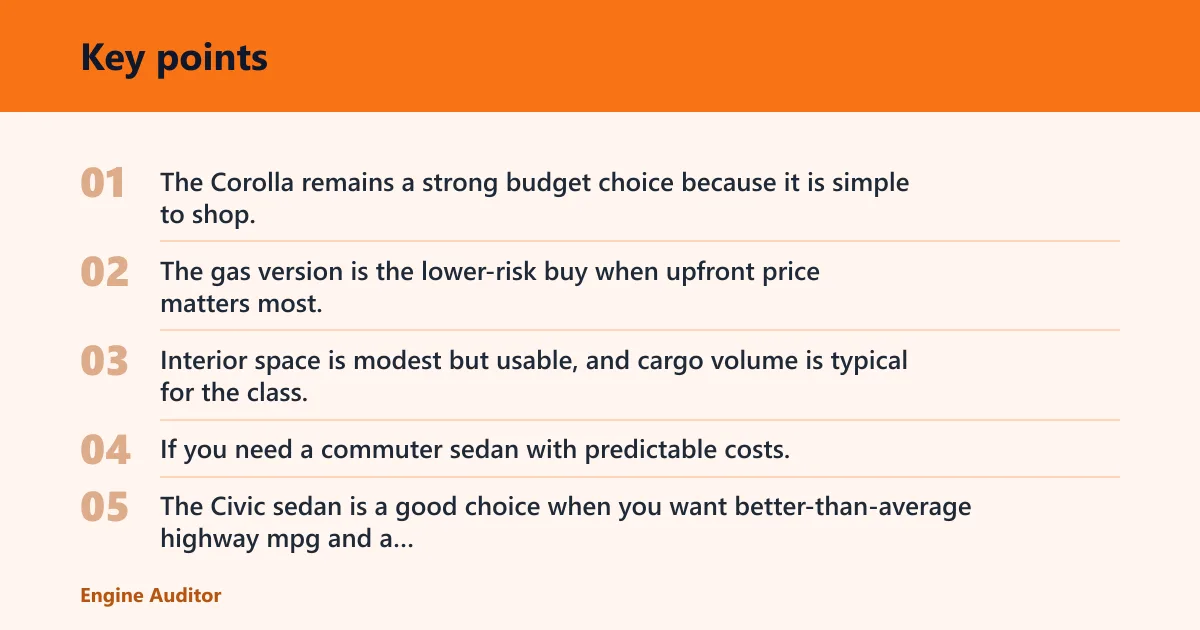
The Corolla remains a strong budget choice because it is simple to shop, widely available, and easy to compare by trim. The gas version is the lower-risk buy when upfront price matters most, while the hybrid becomes attractive for higher-mileage drivers who can use its 50 mpg combined rating.
Interior space is modest but usable, and cargo volume is typical for the class. If you need a commuter sedan with predictable costs, this is one of the safest names to start with.
Honda Civic sedan
The Civic sedan is a good choice when you want better-than-average highway mpg and a refined drive without stepping into hybrid pricing. Its gas versions often return mid-30s combined mpg, which keeps fuel costs reasonable for mixed commuting.
It is a strong pick for buyers who want a compact sedan that feels a bit larger inside than many rivals.
Hyundai Elantra gas and hybrid
The Elantra gas model is often among the cheapest compact sedans to buy used, while the hybrid can be one of the best mpg values in the class. The hybrid’s savings are real, but the price gap has to be checked carefully against how many miles you actually drive.
For budget buyers, the Elantra gas trim can make more sense if the hybrid premium is large or the available used hybrid has limited service records.
Are hybrid cars worth it for budget buyers?
Hybrids are worth it when the fuel savings are large enough to pay back the purchase premium before the car ages into higher repair risk. They are less appealing when you drive few miles, face a big price gap, or plan to keep the car only briefly.
Battery warranty and long-term repair points
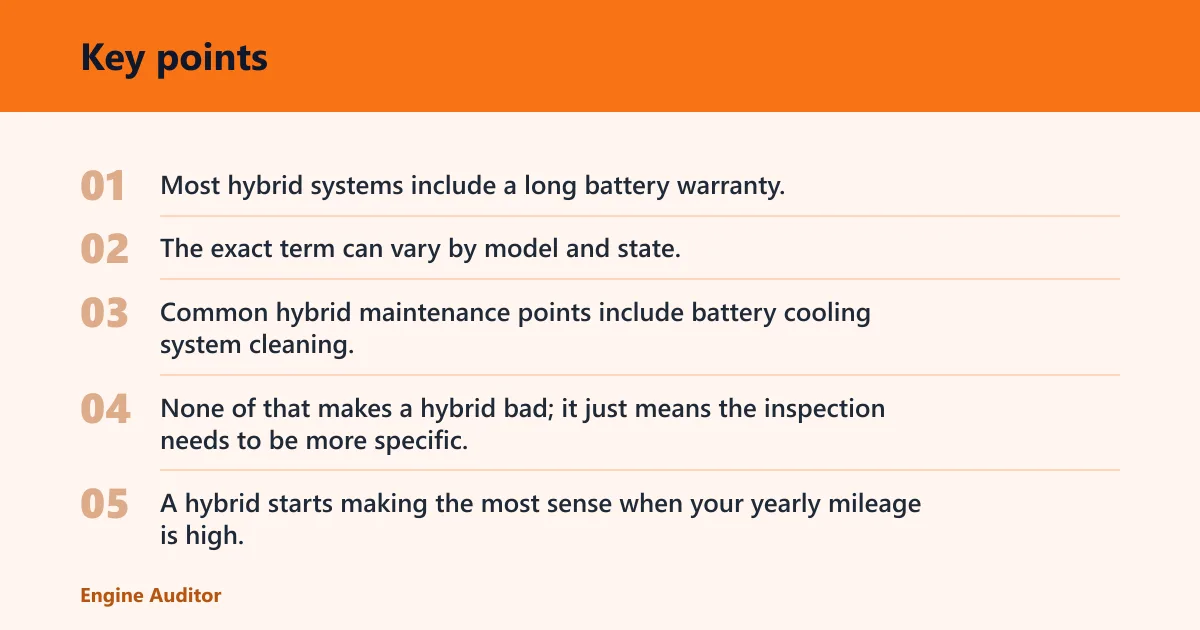
Most hybrid systems include a long battery warranty, and in the United States that coverage is often longer than the basic bumper-to-bumper plan. The exact term can vary by model and state, so you should confirm the warranty booklet for the car you are shopping.
Common hybrid maintenance points include battery cooling system cleaning, inverter coolant service on some models, brake system checks, and careful inspection of the high-voltage battery on older cars. None of that makes a hybrid bad; it just means the inspection needs to be more specific.
When a hybrid pays off fast enough to matter
A hybrid starts making the most sense when your yearly mileage is high, your route includes steady stop-and-go traffic, and the purchase premium is modest. If you drive 15,000 miles a year, a 10 to 15 mpg combined advantage can add up quickly. If you drive 8,000 miles a year, the math moves much slower.
Say your commute is 22 miles each way with heavy traffic and you keep the car for eight years. A Corolla Hybrid or Prius can claw back a higher buy-in through fuel savings. If your driving is mostly short weekend trips, a gas sedan may be the smarter budget move.
Best subcompact hatchbacks for city driving
Subcompact hatchbacks work well in tight parking, dense traffic, and short urban errands. They usually have lower purchase prices than hybrids and can be cheaper on tires and insurance, but their mpg can trail compact sedans and their crash-test comfort varies by model and year.
Honda Fit
The Fit is a standout for cargo flexibility because its tall hatchback shape gives it useful load space for its size. It is easy to place in a city and often inexpensive to keep on the road if maintenance history is clean.
Its fuel economy is good rather than class-leading, so the value case comes more from practicality and low purchase cost than from the best mpg number.
Hyundai Accent hatchback and Kia Rio hatchback
These cars appeal to buyers who want a low starting price and simple city manners. They usually do not match the fuel economy of the best hybrids, but they can keep total ownership cost down when the purchase price matters more than fuel perfection.
Insurance and tire costs are often easier to live with than on larger vehicles, which helps a tight budget stretch further.
Why city drivers should look at hatchbacks
A hatchback can carry more bulky cargo than a sedan with the same footprint. That matters if your budget car also has to haul groceries, tool bags, or folded strollers without forcing you into a larger, pricier vehicle.
What mpg should I expect from a budget car?
Most budget-friendly gas cars land somewhere in the low-30s to mid-30s combined mpg, while strong hybrids often sit around 45 to 57 combined mpg. Real-world results can be lower than EPA labels if you drive hard, take many short trips, or spend winter mornings idling to warm the cabin.
EPA labels and real-world driving
EPA city mpg, highway mpg, and combined mpg are standardized comparison numbers, not a guarantee. City ratings help when you sit in traffic and stop often. Highway ratings matter more on long, steady commutes. Combined mpg is the best single shorthand for most buyers.
If your route has steep hills, winter slush, or short cold starts, expect the car to return less than the sticker number. That gap is normal.
What are the cheapest cars to own and fuel?
The cheapest cars to own and fuel are usually efficient used compacts with clean service histories, modest insurance costs, and no major battery or turbo complexity. On a tight budget, a lower purchase price often matters more than chasing the last few mpg points.
Total cost of ownership, not mpg alone
Total cost of ownership includes fuel, maintenance, insurance, and depreciation. A car that costs less to buy and is easy to repair can beat a pricier hybrid if you do not drive enough to recover the premium.
This is where the cheapest gas car on the lot can beat the most efficient hybrid in the listing. If the hybrid does not save enough fuel to catch the extra upfront cost, the math does not favor it.
Scenario examples
Suppose a buyer drives 8,000 miles a year in mostly suburban traffic. A gas Corolla may cost less overall than a Corolla Hybrid, because the fuel savings are too small to offset the higher price before the next replacement cycle.
Picture a driver who logs 16,000 miles a year on a long daily commute. A Prius or Corolla Hybrid can be the better budget choice because the extra mpg turns into enough annual savings to matter.
How to choose the cheapest car to live with
The cheapest car to live with is the one that matches your mileage, route, and risk tolerance. Start with the purchase price, then compare expected fuel use, insurance, maintenance, and the chance that a major repair arrives early.
A simple buyer checklist
- Estimate your yearly miles, not just your commute distance.
- Separate new MSRP from used-market price bands.
- Compare combined mpg, then sanity-check city and highway mpg against your route.
- Check service records, mileage, and accident history.
- For hybrids, inspect battery condition and ask about warranty remaining.
- Choose the car whose savings pay back within your ownership plan.
For city drivers, a hybrid hatchback or compact sedan often makes the most sense. For highway commuters, a gas Civic or Corolla can be cheaper to buy and close enough on fuel. For short-trip drivers, the lower upfront cost of a gas car usually wins unless the hybrid price gap is very small.
Frequently asked questions
What are the best gas mileage cars for budget buyers?
The best gas mileage cars for budget buyers are usually used Toyota Priuses, Corolla Hybrids, and efficient compact sedans like the Honda Civic or Hyundai Elantra. The right pick depends on whether you need the lowest fuel bill, the lowest purchase price, or the best mix of both.
Which fuel-efficient cars are cheapest to buy used?
Used gas compacts and subcompact hatchbacks are often cheapest to buy, including models like the Hyundai Elantra, Honda Fit, and older Toyota Corolla trims. They may not match hybrid mpg, but they can be the easier budget buy if the price gap is large.
Which compact cars get the best gas mileage?
Among compact cars, the Toyota Corolla Hybrid, Hyundai Elantra Hybrid, and Honda Civic hybrid or efficient gas trims are usually near the top. If you want the highest mpg without a luxury price, hybrids usually lead the class.
Which fuel-efficient cars are reliable long term?
Toyota Corolla, Prius, and Corolla Hybrid models are commonly chosen for long-term use because they pair strong fuel economy with a long record of predictable ownership. Reliability still depends on maintenance history, so a clean service record matters more than a badge alone.
Products related to this article
Sponsored / affiliate links. As an Amazon Associate I earn from qualifying purchases. I may earn additional commission from eligible campaigns.