Car Tire Maintenance Guide
Check tire pressure about once a month, check it again the night before a highway trip, inspect tread and sidewalls every couple of weeks, rotate tires around every 5,000 to 7,500 miles, and replace any tire with very low tread or that is getting up there in age. Skip that routine and you raise the odds of a blowout, add stopping distance, burn more fuel, and buy tires sooner than you should. I use this kind of schedule because it is repeatable, fast, and good at catching trouble before it turns into a roadside problem.
Start with a 10-minute tire check routine



A good tire routine starts with decisions, not theory. Check pressure first, then tread depth, then visible damage, then the spare. The goal is simple: decide whether the vehicle is fine to drive now, needs monitoring, or needs shop attention before the next trip.
What to check first: pressure, tread, damage, spare
- Check all four tires with a tire gauge while the tires are cold.
- Compare each PSI reading to the vehicle tire placard on the driver-side door jamb or the owner’s manual.
- Measure tread depth across the inner edge, center, and outer edge.
- Look for bulges, cuts, cracks, cords, nails, or screws.
- Inspect the spare tire for pressure and visible condition.
That order finds the issues that leave people stranded most often. Pressure faults are quick to spot. Tread and wear patterns point to slower problems, especially alignment drift and inflation mistakes. Sidewall damage is the stop sign. The spare matters because a flat plus an empty spare turns a minor problem into a tow.
The tools worth keeping in the glove box
- Digital or standard tire pressure gauge
- Tread depth gauge
- Valve cap spares
- Work gloves
- Small flashlight
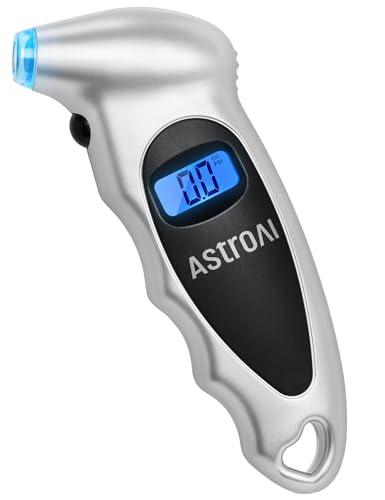
A digital gauge is faster to read, but a basic stick gauge still does the job if it gives the same reading each time. The tire gauge goes on the valve stem for a quick monthly check. A tread depth gauge gives a reading in 32nds of an inch, which can be helpful once wear starts to look uneven.
When to inspect: monthly, before trips, and after impacts
The guide recommends checking tire pressure once a month and again before long trips. That timing fits how tires lose air naturally at around one PSI per month. Add an extra inspection after hitting a pothole, curb, or road debris, because one hard impact can start sidewall damage or knock alignment out.
For tread and visible damage, a monthly routine works on many cars. Higher-mileage vehicles should tighten that gap and check tread every two to three months at minimum, with a quicker look at sidewalls and nails every couple of weeks.
How often should I check my car tire pressure?
Check tire pressure monthly and before long trips, and check more often if the vehicle covers a lot of miles or temperature swings are large. Always take readings when tires are cold, because driving raises PSI and can trick owners into letting out air they still need.
Monthly checks versus high-mileage driving
Monthly is the floor, not the right target for every driver. A commuter doing short errands can stay on that schedule. A family SUV handling school runs and weekend miles does better with a quick check every two weeks. A high-mileage driver should treat pressure checks like checking fuel or washer fluid.
Small losses matter because they stack up. Michelin says tires lose air naturally at around one PSI per month. That slow drop is easy to miss by eye, especially on modern tires with stiff sidewalls.
Why pressure should be checked before long trips
Highway driving builds heat, and that heat starts with whatever pressure the tire had when it left the driveway. A tire that begins the trip low runs hotter, wears the shoulders faster, and is more likely to turn a small puncture into a stop on the shoulder.
Cold-tire readings and the hot-tire mistake owners make
Cold means the vehicle has been parked long enough for the tires to return close to ambient temperature. Readings taken right after driving will be higher. That is normal. The mistake I see all the time is reading the hot number, assuming it is too high, and bleeding air out. Once the tire cools, it ends up underinflated.
What tire pressure should my car tires be at?
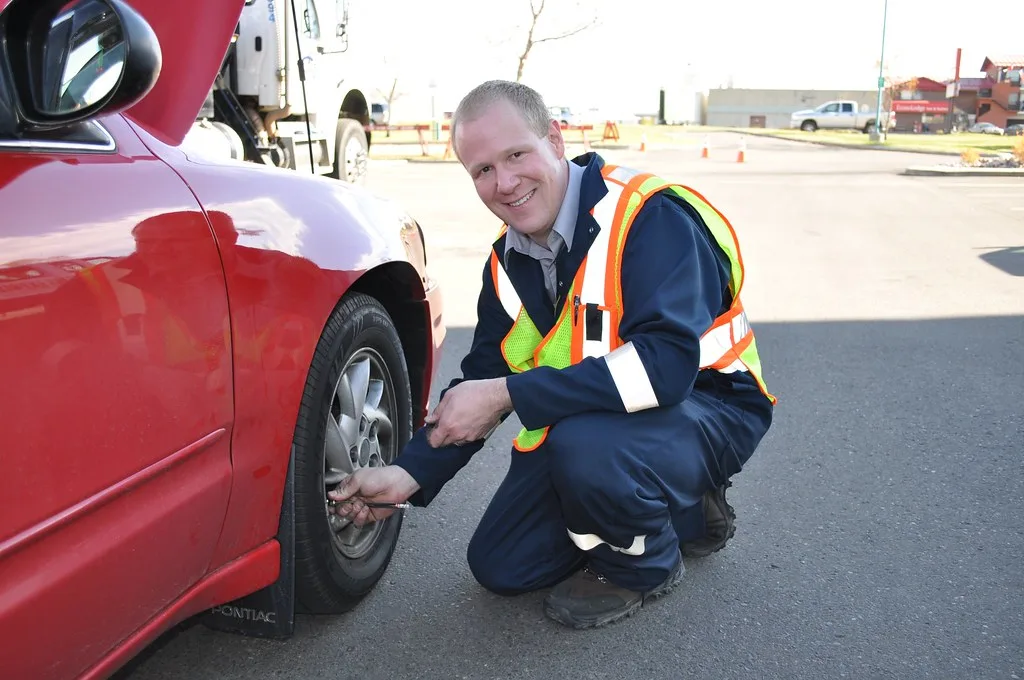
Use the PSI on the vehicle tire placard inside the driver’s door jamb or the owner’s manual, and ignore the pressure molded into the tire sidewall as your target. Check with a tire gauge on the valve stem while the tires are cold, then add air to match the placard.
Find the spec on the driver-side door-jamb placard
Correct tire pressure is printed on the sticker inside your driver’s door, not on the tire itself. This is the manufacturer-recommended PSI source for normal driving. If the placard is missing, use the owner’s manual.
Why the sidewall number is not your target PSI
The sidewall marking refers to the tire’s maximum-rated pressure context, not the car’s normal operating target. Using it as the goal often causes center wear, a harsher ride, and less predictable braking on broken pavement.
How to measure PSI with a digital or standard tire gauge
- Remove the valve cap.
- Press the gauge squarely onto the valve stem.
- Read the PSI.
- Compare it to the placard value.
- Add air if low, then recheck.
- Reinstall the valve cap.
Repeat on the spare. Compact spares and full-size spares often get ignored for months, then people expect them to work perfectly.
When to add air and when a slow leak needs attention
If one tire is a little low and the others stay stable, add air and recheck within days. If the same tire keeps dropping, look for a nail, valve issue, or bead leak. At that point, it is no longer routine maintenance. It is a repair call.
How do I know if my tire tread is too low?
Tire tread is too low when it measures under 2/32 inch, and the penny test can screen for that quickly. For exact readings, use a tread depth gauge and check the inner edge, center, and outer edge. Replace sooner if wear is uneven, cords show, or wet traction has dropped sharply.
Using the penny test as a quick screen
A penny test can show if tread is below 2/32 inch. It is quick and useful in a driveway, but it is still only a screen. It will not tell you if the inside edge is worn out while the center still looks fine from a standing position.
Measuring tread depth in 32nds with a gauge
A tread depth gauge reads in 32nds of an inch. That matters because wear patterns rarely stay uniform. Measure each tire in at least three spots across the tread: inner shoulder, center rib, and outer shoulder. Record the lowest reading, not the nicest-looking one.
The 2/32-inch threshold and earlier replacement cases
The 2/32-inch threshold is the hard line. Earlier replacement makes sense when one edge is much lower than the rest, the tire hydroplanes easily, or the wear bars are close to exposure on a tire that sees heavy highway use.
How often to check tread on low-mileage and high-mileage cars
Low-mileage cars can measure tread monthly or every two to three months. High-mileage drivers should stay closer to monthly because a tire that still looks decent can move from acceptable to replacement territory faster than most owners expect, especially if pressure or alignment has drifted.
What causes uneven tire wear on one side?
Uneven tire wear on one side usually points to alignment issues, inflation problems, or suspension wear rather than one single cause. Inside-edge wear often suggests alignment trouble, center wear often follows overinflation, and shoulder wear often follows underinflation. If you read the pattern early, the tire usually tells you what went wrong.
Inside-edge wear and likely alignment issues
Inside-edge wear is the classic sign that sends a car in for alignment. It can also show up with worn suspension parts, but alignment is the first thing I would check, especially if the steering wheel sits off-center or the car started pulling after a pothole hit.
Center wear from overinflation and shoulder wear from underinflation
Center wear usually means the tire has been running above the vehicle placard target. Too much pressure crowns the tread and loads the middle. Shoulder wear on both edges points the other way. Underinflation makes the edges carry more load and build more heat.
Cupping, patchy wear, and what vibration can tell you
Cupping or patchy scalloped wear often comes with vibration. That can point to a balancing problem, a worn damper, or suspension looseness. Alignment and balancing often get lumped together, but they fix different issues. Alignment sets wheel angles. Balancing fixes rotating weight mismatch that causes shake.
When uneven wear means replace now versus monitor
Replace now if cords are showing, one edge is at or below 2/32 inch, or a wear pattern has made the tire noisy and unsettled in the wet. Monitor only if the depth is still healthy across the tire and the wear pattern was caught early enough to correct with inflation, rotation, or alignment.
How often should I rotate my car tires?
Tire rotation is recommended every 5,000 to 7,500 miles, and Michelin says rotation should be done every 6,000 to 8,000 miles. In practice, I like to tie rotation to regular service so the front and rear tires swap positions before one axle gets far ahead in wear.
The usual 6,000-8,000 mile interval
Front tires on many vehicles scrub harder during steering and braking, while rear tires often wear differently under load. Rotating at a set mileage interval evens that out and lowers the chance that two tires age out long before the other pair.
Front-to-back and X-pattern rotation basics
Front-to-back patterns are common on vehicles where crossing is not used. An X-pattern is typical for non-directional tires when the vehicle and tire setup allow it. The owner’s manual matters here because some vehicles have fitment limits that change the pattern choice.
Why directional tires should not be crossed side-to-side
Directional tires are built to roll one way. Crossing them side-to-side reverses that direction unless the tires are remounted on the wheels. For a driveway routine, treat directional tires as front-to-back only unless a shop is doing the work.
How rotation schedules change with all-wheel drive or staggered setups
All-wheel-drive vehicles benefit from staying on schedule because uneven circumference can stress the system over time. Staggered setups, where front and rear sizes differ, limit rotation options. Those owners should watch pressure, alignment, and balancing even more closely because rotation will not save a bad wear pattern.
When should I get a wheel alignment or balancing check?
Get a wheel alignment check after a pothole or curb impact, when the vehicle pulls, when the steering wheel sits off-center, or at least annually. Get a balancing check when vibration rises with road speed, especially through the steering wheel. They fix different problems and should not be confused.
Alignment triggers: pulling, off-center steering wheel, impact damage, annual checks
Alignment affects handling, tire wear, and fuel economy. A car that drifts on a flat road, chews an inside edge, or feels different after an impact should be checked soon. Annual alignment checks make sense because small errors can eat tires slowly without obvious symptoms.
Balancing triggers: steering-wheel shake and speed-related vibration
Balancing is about rotating mass. If the steering wheel shakes at certain speeds, or the seat and cabin buzz on smooth pavement, balancing moves to the top of the list. It often gets paired with rotation because the wheels are already off the car.
How alignment and balancing affect wear, handling, and fuel use
Alignment errors scrub tread away. Balance problems usually create vibration first, then uneven wear if ignored long enough. Both can hurt fuel use, but alignment is the bigger tire-killer when one edge disappears early.
What to pair with rotation so you catch problems early
Each rotation visit should include a quick tread-depth map and a visual inspection of inner shoulders. That one habit finds hidden wear early, before the tire looks bad from the outside.
What is the safest way to inspect car tires for damage?
The safest inspection checks the sidewalls, tread grooves, inner sidewall, and spare while the vehicle is parked on level ground. Stop driving for bulges, exposed cords, or sidewall cuts. A nail in the tread may allow a careful short trip to a shop, but sidewall punctures do not.
Bulges, cracks, cuts, and sidewall damage that end the drive
A bulge means the tire structure has been damaged. A sidewall cut deep enough to expose cords is also a stop-now condition. Cracks can come with age or from storage and ozone exposure, and if they are widespread or deep, the tire needs a professional inspection before further use.
Embedded nails and screws: when to drive carefully to a shop and when to stop
Michelin says a nail in the tread may be repairable, but a nail in the sidewall never is. Michelin also says a safe repair puncture must be no larger than 1/4 inch (6mm). If the tire is holding air and the object is in the tread area, a careful short drive to a shop may be reasonable. If pressure is dropping fast, stop and change to the spare.
Checking the inner sidewall and tread grooves
The inner sidewall is where many owners never look, and it is where curb rub, cuts, and hidden bubbles can sit unnoticed. Turn the steering wheel for better access on the front tires, and use a flashlight to scan the tread grooves for small embedded objects.
Do not forget the spare tire
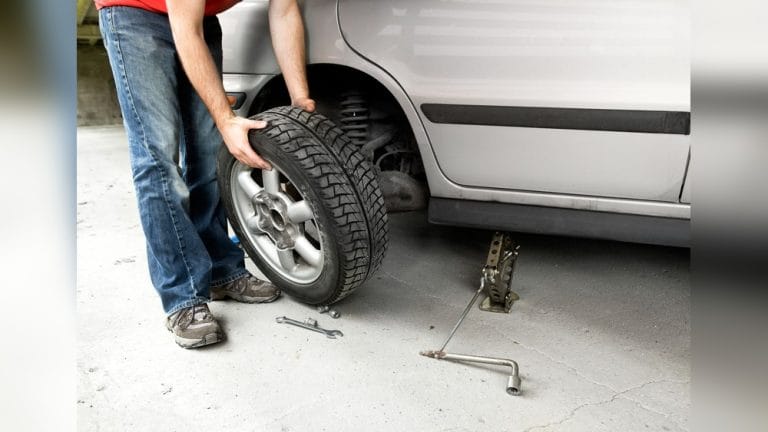
The spare gets ignored until the day you need it. Check its pressure with the same gauge, inspect the sidewall, and make sure the tools are present. A flat spare turns a simple puncture into a tow.
The one-page tire maintenance decision checklist

Use the chart below as a monthly decision tool. Start with the symptom you can see or feel, match it to the likely cause, then act immediately at the right level: drive now, monitor, book service, or replace before driving again.
Decision checklist: symptom, likely cause, action now
| Symptom | Likely cause | Action now |
|---|---|---|
| Low pressure in one tire | Natural air loss, valve leak, bead leak, or puncture | Set PSI to the driver-door placard with a tire gauge while cold. Recheck soon. If it drops again, inspect for damage and book repair. |
| Inside-edge wear | Wheel alignment issue, possible suspension wear | Measure tread across the tire. If one edge is near 2/32 inch, replace. Otherwise get an alignment check soon. |
| Center wear | Overinflation relative to vehicle placard | Verify cold PSI against the door-jamb placard. Correct pressure now and keep monitoring tread depth. |
| Shoulder wear on both edges | Underinflation, heavy loading, long-term low PSI | Inflate to placard PSI when cold. If shoulders are badly worn, plan replacement and inspect the other tires too. |
| Vibration at speed | Wheel balancing issue, cupped tread, bent wheel, suspension wear | Check tread for patchy wear. If tires look sound, schedule balancing and inspect alignment or suspension if vibration remains. |
| Bulge in sidewall | Impact damage and broken internal structure | Do not keep driving on it. Install the spare or tow the vehicle. Replace the tire. |
| Cut in sidewall | Road debris or curb damage | Stop driving if cords show or the cut is deep. Sidewall damage is a replace-now issue. |
| Nail or screw in tread | Puncture in repairable area or slow leak | If air loss is slow, drive carefully to a shop. If pressure falls quickly, use the spare. Sidewall punctures are not repairable. |
Turn the checklist into a monthly routine by driver type
- Commuter: pressure monthly, tread every two to three months, rotate on schedule, alignment after impacts.
- Family SUV: pressure every two weeks if loads change often, check spare monthly, inspect shoulders for underinflation wear.
- High-mileage driver: pressure every fuel-stop cycle or weekly, tread monthly, rotate promptly, respond fast to vibration or pull.
This is where cheap maintenance pays off. A gauge check takes minutes. Rotation costs far less than replacing two front tires early. Finding an alignment problem before one inside edge reaches the cords can save a tire pair that still has life left.
How should I store car tires for long-term use?
Store tires in a cool, dark, dry location, away from sunlight, ozone sources, and electrical equipment. Clean and dry them first, bag them if possible, and position mounted and unmounted tires correctly so they do not deform during storage.
Choose a cool, dark, dry space
Michelin advises storing tires in a cool, dark, dry location. Heat speeds aging. Sunlight adds UV exposure that hardens rubber over time. Damp areas invite corrosion on mounted wheel assemblies and make storage conditions less predictable.
Keep tires away from sunlight, ozone sources, and electrical equipment
Michelin warns to keep stored tires away from electrical equipment. That matters because motors, compressors, furnaces, and generators can create ozone, which attacks rubber compounds over time. Many competing pages stop at “store indoors.” That misses the actual problem sources in many garages.
Use sealed bags when possible and prep tires before storage
Wash off road salt and brake dust, let the tires dry fully, then place each tire in a sealed bag if possible. The goal is to reduce exposure to moving air and contamination during long storage. Keep the bags opaque if the area gets stray light.
How to position mounted and unmounted tires
Mounted tires can be stacked carefully or stored upright on a rack if the setup supports them evenly. Unmounted tires are generally better stored upright and rotated in position from time to time so one spot does not carry the load for months.
Frequently asked questions
How often should I check my car tire pressure?
Check tire pressure monthly and before long trips, using a gauge on cold tires. Higher-mileage driving, big temperature swings, or a known slow leak justify more frequent checks. Monthly is the minimum because tires lose air naturally over time even when there is no puncture.
What tire pressure should my car tires be at?
Set pressure to the PSI listed on the driver-side door-jamb placard or in the owner’s manual. Do not use the tire sidewall number as the routine target. Measure with a digital or standard gauge while the tires are cold, then add air and recheck.
How do I know if my tire tread is too low?
Use the penny test for a quick screen, then confirm with a tread depth gauge. Replace tires that are under 2/32 inch, and consider earlier replacement when one edge is far more worn than the rest or wet-road grip has dropped noticeably.
What causes uneven tire wear on one side?
One-sided wear usually comes from alignment issues, though inflation errors and worn suspension parts can add to it. Inside-edge wear points strongly toward alignment trouble. Center wear suggests overinflation, and shoulder wear on both edges usually points to underinflation.
Can I drive with a nail in my tire tread?
If the nail is in the tread area and the tire is holding air, a careful short trip to a repair shop may be possible. If the puncture is in the sidewall, the tire is not repairable. Fast air loss means stop and fit the spare.
How should I store car tires for long-term use?
Store tires in a cool, dark, dry place away from sunlight and electrical equipment. Clean and dry them first, use sealed bags when possible, and position mounted and unmounted tires in ways that reduce flat-spotting or sidewall stress during long storage.
Products related to this article
Sponsored / affiliate links. As an Amazon Associate I earn from qualifying purchases. I may earn additional commission from eligible campaigns.
 Bullseye 12V DC Car Tire Inflator Portable Air Compressor - Rapid 2 Minute Inflation, Auto Shut-Off, Max 150 PSI, Easy Cord Storage, Digital Pressure Gauge, LED Display (Royal Blue) - As Seen on TV
 Bullseye 12V DC Car Tire Inflator Portable Air Compressor - Rapid 2 Minute Inflation, Auto Shut-Off, Max 150 PSI, Easy Cord Storage, Digital Pressure Gauge, LED Display (Yellow) - As Seen on TV
 Bullseye 12V DC Car Tire Inflator Portable Air Compressor - Rapid 2 Minute Inflation, Auto Shut-Off, Max 150 PSI, Easy Cord Storage, Digital Pressure Gauge, LED Display (Orange) - As Seen on TV