How to Fix a Car Tire That Keeps Losing Pressure in Cold Weather
A tire can lose about 1 psi for every 10°F drop, so if pressure falls only after cold nights, set it to the door-jamb placard pressure, then check again before you start chasing a leak. Ignore repeated drops and you risk underinflation, uneven wear, poorer grip, and a tire that looks fine until it runs too soft. This guide shows how to separate normal cold-weather PSI loss from a true slow leak and the next diagnostic step.
Why cold weather drops tire pressure
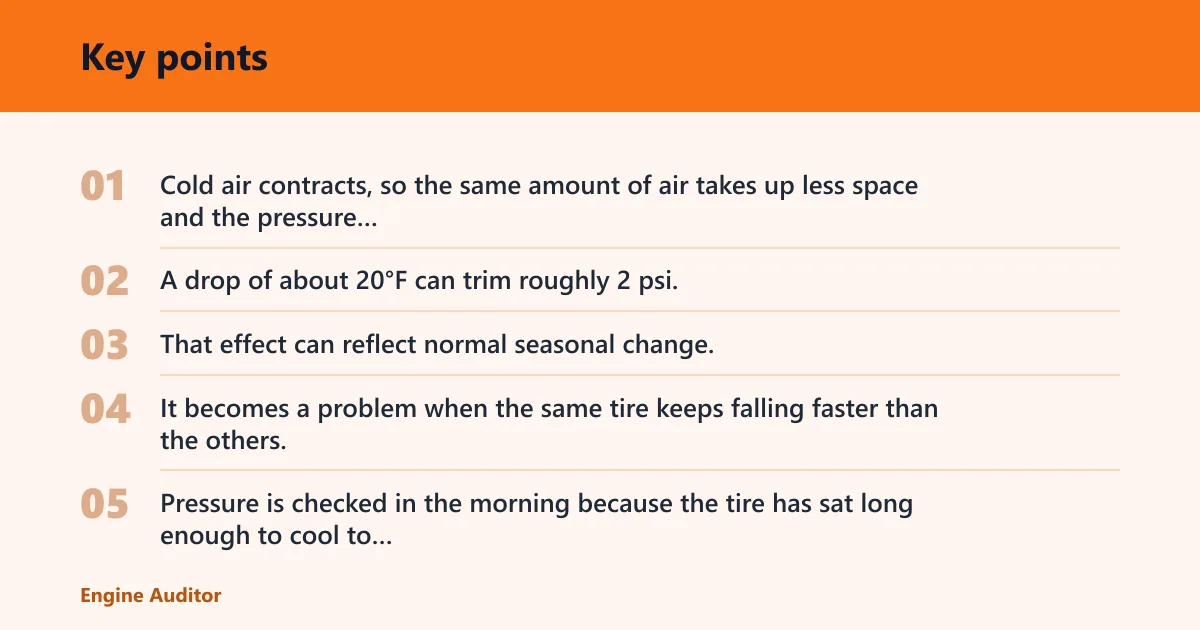

Cold air contracts, so the same amount of air takes up less space and the pressure inside the tire falls. A drop of about 20°F can trim roughly 2 psi, and a larger overnight swing can make the TPMS light appear even when no part has failed.
That effect can reflect normal seasonal change. It becomes a problem when the same tire keeps falling faster than the others, or when a refill does not hold over about the next 24 to 72 hours.
Why overnight drops are most noticeable
Pressure is checked in the morning because the tire has sat long enough to cool to ambient temperature. A tire that was driven on recently may read higher from heat, then look low the next day even though the air did not suddenly vanish.
Say your front tires read 35 psi after a highway run, then 32 psi the next cold morning. That can be a temperature effect. If one front tire drops to 28 psi while the other three sit near 32 to 33 psi, you should inspect that wheel for a leak.
What seasonal pressure loss looks like
Seasonal loss is usually even across the car. If all four tires fall by about the same amount after a cold snap, a common first step is to restore the placard pressure rather than assume four separate failures.
Uneven loss points to a fault in one wheel assembly. The likely sources are a valve stem, valve core, tread puncture, bead seal, or rim damage.
Winter tire pressure diagnostic table
Use this table to sort the pattern before you add more air again. It separates normal cold-weather loss from a true leak and points you to the next move.
| Symptom pattern | Likely cause | Recommended next action | Decision |
|---|---|---|---|
| All four tires drop by about the same amount after a cold night | Temperature-related contraction of air | Inflate each tire to the vehicle placard PSI when cold | Reinflate |
| One tire drops faster than the other three over 24 to 72 hours | Puncture, valve stem leak, bead leak, or rim issue | Inspect that wheel closely and test with soapy water | Inspect |
| Pressure falls only after overnight cold, then returns to normal after topping up | Normal seasonal pressure change, or a very small leak | Set cold pressure to spec and recheck on the next cold morning | Reinflate, then monitor |
| TPMS light comes on in cold weather, but all tires are close to the placard PSI | Warning threshold reached, not proof of a bad tire | Confirm each tire with a gauge before adding air | Reinflate if low |
| Pressure keeps falling after a refill, usually within 1 to 3 days | Active leak at the tread, valve, bead, or rim | Locate the leak source and repair or replace as needed | Repair or replace |
How do you tell normal cold PSI loss from a slow leak?
Start with the door-jamb placard pressure when the tires are cold, then compare all four tires instead of trusting one reading. A uniform drop after a temperature swing points to normal contraction. A single tire that keeps falling, especially after a refill, points to a leak.
Check the placard PSI when tires are cold
The vehicle placard gives the target PSI for that car. Do not use the maximum pressure printed on the tire sidewall as the target. The sidewall number is not the operating pressure for daily driving.
Measure before driving or after the car has sat for several hours. That gives a cold reading. If you fill a warm tire to the placard number, the next cold check may read low, but that is not proof of a leak.
Compare all four tires instead of one reading
One low tire can be a defect. Four equally lower tires often mean the weather changed. The comparison matters more than the absolute number.
A common first-timer mistake is topping off only the tire that triggered the TPMS light. The car may still have three tires below spec. Check every tire with a gauge, then correct each one to the same cold target if the placard calls for the same PSI front and rear.
Use pressure trends, not a single reading
A one-time low reading can come from temperature, a weak gauge, or a tire that was warm from driving. A repeated drop over about 24 to 72 hours is stronger evidence of a leak. Track the pattern, not the moment.
How much tire pressure drops in cold weather?
A common rule of thumb is about 1 psi for every 10°F drop in temperature. That means a 30°F cold snap can trim about 3 psi from a tire, even if it has no leak. Small seasonal drops are normal; repeated drops after refilling are not.
Typical PSI change with temperature swings
The exact change depends on the starting pressure and temperature, but the direction is predictable. A cold front, a freezing night, or parking outside in an exposed lot can all lower PSI enough to trip a warning light.
Suppose a tire is set to 35 psi on a 60°F afternoon. If the next morning is 20°F, a drop near 4 psi is plausible from temperature alone. If that same tire is back at 31 psi every morning after being refilled, a leak is more likely.
When a small drop is normal
A small drop after a cold night is normal when all four tires fall together and none of them keeps falling faster than the rest. In that case, restore the placard PSI and move on.
If the tire settles back to the same pressure after a week of similar weather, the behavior is likely temperature-driven. If it loses another 2 to 4 psi despite no new cold snap, you need a leak search.
When repeated top-offs point to a leak
If a tire needs air again every few days, treat it as a slow leak until proven otherwise. Cold weather may reveal the problem sooner, but the weather is not the cause.
Pressure loss that returns after a refill usually means air is escaping through a puncture, valve component, bead seal, or rim surface. That is the point to inspect, not to keep adding air without a diagnosis.
Inspect the leak sources that winter exposes
Winter often makes weak points show up because cold rubber stiffens and metal contracts. Focus on the valve stem, valve core, tread area, and the bead where the tire seals against the rim. Also look for corrosion and pothole damage.
Valve stem cracks and aging rubber
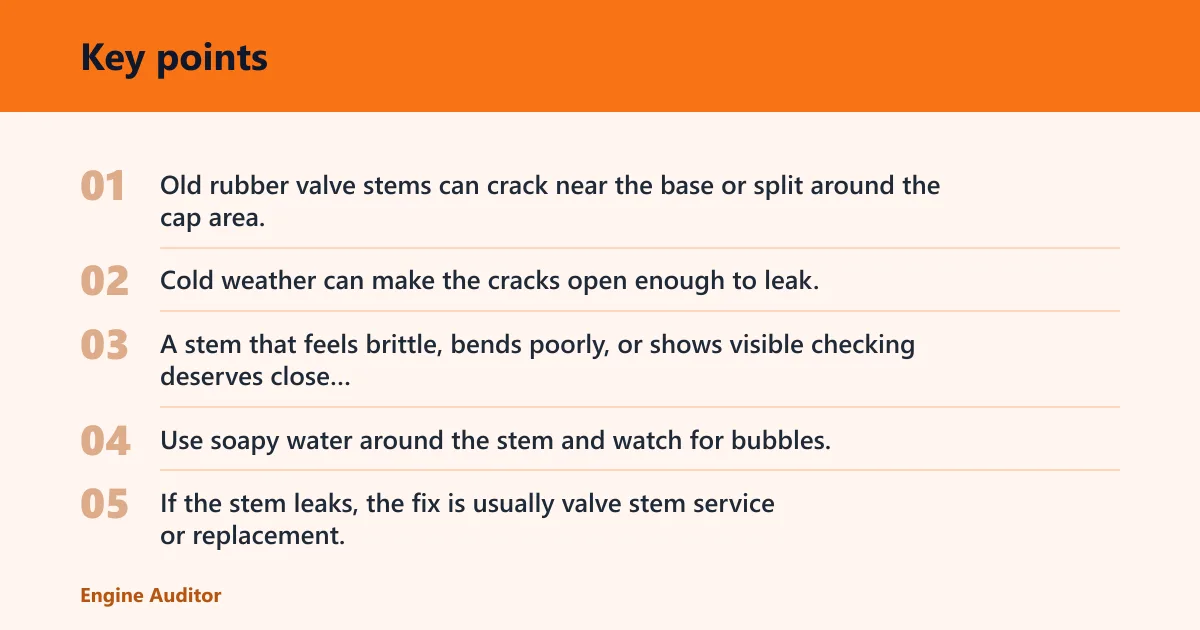
Old rubber valve stems can crack near the base or split around the cap area. Cold weather can make the cracks open enough to leak. A stem that feels brittle, bends poorly, or shows visible checking deserves close inspection.
Use soapy water around the stem and watch for bubbles. If the stem leaks, the fix is usually valve stem service or replacement, not repeated inflation.
Valve core leaks and serviceability
The valve core is a small threaded part inside the stem. It can leak slowly if it is loose, dirty, or worn. A core leak often shows as bubbles at the center of the valve after a soapy-water test.
The core is serviceable on many tires. If the stem itself is sound, a shop can replace the core and recheck the seal without replacing the whole tire.
Punctures in the tread area
Nails, screws, and sharp road debris usually cause slow leaks in the tread area. Some tread punctures are repairable, but only if the damage is in the repairable zone and the tire has not been abused by driving while very low.
The safest repair for most repairable punctures is a patch-plug from the inside, not a simple outside plug alone. If the cut is too large, too close to the sidewall, or the tire has internal damage, replacement is the safer call.
Bead leaks, rim corrosion, and impact damage
The bead seal can leak where the tire meets the rim. Corrosion on the rim lip, dirt between the bead and wheel, or impact damage from a pothole can break that seal. These leaks often show up after temperature changes or after the wheel has been hit.
If one corner keeps losing air and the outside looks fine, inspect the wheel edge for bent metal, flaking corrosion, or a tire that may not be seated evenly on the rim.
What should you do after refilling the tire?
Add air in small steps, recheck with a tire pressure gauge, and watch the tire over the next 24 to 72 hours. Do not blast in air until the tire feels right by hand. That increases the chance of overinflation, especially when the tire warms up later.
Add air in small steps
Use an air compressor or gas-station inflator and add air in short bursts. Stop often and check the reading. Cold tires can take a few pounds more than you expect if the weather is well below freezing, so sneak up on the target rather than overshooting it.
Overinflation can be just as unhelpful as underinflation. If the tire is filled in a warm garage, the pressure may rise further after driving. The goal is the cold placard PSI, not a guess.
Recheck with a tire pressure gauge
Use a digital or analog gauge that reads within about 1 to 2 psi if it is in good condition. Compare the gauge reading to the TPMS warning only as a cross-check. TPMS is a warning system, not a precise measurement tool.
If the TPMS light stays on after correct inflation, drive a short distance only if the tires are safe to use, then recheck cold pressure. A persistent warning may mean the tire is still low, the system needs time to reset, or the sensor itself has a fault.
Monitor the tire over the next 24 to 72 hours
After refilling, check the same tire again when it is cold on the next morning, and again after a few days if the weather stays similar. A stable reading suggests temperature change was the main issue. Another drop means the leak is still active.
That pattern matters more than one refill. If the tire loses pressure again in a day or two, inspect for bubbles at the valve, tread, and bead rather than adding more air and hoping the problem fades.
When should the tire be repaired or replaced?
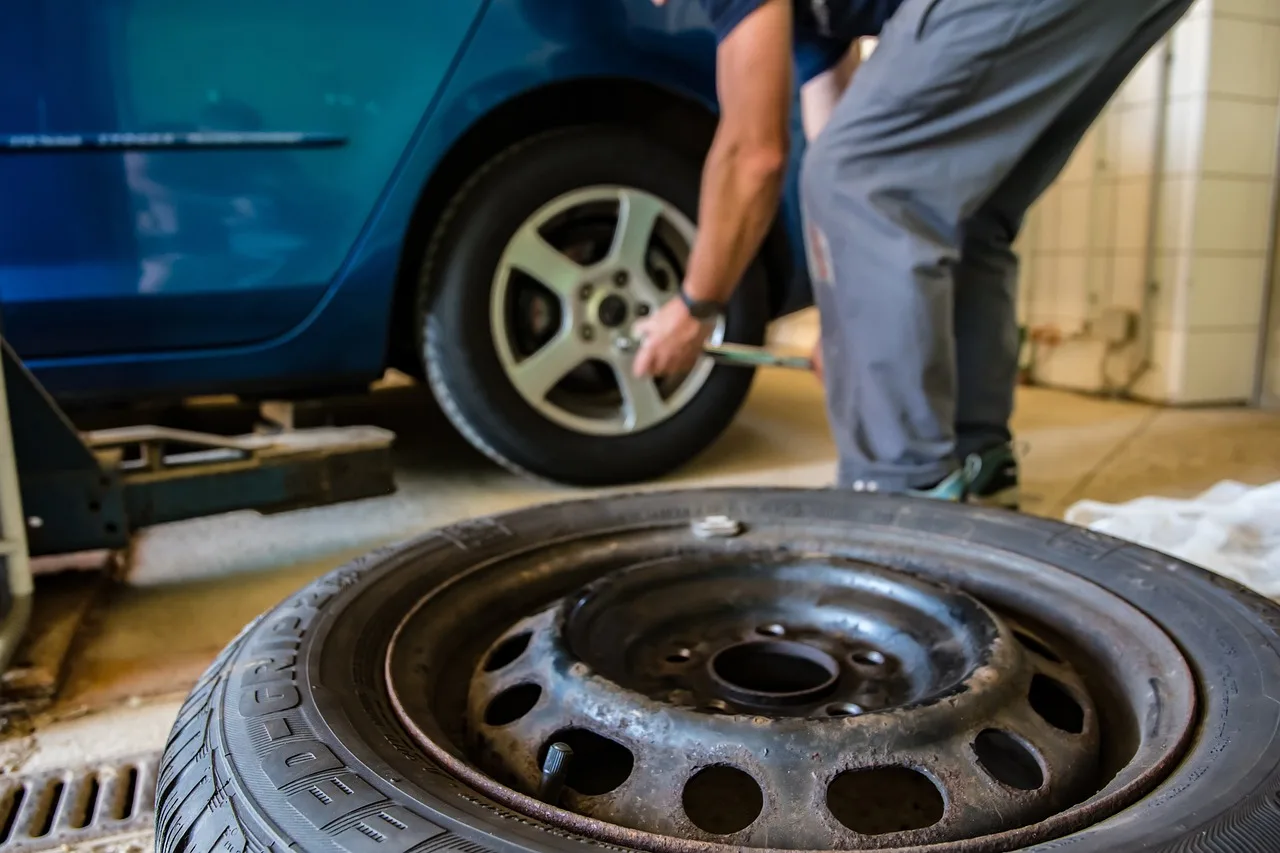
Repair a tread puncture only when the damage is in the repairable area and the tire still has healthy tread and structure. Replace the tire when the puncture is not repairable, the sidewall is damaged, or the tread is too low to justify further service.
Tread punctures and repairable damage
A puncture in the tread area is often repairable if it is small and the tire has not been run flat. The common professional repair is an internal patch-plug. A sidewall puncture is different and is generally not a repair candidate.
If the tire keeps dropping after a puncture repair, the leak may be elsewhere or the damage may be larger than it first appeared. That is a repair failure, not a reason to keep topping it off.
When low tread makes winter complaints worse
Low tread does not cause pressure loss, but it makes winter tire problems more serious. Shallow tread reduces wet and snow traction and leaves less margin when a tire is slightly underinflated. If tread is near the legal minimum, the safer choice may be replacement even if the leak is small.
Worn tread also makes a winter pressure complaint harder to ignore because the tire can feel worse sooner. A tire at or near minimum tread depth deserves a stricter replacement threshold than a newer tire.
When replacement is the safer call
Replace the tire if the damage is in the sidewall, the bead area is compromised, the casing is damaged, or the leak returns after proper repair. Replace the tire if the rim or bead damage cannot seal reliably, or if the tire is too worn to justify another repair.
Say a rear tire loses 3 psi every two days, bubbles at the valve stem, and the tread is already near the wear bars. That tire needs more than a refill. It needs service, and it may need replacement if the stem, tire, or rim cannot be made reliable.
Frequently asked questions
Why does my car tire keep losing pressure when it gets cold?
Cold air contracts, so tire pressure falls even without a leak. If all four tires drop by about the same amount after a cold night, that is usually normal seasonal change. If one tire keeps falling faster than the others, inspect the valve stem, tread, bead, and rim.
How often should I check tire pressure in winter?
Check at least once a month, and more often during cold snaps or if the TPMS light comes on. If a tire has been refilled because it was low, recheck it over the next 24 to 72 hours. Repeated loss in that window usually means a leak.
Can a slow leak only show up in cold weather?
Yes. A small leak can be masked when the tire is warm and show up after an overnight temperature drop. Cold weather does not create the leak, but it can make a weak valve stem, valve core, bead seal, or tiny puncture lose enough air to notice.
How do I know if it’s the valve stem or a puncture?
Look for bubbles with soapy water. Bubbles at the valve stem or core point to that assembly. Bubbles along the tread point to a puncture. If the tire loses pressure near the rim edge, suspect the bead seal or rim corrosion rather than the tread.
When should I get the tire repaired instead of just refilling it?
Repair it when the same tire keeps losing air after a refill, especially over 24 to 72 hours. Refilling is fine for normal cold-weather PSI loss, but repeated top-offs mean you should find the leak source. A tread puncture may be repairable; a sidewall, bead, or damaged rim may not be.
Products related to this article
Sponsored / affiliate links. As an Amazon Associate I earn from qualifying purchases. I may earn additional commission from eligible campaigns.