Ford Tire Rotation Schedule and Why It Matters
Most Ford owners should rotate tires every 5,000 to 7,500 miles, or at each oil change, unless the owner’s manual gives a different interval. Directional or staggered setups use different patterns, and some cannot be rotated side to side. Skip the service, or use the wrong pattern, and you can speed up uneven wear, add noise, and shorten tire life. This guide explains when to rotate, when to wait, and which pattern fits FWD, RWD, AWD, 4WD, directional tires, staggered wheels, and uneven wear.
How driving conditions and mileage affect rotation
Most Ford owners should plan on a tire rotation every 5,000 to 7,500 miles, with many schedules lining up with oil changes. Ford’s manuals say rotation at the recommended interval helps tires wear more evenly, but the exact interval can vary by model and driving conditions.
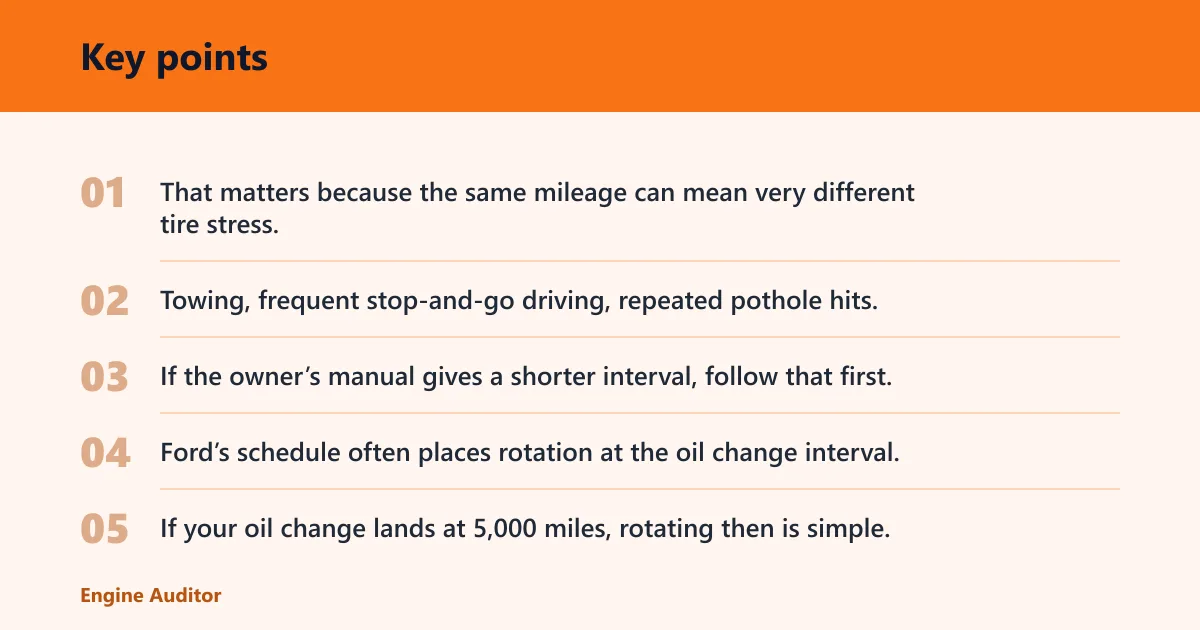
That matters because the same mileage can mean very different tire stress. Towing, frequent stop-and-go driving, repeated pothole hits, and heavy highway miles can move wear faster than a low-stress commute. If the owner’s manual gives a shorter interval, follow that first.
How oil changes and driving severity affect timing
Ford’s schedule often places rotation at the oil change interval, but that is a planning shortcut, not a universal rule. If your oil change lands at 5,000 miles, rotating then is simple. If the oil interval is longer, the tire interval still governs when tread wear is building unevenly.
Severity changes the picture. A truck that tows often may need rotation closer to the 5,000-mile end. A vehicle driven mainly on smooth roads may be able to stay nearer 7,500 miles if the tread is wearing evenly and the manual allows it.
When low-mileage annual driving still needs a rotation
Low mileage does not cancel time-based care. If a Ford is driven only a few thousand miles a year, the tires can still age, sit in one position, and develop uneven wear patterns from storage, pressure drift, or road impacts. A yearly check is still useful even when the odometer is moving slowly.
Say your Escape covers 4,000 miles in 12 months, mostly short trips. The mileage alone may not trigger a rotation yet, but a tread inspection can still show whether the fronts are wearing faster, which is common because they do more steering and braking.
Which rotation pattern fits your Ford?
The right pattern depends on drivetrain, tire type, and whether the tires are directional or staggered. The owner’s manual is the official source for the exact pattern and the scheduled maintenance section for that model. If the manual and the tire layout conflict, the layout wins.
Rearward cross for many rear-wheel-drive and all-wheel-drive setups
A rearward cross is commonly used for many FWD vehicles and may also be used on some AWD vehicles, depending on tire uniformity. It usually moves the rear tires straight to the front and crosses the front tires to the opposite rear positions. Simon’s Automotive lists Ford Escape and Edge as FWD examples for this pattern.
Forward cross for many rear-wheel-drive trucks
For many non-staggered RWD and 4WD Ford trucks, a forward cross is commonly used. Simon’s Automotive lists F-150 non-staggered RWD/4WD trucks in this group. In this pattern, the front tires move straight back, and the rear tires cross to the front.
X-pattern and side-to-side or front-to-rear only cases
Some AWD Ford vehicles can use an X-pattern or a rearward cross, depending on how even the tire wear is and whether the manual allows it. Directional tires usually stay on the same side of the vehicle and often only move front to rear. Staggered setups may not allow a true rotation at all.
A common first-timer mistake is assuming all four tires can cross freely. A Mustang with staggered wheel widths may not allow a normal rotation without dismounting the tires from the wheels, because front and rear sizes are different.
Why drivetrain changes the pattern
Drivetrain changes how load, torque, and steering affect the tread. Front-wheel drive sends most work to the front axle, rear-wheel drive shifts more drive load to the rear, and AWD or 4WD systems can spread wear across all four tires in a different way. The pattern should match that job mix.
Front-wheel drive tire wear differences
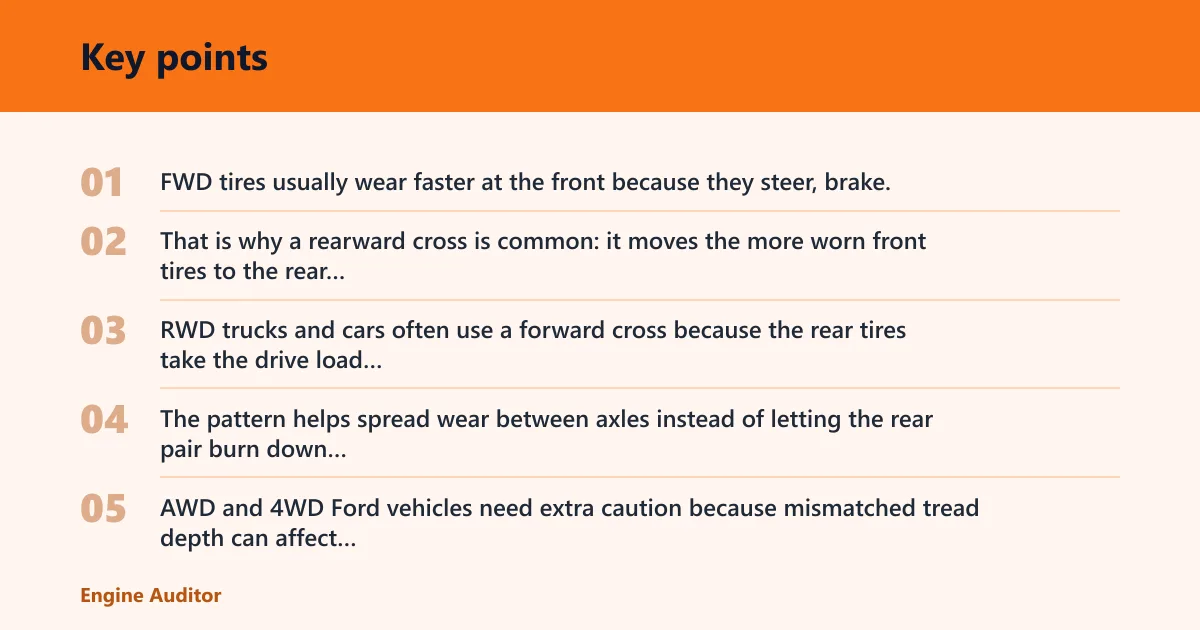
FWD tires usually wear faster at the front because they steer, brake, and often drive the vehicle too. That is why a rearward cross is common: it moves the more worn front tires to the rear while bringing the rear tires forward in a way that balances wear.
Rear-wheel drive and torque delivery
RWD trucks and cars often use a forward cross because the rear tires take the drive load while the fronts handle steering. The pattern helps spread wear between axles instead of letting the rear pair burn down faster than the fronts.
All-wheel drive and four-wheel drive service cautions
AWD and 4WD Ford vehicles need extra caution because mismatched tread depth can affect driveline behavior. Simon’s Automotive notes that AWD vehicles can use an X-pattern or rearward cross depending on uniformity. If the tires are not close in wear, the better move may be to correct the tire issue before changing positions.
Ford warns that an unbalanced wheel can wear a tire unevenly. That means a rotation can move the symptom around without fixing the cause. If a wheel balance issue is present, correct it rather than treating rotation as the cure.
Directional and staggered tires
Directional tires and staggered wheel setups change the schedule more than most owners expect. A directional tire has a single rolling direction, so it usually stays on the same side of the vehicle. A staggered setup uses different front and rear sizes or widths, which can block normal cross-rotation.
How directional tread limits rotation direction
Directional tread is built to roll one way. Because of that, the tire usually can move only front to rear on the same side. If the tread arrows point the wrong way after a swap, the tire is installed incorrectly.
Why staggered fitments may block normal rotation
Staggered fitments are common on some Mustangs. They may use different wheel widths or tire sizes front and rear. In those cases, side-to-side rotation and even some front-to-rear moves are not possible without changing tire positions on the wheels.
When dismounting is the only way to rotate
When the wheel widths or tire sizes differ, the only way to rotate may be to dismount and remount the tires on different wheels. That is a service decision, not a casual driveway job. If the setup is staggered, check the manual before assuming a standard rotation still applies.
Ford rotation decision table
This table gives a practical starting point. Use the owner’s manual first, then match the rotation pattern to the drivetrain, tire type, and wear pattern you see.
| Drivetrain | Tire type | Wear pattern | Recommended rotation pattern | Alignment-first warning | TPMS and pressure notes after service |
|---|---|---|---|---|---|
| FWD | Non-directional, uniform size | Front shoulders worn faster than rear | Rearward cross | Check alignment first if one edge is much more worn than the other | Set all pressures to spec and confirm TPMS status after rotation |
| RWD | Non-directional, uniform size | Rear wear heavier from torque | Forward cross | Inspect alignment if the vehicle pulls or one rear tire is cupped | Check pressures and recheck lug nut torque after 50–100 miles |
| AWD | Non-directional, uniform size | Wear spread but not equal | X-pattern or rearward cross, if manual allows | Delay rotation if tread depth spread is clearly uneven across axles | Reset pressures and confirm any TPMS relearn or sensor-setting step |
| 4WD | Non-directional, uniform size | Mixed front and rear wear | Forward cross on many trucks | Check alignment if wear is feathered or one shoulder is scrubbed | Verify pressure on all four tires and torque to Ford spec |
| Any drivetrain | Directional | Even wear with same-side tread direction | Front-to-rear only on the same side | Do not force a cross rotation if arrows would reverse | Check pressure and TPMS after reinstalling each wheel |
| Any drivetrain | Staggered | Different front and rear sizes | May require dismounting or may not permit rotation | Confirm fitment first; a normal rotation may be impossible | Update any TPMS settings if the vehicle uses different front and rear pressures |
Should you check alignment first?
Yes, if the wear is uneven. Ford says alignment should be checked before rotating if wear is uneven, because rotation does not fix misalignment. If one edge is worn faster, or the tread has a sawtooth feel, the problem may be alignment rather than simple mileage spread.
Uneven wear that points to alignment trouble
Look for wear on one inside edge, one outside edge, or a clear difference in tread depth from side to side. A simple rotation can spread that wear to a different corner, but it does not correct the cause. A depth difference of about 2/32 inch or more between inner and outer edges on the same tire is a practical sign to inspect alignment before rotating.
Potholes, curbs, and suspension damage
Potholes and curb strikes can knock alignment out. So can worn suspension parts. If the steering wheel is off-center, the vehicle pulls, or one tire shows odd shoulder wear after impact, rotation should wait until the mechanical issue is checked.
Suppose a Ranger hits a deep pothole and then begins to pull right. Rotating the tires may move the pull, but it will not correct a bent component or toe setting that is now out of spec. That is an alignment job first.
When rotation should wait until repairs are done
Delay rotation when the wear pattern looks active and uneven enough that the cause still matters. If one axle is clearly more worn, or the wear is tied to a pull, vibration, or recent impact, fix the cause first. Then rotate so the new wear pattern does not continue.
What happens if you skip rotations?
Skipping rotations usually means the front and rear tires age at different speeds. Front tires often wear faster because they steer and brake more, so the vehicle can end up with one pair ready for replacement much sooner than the other. That shortens tire life and can change how the Ford feels on the road.
Uneven tread wear and shorter tire life
Uneven wear reduces how much usable tread remains on the set. One axle can be worn out while the other still has usable life, which wastes tire depth and can force earlier replacement. Ford’s manuals say regular rotation helps tires wear more evenly for that reason.
Vibration, pull, and noise from wear mismatch
Uneven wear can bring vibration, pulling, and extra road noise. That blog lists vibration, pulling, and extra road noise as signs a rotation may be needed. Ford also warns that an unbalanced wheel can wear a tire unevenly, so a vibration should not be blamed on rotation alone.
Why pressure checks still matter after service
After any rotation, Ford says tire pressures must be checked and set correctly. That step matters because different pressures can make one axle wear faster and can trigger warning issues. Ford also warns TPMS settings may need updating after rotation on vehicles with different front and rear pressures.
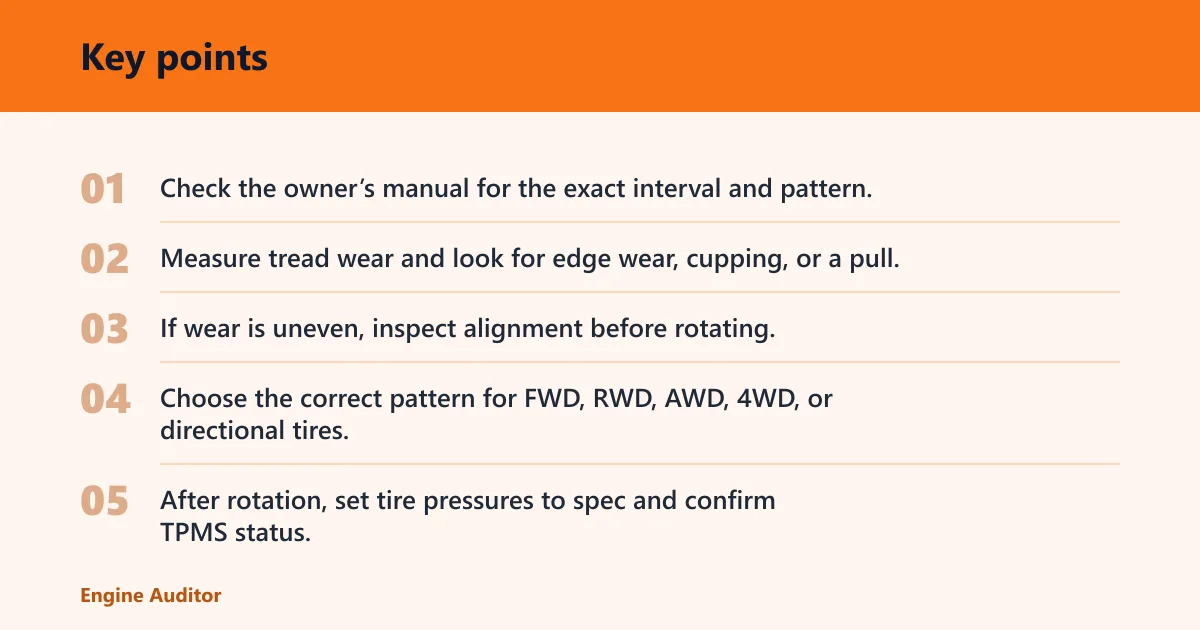
- Check the owner’s manual for the exact interval and pattern.
- Measure tread wear and look for edge wear, cupping, or a pull.
- If wear is uneven, inspect alignment before rotating.
- Choose the correct pattern for FWD, RWD, AWD, 4WD, or directional tires.
- After rotation, set tire pressures to spec and confirm TPMS status.
- Torque the lug nuts to Ford spec and recheck them after 50–100 miles.
Frequently asked questions
How often should I rotate my Ford tires?
Most Ford owners should rotate tires every 5,000 to 7,500 miles, and many schedules line up with oil changes. The exact interval can change by model and driving conditions, so the owner’s manual is still the final word. If you tow, drive on rough roads, or rack up miles quickly, stay closer to the short end.
What is the correct tire rotation pattern for a Ford?
There is no single pattern for every Ford. Many FWD vehicles use a rearward cross, many RWD trucks use a forward cross, and some AWD vehicles use an X-pattern or rearward cross. Directional tires usually stay on the same side, while staggered setups may block normal rotation.
Does tire rotation need to happen at every oil change?
Not always, but Ford’s schedule often places tire rotation at the oil change interval. If your oil change interval is within the 5,000 to 7,500 mile range, the two tasks often line up. If the manual calls for a different mileage, follow the tire schedule rather than forcing the oil-change rhythm.
What happens if I skip tire rotations on my Ford?
The fronts usually wear faster, so skipping rotations can leave you with uneven tread depth, more road noise, and a shorter total tire life. You may also notice vibration or a pull if wear is already uneven. Rotation will not fix the cause if the problem is alignment, pressure, or wheel balance.
Can I rotate tires on an AWD Ford the same way as FWD?
Not always. AWD Fords can use a rearward cross or an X-pattern depending on the manual and how even the tires are. The driveline may be more sensitive to tread-depth differences, so you should match the pattern to the specific vehicle instead of copying a FWD layout automatically.
Should I check alignment before rotating tires?
Yes, if wear is uneven. Ford says alignment should be checked before rotating when tire wear is not even, because rotation only moves the wear pattern. If the vehicle pulls, the steering wheel is off-center, or one edge is much more worn than the other, address alignment first.
Products related to this article
Sponsored / affiliate links. As an Amazon Associate I earn from qualifying purchases. I may earn additional commission from eligible campaigns.