How Many Car Tyres Fit In A 40ft Container
Figuring out how many car tyres fit in a 40ft container can seem tricky at first. You might wonder if they stack neatly or if there’s a trick to packing them efficiently. It’s a common question, especially if you’re planning a shipment or just curious about logistics.
Don’t worry, it’s not as complicated as it looks. We’ll break it down simply, step-by-step, so you can get a clear picture.
Calculating Car Tyres In A 40ft Container
This section will explain the basic math and factors involved in determining the maximum number of car tyres that can fit inside a standard 40-foot shipping container. We will look at typical tyre sizes and how they influence the total count, along with general best practices for loading to maximize space. Understanding these foundational elements is key to estimating the capacity accurately for any shipment.

Fix-A-Flat
Fix-A-Flat S60420 Aerosol Emergency Flat Tire Repair…
- Emergency flat tire repair solution, connect, inflate and go! The easiest and quickest way to temporarily repair a flat tire in an…
- Fix-a-Flat is designed to seal small tread tire punctures up to 1/4 of an inch in diameter in seconds and provide enough inflation…
- Flats happen, so be prepared with Fix-a-Flat, an easy-to-use, better alternative to the spare tire and perfect for roadside emerge…
As an Amazon Associate I earn from qualifying purchases.
Understanding Container Dimensions
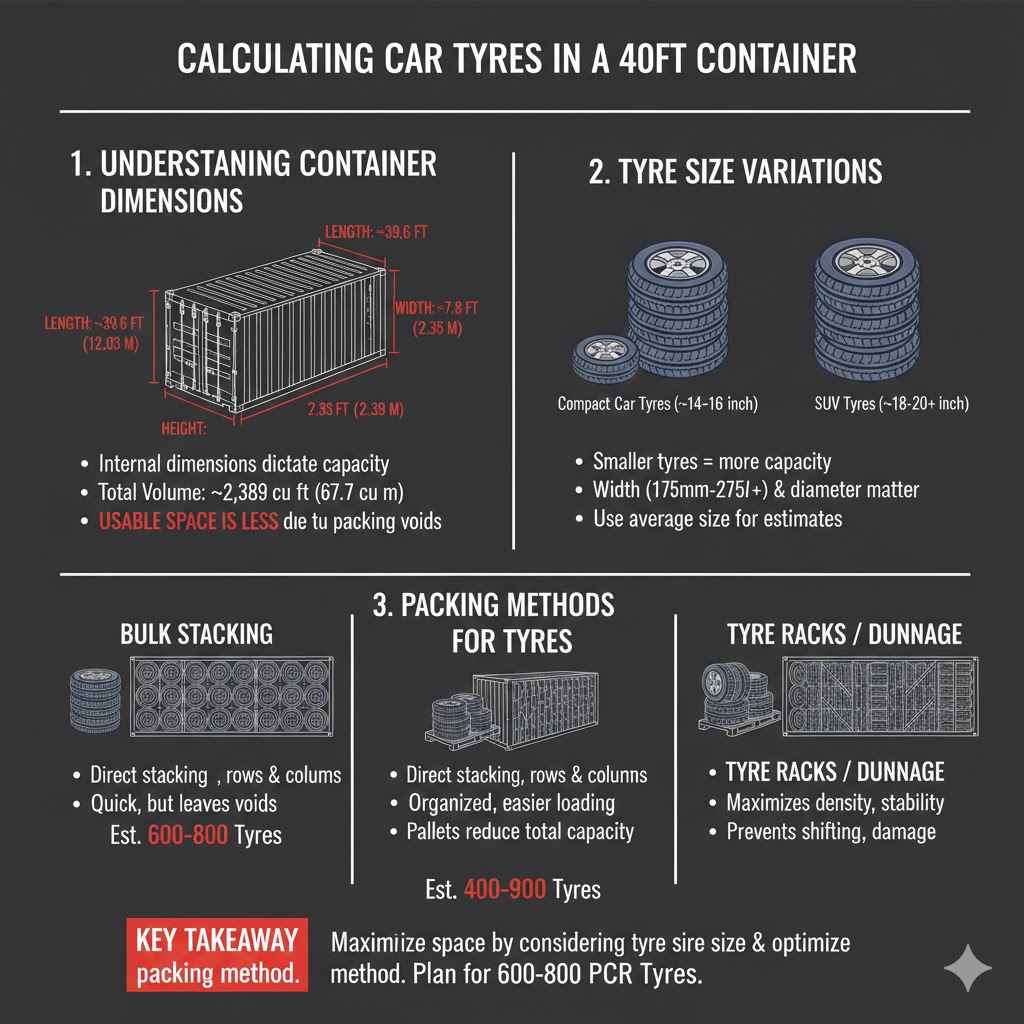
A 40-foot container has specific internal dimensions that dictate how much it can hold. It’s not just about the length; the width and height are equally important for packing goods like car tyres. Knowing these precise measurements helps in calculating the volume available for stacking.
The standard internal length of a 40-foot dry cargo container is approximately 39 feet and 5.5 inches (about 12.03 meters). The internal width is typically around 7 feet and 8.7 inches (about 2.35 meters). The internal height usually measures about 7 feet and 10 inches (about 2.39 meters).
These dimensions give us a total internal volume of roughly 2,389 cubic feet or 67.7 cubic meters. However, this is the theoretical maximum. In reality, the space occupied by tyres, how they are arranged, and any dunnage or bracing will reduce the usable volume.
When calculating, we need to consider the actual space each tyre takes up, including any air gaps between them. The shape of a tyre, being round, creates natural voids. Efficient packing aims to minimize these voids.
Tyre Size Variations
Car tyres come in many different sizes, and this is a major factor affecting how many fit. A smaller tyre will take up less space than a larger one. Tyre profiles, width, and rim diameter all play a role.
For example, a compact car tyre will have a smaller overall diameter and width compared to an SUV tyre. This means more compact car tyres can be loaded into the same container space. It’s essential to know the average size of the tyres you intend to ship.
Common tyre sizes can range from around 14 inches in diameter for smaller vehicles to over 20 inches for larger cars and SUVs. The width can vary from about 175mm to over 275mm. These differences are significant when calculating bulk quantities.
Shipping companies often deal with a mix of sizes, but for an estimate, it’s best to use an average or the most common size within your shipment. This will give you a reasonable baseline for your calculation.
Estimating Space Per Tyre
To estimate how many car tyres fit in a 40ft container, we need to estimate the space one tyre occupies. This involves considering its dimensions and how it can be packed.
A common method is to stack tyres in a way that utilizes the container’s space efficiently. Tyres can be stacked on top of each other, or sometimes placed side-by-side. The specific arrangement affects the overall density of packing.
For estimation purposes, a single car tyre might occupy a space of about 2.5 to 3 cubic feet, depending on its size and how it’s compressed or stacked. This is a rough guide, as packing can involve interlinking tyres or filling gaps.
When stacked, tyres can often nest slightly into each other, reducing the total volume required per tyre compared to if they were perfectly separate. This nesting effect is a key element in maximizing container capacity.
Packing Methods for Tyres
The way tyres are packed directly impacts the total number that can be loaded into a 40ft container. Different methods can yield significantly different results. Let’s explore some common and effective packing strategies.
Proper packing not only maximizes the quantity but also ensures the tyres arrive in good condition, preventing damage during transit. This involves careful arrangement and potentially using additional materials for support.
The goal is to fill as much of the container’s volume as possible without exceeding its weight limit. It’s a balance between cubic capacity and gross weight capacity.
Bulk Stacking
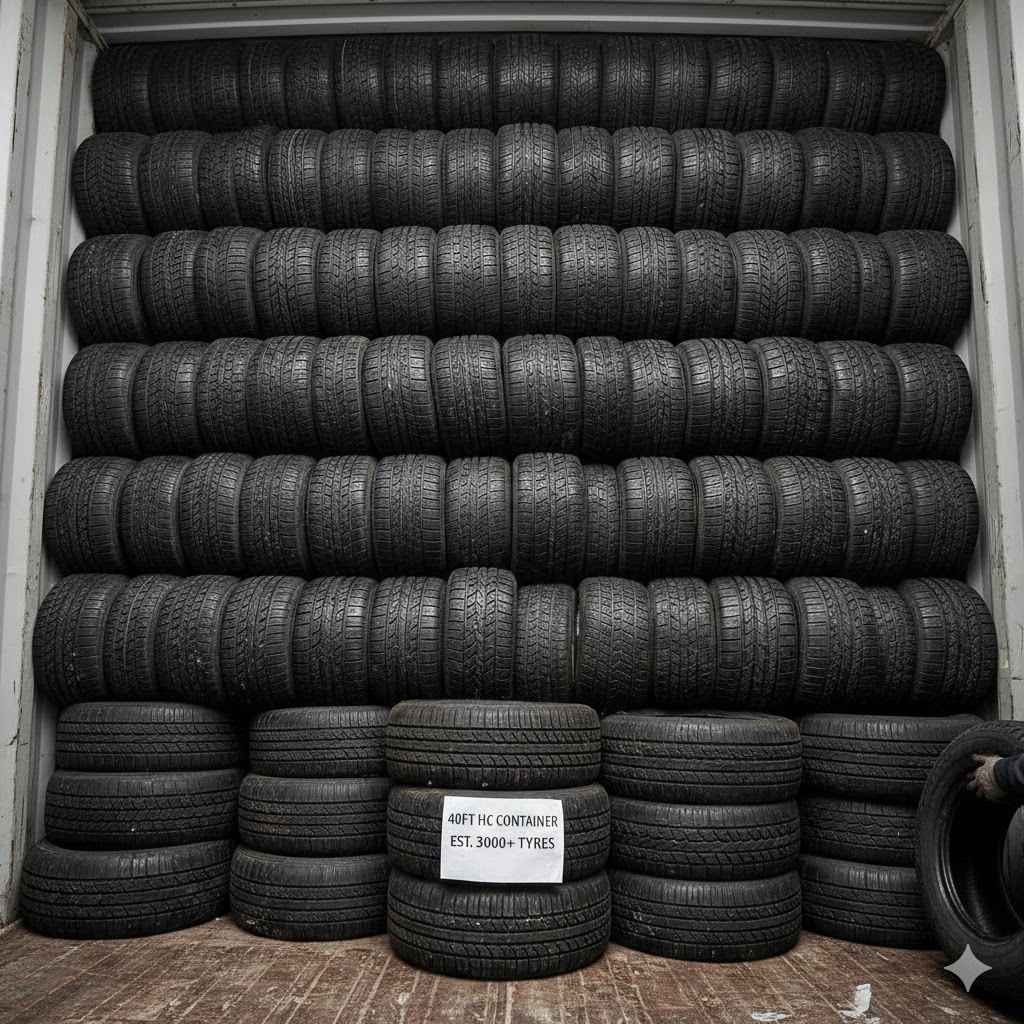
Bulk stacking is the most straightforward method. Tyres are simply loaded and stacked vertically or horizontally, filling the container space as much as possible.
In this method, tyres are often placed in rows and columns. They can be stacked several layers high, limited by the container’s internal height and the stability of the stack. Workers might also interlock tyres to create more stable and dense packing.
This method is relatively quick but might leave significant empty space, especially if tyre sizes are not uniform. It relies on the natural shape of the tyres to create some level of interlocking.
The density achieved with bulk stacking can vary greatly. For standard passenger car tyres, it’s possible to stack them in a way that they take up less space than their individual volumes suggest, due to their flexible nature.
Tire Pallets
Using pallets can organize tyres and make loading and unloading easier. Tyres are typically stacked and secured onto pallets, and then the pallets are loaded into the container.
Palletizing can standardize the loading process and protect tyres from damage from forklifts or other handling equipment. However, pallets themselves take up space and add weight, which can reduce the total number of tyres shipped.
The type of pallet used matters. Standard wooden pallets are common, but specialized tyre pallets are also available that are designed to hold tyres more securely and efficiently.
The dimensions of the palletized tyre stacks need to be considered carefully against the container’s internal dimensions. A well-designed pallet setup can create consistent blocks of tyres that fit snugly within the container.
Tire Racks or Dunnage
For optimal space utilization and stability, specialized tyre racks or dunnage can be used. These are structures built inside the container to hold tyres securely and allow for denser stacking.
Racks can allow for vertical stacking of more layers than might be stable in a simple bulk stack. They can also compartmentalize tyres, preventing shifting during transit and reducing the risk of damage.
Dunnage, such as straps, bracing, or cardboard inserts, can be used to fill gaps, stabilize stacks, and protect tyre sidewalls. This helps to utilize every inch of space effectively.
While these methods add complexity and potentially cost, they often result in fitting more tyres into the container and ensuring they arrive in pristine condition, which is crucial for resale value and customer satisfaction.
Factors Influencing Tyre Capacity
Several key factors influence precisely how many car tyres can fit into a 40ft container. These aren’t just about the container’s size but also the tyres themselves and how they are handled during the packing process. Understanding these variables is crucial for accurate estimations.
The weight of the tyres is also a significant consideration. While we focus on volume, containers have weight limits that must not be exceeded. Overloading can lead to penalties or safety issues.
The goal is always to strike the right balance between maximizing volume and respecting weight restrictions to achieve the most cost-effective shipment.
Tyre Size and Profile
As mentioned, tyre size is paramount. A tyre’s diameter, width, and sidewall height all contribute to its overall volume. Smaller, lower-profile tyres will naturally occupy less space than larger, high-profile tyres.
For example, a common tyre size like P215/65R16 (which means a tread width of 215mm, a sidewall height of 65% of the width, and a 16-inch rim diameter) will occupy a different volume than a P275/40R20 (275mm width, 40% sidewall height, 20-inch rim).
The “R” in the size designation stands for radial construction, which is standard for most modern car tyres. The number after the “R” indicates the rim diameter in inches.
When calculating, it’s important to use an average tyre size or focus on the most prevalent size in your shipment. If you have a mix, the calculation becomes more complex, often requiring a visual estimate or specialized software.
Considering the tyre’s aspect ratio (the sidewall height as a percentage of the tread width) is also important. Lower aspect ratios result in shorter sidewalls, and for a given tread width and rim diameter, these tyres can be shorter overall, affecting how they stack.
Tyre Weight
Each car tyre has a specific weight. A typical passenger car tyre can weigh between 20 to 50 pounds (about 9 to 23 kg). Larger tyres for SUVs or performance vehicles can weigh even more, sometimes exceeding 60 pounds (about 27 kg).
A 40-foot container has a maximum payload capacity, usually around 26,000 kg to 28,000 kg (approximately 57,000 to 62,000 pounds). This weight limit can be reached before the container is visually full, especially with heavier tyres.
For instance, if you assume an average tyre weight of 45 pounds (about 20.4 kg) and a maximum payload of 60,000 pounds (about 27,215 kg), you could theoretically fit about 1,333 tyres based on weight alone. However, volume constraints will likely limit this.
This means that if you are shipping larger, heavier tyres, you might hit the weight limit before you can fill the container completely with tyres. Conversely, if you are shipping lighter tyres, you might reach the volume limit first.
It’s crucial to check the specific weight of the tyre models you are shipping. This information is usually available from the manufacturer or distributor. This will help you calculate both volumetric and weight-based capacity limits.
Container Type and Condition
While we are focusing on a standard 40ft dry cargo container, variations exist. For instance, high-cube containers offer extra height, which can increase tyre capacity.
A standard 40ft dry container has an internal height of about 7 feet 10 inches (2.39 meters). A 40ft high-cube container has an internal height of about 8 feet 10 inches (2.70 meters), giving an extra foot of space.
This extra height in a high-cube container can allow for an additional layer of stacked tyres, significantly increasing the total number. For example, if you can stack 5 layers in a standard container, you might be able to stack 6 in a high-cube, depending on tyre height and loading method.
The condition of the container also matters. A container with damaged walls, floors, or doors might not be able to withstand the weight and pressure of tightly packed tyres, leading to potential structural failure or reduced loading capacity due to safety concerns.
Inspect the container for any dents, holes, or significant wear and tear before loading. Ensure the floor is solid and can support the weight distribution. A well-maintained container provides a stable and safe environment for your shipment.
Loading and Unloading Logistics
The practicalities of loading and unloading can also affect the number of tyres packed. If using forklifts, there must be enough clearance for the forks. If hand-loading, the speed and efficiency of the workers are factors.
The accessibility of the container for loading equipment and personnel is a logistical consideration. Ease of access can speed up the process and potentially allow for more careful and dense packing.
Automated systems or specialized equipment for tyre handling can significantly increase the speed and density of loading. These systems are designed to manipulate tyres efficiently, minimizing wasted space and effort.
Conversely, manual loading without proper tools can be slower and may lead to less organized packing, potentially leaving more unused space. It’s important to consider the available resources and time when planning the loading process.
The design of the loading area, including the height of the loading dock, can also influence how tyres are loaded. If loading from ground level, different techniques might be used compared to loading from a high dock.
Typical Tyre Counts and Calculations
Based on common tyre sizes and packing methods, we can arrive at some estimated numbers for how many car tyres fit in a 40ft container. These figures serve as a good starting point for planning.
It’s important to remember these are estimates. The actual number can vary based on the precise dimensions of the tyres, the specific packing technique used, and whether the container is filled to its volume or weight limit.
For a more precise calculation, you would need the exact dimensions (diameter, width) of the tyres you are shipping and information on how they will be stacked or palletized.
Passenger Car Tyre Estimates
For standard passenger car tyres, a common estimate is that a 40ft container can hold between 1,500 to 2,000 tyres when packed efficiently. This range assumes typical sizes and good stacking practices.
Let’s break this down with an example. Assume a tyre has an outer diameter of 26 inches and a width of 8 inches when laid flat. If stacked vertically, the height of the stack depends on the tyre’s thickness.
When stacked, they often nest.
A common way to estimate is to consider the volume of the tyre. A rough approximation for a typical car tyre’s volume might be around 2.5 cubic feet. The internal volume of a 40ft container is approximately 2,389 cubic feet.
If we divide 2389 by 2.5, we get 955.6, which is much lower than the actual estimates. This highlights that simple volume division doesn’t account for nesting and efficient packing.
A more practical approach is to use industry benchmarks. Shipping companies and tyre distributors often have guidelines based on extensive experience. For example, many sources suggest around 1,700 to 1,800 passenger car tyres for a 40ft container.
This number can increase if specialised racks are used or if the tyres are a smaller size. It can decrease if they are larger tyres or if the packing is not optimized.
Larger Tyre and SUV Tyre Estimates
When dealing with larger tyres, such as those for SUVs or trucks, the capacity naturally decreases. These tyres are bigger in diameter, wider, and often heavier.
A 40ft container might hold around 1,200 to 1,500 larger SUV tyres. The exact number depends heavily on the specific dimensions and weight of these larger tyres.
For instance, a 20-inch SUV tyre with a wider tread might take up significantly more space than a 16-inch compact car tyre. If a smaller tyre occupies roughly 2.5 cubic feet, a larger one could easily occupy 3.5 to 4 cubic feet or more when considering the space needed for effective stacking.
The weight factor becomes more critical with larger tyres. If an average passenger car tyre weighs 45 pounds, an SUV tyre might weigh 60 pounds or more. If the container’s weight limit is 60,000 pounds, 1,000 heavy SUV tyres would reach 60,000 pounds.
This means you could fit 1,000 tyres based on weight, but potentially fewer based on volume if they are packed loosely.
When packing heavier tyres, it is essential to perform both a volume calculation and a weight calculation and take the lower number as your capacity limit. This ensures compliance with shipping regulations and safety standards.
Case Study: A tyre distributor’s shipment
Let’s consider a hypothetical case study. A tyre distributor is looking to ship 2,000 standard passenger car tyres from their factory to a distribution center overseas. They are using a 40ft standard dry container.
Their tyres are of average passenger car size, measuring approximately 27 inches in diameter and 8 inches in width. They decide to use a method of interlocking them into stable columns and stacking them as high as possible, leaving minimal gaps. They also ensure the weight distribution is even.
After careful loading by experienced handlers, they manage to fit approximately 1,850 tyres into the container. The total weight of these tyres is around 83,250 pounds (1850 tyres * 45 lbs/tyre), which is well within the container’s typical 60,000+ pound capacity, indicating that volume was the limiting factor.
If they had tried to fit all 2,000 tyres, they might have had to use a less stable packing method, potentially damaging some tyres, or they would have simply run out of space. This case shows how optimizing packing can achieve near-maximum capacity.
Impact of Tyre Condition (New vs. Used)
New tyres are typically packed and shipped in a way that optimizes space, often stacked tightly. Used tyres, on the other hand, can be more variable.
Used tyres might have uneven wear, making them harder to stack uniformly. They might also have more dirt or debris, which can affect density. If used tyres are bundled or strapped together, this can also change their packing volume.
For new tyres, the manufacturer usually provides specifications on how they should be packed for shipping. This information often includes maximum stacking heights and recommended arrangements to prevent damage and maximize space.
When shipping used tyres, it’s wise to inspect them for any damage that might make them unstable when stacked. Cleaning them before packing can also help improve packing density and reduce the risk of damage from grit.
The variability of used tyres means that capacity estimates might be lower than for new tyres. It’s often best to err on the side of caution and aim for a slightly lower number to ensure a safe and organized load.
Calculating Total Tyre Capacity
To calculate the total tyre capacity, you essentially need to perform two checks: one based on volume and one based on weight. The lower of the two results will be your actual maximum capacity.
Volume Calculation:
1. Determine the internal usable volume of your 40ft container (approx. 2,389 cubic feet for standard, 2,690 cubic feet for high-cube).
2. Estimate the average volume occupied by one tyre, considering how it will be stacked and nested. This is often an empirical value derived from experience or by measuring a sample stack.
3. Divide the container’s usable volume by the estimated volume per tyre.
Weight Calculation:
1. Determine the maximum payload capacity of the 40ft container (e.g., 26,000 kg or 57,320 lbs).
2. Find the average weight of a single tyre.
3. Divide the container’s maximum payload by the average tyre weight.
The number of tyres you can fit is the smaller of the two results. For example, if your volume calculation suggests 2,000 tyres and your weight calculation suggests 1,800 tyres, then you can only fit 1,800 tyres.
| Container Type | Internal Volume (Approx.) | Max Payload (Approx.) |
|---|---|---|
| 40ft Standard Dry | 2,389 cu ft (67.7 m³) | 26,000 kg (57,320 lbs) |
| 40ft High-Cube Dry | 2,690 cu ft (76.2 m³) | 26,000 kg (57,320 lbs) |
The table above shows typical specifications. Always verify the exact specifications for the container you are using and the tyres you are shipping.
Optimizing Tyre Loading for Maximum Capacity
Achieving the maximum number of car tyres in a 40ft container requires more than just basic stacking. It involves careful planning, efficient packing techniques, and sometimes specialized equipment. This section focuses on strategies to get the most out of your container space.
Proper optimization not only increases the number of units shipped but also reduces per-unit shipping costs, making your logistics more economical. It also ensures that the load is secure and stable throughout the journey.
Thinking about how tyres interact with each other and the container walls is key. Every inch of space, and every pound of weight capacity, should be considered.
Advanced Stacking Techniques
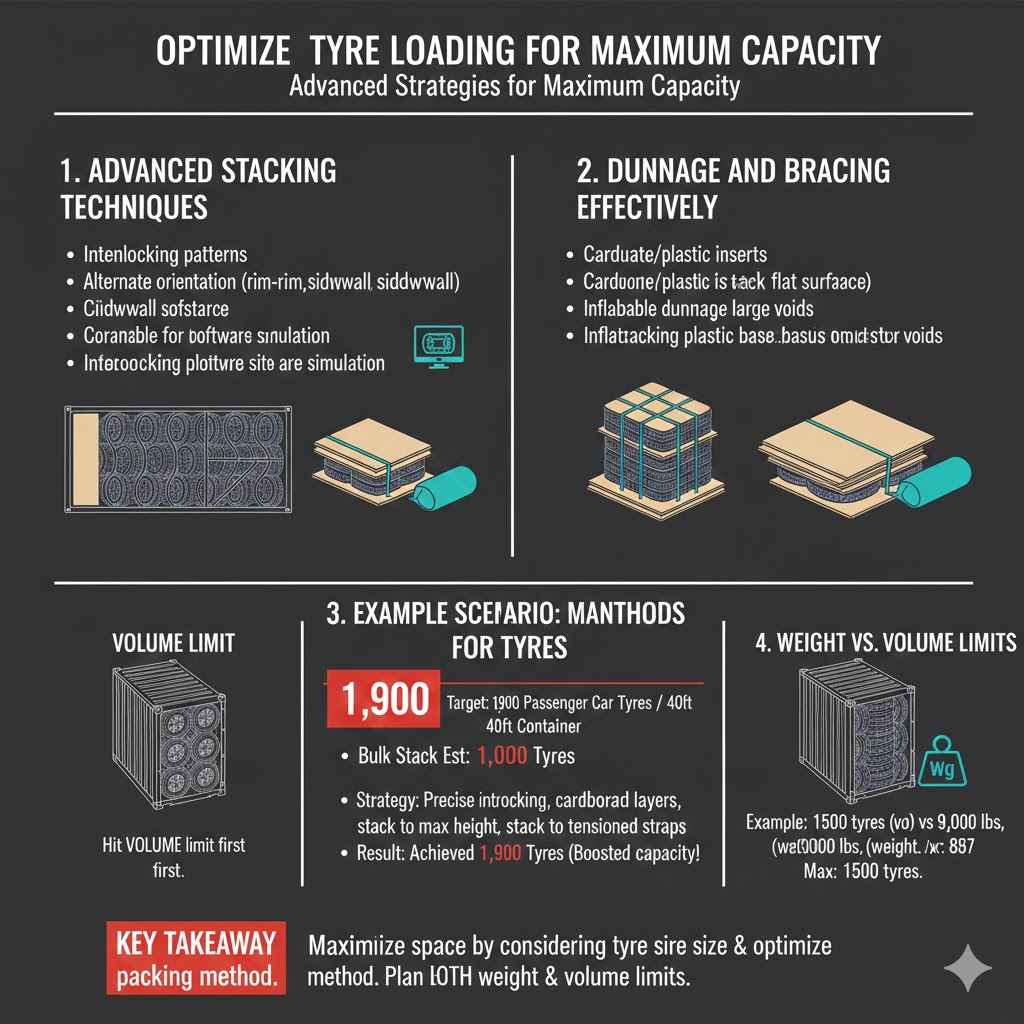
Beyond simple vertical stacking, advanced techniques involve interlocking tyres more deliberately and utilizing the container’s shape to your advantage. This can include arranging tyres in patterns that fill corner spaces or create more compact units.
One technique is to alternate the orientation of tyres in stacks to create a tighter fit. For example, in one layer, tyres might be placed rim-to-rim, and in the next layer, they might be interlinked via their sidewalls. This can significantly reduce the overall height and increase density.
Another approach is to use a combination of full tyres and smaller tyre sizes or even tyre components to fill small gaps that would otherwise be wasted space. This requires a detailed understanding of the tyre dimensions.
Professionals often use load planning software that simulates different stacking configurations to find the most efficient arrangement. These tools take into account tyre dimensions, container dimensions, and weight distribution.
The idea is to treat the container not just as a box, but as a three-dimensional puzzle where each tyre must find its optimal position to maximize the whole.
Using Dunnage and Bracing Effectively
Dunnage and bracing are not just for preventing movement; they can also be used to create stable structures that allow for denser packing. For example, cardboard or plastic inserts can be placed between tyres to maintain spacing and prevent sidewall damage, while also providing a flat surface for subsequent stacking.
Straps are essential for securing the load. When used correctly, they can help compress stacks slightly, making them more stable and taking up less volume. However, over-tightening can damage tyres.
Airbags or inflatable dunnage can be used to fill larger voids that cannot be filled with tyres. While they take up some space, they provide crucial stability for the entire load.
Consider using interlocking plastic bases or frames that can be placed between layers of tyres. These can create a more rigid structure, allowing for higher and more stable stacks, thus increasing the overall number of tyres that can be loaded.
The strategic placement of dunnage can transform a loosely packed container into a tightly secured one, allowing for maximum density without compromising safety.
Example Scenario: Maximizing Capacity
Imagine a shipment of 1,900 passenger car tyres. The handler knows that a standard bulk stack might only fit 1,700. To reach 1,900, they employ advanced techniques.
First, they interlock tyres more precisely, using the natural curves of the sidewalls to create a compact base. They then use thin, rigid cardboard sheets between layers to create flat surfaces for the next stack, preventing the tyres from shifting and creating unstable peaks.
In the upper layers, they might place some tyres on their sides, rim to rim, and then stack others on top, fitting the treads into the space. This requires careful manual placement and adjustment.
They also utilize the height of the container fully, stacking to the maximum safe height. Finally, they use straps that are tensioned just enough to keep the stacks from loosening but not so much as to deform the tyres.
This meticulous approach allows them to fit the desired 1,900 tyres, demonstrating that with the right techniques, capacity can be significantly boosted beyond basic estimates.
Weight vs. Volume Limits Revisited
It’s crucial to re-emphasize the interplay between weight and volume limits. For lighter passenger car tyres, you will likely hit the container’s volume limit first.
However, for heavier, larger tyres (like those for trucks or performance cars), the weight limit might be reached before the container is visually full. For instance, if the weight limit is 60,000 lbs and each tyre weighs 70 lbs, you can only fit about 857 tyres (60,000 / 70).
If your volume calculation for these heavy tyres suggested you could fit 1,200, the weight limit dictates your actual capacity. This is why performing both calculations is non-negotiable for accurate planning.
Consider a container with a volume of 2,389 cubic feet. If your tyres are very dense and pack efficiently, you might be able to fit 1,500 tyres volumetrically. But if each tyre weighs 60 lbs, the total weight would be 90,000 lbs (1,500 * 60), far exceeding the container’s 60,000 lbs capacity.
In such a scenario, the weight limit dictates that you can only load approximately 1,000 tyres (60,000 / 60). This highlights the importance of knowing both your tyre’s dimensions and its weight.
Frequently Asked Questions
Question: What is the average number of car tyres that fit in a 40ft container
Answer: A typical 40ft container can hold between 1,500 to 2,000 passenger car tyres, depending on their size and how they are packed.
Question: Do larger tyres fit in smaller numbers
Answer: Yes, larger tyres like those for SUVs take up more space and are heavier, so fewer will fit in a 40ft container compared to standard car tyres.
Question: How does tyre weight affect how many fit
Answer: The weight of tyres can be a limiting factor. If the total weight of the tyres reaches the container’s maximum payload capacity before it’s full, you cannot add more tyres.
Question: Is it better to stack tyres vertically or horizontally
Answer: A combination of vertical stacking, interlocking, and sometimes placing tyres on their sides can optimize space better than just one method alone. Careful arrangement is key.
Question: Can I mix tyre sizes in one container
Answer: You can mix tyre sizes, but it makes calculating the exact number more difficult. It’s best to use an average size or plan for potentially fewer tyres overall due to packing challenges.
Summary
Estimating how many car tyres fit in a 40ft container involves understanding tyre dimensions, container volume, and weight limits. Efficient packing, advanced stacking, and using dunnage can maximize capacity. Always calculate both volume and weight limits to ensure safe and cost-effective shipping. See also how to read car tire size like a pro full simple guide .
Related pick: Check today's price on Amazon
Products related to this article
Sponsored / affiliate links. As an Amazon Associate I earn from qualifying purchases. I may earn additional commission from eligible campaigns.