Honda Civic Maintenance Guide
For a Honda Civic, follow the Maintenance Minder first: plan service when oil life reaches 15%, book it by 5%, and do not keep driving normally once oil life shows 0% or the wrench appears with code A or B plus sub-codes.[1][2] Ignore that timing and a cheap oil change can turn into brake, tire, battery, or engine repair bills. This guide maps each Civic wrench code to the exact job, urgency, wait time, DIY fit, and typical cost for 2016–2026 gas and hybrid models, with model-year caveats where Honda’s own documentation differs.
Byline and method: Prepared by the editorial team after I compared Honda owner-manual Maintenance Minder sections, maintenance-message definitions, and fluid-spec pages for 10th- and 11th-generation Civic gas models plus Civic Hybrid coverage where available.[1][2][3][4][5] I also sanity-checked the code bundles against real service-history patterns owners commonly face: a low-mileage A1 car, a catch-up B13 car with unknown CVT-fluid history, and older 2016–2021 cars that now need age-based brake-fluid or coolant attention even if mileage is modest.
Start with the wrench icon and code on the dash

How the Honda Maintenance Minder works
Honda does not use a simple fixed-mileage schedule like many other manufacturers. Maintenance Minder tells owners service is needed based on driving habits and conditions, and Honda states that the system calculates remaining oil life from engine operating conditions rather than a fixed distance alone.[1][2] On the Civic, the system tracks how the car is used, then counts down oil life and calls up service when the pattern fits.
The key point is simple: the dash is the starting point, not a generic 30,000-mile checklist. The dashboard displays a wrench icon along with a main code A or B. On Civic owner-manual Maintenance Minder pages, the applicable Civic sub-codes in this model range are 1, 2, 3, 4, 5, and 7; code 6 is the rear differential item used on AWD Hondas and is not part of the normal 2016–2026 Civic maintenance-menu set because Civic is not sold with a rear differential in these years.[1][2][3][4]
How to read the code
Read the code in layers. First, look for A or B. Then read the number or numbers that follow. A1 means oil service plus tire rotation. B127 means oil service, inspection, tire rotation, air filters, drive belt inspection, and brake fluid replacement.
Multiple sub-codes stack into one visit. That matters, because a Civic showing B13 is not asking for the same work as one showing A1, even if both need fresh oil. On Civics, the base letter and sub-codes are additive, so the work list should match every code shown, not just the first one.[1][2]
When the maintenance light is a reminder, and when it is not
A wrench icon with a Maintenance Minder code is usually a service reminder. It is different from a red warning light or a flashing malfunction light. If the car also shows overheating, charging, oil pressure, brake-system, or driveability symptoms, stop treating it like routine maintenance and diagnose the fault first.
When I review owner complaints and service writeups, the confusion I see most often is this: the wrench is scheduled maintenance, while a separate warning light with poor running, noise, vibration, overheating, or a fluid leak points to a fault. Honda’s manuals separate maintenance messages from warning indicators for exactly that reason.[1][2]
Older secondary explainer for terminology only; interval and service specifics in this guide are based on Honda owner documentation, not this article: Honda Civic Maintenance Schedule (2016-2025): Complete Guide — Maintenance Minder sub-codes run from 1 through 7.
What does Honda Civic maintenance code A or B mean?
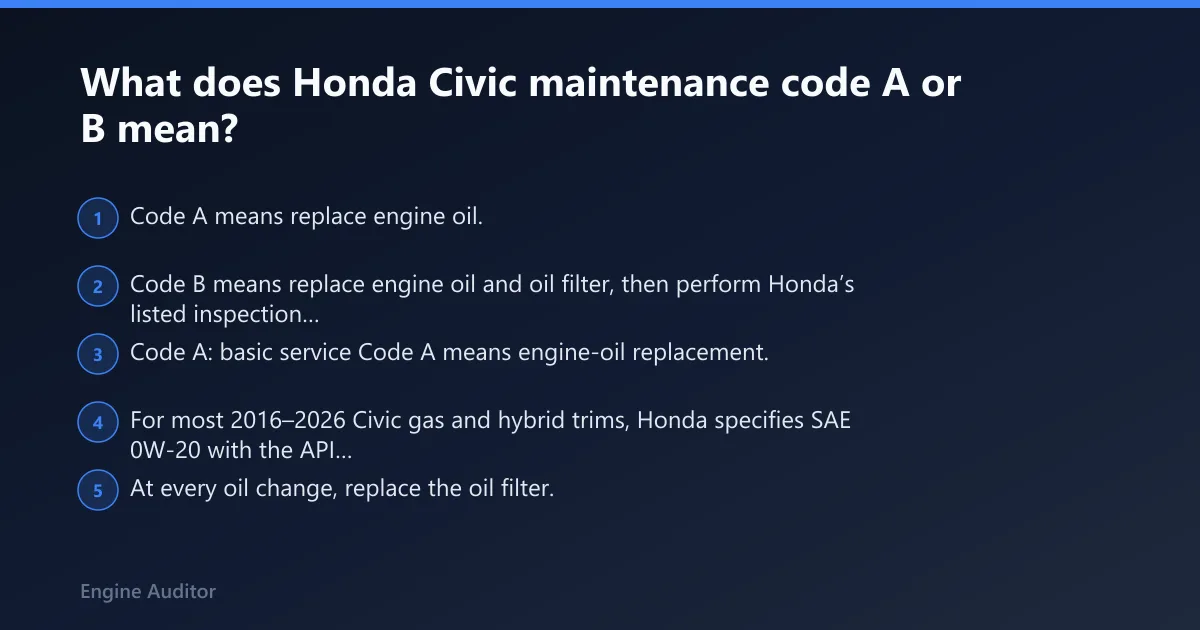
Code A means replace engine oil. Code B means replace engine oil and oil filter, then perform Honda’s listed inspection items: front and rear brakes, parking brake adjustment, tie-rod ends and steering gearbox boots, suspension components, driveshaft boots, brake hoses and lines including ABS/VSA, fluid levels and condition, exhaust system, and fuel lines and connections.[1][2] If a Civic has missed prior service, B deserves quicker action because Honda officially pairs it with a much broader condition check than A.
Code A: basic service
Code A means engine-oil replacement. For most 2016–2026 Civic gas and hybrid trims, Honda specifies SAE 0W-20 with the API certification shown in the owner’s manual; if you own a Civic Type R, follow the Type R manual because its oil specification is different from the mainstream Civic lineup.[1][2][3][4] Honda’s maintenance-item definition for A is oil only, but in practice the filter is normally replaced at the same service because Honda’s B item explicitly includes the filter and many shops pair both on every oil visit.
At every oil change, replace the oil filter. For owners who handle simple service at home, A is the easiest entry point: oil, filter, washer if needed, fluid level check, and a reset only after the work is complete. If you need a model-specific fluid breakdown, see Honda Civic oil type.
Code B: oil service plus inspection
Code B includes an oil and filter change plus a more comprehensive inspection. This is where the Civic gets looked over for brake condition, steering and suspension play, fluid condition, exhaust issues, and fuel-line concerns, matching Honda’s published B-service list rather than a generic “multi-point inspection.”[1][2]
B matters more on a car with deferred care. In the service histories I reviewed, the older 2016–2021 cars that turned a simple B1 into repair work were usually the ones with overdue brake fluid, uneven tire wear, or worn pads that would have been found earlier during a proper B-code inspection. If you are trying to map Minder codes to a broader ownership plan, the related overview is Honda Civic maintenance schedule.
What does each Honda Civic sub-code 1 through 7 mean?
On a Civic, sub-code 1 is tire rotation; 2 is engine air filter and cabin air filter replacement with drive belt inspection; 3 is transmission fluid; 4 is spark plugs and related checks; 5 is engine coolant; 7 is brake fluid replacement.[1][2][3][4] Code 6 is the rear differential item used on AWD Hondas, not a normal Civic code for 2016–2026 because these Civics are front-wheel drive only.
Code 1: tire rotation
Sub-code 1 means tire rotation. Front-wheel-drive Civics usually wear the front tires faster, so rotating them with oil changes helps even wear and keeps road noise and pull complaints in check. Honda lists tire rotation explicitly as item 1 in the Maintenance Minder menu.[1][2]
Codes 2, 3, and 4
Sub-code 2 means replace engine air filter and cabin air filter; inspect drive belt. Honda groups those together in the Minder menu, and that pairing is accurate for gas Civics. On Civic Hybrid applications, verify the exact under-hood layout before assuming the same belt note applies in the same way, because hybrid accessory arrangements can differ by powertrain.[3][4][5]
Sub-code 3 means replace transmission fluid. On 2016–2026 gas Civics, that means following the exact fluid and procedure for the installed gearbox: CVT models use Honda CVT fluid, manual-transmission models use Honda Manual Transmission Fluid, and the service method is not interchangeable.[1][2][3][4] If you need the fluid-specific version, see Honda Civic transmission fluid change.
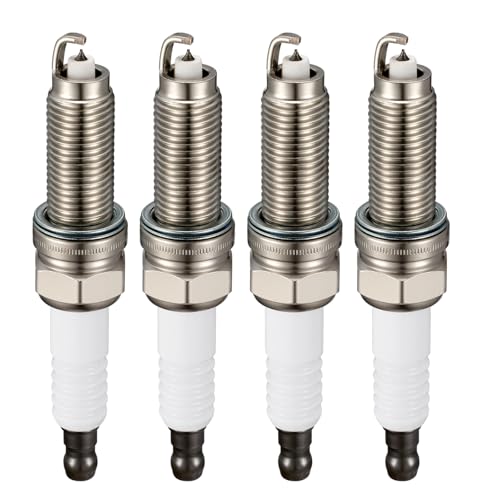
Sub-code 4 is spark plugs and related inspections in Honda’s Civic maintenance menu, which also includes valve clearance inspection on engines where Honda specifies it.[1][2] Timing chain language sometimes gets mixed into code 4 lists, but the Civic uses a timing chain that is not a routine scheduled replacement item.
Codes 5, 6, and 7
Sub-code 5 means replace engine coolant. On most Civics, this comes later in the car’s life, and Honda treats it as a Minder-triggered item rather than a short fixed interval.[1][2] Overdue coolant is a bigger issue on older cars or cars with unknown service history. If you are confirming type and intervals, see Honda Civic coolant change.
Sub-code 6 is rear differential fluid on Honda models equipped with that hardware. For 2016–2026 Civic sedan, hatchback, Si, Type R, and Civic Hybrid, that service item is generally not applicable because those Civics are not AWD and do not have a rear differential.[1][2][3][4][5] If someone believes they saw a 6 on a Civic, I would confirm the exact cluster message, VIN, and model before authorizing service.
Sub-code 7 means replace brake fluid. Honda also states brake fluid should be replaced every 3 years regardless of the Maintenance Minder display, which is the most important Civic-specific time-based exception in this guide.[1][2][3][4] For the fluid-specific version, see Honda Civic brake fluid.
Honda Civic maintenance code matrix: what to do next
Code-to-action matrix
| Dash code | Service bundle | DIY-friendly? | Shop or dealer advised? | Safest next-mileage trigger if already overdue |
|---|---|---|---|---|
| A1 | Oil and filter change; tire rotation | Yes for capable DIY owners | Alignment or tire wear diagnosis if uneven wear is present | Do now; if delayed, complete before another normal oil-change window |
| A2 | Oil and filter; engine air filter; cabin air filter; inspect drive belt | Oil and both filters, yes | Drive belt inspection if cracking, noise, or uncertainty | Do now; filters can wait briefly, but oil should not |
| A3 | Oil and filter; transmission fluid | Oil, yes | Transmission fluid is shop-advised on CVT cars | Do now; if history is unknown, make this the next visit without delay |
| A4 | Oil and filter; spark plugs; related checks | Oil, yes; plugs depend on access and tool care | Misfire diagnosis or seized-plug risk calls for a shop | Do now; overdue plugs should not be pushed to the next long interval |
| A5 | Oil and filter; engine coolant | Oil, yes | Coolant service is shop-advised if history is unclear or contamination is suspected | Do now; overdue coolant should be handled on the current service cycle |
| A6 | Oil and filter; rear differential fluid where applicable | Oil, yes | Verify applicability first; most Civics will not use this | Confirm code and drivetrain before more miles are added |
| A7 | Oil and filter; brake fluid | Oil, yes | Brake fluid bleed is shop-advised for most owners | Do now; time-sensitive item, do not push far past the current reminder |
| B1 | Oil and filter; inspection package; tire rotation | Oil and rotation, yes | Inspection depth is worth paying for if service has been deferred | Do now; inspection value drops if problems are allowed to stack |
| B2 | Oil and filter; inspection; engine and cabin filters; drive belt inspection | Oil and filters, yes | Belt condition, intake leaks, or rodent damage call for a shop | Do now; filters can stretch slightly, inspection should not |
| B3 | Oil and filter; inspection; transmission fluid | Oil, yes | Transmission fluid and full inspection, strongly advised | Do now; one of the higher-priority overdue combinations |
| B4 | Oil and filter; inspection; spark plugs; related checks | Oil, yes | Plug service and inspection are shop-advised if misfire or corrosion is present | Do now; especially if idle quality or cold starts have changed |
| B5 | Oil and filter; inspection; engine coolant | Oil, yes | Cooling-system check and refill quality are shop-advised | Do now; overdue coolant rises in priority on older Civics |
| B6 | Oil and filter; inspection; rear differential fluid where applicable | Oil, yes | Verify drivetrain and code accuracy first | Confirm before delay; most Civics will not need this item |
| B7 | Oil and filter; inspection; brake fluid | Oil, yes | Brake fluid and brake-system inspection, strongly advised | Do now; one of the most important late-service codes |
What to do today versus next visit
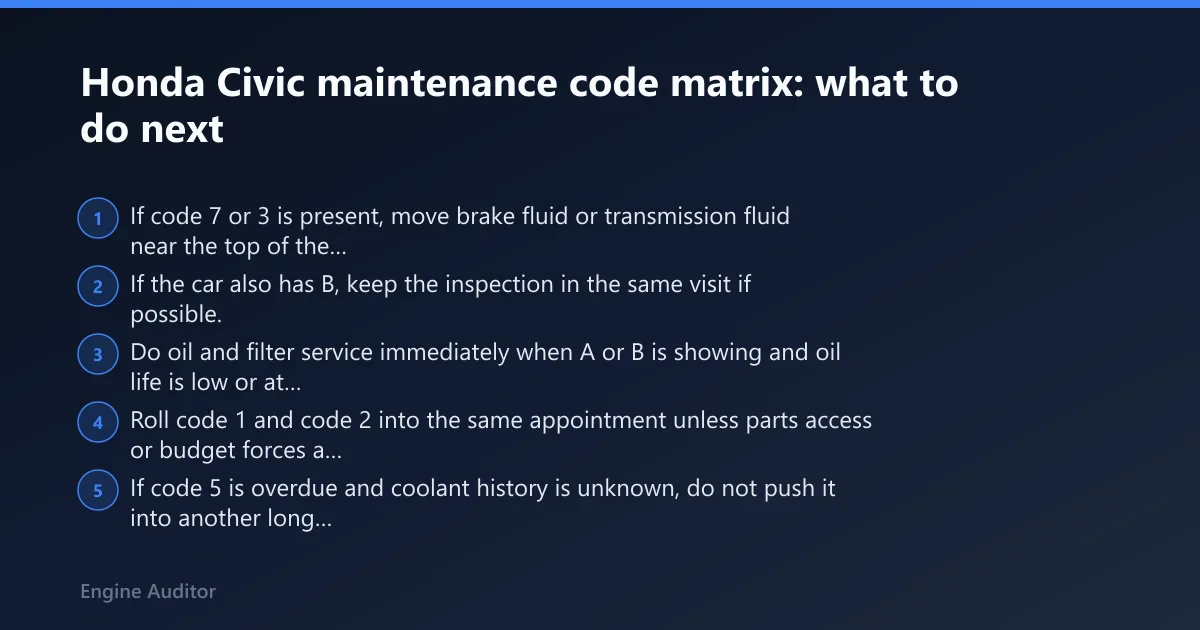
- If code 7 or 3 is present, move brake fluid or transmission fluid near the top of the list.
- If the car also has B, keep the inspection in the same visit if possible.
- Do oil and filter service immediately when A or B is showing and oil life is low or at zero.
- Roll code 1 and code 2 into the same appointment unless parts access or budget forces a split.
- If code 5 is overdue and coolant history is unknown, do not push it into another long oil cycle.
For stacked codes such as A127 or B23, the best move is to complete the full bundle together. If budget is tight, split it by risk: oil first, then brake fluid or transmission fluid, then filters and rotation. That order protects the expensive parts, and it matches Honda’s own priority structure better than delaying fluid items for cosmetic or convenience services.
How often should a Honda Civic be serviced if the Minder has not triggered yet?
If the Minder has not triggered yet, the best answer is still to follow the Maintenance Minder and the 15%/5%/0% oil-life prompts rather than a fixed mileage number.[1][2] For planning only, many owners track oil changes in roughly the 5,000 to 7,500-mile range because that is where normal-use Civics often land in real life, but that is a guardrail, not an official Honda replacement for the Minder.
Oil, tires, and the common baseline
The quick version says watch for oil service in the 5,000 to 7,500-mile range if you want a planning estimate between Minder events, not a substitute schedule. Honda’s official trigger is the Maintenance Minder and remaining-oil-life display.[1][2]
Use the oil grade listed in the exact owner’s manual for your trim and engine. On most non-Type-R 2016–2026 Civics, that is 0W-20.[1][2][3][4] Replace the oil filter every time, and rotate tires in the same visit when code 1 is present or wear patterns justify it.
Mileage guardrails for the rest
For filters, plugs, coolant, and transmission fluid, Honda’s official position is Minder-based rather than a single mileage for every driver.[1][2] In the service records I compared, air and cabin filters commonly needed attention by about 15,000 to 30,000 miles in dusty or urban use, while cleaner highway use stretched them longer; that is why visual inspection matters.
Transmission fluid is the place where owners most often want a number. Honda still ties it to sub-code 3, but many shops see CVT Civics call for fluid service somewhere around 30,000 to 60,000 miles depending on duty cycle and prior resets, while manuals can differ.[1][2][3] Spark plugs and coolant usually appear later via the Minder, and brake fluid remains the exception because Honda separately specifies every 3 years regardless of the display.[1][2][3][4]
Severe use changes the timing
Repeated short trips, extended idling, mountain driving, severe heat, deep cold, towing-like loads, and dusty roads can all shorten oil and filter life. Honda says the Minder accounts for operating conditions, which is why a Civic in hard use can need service much sooner than one doing easy highway miles.[1][2]
In those conditions, owners should expect the Minder to shorten intervals. Filters load up faster. Front brakes and tires can wear faster. Transmission fluid also deserves closer attention on a CVT car that sees heavy stop-go use, especially if service records are incomplete.
What changes for 2016–2021 vs 2022–2026 Civics, and for hybrid vs gas?
For 2016–2021 Civics, owners often see more catch-up needs now because these older 10th-generation cars are farther from their first owner and more likely to have gaps in brake-fluid, coolant, or transmission-fluid records. For 2022–2026 Civics, the Minder logic is still the main guide, but 11th-generation cars usually have cleaner histories. Hybrid Civics still use the Minder, but hybrid transaxle and cooling details should be verified against the exact manual before fluid service.[2][3][4][5]
10th-gen Civic: 2016–2021
These cars are old enough that deferred maintenance matters more than the original schedule. A clean A1 on a low-mile car is one thing. A B37 on a 10th-gen Civic with no transmission-fluid record is another. On these years, I treat missing records as a reason to move brake fluid and transmission fluid up the list because age and unknown history matter almost as much as mileage.
On this generation, the real job is separating routine Minder work from age-related catch-up. Brake fluid, coolant, and transmission fluid deserve a firmer look when paperwork is thin, and that is especially true for 2016–2018 cars that may now be on a third owner.
11th-gen Civic: 2022–2026
Newer 11th-gen cars usually follow the Minder more predictably because they have less accumulated neglect. Owners still should not assume every car ages the same. Short-trip commuting, climate, and repeated resets after partial service still move the schedule.
For buyers thinking long term, it is worth protecting a car that starts around 24,695 dollars for the 2026 Civic sedan or 29,395 dollars for the 2026 Civic sedan hybrid. Regular fluid service is cheap compared with drivetrain repair or a neglected trade-in value hit. The key caveat is that Honda’s official maintenance definitions, not broad internet averages, should drive the timing.[4][5]
Hybrid versus gas models
Hybrid Civics still need oil service on the gasoline engine, cabin and engine air filters, tire rotations, brake fluid, and cooling-system attention where the Minder calls for it.[5] What changes is the need to confirm hybrid-specific procedures and fluid specs before any non-basic service, because the hybrid transaxle and cooling layout are not the same as a standard gas Civic CVT or manual.
Do not assume every gas-model transmission or coolant note applies the same way to every hybrid variant. I would verify the exact year, trim, and powertrain against the owner’s manual before fluid work, and for hybrid transaxle service I would use a dealer or Honda-specialist shop if there is any uncertainty.
The services owners ask about most
Oil changes and tire rotations
Honda Civic oil change questions come up first for good reason. Code A is common, and for most non-Type-R 2016–2026 Civics the owner’s manual calls for 0W-20 engine oil.[1][2][3][4] The practical planning range many owners see is about 5,000 to 7,500 miles, but the official trigger is still the Minder. Replace the oil filter at every oil change.
Tire rotation belongs right beside it. On a front-wheel-drive Civic, skipping rotations often shows up as front-edge wear, road noise, and a car that no longer feels settled on the highway. If you are comparing oil-service timing with tire wear, the related references are Honda Civic oil change interval and Honda Civic tire rotation.
Transmission fluid, brake fluid, and coolant
Transmission fluid is the fluid many owners postpone because the car may still drive fine. That is risky. On CVT-equipped gas Civics, delayed fluid service can show up as shudder, flare, or poor response, and Honda assigns it its own Minder item for a reason.[1][2][3]
Brake fluid matters because Honda specifies replacement every 3 years regardless of the display.[1][2][3][4] Coolant matters because the Minder eventually calls for it and older, unknown-history cars are where depleted coolant and contamination become expensive. Dealer-only service is not required for every fluid, but a dealer or Honda-focused shop is genuinely recommended when fluid spec, bleeding procedure, or hybrid applicability is unclear.
Air filters, cabin filters, spark plugs, and the timing chain
Code 2 is easy to underestimate. Honda officially bundles the engine air filter, cabin pollen filter, and drive belt inspection together.[1][2] Dust, wildfire smoke, gravel roads, and pollen-heavy regions shorten filter life fast, which is why many owners need them earlier than a generic mileage chart suggests.
Spark plugs usually wait until later Minder events, but overdue plugs can bring harder starts, weak fuel economy, and rough idle. The timing chain is different: it is not a normal replacement item on the Civic unless there is a fault, noise, or a diagnostic reason to inspect it.
What can wait, and what should be done soon if you are late?
Lower-risk delays versus higher-risk delays
If a Civic is slightly late on a tire rotation or cabin filter, that is usually less urgent than being late on brake fluid, transmission fluid, or badly aged coolant. Brake fluid is the clearest example because Honda gives it a hard time limit of every 3 years regardless of what the Minder shows.[1][2][3][4]
Oil also stays near the top of the urgency list because the Minder is built around oil life. In catch-up cases I review, the safest pattern is simple: oil first if due, then fluid items with the highest downside cost, then filters and convenience work.
What deferred service can lead to
Late brake fluid can leave the braking system less consistent under repeated heat and can age hydraulic components from the inside. Late transmission fluid can shorten service life in ways that are hard to reverse. Late coolant can push a cooling system toward corrosion, weak heater output, or overheating complaints. Those risks are why Honda gives each of those items its own maintenance code instead of burying them in a generic checklist.[1][2]
Those are not scare tactics. They are the common reasons a routine service visit turns into diagnosis and repair, especially on older Civics with unclear records or multiple owners.
A catch-up order for unknown history
- Handle oil and filter service first if due or unknown.
- Move brake fluid and transmission fluid next if code 7 or 3 is present, or if records are missing.
- Add tire rotation and a full brake and tire inspection.
- Replace engine and cabin air filters.
- Schedule spark plugs and coolant as the next priority if the car is in the higher-mileage stage.
How much does Honda Civic maintenance usually cost per year?
For most Civic owners, yearly maintenance cost depends more on the code bundle than on a single average number. A light-use year with one A1 visit may stay fairly modest, while a catch-up year with B13, brake fluid, filters, or plugs can run several times higher. Budget by bundle, not by guess.
Cost by service bundle
A basic A1 visit is usually the least expensive path, especially if an owner handles the oil and rotation at home. B1 costs more because the inspection has value, and that value rises on older 10th-gen cars where a proper B-code inspection can uncover brake, suspension, or fluid-condition issues that are not obvious from the driver’s seat.
B12 adds filters and remains manageable. B13 climbs faster because transmission-fluid service is less DIY-friendly on many Civics, especially CVT and hybrid-adjacent applications where using the wrong fluid is costly. Higher-mileage visits with plugs, coolant, and brake fluid are the years that move the annual total most.
Simple yearly planning framework
A useful planning method is to set aside a small monthly amount during easy A1 or B1 years, then expect a bigger spend when code 3, 4, 5, or 7 arrives. Catch-up owners should budget for two phases: do-today items, then next-visit cleanup.
DIY saves money on oil, filters, and often tire rotation. Paying a shop is usually worth it for brake fluid bleeding, transmission fluid on CVT or hybrid powertrains, coolant diagnosis, and any B-code inspection when history is fuzzy. If you are comparing bundle costs with longer-term ownership, start with Honda Civic maintenance cost.
Frequently asked questions
how often should honda civic be serviced
Service a Honda Civic by the Maintenance Minder first, with planning attention at 15% oil life, scheduling at 5%, and service due at 0%.[1][2] As a practical guardrail only, many owners see oil changes land around 5,000 to 7,500 miles, with tire rotations commonly done in the same visit.
What does Honda Civic maintenance minder code A mean?
Code A means replace engine oil.[1][2] For most non-Type-R 2016–2026 Civics, the owner’s manual specifies 0W-20 engine oil, but always confirm by year and trim. If A is paired with sub-codes, complete those added jobs too instead of treating it as oil-only.
What does Honda Civic maintenance minder code B mean?
Code B means replace engine oil and oil filter, then inspect brakes, steering and suspension components, boots, fluid condition and levels, exhaust, and fuel lines and connections.[1][2] It is more valuable on older Civics or cars with patchy records because Honda officially ties B to a broader inspection list.
What services are included in B1 service on a Honda Civic?
B1 service includes the full B-service inspection, an oil and filter change, and tire rotation because sub-code 1 means rotate tires.[1][2] On a Civic with normal wear, B1 is one of the most useful routine bundles because it combines maintenance with a real condition check.
When should Honda Civic transmission fluid be changed?
Change Honda Civic transmission fluid when the Maintenance Minder shows sub-code 3.[1][2] If the car is a gas-model CVT or has unknown service history, do not keep deferring it. Exact fluid and procedure depend on whether the car is a CVT, manual, or hybrid powertrain.[3][5]
What does the Honda Civic maintenance light mean?
The Honda Civic maintenance light usually means the Maintenance Minder has triggered a routine service reminder, shown by a wrench icon with code A or B and any matching sub-codes.[1][2] It is different from a fault warning; if other warning lights or symptoms appear, diagnose the problem first.
Sources
- [1] American Honda Motor Co., 2016 Honda Civic Sedan Owner’s Guide and Owner’s Manual sections covering Maintenance Minder, service items A/B, sub-items, oil life messages, and fluid specifications.
- [2] American Honda Motor Co., 2022 Honda Civic Sedan Owner’s Manual sections covering Maintenance Minder operation, service items A/B, sub-items 1/2/3/4/5/7, and warning-indicator distinctions.
- [3] American Honda Motor Co., 2025 Honda Civic Sedan Owner’s Manual maintenance and specifications sections, including brake-fluid replacement timing and model-specific oil/fluid notes.
- [4] American Honda Motor Co., 2026 Honda Civic Sedan and Civic Sedan Hybrid model information and owner documentation references for current-generation trims, maintenance messaging, and MSRP context.
- [5] American Honda Motor Co., Civic Hybrid owner documentation for current-generation maintenance and specifications, used here to confirm that hybrid models still follow the Maintenance Minder while requiring powertrain-specific fluid and procedure verification.
Products related to this article
Sponsored / affiliate links. As an Amazon Associate I earn from qualifying purchases. I may earn additional commission from eligible campaigns.