Honda Civic Hybrid Maintenance: What Changes From the Gas Model
Most Civic hybrid maintenance matches the gas Civic on routine items, but the hybrid adds checks for the high-voltage system, its cooling, and time-based fluid changes. Skip those, and battery or inverter life can drop, repair costs can rise, and warning lights can stay unresolved. This guide separates what stays the same, what changes, and what Maintenance Minder may miss.
Civic maintenance comparison table


| Service item | What stays the same | What changes | What to monitor |
|---|---|---|---|
| Oil service | Still required on both cars; the gas engine still needs lubrication. | The hybrid still follows Maintenance Minder oil-life logic, but the drivetrain is different. | Watch for Service Due Soon (A) at 15% oil life, and do not assume oil level is checked by the system. |
| Brake wear | Brake pads and rotors still wear and still need inspection. | Regenerative braking reduces brake use, so hybrids can go longer between brake jobs. | Inspect pad thickness, rotor condition, and brake feel if the interval looks unusually long. |
| Transmission type | Fluid condition still matters, and service questions still matter. | Gas Civic models use a CVT; hybrid trims use an eCVT. | Ask the dealer which fluid, interval, and inspection steps apply to the hybrid eCVT. |
| Battery warranty | The battery is not a routine replacement item under normal maintenance. | The hybrid battery is covered by an 8-year high-voltage battery warranty, with 100,000 miles in many cases and 10 years/150,000 miles in California. | Monitor warning lights, cooling issues, and any drop in hybrid behavior rather than planning routine battery service. |
| Inspection priorities | Basic checks still include tires, fluids, filters, and underhood leaks. | Hybrid owners should pay more attention to brake wear patterns and high-voltage system-related concerns. | Do not rely on Maintenance Minder for wear items it cannot measure. |
| Owner watchouts | Routine civic service still applies. | The hybrid may need extra attention to braking, cooling, and service advisor communication. | Bring up any odd service interval, warning light, or brake noise early. |
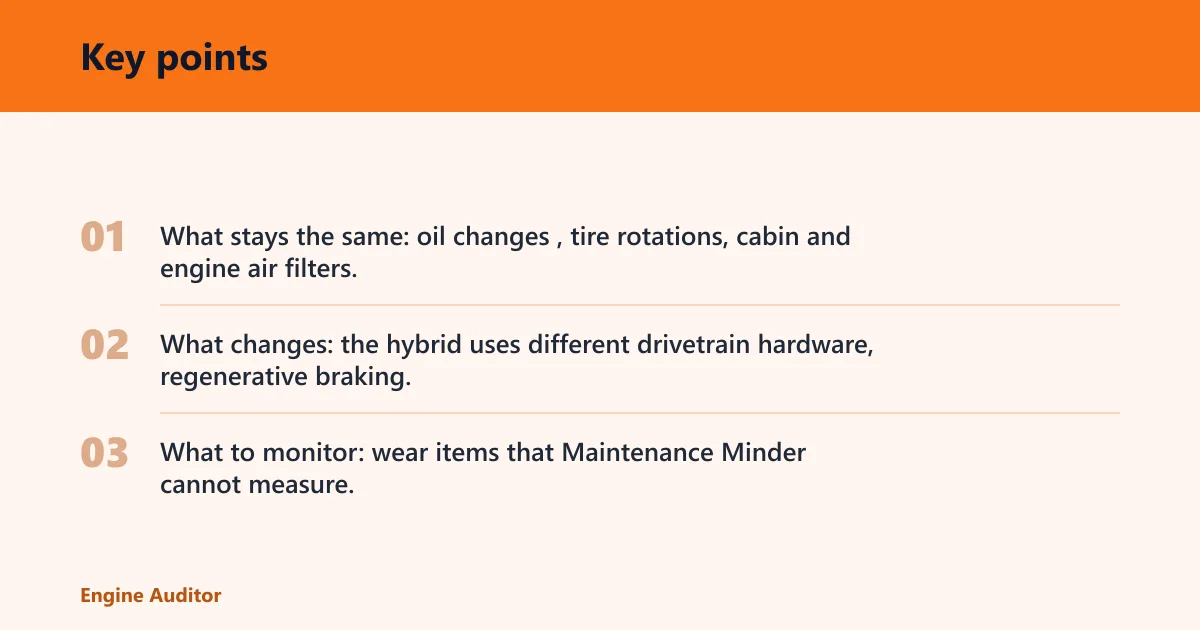
What stays the same: oil changes, tire rotations, cabin and engine air filters, and normal inspections still matter. What changes: the hybrid uses different drivetrain hardware, regenerative braking, and a different transmission setup. What to monitor: wear items that Maintenance Minder cannot measure, plus any warning signs tied to the hybrid system.
What changes on a Civic Hybrid?
The Civic Hybrid uses a 2.0-litre 4-cylinder engine paired with two electric motors, up to 200 combined horsepower, and an eCVT. That changes the drivetrain layout and the way braking energy is recovered, but it does not remove routine service. The gas Civic uses a 2.0-litre inline 4-cylinder engine with up to about 150 hp, about 133 lb.-ft. of torque, and a CVT.
Drivetrain hardware differences
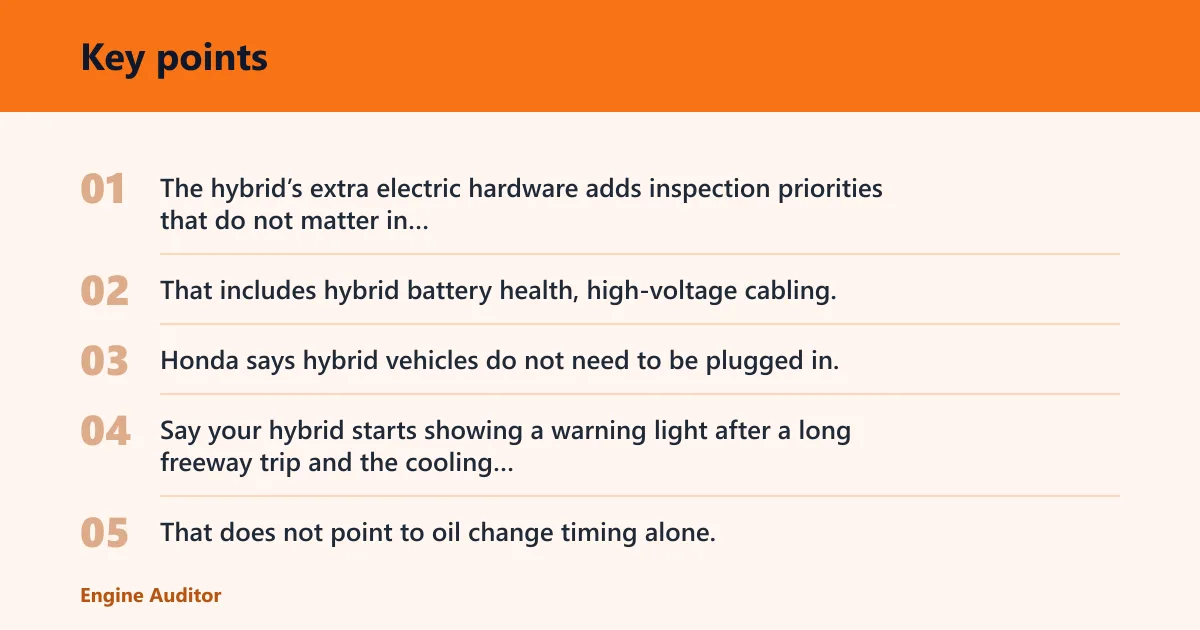
The hybrid’s extra electric hardware adds inspection priorities that do not matter in the same way on the gas car. That includes hybrid battery health, high-voltage cabling, and cooling checks tied to the electrified system. Honda says hybrid vehicles do not need to be plugged in.
Say your hybrid starts showing a warning light after a long freeway trip and the cooling fan runs more often than expected. That does not point to oil change timing alone. It points to a system check, because the hybrid stack has parts the gas Civic does not.
Brake wear differences
Regenerative braking reduces brake wear, so pads and rotors can last significantly longer on a Civic Hybrid than on a gas Civic. That is a real maintenance advantage. It is not zero wear, though, and a hybrid that goes a long time without brake service still needs inspection.
Brake fluid age, sticking slides, rust on rotors, and uneven pad wear can still show up. If the pedal feel changes, the vehicle pulls to one side, or the brakes make noise after long intervals, the brakes need attention even if the car has recovered a lot of energy through regeneration.
Transmission differences
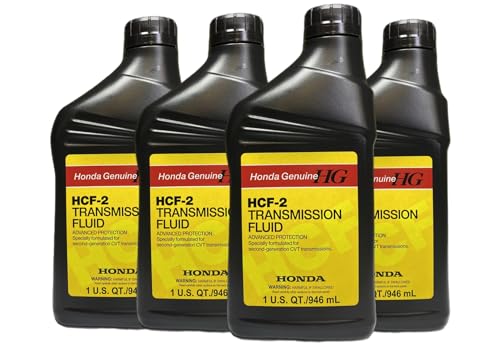
The gas-only Civic uses a CVT, while hybrid trims use an eCVT. That matters when you ask about fluid service, inspection intervals, and the correct service procedure. Do not assume the gas Civic schedule maps exactly to the hybrid.
For owners, the practical point is simple: ask which fluid applies, whether the hybrid eCVT has a different interval, and whether the dealer sees any model-year-specific updates. The transmission discussion should follow the hybrid hardware, not the gas-car template.
Which service items stay the same?
Oil and tire service still apply. The Civic Hybrid still has a gasoline engine, so it still needs oil and an oil filter. Tires still need rotation. Basic inspections still matter, including fluid level checks, hose and belt inspection where applicable, and a look at visible leaks or damage.
Oil and oil filter
Honda says Maintenance Minder estimates engine oil life. When oil life reaches 15%, Honda says the system shows a Service Due Soon (A) message. That is a reminder for oil service, not a sign that the hybrid has escaped lubrication needs.
Honda also says Maintenance Minder does not monitor oil level. That is a separate check. If a vehicle uses oil between services, the oil-life percentage will not tell you that by itself.
Tire rotation
Tire rotation remains required. Hybrid torque delivery and extra weight can change how tires wear, so a Civic Hybrid may show a different wear pattern from a gas Civic even when both are rotated on schedule. The schedule still matters because rotation helps even out front-to-rear wear.
A common first-timer mistake is assuming low fuel use means low tire wear. It does not. Even on a hybrid, tread depth, pressure, and alignment still need regular attention.
Basic inspections
Look at tire pressure, tread depth, fluid condition, wiper blades, lights, and visible leaks. Honda says Maintenance Minder can use additional codes 1-9 to flag items such as tires, brakes, filters, spark plugs, and fluids, but it does not inspect those parts on its own.
How Maintenance Minder works on a hybrid
Maintenance Minder is useful, but it is not a full inspection system. Honda says it estimates engine oil life, shows a Service Due Soon (A) message at 15% oil life, and can add codes 1-9 for other maintenance items. It does not monitor oil level, brake pad or rotor condition, tire tread depth, or battery life.
Oil life and A/B alerts
The A/B alert system tells you when scheduled service is due. On a Civic Hybrid, that still matters because the gas engine still runs and still needs fresh oil and a filter. The reminder is a service cue, not a wear-parts diagnosis.
Service Due Soon (A) typically points to an oil service. B-type maintenance can add inspection and replacement items depending on the car’s needs and mileage. The exact code matters more than guessing from the dashboard icon alone.
Additional codes 1-9
Honda says additional maintenance codes 1-9 can cover items such as tires, brakes, filters, spark plugs, and fluids. That is helpful, but it is still limited. The system can point to a category of work without measuring every part inside that category.
What it does not monitor
Honda states Maintenance Minder does not monitor oil level. It also cannot monitor tire tread depth, brake pad or rotor condition, or battery life. That means a hybrid can show plenty of oil life and still need a brake inspection, or show a service code while one wear item is still fine and another is not.
That gap matters most when service intervals look odd. Suppose the dashboard says little is due, but the brake pedal feels soft or the tires look worn on the inner edge. The car needs a human inspection, not another guess from the reminder system.
What should you inspect beyond Maintenance Minder?
Inspect brake hardware, tires, alignment wear, and underhood fluids even when Maintenance Minder looks calm. Those are the places where a hybrid can hide ordinary wear. The system can guide you, but it cannot measure every item that ages over time.
Brake pads and rotors
Because regenerative braking reduces brake wear, hybrids often go longer between brake jobs. That can be good for pad and rotor life, but it can also hide corrosion or uneven wear if the brakes go too long without a close look. A longer interval does not mean the parts last forever.
Ask for a visual measurement if you hear noise, feel vibration, or have a service record that shows the brakes have not been inspected in a long time. A hybrid that rarely uses friction brakes may still need the calipers, slides, and rotor faces checked.
Tires and alignment wear
Check tread depth, pressure, and wear pattern. A Civic Hybrid’s torque delivery and weight can change how the front tires age. If the steering wheel is off-center, the car pulls, or one edge of a tire wears faster, alignment should be part of the service discussion.
Fluids and underhood checks
Ask for a check of engine oil, coolant, brake fluid, washer fluid, and any hybrid-system cooling points listed in the service menu for your trim. The point is not to treat the hybrid as fragile. The point is to make sure the parts Maintenance Minder cannot see still get looked at.
Hybrid battery warranty and what it means
Honda says hybrid batteries are covered by an 8-year high voltage battery warranty, with 100,000-mile coverage, and 10 years/150,000 miles in California. That is warranty coverage, not a replacement schedule. It protects against covered defects within the terms Honda sets.
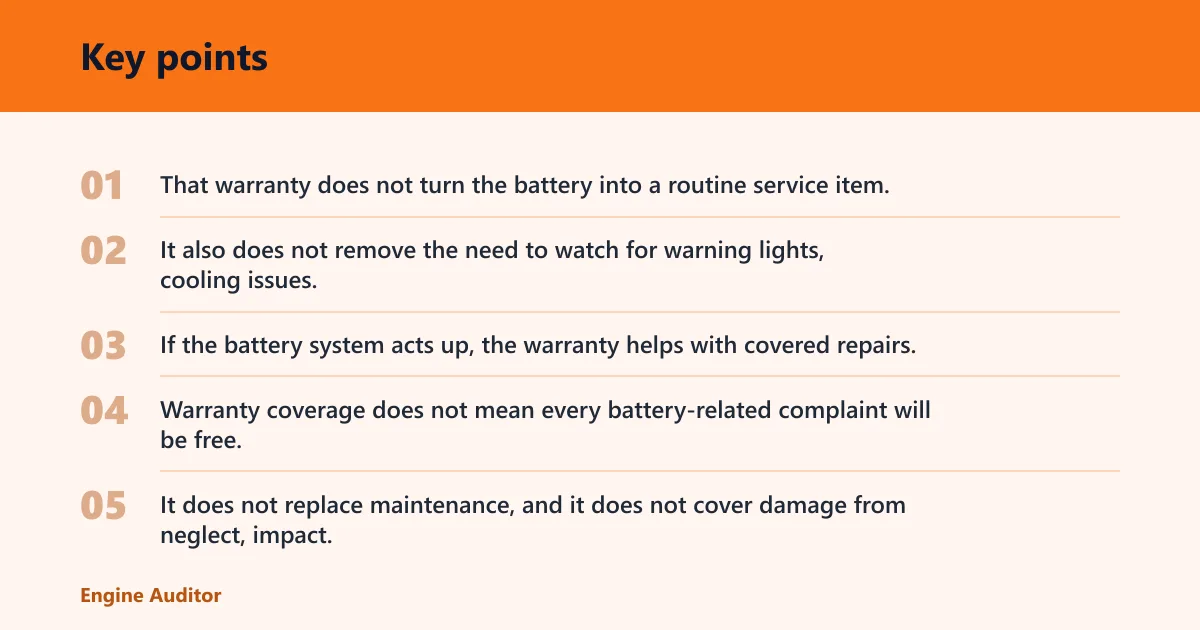
That warranty does not turn the battery into a routine service item. It also does not remove the need to watch for warning lights, cooling issues, or reduced hybrid behavior. If the battery system acts up, the warranty helps with covered repairs; it does not replace diagnosis.
What the warranty does not cover
Warranty coverage does not mean every battery-related complaint will be free. It does not replace maintenance, and it does not cover damage from neglect, impact, or unrelated faults. If the hybrid system warning appears, have the car scanned and documented quickly.
Does a Civic Hybrid need transmission fluid service?
Yes, transmission service still matters, but the answer is not a copy-and-paste from the gas Civic. The gas model uses a CVT, while hybrid trims use an eCVT, so the service discussion should be based on the hybrid transmission design and Honda’s guidance for that trim.
What to ask the dealer
Ask which fluid the hybrid eCVT uses, whether the service interval differs from the gas Civic, and whether any inspection step is required before a fluid change is recommended. If the advisor gives you a generic CVT answer, ask them to confirm it for the hybrid trim.
- Confirm the exact trim and model year.
- Ask whether the transmission service item is fluid change, inspection, or both.
- Ask if Honda lists a mileage or time interval for that hybrid.
- Ask whether any updates or service bulletins change the recommendation.
That conversation matters because transmission service can be different in method even when the service name sounds similar. A hybrid eCVT should be discussed as a hybrid unit, not as a gas CVT by default.
Do Honda hybrids cost more to maintain than regular cars?
Not automatically. Honda says hybrid maintenance is the same as a conventional Honda for routine items like oil changes, tire rotations, and air filters. The difference is that hybrids add a few inspection priorities and can shift brake wear and transmission discussions. That makes the schedule different in spots, not entirely new.
Hybrid ownership can still change the cost mix. Regenerative braking may extend pad and rotor life, which can lower brake-related spending over time. On the other hand, hybrid-specific diagnosis or drivetrain work can cost more when it is needed. Compare the actual service list, not the badge on the trunk.
Frequently asked questions
What maintenance is different on a Honda Civic hybrid compared with the gas model?
The main differences are the hybrid drivetrain, regenerative braking, eCVT, and battery-related inspection priorities. Routine oil changes, tire rotations, and basic inspections still apply. The hybrid also needs closer attention to brake wear patterns and to service items Maintenance Minder cannot measure.
Does a Honda Civic hybrid still need oil changes and tire rotations?
Yes. Honda says hybrid maintenance is the same as a conventional Honda for routine items like oil changes, tire rotations, and air filters. The gas engine still needs lubrication, and tires still need rotation because wear does not disappear just because the car is a hybrid.
How often does the Honda Civic hybrid need brake service?
There is no fixed “hybrid-only” brake interval because regenerative braking reduces brake wear and can extend pad and rotor life. Even so, brakes still need inspection, especially if noise, vibration, pulling, or a long service gap appears. Longer life is common; zero wear is not.
What parts are unique to the Civic hybrid maintenance schedule?
The unique parts are the high-voltage battery system, its cooling and related inspection points, the eCVT, and the regenerative braking hardware. Those items add service questions that the gas Civic does not have in the same form. The battery warranty is also a hybrid-specific ownership detail.
Does the Civic Hybrid need transmission fluid changes like the gas model?
It may need transmission service, but the hybrid uses an eCVT, while the gas Civic uses a CVT. That means you should not assume the same fluid or interval. Ask the dealer to confirm the hybrid trim’s service schedule instead of using the gas model as the default.
What should I inspect on a Civic Hybrid that Maintenance Minder won’t monitor?
Inspect tire tread depth, brake pad and rotor condition, oil level, visible fluid leaks, and any signs of battery or cooling trouble. Honda says Maintenance Minder does not monitor those items directly. If the dashboard and the car’s behavior disagree, the physical inspection wins.
Products related to this article
Sponsored / affiliate links. As an Amazon Associate I earn from qualifying purchases. I may earn additional commission from eligible campaigns.