Honda Civic A1 service: What it means and what gets checked
Honda Civic A1 service means Honda is calling for an engine oil change plus tire rotation, and the exact A1 code does not mean a full inspection package. Wait too long, and the oil can age, the tires can wear unevenly, and later repairs can cost more than routine maintenance. This guide explains what Honda includes, what a shop may try to add, what can wait, and how to verify the work before you pay.
What A1 Maintenance Minder Code Actually Means


A1 is Honda Maintenance Minder code language. The letter A means engine oil service, and the number 1 means tire rotation. Honda says A1 is routine maintenance, not an emergency warning, so the code should be treated as scheduled service rather than a fault signal.
What the code is telling you
Honda’s Maintenance Minder uses a code system to signal when routine maintenance is due. On a Civic, A1 usually means the oil-life monitor has reached a service point and the tires should be rotated at the same visit. The reminder can stay on until the work is completed and cleared.
What it is not
A1 is different from a check engine light, oil pressure warning, or other urgent dashboard message. Those warnings point to a possible fault and can call for immediate attention. A1 does not. It is a maintenance reminder based on wear and service intervals, not a breakdown alert.
📊 Honda A1 service is a maintenance reminder, not an emergency warning. Source: Honda A1 Service: Cost, Checklist, Meaning & Maintenance.
How Honda’s Maintenance Minder decides when A1 appears
Honda’s Maintenance Minder is oil-life based, rather than just a fixed mileage timer. The system tracks operating conditions and displays a code when routine service is due. Short trips, long idle periods, hot weather, repeated cold starts, and stop-and-go use can make the reminder appear sooner than a simple mileage estimate might suggest.
Why driving pattern matters
Engine oil ages faster in severe use than in steady highway driving. If a Civic spends much of its time on short hops, idling in traffic, or making repeated cold starts, the oil-life monitor may call for service earlier. That is one reason the same model can show A1 at different times.
Gas and hybrid Civic schedules can differ by year
Honda also notes that owner manual and service schedule details can vary by year and powertrain. That matters for current Civic Sedan gas models, Civic Sedan Hybrid models, and Civic Hatchback models. The Maintenance Minder logic is the guide, but the correct oil specification and any model-year notes should come from the owner manual for that exact car.
What gets checked during an A1 visit
The core A1 visit is simple: replace the engine oil and rotate the tires. A careful shop will also inspect tread wear, check tire pressure, and look over basic safety items such as visible fluid leaks, fluid levels, belts, and hoses. Those inspection items are common, but they are not the same as add-on repairs.
Engine oil and oil filter
The A code tells you to replace the engine oil. On many services, the oil filter is replaced at the same time because fresh oil should not pass through an old, loaded filter. The important part is matching the oil viscosity and Honda specification for the model year, since the correct oil is not one-size-fits-all.
Tire rotation, tread, and pressure
The 1 code tells you to rotate the tires. The goal is front-to-rear wear balancing so the tires wear more evenly. A shop should also inspect tread depth, abnormal wear, and tire pressure. The exact rotation pattern can vary with drivetrain and tire setup, so the pattern should follow the Civic’s tire type and manual guidance. (en.wikipedia.org)
Basic inspection context
Many shops bundle a multi-point inspection with A1. That usually means a visual check of brake condition, fluid levels, leaks, belts, hoses, and tire wear. Useful? Yes. Required by the A1 code itself? Not always. Keep the line clear between what Honda asks for and what the shop is recommending.
What you can verify before you book service
You can spot several A1 issues before paying for a visit. Look for uneven tire wear, low pressure, oil spots where the car parks, warning lights other than Maintenance Minder codes, and drivability changes such as vibration or pulling. Also confirm your Civic’s exact model year and engine oil spec in the owner manual.
Two common examples
Say your Civic has a slow leak in one front tire and the outer edges of both front tires are wearing faster than the rears. That makes the rotation part of A1 more important, but it also means the shop should look for the cause of the wear, not only rotate the tires and move on.
Suppose the A1 code appears and you also notice a fresh oil spot under the engine after parking overnight. That is not an A1-only situation anymore. The code may still call for oil service, but the leak needs attention before you assume routine maintenance is the full story.
Civic-specific checklist before booking
| Honda-required items | Owner-checkable items before booking | Common upsells to decline unless symptoms or mileage justify them |
|---|---|---|
| Engine oil replacement | Check dipstick level if equipped, note oil color, look for oil spots | Engine flush |
| Tire rotation | Inspect tread depth differences front to rear, look for cupping or feathering | Wheel alignment unless the car pulls, the wheel is off-center, or wear suggests it |
| Oil filter replacement when specified with the oil service | Confirm the correct oil grade/spec in the owner manual for your year | Fuel system cleaning |
| Maintenance Minder reset after service | Check tire pressures against the door-jamb placard | Cabin air filter unless airflow is weak or it is due by schedule |
| Basic visual inspection of brakes, fluids, belts, hoses, and leaks | Look for brake noise, fluid puddles, cracked hoses, or belt fraying | Brake fluid exchange unless the manual or condition calls for it |
How much Honda Civic A1 service usually costs
Cost depends on where you go, which oil the Civic needs, and whether tire rotation is bundled in the quoted price. Dealer pricing is often higher than an independent shop. DIY can be cheaper in parts only, but you still need the correct oil, filter, tools, and a safe way to rotate the tires.
What moves the price
A quote can climb if the Civic needs full synthetic oil, a higher-priced filter, shop labor for rotation, tax, or disposal fees. Hybrid and gas Civics can also differ by oil spec and service note by year, which affects what the shop must stock. That is normal. Surprise add-ons are not.
When a quote looks inflated
If the estimate adds a long list of “must do” services without symptoms, mileage due dates, or visual evidence, ask what is required for A1 and what is optional. An A1 visit that includes only oil, filter, and rotation should not be priced like a major repair. The code itself is routine maintenance.
How is A1 service different from B1 service?
A1 is the simpler package, usually covering oil service plus tire rotation. B1 includes more inspection items, so it is usually more involved and can cost more. Both are Maintenance Minder routine service codes, but B1 is broader and often closer to a full scheduled check than A1.
What stays the same
Both codes come through Honda’s Maintenance Minder and both relate to routine service. Either one can remain on until the work is completed and the system is reset. In both cases, the owner should still check for unrelated symptoms such as leaks, tire damage, brake noise, or warning lights.
Why B1 may cost more
Because B1 includes additional inspection items, a shop may spend more time on the visit. That does not mean every B1 line item requires replacement. It means more parts of the car get checked. A1 is narrower. If a shop treats A1 like B1 without explanation, ask for the difference in writing.
Can I keep driving with the A1 service light on?
Usually, it may be acceptable for a short time, since A1 is a maintenance reminder rather than an emergency warning. But you should not ignore it for long. If the Civic also shows low tire pressure, uneven wear, an oil leak, a check engine light, or drivability changes, inspect the car first because the issue may be bigger than routine service.
When A1 can wait briefly
If the car drives normally, tire pressures are correct, there are no leaks, and the only message is A1, a short delay is generally less risky than skipping service indefinitely. Still, plan the visit soon. Old oil and neglected tire rotation create wear that accumulates, even when nothing feels wrong from the driver’s seat.
How to reset the reminder after service
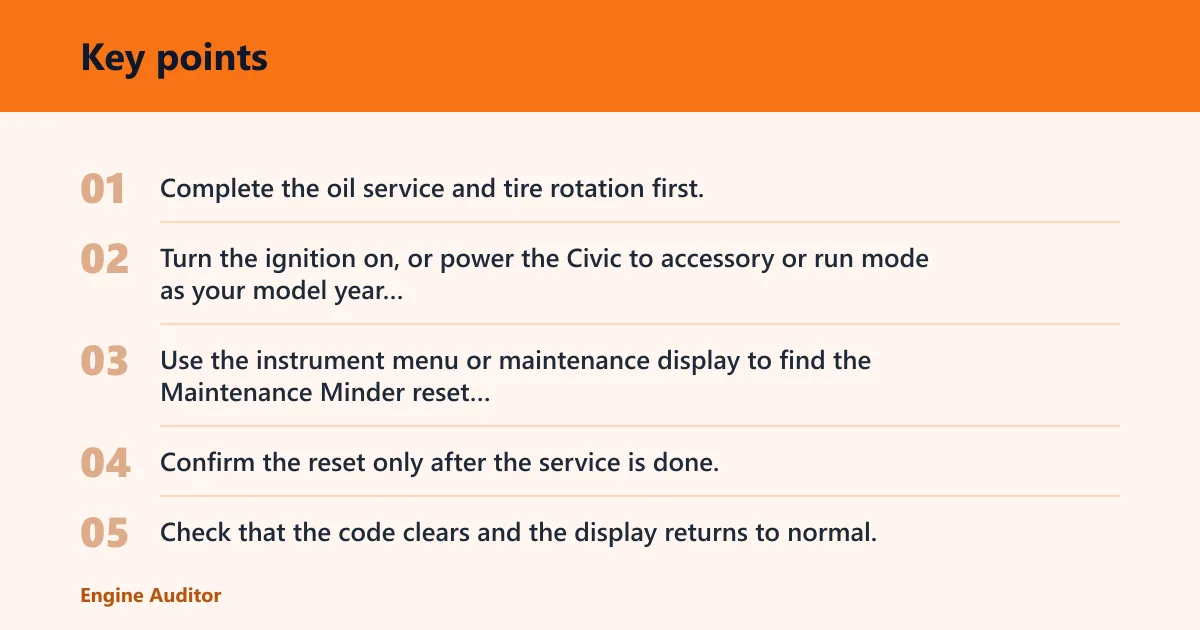
- Complete the oil service and tire rotation first.
- Turn the ignition on, or power the Civic to accessory or run mode as your model year requires.
- Use the instrument menu or maintenance display to find the Maintenance Minder reset function.
- Confirm the reset only after the service is done.
- Check that the code clears and the display returns to normal.
The exact reset steps vary by model year and cluster design, so the owner manual is the right reference. If the reminder returns immediately, the reset was not completed correctly or the system still sees due maintenance. Do not clear it and assume the car is serviced.
What Honda Civic A1 service means
Honda Civic A1 service means the Maintenance Minder wants engine oil replaced and the tires rotated. It is a routine service code, not a fault code, and it should be read in the context of the car’s model year, oil spec, tire setup, and any symptoms that point to a separate problem.
How to think about A1 before you pay
Start with the code, then check the car. If the only need is oil and rotation, the visit should stay close to that scope. If you find pressure loss, uneven wear, fluid spots, or warning lights, the car needs a closer look than A1 alone implies.
Frequently asked questions
Is A1 service just an oil change and tire rotation?
Yes, A1 is the oil service plus tire rotation at its core. Shops may also perform a visual inspection of brakes, fluids, belts, hoses, tread, and tire pressure during the visit. Those checks are useful, but they are not the same as extra repairs or automatic add-ons.
How do I reset the maintenance minder after A1 service?
Resetting the Maintenance Minder varies by Civic model year, but the basic idea is the same: finish the service first, then use the dashboard menu or instrument controls to clear the reminder. If the code remains after reset, check that the service was completed and that the right reset steps were used.
Does the A1 code mean something is wrong with my Civic?
Not by itself. A1 is Honda’s routine service reminder for oil replacement and tire rotation. It does not mean the Civic has a fault. If the car also has warning lights, leaks, tire damage, or a change in how it drives, that separate issue should be checked before treating A1 as the full explanation.
Products related to this article
Sponsored / affiliate links. As an Amazon Associate I earn from qualifying purchases. I may earn additional commission from eligible campaigns.