Honda Civic Maintenance Kit: Best Parts to Keep On Hand
For a Honda Civic maintenance kit, I keep the first-line items on hand first: engine oil, Honda Genuine oil filter, windshield wiper blades, cabin air filter, engine air filter, 12V battery terminals, fuse assortment, and tire repair gear; add brake pads, spark plugs, serpentine belt, and coolant at mileage intervals. Skip the right parts, and a simple service can turn into tow bills, missed intervals, and worn components that start hurting other systems. This guide sorts Civic parts by urgency tier so you know what to stock and what to buy only when mileage or failure calls for it.
This guide is part of our Honda Civic maintenance guide series.

Must-have
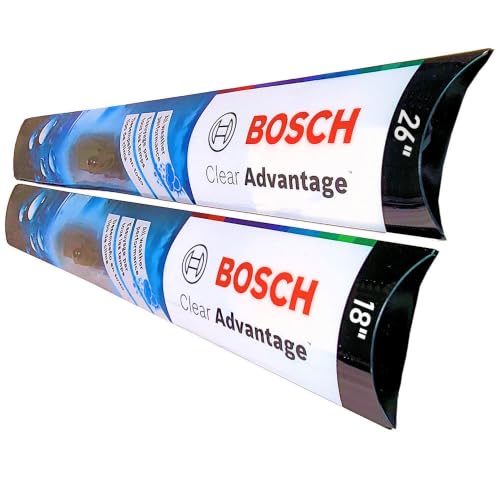
The must-have tier is the short list that keeps a Civic moving and visible. For most owners, that means the oil filter, the correct engine oil, and wiper blades first, because those are the parts that turn a normal service into an immediate problem when they are missing or wrong.
Honda Genuine oil filter
Honda Genuine oil filters are a strong choice to keep on hand because they are typically replaced at each oil change. Fitment matters more than brand loyalty here: Civic engine family and model year drive the correct part, and a wrong filter can mean poor sealing, wrong bypass behavior, or an awkward service delay. OEM is the safe default; quality aftermarket can be fine if the catalog data matches the exact engine and year.
For current Civic owners, the main mistake is buying by model name only. A Civic Sedan, Civic Sedan Hybrid, Civic Hatchback, and Civic Hatchback Hybrid do not all use the same service parts, and some older Civics have very different filters and drain hardware.
Engine oil
Engine oil is the one liquid you should keep on hand only after checking the owner’s manual for the exact viscosity and capacity. I do not trust the bottle label alone. Honda also sets different specs by engine family and powertrain, and hybrid Civics can have different service access and drain intervals than gas models.
Synthetic oil is the better default for current Civics because it holds up better between changes and in stop-and-go use. Conventional oil is generally a poor fit for a kit unless the manual specifically allows it and the engine is older. If you are buying a top-off bottle, match the grade already in the engine and keep the container sealed until needed.
Windshield wiper blades
Wiper blades are a must-have because you notice failure immediately. Streaking, chatter, split rubber, skipped patches, and smearing at night are the signs that the set is done. Blade sizes vary by Civic year and body style, so this is not a one-size purchase.
Keep a spare set only if the car is daily-driven in wet weather or parked outside. For a garage shelf, the value is lower than oil and filters, but it is still one of the few parts that can turn a safe drive into a bad one in a single storm.
📊 Honda’s customer service telephone number is listed as +1-800-999-1009. Source: American Honda Motor Co., Inc..
What should I keep in the garage, not the trunk?
Garage stock should cover parts that are cheap, predictable, and easy to inspect before they are installed. That includes filters, the drain washer, and unopened fluid containers. These are sensible to buy ahead of time, but they do not belong loose in the car.
 Our pick
Carory · Activated Carbon Filter 2016-2025
Our pick
Carory · Activated Carbon Filter 2016-2025
- Fits wide range of Honda models
- Includes activated carbon filtration media
- Low cost essential maintenance item
Drawback: Not compatible with pre-2016 Civic model years
$7.99
Price as of 7 Oct 2026
View on Amazon →
As an Amazon Associate we earn from qualifying purchases. Prices and availability are accurate as of the date shown and are subject to change.
- Fits wide range of Honda models
- Includes activated carbon filtration media
- Low cost essential maintenance item
Cabin air filter
The cabin air filter belongs on the garage shelf. It is a routine wear item that affects airflow, odor control, and allergen load, and a clogged filter often shows up as weak vent flow, musty smell, or dust that returns too quickly after cleaning. The Carory CF182 listing covers many Honda models, including some Civic fitments from the late 2010s through the mid-2020s, and its activated carbon media is the main reason to keep one ready.
The drawback is simple: fitment is broad, so the buyer still needs to confirm the exact Civic year and cabin filter case shape before ordering. A cheap filter that fits badly is wasted money. If the vents smell stale or the fan seems louder for the same airflow, this is usually the shelf item to pull first.
Engine air filter
Engine air filters also belong in the garage. The replacement interval depends on dust, construction, gravel roads, and how often the Civic sits in traffic behind other vehicles. In clean suburban use, they can last a while; in dusty or polluted driving, they clog much sooner.
Inspect by holding the filter up to light. Heavy gray loading, leaf debris, oil mist, or a crushed pleat pattern means it is time. If acceleration feels flat or intake noise changes after a dusty season, a spare is worth having ready rather than waiting for a parts run.
Drain plug crush washer
The drain plug crush washer is one-time-use hardware. Replace it with each oil service if the drain plug design calls for it, because reusing a flattened washer is how small seepage starts. It is cheap, easy to store, and very annoying to skip.
This is the kind of part that should live in the oil-change box, not in a general drawer. If the washer is not in the kit when the oil comes out, owners often reuse the old one and pay for it later with drips on the garage floor.
Brake fluid
Brake fluid is best kept in the garage only as unopened stock for occasional top-off emergencies. It absorbs moisture from the air, so opened bottles age badly and should not be treated like a forever fluid. The service interval matters more than the amount on the shelf, and a low reservoir can mean wear or a leak that needs diagnosis, not just topping off.
Keep one sealed bottle only if you drive far from parts stores or maintain multiple vehicles. Once opened, contamination risk rises. If the reservoir is low, inspect pad wear and the system before adding fluid blindly.
Coolant / antifreeze
Coolant and antifreeze are garage items, but only in the right Honda spec and only sealed. Never mix types blindly. Honda coolant compatibility matters because wrong chemistry can create sludge, corrosion, or poor freeze protection, and that is a much more expensive mistake than the bottle costs.
Use coolant for top-off only when you know the exact type already in the car. A full flush is a different job from a small top-up, and the bottle on the shelf should not blur that line. Hybrid Civics deserve extra care here because the cooling system layout can differ from gas models.

Consumables and spares to buy only when symptoms or mileage trigger it
This tier is for parts that should not sit in duplicate on a shelf unless the Civic is already near the service point. Long-life wear parts can last a long time, but once they start showing symptoms, the correct move is to order the right replacement instead of guessing early.
 Upgrade pick
Sixity Auto · NGK Iridium 4-Pack 2002-11
Upgrade pick
Sixity Auto · NGK Iridium 4-Pack 2002-11
- Genuine NGK Iridium IX technology
- Includes four plugs for full set
- Direct replacement for L4 engines
Drawback: Only fits 2002-2011 Civic, not newer models
$43.28
Price as of 7 Oct 2026
View on Amazon →
As an Amazon Associate we earn from qualifying purchases. Prices and availability are accurate as of the date shown and are subject to change.
- Genuine NGK Iridium IX technology
- Includes four plugs for full set
- Direct replacement for L4 engines
Spark plugs
Spark plugs are mileage-triggered parts, not casual shelf stock for most owners. Many Civics use long-life iridium plugs, and they should be replaced at the recommended interval or sooner if misfires, rough idle, poor fuel economy, or hesitation appear. The Sixity Auto NGK Iridium IX set is a direct replacement for some older 1.8L and 2.0L L4 Civics from the early 2000s through the early 2010s, so fitment is the main limitation.
The drawback is that this set is not for current Civic generations. That makes it useful only for owners of the matching older engines. For everyone else, the lesson is the same: do not buy spark plugs until the engine family and service interval line up.
Serpentine belt
The serpentine belt should be bought after inspection shows cracking, glazing, fraying, or audible squeal. Age matters too. Even a belt that looks fine can be close to failure after enough heat cycles, and a broken belt can leave the car stranded with charging or accessory problems.
For a Civic kit, the belt is a planned replacement part, not a spare you need to keep in the trunk. If the belt has sheen, visible checking, or the accessory drive is noisy on cold start, it belongs on the next order list.
Transmission fluid
Transmission fluid is highly Civic-specific. Automatic and CVT Civics do not use the same fluid, and choosing the correct Honda fluid type matters more than relying on a generic bottle with broad compatibility claims. Interval sensitivity is real here; towing, heat, and stop-and-go use shorten the useful life of the fluid.
Do not stock this casually unless you know exactly which transmission is in the car. If the Civic is a hybrid, or if the owner cannot verify the transmission type, this is a buy-after-confirmation item only.
What parts should I keep on hand for Honda Civic maintenance?
Keep the parts that stop small maintenance from becoming a delay: engine oil, Honda Genuine oil filters, wiper blades, cabin air filters, engine air filters, and a crush washer supply. Add brake fluid and coolant only as sealed garage stock, then buy plugs, belts, and transmission fluid when the car’s condition or mileage justifies them.
That is the practical hierarchy. The first group gets used often. The second group supports scheduled service. The third group should be bought only when the car tells you it needs them.
What is a good emergency kit for a Honda Civic owner?
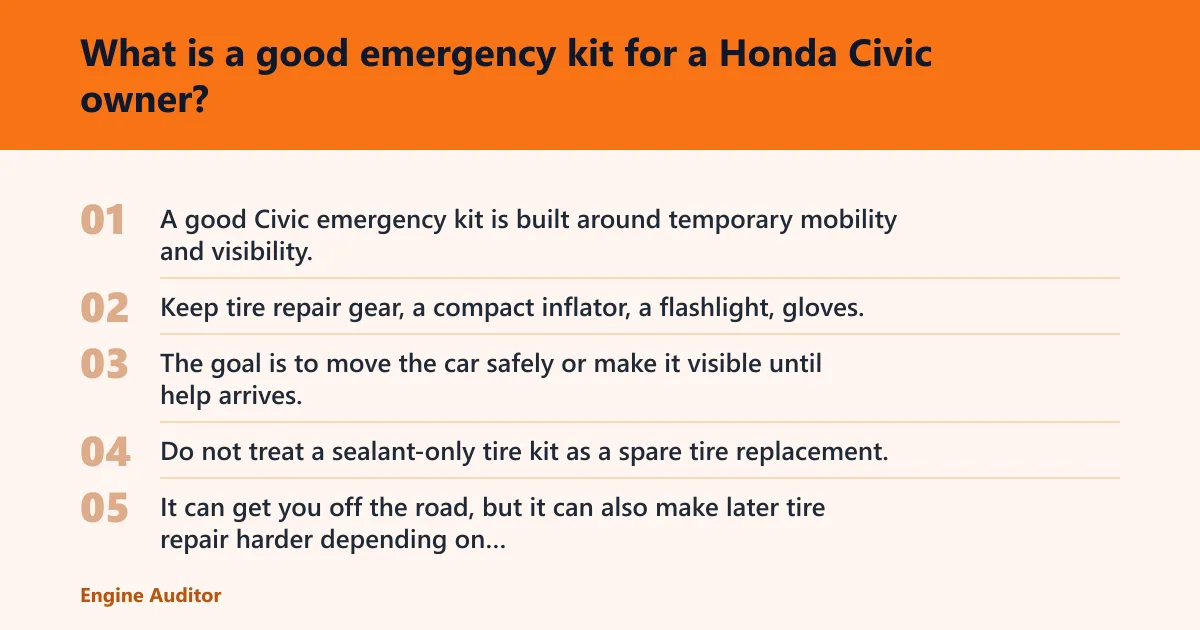
A good Civic emergency kit is built around temporary mobility and visibility, not full repair. Keep tire repair gear, a compact inflator, a flashlight, gloves, warning triangles or reflective items, and basic tools for battery terminal issues or a loose fuse. The goal is to move the car safely or make it visible until help arrives.
Do not treat a sealant-only tire kit as a spare tire replacement. It is a temporary fix. It can get you off the road, but it can also make later tire repair harder depending on the puncture and the wheel sensor setup.
Tire repair kit or spare-related items
Tire repair gear should include an inflator, sealant if the car is equipped for it, and any spare-related items the Civic actually uses. Some trims rely on an inflator kit instead of a full-size spare, which changes what belongs in the trunk. If a spare is fitted, keep the jack, wrench, and lug hardware checked and accessible.
The limitation is important: inflator-and-sealant systems are for temporary mobility after a simple puncture. They do not solve sidewall damage, bent wheels, or large tears. A proper repair still needs inspection and, in many cases, a tire shop.
Roadside basics for visibility and safe pull-offs
Visibility items matter because a breakdown at night is more dangerous than the mechanical fault. A flashlight, reflective triangle, gloves, and a phone charger are all reasonable additions. They do not repair the Civic, but they make a stop on the shoulder less risky.
If the car has a spare, make sure the air pressure and tools are checked before a trip. A spare that is flat is dead weight.
Do hybrid Honda Civics need different maintenance parts?
Yes. Hybrid Civics often share wear items like filters and wiper blades, but fluid choice, service access, and some maintenance timing can differ. Honda’s current Civic lineup includes a Civic Sedan, Civic Sedan Hybrid, Civic Hatchback, and Civic Hatchback Hybrid, so the buyer must match parts to powertrain before ordering.
Hybrid ownership changes the kit strategy. Shared items still matter, but the wrong fluid or wrong service assumption can create more trouble than it saves.
Fluid compatibility differences that matter
Hybrid Civics still need the correct Honda-spec coolant, brake fluid, and transmission fluid if the transmission design uses it. Never assume a gas Civic fluid bottle is automatically correct for a hybrid. The owner’s manual is the final reference, especially for top-off and service-fill decisions.
For stocking purposes, this means unopened brake fluid may be shared across powertrains, but coolant and transmission fluid need model-specific confirmation. That is where a lot of overbuying starts.
Parts that are shared across powertrains
Shared parts often include cabin air filters, engine air filters, wiper blades, and sometimes oil filters when the engine family matches. Those are useful garage items because they do not force the owner to stock duplicate inventories for each Civic variant.
Even then, fitment still needs a year check. Honda trims and body styles shift details faster than owners expect.
Hybrid-specific items worth keeping on hand
For hybrids, keep the same emergency roadside gear as a gas Civic, plus a little more caution about fluids and diagnostics. A hybrid warning light is not the same as a low washer light, and it should not be handled with guesswork.
If the vehicle is a Civic Sedan Hybrid or Civic Hatchback Hybrid, stock less fluid and more confirmation: exact manual, exact part number, exact drain and fill procedure.
Which Honda Civic parts wear out the fastest?
The fastest wear items are the ones exposed to weather, dirt, heat, and daily use: oil filters, engine oil, cabin and engine air filters, wiper blades, and sometimes brake fluid by age rather than mileage. Tires and brake friction parts wear quickly too, but they are usually not shelf stock items.
If the Civic lives in dust, heavy rain, or stop-and-go driving, these parts age faster than the calendar suggests. That is where a kit saves time.
Which Honda genuine parts are worth buying ahead of time?
Honda Genuine oil filters, drain plug crush washers, and the correct service fluids are the Honda parts most worth buying ahead of time. They are low-risk storage items when sealed, they are easy to forget during a service run, and the cost of being wrong is higher than with generic consumables.
Honda Genuine is most valuable where fit and chemistry matter. For simple items like some wiper blades or cabin filters, a quality aftermarket part can be fine if the exact fit is verified. For filters and fluids, Honda Genuine remains the safer default.
What parts should be included in a Civic maintenance kit for 60,000 miles?
By 60,000 miles, the kit should usually include a planned set of filters, a drain washer supply, the correct engine oil, and a serious look at spark plugs, transmission fluid, brake fluid, and the serpentine belt. What is already on the shelf depends on what has been consumed earlier and what the manual calls for at that mileage.
This is the point where owners often discover they stocked the easy parts and forgot the timed ones. The kit should already have handled the recurring items and be ready for the larger scheduled services.
Parts likely due by this point
At this mileage, spark plugs may be due on many Civics with long-life iridium plugs, and the serpentine belt may need inspection or replacement depending on condition. Transmission fluid may also be due, especially if the car sees heat, traffic, or frequent stop-and-go use.
Brake fluid age should also be checked. If it has not been serviced, do not treat the reservoir as a storage bin. It is part of the service plan.
What should have been bought earlier
Earlier buys should already have covered oil filters, engine oil, wiper blades, air filters, cabin filters, and drain washers. Those are the parts that keep the maintenance schedule from stalling when a service window opens.
If those are still not on hand at 60,000 miles, the kit strategy is behind. That usually means repeat shopping for the same small items and more time with worn consumables than necessary.
What to inspect before ordering duplicates
Before buying duplicates, inspect the current filter sizes, blade lengths, fluid types, and the exact transmission type. Gas and hybrid Civics do not always share the same service parts, and a mismatch here is how garage shelves fill with unusable stock.
If a part still has clean life left, do not buy the second copy just because it was cheap. Stock the items that will actually be consumed next.
Budget setups
A Civic kit does not need to be bought in one shot. The smarter approach is to build it in layers: keep the daily-use items close, keep service parts in the garage, and order timed wear items only when the car calls for them. That keeps money tied to actual need instead of dead inventory.
| Setup | What to buy first | Best fit |
|---|---|---|
| Starter | Honda Genuine oil filter, correct engine oil, windshield wiper blades, tire inflator/repair gear | Daily drivers that need the basics covered now |
| Mid | Cabin air filter, engine air filter, drain plug crush washer, sealed brake fluid, sealed coolant | Owners who do their own oil changes and seasonal checks |
| Serious | Spare spark plug set when due, serpentine belt at inspection time, correct transmission fluid, spare fuses and terminals | High-mileage Civics, long-trip cars, and hybrid owners who want service readiness |
How often should I replace Honda Civic oil filters and air filters?
Oil filters should be replaced at every oil change. Engine air filters and cabin air filters last longer, but their interval changes with dust, traffic, weather, and cabin use. If airflow drops, dust returns fast, or the filter media looks loaded, the part is due before the calendar says so.
That is why these items belong in different tiers. Oil filters are recurring service stock. Air filters are shelf stock until inspection says move them into the car.
What fluids should I stock for a Honda Civic?
Stock engine oil, and only the exact viscosity your Civic engine calls for. Keep sealed brake fluid and coolant only if you are certain of the Honda spec and you understand they are top-off stock, not open-container fluids. Transmission fluid should be stocked only after confirming the transmission type and fluid family.
For hybrid Civics, the same caution applies, but the tolerance for guessing is lower. One wrong fluid choice can cost more than several correct maintenance items combined.
Frequently asked questions
What parts should I keep on hand for Honda Civic maintenance?
Keep engine oil, Honda Genuine oil filters, wiper blades, cabin air filters, engine air filters, and drain plug crush washers first. After that, add sealed brake fluid and coolant only if you can verify the exact Honda spec. Leave plugs, belts, and transmission fluid for mileage-based buying.
Which Honda Civic parts wear out the fastest?
Oil, oil filters, wiper blades, and cabin and engine air filters wear out first because they deal with contamination and weather. Brake fluid ages by moisture absorption, not just mileage. Tires and brake pads often wear faster than many owners expect, but they are usually inspected rather than stocked.
How often should I replace Honda Civic oil filters and air filters?
Replace the oil filter with every oil change. Replace the engine air filter and cabin air filter by condition, dirt, and airflow, not by habit alone. A dusty commute, construction routes, or a musty cabin can shorten the interval well before a normal schedule would.
What fluids should I stock for a Honda Civic?
Engine oil is the primary fluid to stock, and only in the correct viscosity. Brake fluid and coolant make sense as unopened garage stock if the Honda spec is confirmed. Transmission fluid should be bought only after verifying automatic or CVT application and the correct Honda fluid type.
Do hybrid Honda Civics need different maintenance parts?
Yes. Hybrid Civics can share filters and wiper blades with gas models, but fluid compatibility and some service access details differ. The same rule applies: verify the exact year, trim, and powertrain before ordering. A hybrid kit should be built around confirmed fitment, not assumptions.
What is a good emergency kit for a Honda Civic owner?
A useful emergency kit includes tire repair gear, a compact inflator, flashlight, reflective warning items, gloves, and basic charging or battery-access tools. Sealant kits are temporary fixes, not full replacements for a tire. If the car has a spare, keep its tools and pressure checked too.
Products related to this article
Sponsored / affiliate links. As an Amazon Associate I earn from qualifying purchases. I may earn additional commission from eligible campaigns.