Honda Civic alignment vs balancing: which one you need?
Use alignment for pull or a crooked wheel. Use balancing for highway shake that rises with speed. Use both when the Civic shakes and wears tires unevenly. Skip the wrong fix and you can waste money, keep burning through tires, and chase the same symptom twice. This guide maps Civic symptoms to the first shop check, the likely repair, and when to ask for both services.
This guide is part of our Honda Civic maintenance guide series.
| Decision factor | Honda Civic alignment | balancing: Which one do you need | Winner |
|---|---|---|---|
| Main symptom it fixes | Pulling to one side, crooked steering wheel, uneven tire wear | Steering wheel vibration, seat shake, speed-related shimmy | Tie |
| Best first check after damage | Pothole, curb strike, accident, suspension change | New tires, tire rotation, flat tire repair | Tie |
| What the shop changes | Steering and suspension geometry; tire angles for road contact | Weight distribution in the wheel and tire assembly with small metal weights | Tie |
| Cost control when you are unsure | May be wasted if the real issue is imbalance only | Often cheaper to test first for pure vibration complaints | balancing: Which one do you need |
| Protects tire life when wear is already visible | Usually the stronger fix for feathering, inner-edge wear, or a crooked wheel | Can help even wear, but will not correct bad angles | Honda Civic alignment |
Cost, timing, and symptom fit on a Civic
Alignment usually wins when the Civic has a direction problem. Balancing usually wins when the complaint is shake that builds with road speed. If both problems show up together, the shop should inspect both systems before swapping parts or selling tires.
Honda Civic alignment
Alignment adjusts steering and suspension geometry so the tires meet the road at the right angles. On a Civic, that matters after potholes, curb strikes, and accidents because the car can start pulling or sit with an off-center wheel even when the tires still look fine.
balancing: Which one do you need
Balancing corrects uneven weight distribution in the wheel and tire assembly. That is the fix when one corner of the car is causing shake, and it often shows up after new tires, a tire rotation, or a flat repair.
Why the table leans the way it does
The winning row is rarely about which service is “better.” It is about matching the symptom. Vibration points to imbalance more often; pull or a crooked wheel points to alignment more often.
According to Tire Balance vs. Alignment: Which One Do You Need? — Firestone says wheel alignment should be checked every 6,000 miles. (source)
What is the difference between wheel alignment and tire balancing?
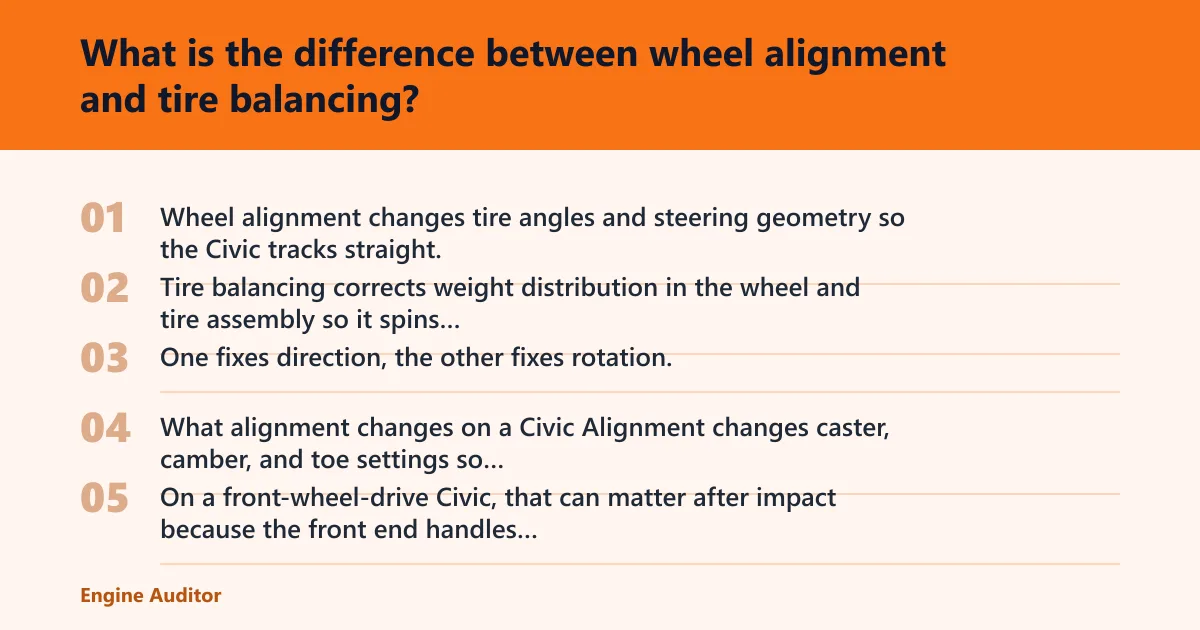
Wheel alignment changes tire angles and steering geometry so the Civic tracks straight. Tire balancing corrects weight distribution in the wheel and tire assembly so it spins without shake. One fixes direction, the other fixes rotation.
What alignment changes on a Civic
Alignment changes caster, camber, and toe settings so the tires point and sit correctly on the road. On a front-wheel-drive Civic, that can matter after impact because the front end handles most of the steering and much of the work.
What balancing changes on a wheel and tire assembly
Balancing adds small metal weights where needed so the wheel is less likely to hop or wobble as it turns. That is why a tire can look fine and still shake at speed. A cosmetic check is not enough here.
Why the two fixes solve different problems
Alignment deals with where the tires aim. Balancing deals with how evenly the assembly spins. A Civic can need one, the other, or both, and the wrong choice often leaves the complaint unchanged.
Which symptoms point to tire balancing?
Start with balancing when the Civic shakes more as speed rises, especially if the steering wheel vibrates. If the seat shakes more than the wheel, the rear wheels are often the first place to inspect. That pattern is more useful than guessing.
Steering wheel vibration at highway speed
Balancing may be needed when the steering wheel vibrates. On a Civic, a shake that starts at highway speed and grows worse as speed rises often points to the front tires first. That is the set that usually feeds vibration into the steering wheel.
Seat vibration and what it often means
Vibration in the seats can point to rear wheels. That clue matters because many drivers send the car in for a front-end fix when the issue sits in the back. A shop should check all four wheel and tire assemblies, not only the front pair.
Shaking that starts after new tires, rotation, or flat repair
Balancing is recommended after new tire installation. It is also a common follow-up after tire rotation or flat tire repair, because the service can reveal or create a weight issue that was not obvious before. If the shake began right after service, balance is the first place to start.
What to ask the shop to inspect first
Ask for a road-force style check if available, then have the tech inspect each wheel and tire for bent rims, missing weights, tire runout, and any assembly that shakes at speed. That is the practical path before assuming the Civic needs suspension work.
Which symptoms point to wheel alignment?
Start with alignment when the Civic drifts, pulls, or the steering wheel sits crooked on a straight road. Uneven tire wear also pushes alignment higher on the list, especially after a pothole, curb hit, or suspension work. Those are geometry symptoms, not spin symptoms.
Pulling to one side after a pothole or curb hit
Alignment may be needed when the car pulls to one side. A pothole or curb strike can move suspension angles enough that the Civic no longer tracks straight. After that, the driver often notices the car wandering even on a flat road.
Crooked steering wheel while driving straight
Alignment may be needed when the steering wheel is crooked. A Civic can drive in a straight line while the wheel itself sits off-center, which is a classic sign that the front wheels are not aimed correctly. That is not a balancing problem.
Uneven tire wear patterns that fit alignment trouble
Uneven tire wear can indicate alignment trouble, and ignoring it can shorten tire life by thousands of miles. Look for inner-edge wear, outer-edge wear, feathering, or one tire wearing faster than the others. If wear is already established, the fix may need both alignment and balancing.
What a Civic shop should inspect on the front end
Ask the shop to inspect tire wear, steering wheel centering, front toe, camber, suspension bushings, ball joints, tie rods, and any bent parts from impact. On a Civic, a front-end check after damage is smarter than paying for a wheel spin check alone.
Honda Civic symptom-to-service decision table
| Driver symptom | Most likely cause | First inspection to request | Start with alignment, balancing, or both |
|---|---|---|---|
| Steering wheel shakes at highway speed | Front wheel or tire imbalance | Inspect front tires, wheels, and missing balance weights | Balancing |
| Seat vibration at speed | Rear wheel or tire imbalance | Inspect rear wheel and tire assemblies for imbalance or runout | Balancing |
| Car pulls left or right after a pothole | Alignment changed by impact | Inspect front alignment angles and suspension parts | Alignment |
| Steering wheel is off-center on a straight road | Front toe or related alignment issue | Check steering wheel centering and front-end geometry | Alignment |
| Uneven tread wear plus highway shake | Alignment issue with added imbalance | Inspect wear pattern, then check all four wheel and tire assemblies | Both |
| Shaking began after tire replacement | Assembly imbalance after mounting | Inspect balance, tire seating, and wheel condition | Balancing |
When do you need both services?
You need both when the Civic has a direction problem and a shake problem at the same time. That happens after tire replacement, after a flat repair, or after a hard impact that may have moved the suspension and also disturbed wheel balance. One service alone will miss part of the complaint.
After tire replacement
New tires do not fix alignment problems. They also should not be assumed balanced just because they are new. If the steering wheel was already off-center or the car already pulled, alignment still needs to be checked after the tire work.
After a flat tire repair
Flat tire repair may call for post-repair balancing. The repaired tire may no longer match the others in how it spins, and the vibration can show up only after the car is back on the road. If the flat also came from road impact, alignment should be considered too.
After impact with a pothole, curb, or accident
Potholes, curbs, and accidents are common causes of misalignment on a Civic. They can also bend a wheel or knock a tire out of balance. If the hit was hard enough to leave a new pull and a new shake, ask for both inspections on the same visit.
When uneven wear and vibration show up together
That combo is a strong clue that the car has been driven too long with one problem feeding the other. The uneven wear may come from alignment, while the shake may come from imbalance. Correcting only one side of the problem often leaves the tires heading toward early replacement.
How often should a Honda Civic get each service checked?
Alignment checks are typically tied to mileage, timing, and impact events. Balancing follows tire service more closely and should be checked whenever tires are installed, rotated, or repaired. Driving history matters more than a fixed calendar alone.
Alignment check timing
Firestone recommends checking wheel alignment every 6,000 miles, or twice a year. That timing makes sense for a Civic because small changes in toe and camber can add up without obvious warning. Any pothole hit, curb strike, or accident should move alignment to the front of the line.
Balancing timing
Firestone suggests balancing every 5,000 to 6,000 miles or per schedule. Balancing is also recommended after new tire installation. Tire rotation is another common moment to inspect balance, because a wheel that felt fine in one position may shake in another. (firestonecompleteautocare.com)
How driving events change the schedule
If the Civic starts shaking after a tire swap, do not wait for the next service interval. If it starts pulling after an impact, do not chase the problem with balancing alone. Event-based checks beat calendar-based guesses.
Can new tires fix alignment or balancing problems?
No. New tires do not correct wheel angles, so they do not fix alignment problems. They can still need balancing right after installation, and a fresh tire can make an old alignment issue more obvious because the car now rolls differently and the steering feel changes.
What new tires do help
New tires can improve noise, grip, and ride quality if the old tires were worn out. They also give the shop a clean starting point for balancing. That makes diagnosis easier, but it does not repair a bent or mis-set front end.
What new tires do not fix
New tires will not stop a Civic from pulling to one side. They will not center a crooked steering wheel. If those symptoms were there before the tire change, they will still need alignment after the new set goes on.
What does a crooked steering wheel mean on a Civic?
A crooked steering wheel usually means the front wheels are not aimed straight enough, even if the Civic tracks mostly forward. That is an alignment clue, not a balancing clue. If the wheel is off-center and the car also drifts, the alignment complaint is stronger.
How it differs from vibration
A crooked wheel changes where the driver holds the wheel. Vibration changes how the wheel feels in the hands. Those are different complaints, and they usually send the shop to different first checks.
What to tell the shop
Say whether the wheel is off-center while driving straight, whether the car pulls, and whether the pull changes under braking or after bumps. Those details help the technician separate alignment from a worn part or a tire issue.
What causes uneven tire wear on a Honda Civic?
Uneven tire wear on a Civic can come from alignment trouble, imbalance, or both. Alignment problems usually leave a pattern across the tread or one edge of the tire. Balancing issues are more likely to show up as vibration first, but over time they can still contribute to uneven wear and shortened tire life.
Wear patterns that point toward alignment
Inner-edge wear, outer-edge wear, and feathering are the usual clues. If the wear matches a pull or off-center steering wheel, alignment should be checked first. That pattern is common after impact or after a long stretch of driving with a bad setting.
Why balancing still matters for tire wear
Balancing can help with a smoother ride and even wear. If one tire assembly is out of balance enough to hop, it can wear unevenly even when the alignment is close. That is why tire wear should be read with the vibration complaint, not alone.
Do I need both alignment and balancing after a tire replacement?
Sometimes yes. After a tire replacement, balancing is usually the first thing to check because the new assembly may need weights. If the Civic also pulled before the swap, or if the steering wheel was already crooked, alignment should be checked too.
Best order when money is tight
If the only symptom is highway shake, start with balancing. If the only symptom is pull or a crooked wheel, start with alignment. If the tires were replaced and the car still has both a shake and a steering complaint, ask the shop to inspect both before paying twice.
Verdict
Choose Honda Civic alignment if the Civic pulls, the steering wheel sits crooked, or the tread is wearing unevenly after a pothole, curb strike, or accident. Choose balancing if the main complaint is steering wheel vibration, seat shake, or a new shimmy after new tires, rotation, or flat repair. Choose both when the shake and the steering or wear problem show up together.
Frequently asked questions
What is the difference between wheel alignment and tire balancing?
Wheel alignment adjusts tire angles and steering geometry so the Civic tracks straight. Tire balancing corrects uneven weight distribution in the wheel and tire assembly so it spins without vibration. One fixes direction, the other fixes rotation, and the symptoms usually point to different first checks.
Does my Honda Civic need an alignment or a balance if it shakes at highway speed?
Highway-speed shake usually points to balancing first, especially if the steering wheel vibrates. If the shake is felt more in the seat, the rear wheels may be involved. If the car also pulls or the wheel is crooked, alignment should be checked too.
Why does my Civic pull to one side after hitting a pothole?
A pothole can knock the front-end angles out of spec, which makes the Civic pull. That is a classic alignment symptom. The shop should inspect alignment, suspension parts, and any bent component before assuming the tires themselves are the only issue.
How often should a Honda Civic get tires balanced?
Firestone suggests balancing every 5,000 to 6,000 miles or per schedule. It is also smart after new tire installation, tire rotation, or a flat repair. If vibration appears before that interval, the car should be checked sooner.
How often should a Honda Civic get a wheel alignment checked?
Firestone says wheel alignment should be checked every 6,000 miles. Twice a year is another practical checkpoint. Any pothole hit, curb strike, accident, or suspension change should trigger an earlier inspection.
Can new tires fix alignment or balancing problems?
No. New tires do not fix wheel angles, so they do not solve alignment problems. They often still need balancing, and they can make a pre-existing alignment issue easier to notice because the car now rolls and grips differently.
Products related to this article
Sponsored / affiliate links. As an Amazon Associate I earn from qualifying purchases. I may earn additional commission from eligible campaigns.
 ACARLUOY Portable Air Compressor for Car Tires - 3X Faster Inflation, Fit for Honda civic 2008-2012,6000mAh Battery, LCD Screen, LED Light,Auto Shutoff
 ACARLUOY Portable Air Compressor for Car Tires - 3X Faster Inflation, Fit for Honda civic 2002-2008,6000mAh Battery, LCD Screen, LED Light,Auto Shutoff