Best car batteries for Civic owners (2026): we compared
For many Honda Civics, the right replacement is often Group 51R on newer trims and Group 35 on some older models; match the tray and terminal layout, then meet or exceed the OEM CCA. Choose wrong, and you can get weak starts, fitment problems, and a battery that dies early. This guide compares Civic battery options by group size, CCA, climate, and driving pattern.
Quick comparison
| Product | Badge | Best for | Price | ||
|---|---|---|---|---|---|
 |
OPTIMA® Batteries High Performance DH5 YELLOWTOP® SealedOPTIMA | Our pick | 700 CCA AGM with 115-minute reserve capacity. | $359.99
Price as of 11 Oct 2026
|
View |
 |
Weize Platinum AGM Battery BCI Group 35 Automotive Battery,WEIZE | Budget pick | Group 35 · 650 CCA · 55AH capacity. | $179.99
Price as of 11 Oct 2026
|
View |
Use the table below to narrow fitment before you compare brands. A Civic battery is a fitment part first, and a spec sheet second.
How we chose
Fitment came first: group size, terminal orientation, and tray clearance had to line up with Civic applications. Then came CCA and reserve capacity, because starting power and short-trip recovery matter more than marketing claims.
Battery type also mattered. AGM fits stop-start use and higher accessory loads better than basic flooded batteries, while conventional flooded models still make sense for simpler driving patterns.
Finally, installed value mattered more than sticker price alone. A cheaper battery can cost more once you add a core charge, recycling fee, labor, or a shorter service life in the wrong duty cycle.
Best overall: Group 35 AGM battery
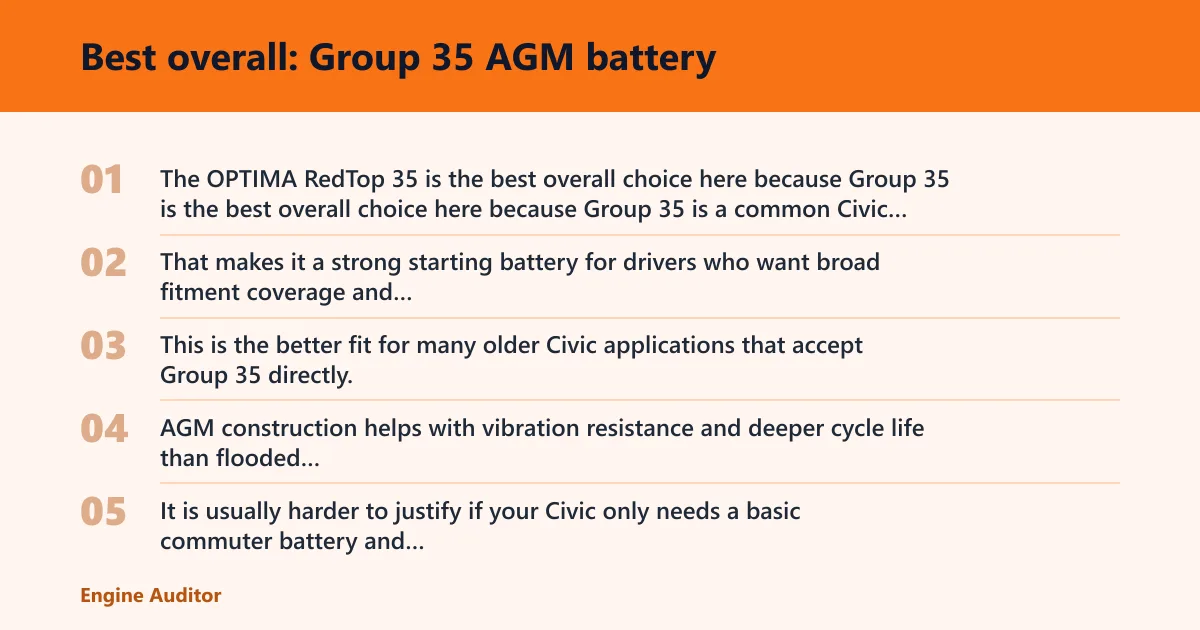
The OPTIMA RedTop 35 is the best overall choice here because Group 35 is a common Civic fitment class, it uses SAE terminals, and it brings 720 CCA with a 90-minute reserve capacity. That makes it a strong starting battery for drivers who want broad fitment coverage and reliable crank performance.
This is the better fit for many older Civic applications that accept Group 35 directly, especially when you want a starting-focused AGM layout instead of a plain flooded replacement. AGM construction helps with vibration resistance and deeper cycle life than flooded batteries, and the sealed design keeps routine maintenance simple.
The drawback is cost. It is usually harder to justify if your Civic only needs a basic commuter battery and you do not need the extra reserve capacity or AGM durability.
Best for: Civic owners who want a starting-first AGM battery with solid reserve capacity and a common group size.
Less ideal for: Budget-only replacements and Civics that require a different tray or terminal layout.
Best premium pick: Group 48 / H6 AGM battery
The UPLUS Group 48 AGM battery is the premium-leaning pick in this guide because it is a maintenance-free start-stop replacement with AGM construction, 760 CCA, 70 Ah, and 120 minutes of reserve capacity. Group 48, also called H6, is a fitment class rather than a universal upgrade, so the battery must clear the tray and cover correctly.
This size can make sense when the Civic’s battery bay accepts Group 48 dimensions and the electrical demand is higher than average. The extra reserve capacity helps with short-trip recovery, accessory load, and repeated starts, especially on cars that spend time idling with the blower, lights, or infotainment on.
The drawback is fitment risk. A higher-CCA battery is not automatically better if the case size, hold-down, or terminal position is wrong for your Civic.
Best for: Stop-start Civics, accessory-heavy driving, and owners who need AGM durability plus more reserve capacity.
Less ideal for: Civics with tight tray clearance or a different terminal orientation.
Best budget pick: flooded Group 35 battery
A conventional flooded Group 35 battery is the best budget path when your Civic calls for Group 35 and you mainly want straightforward starting power at a lower entry cost. This is the simplest choice for older, non-stop-start Civics that do short daily drives and do not carry heavy electrical loads.
The drawback is that flooded batteries generally trail AGM in vibration resistance and deeper cycle life. They can still work well, but they are less forgiving of frequent short trips, repeated starts, and heat stress.
Best for: Basic commuter Civics with confirmed Group 35 fitment and no stop-start system.
Less ideal for: Stop-start models, high-accessory use, and buyers looking for the longest cycle life.
Which one should you buy
Start with fitment, then buy the battery that matches your driving pattern. If your Civic accepts Group 35 and you want the safest all-around starting choice, the OPTIMA RedTop 35 is the strongest default pick in this set.
If your Civic bay accepts Group 48 and you need more reserve capacity for stop-start use or electrical load, the UPLUS Group 48 AGM is the better premium-style choice. If you only need a basic replacement for a non-stop-start commuter, a flooded Group 35 battery is the lower-cost route.
Do not buy purely on the highest CCA number. A battery that is too large, too tall, or wrong at the terminals can create more problems than it solves.
Why the right Honda Civic battery fit matters
Honda Civic battery fitment changes by model year, trim, and engine variant. That matters because the tray, hold-down hardware, and cable routing can differ enough to make one group size fit cleanly and another one interfere with the cover or bracket.
The battery also affects starting performance and electronics stability. That is why the right choice is not only about cranking amps; it is about the case size, terminal layout, and whether the battery can sit securely in the engine bay.
Model year and trim differences
Some Civics use Group 35, while many recent trims use Group 51R. The correct answer depends on the exact year, model variant, and product variant, not just the badge on the trunk.
That is why a 2-door, hybrid, turbo, or stop-start Civic can call for a different battery class than a base commuter trim. Check the owner’s manual, the existing battery label, or the battery fitment chart before ordering.
Group size, terminal orientation, and clearance
Group size controls the outer dimensions and terminal placement. A battery can have enough CCA and still fail the fit test if the posts land on the wrong side or the case is too tall for the hood line.
Always confirm terminal orientation and tray clearance. Civic battery boxes are not generous, and an interference issue often shows up only after the battery is lowered into place.
How to verify fitment before you buy
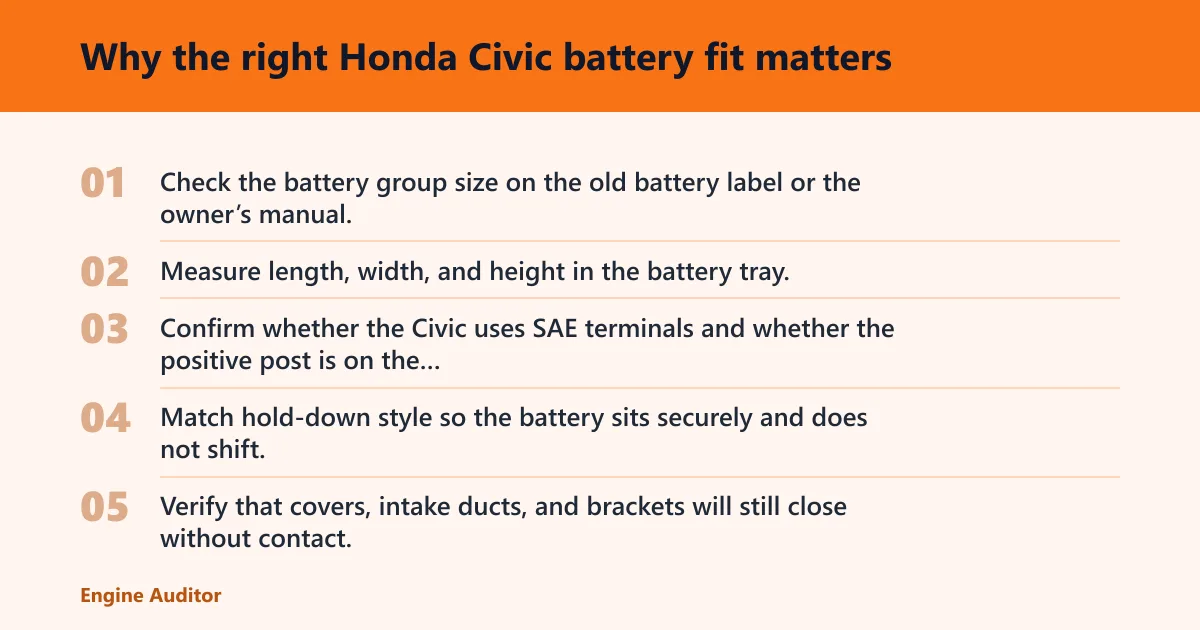
- Check the battery group size on the old battery label or the owner’s manual.
- Measure length, width, and height in the battery tray, including clearance above the terminals.
- Confirm whether the Civic uses SAE terminals and whether the positive post is on the correct side.
- Match hold-down style so the battery sits securely and does not shift.
- Verify that covers, intake ducts, and brackets will still close without contact.
Say your Civic is a short-trip commuter with heated seats, a blower on high, and frequent night driving. A battery that fits the tray but has low reserve capacity may crank fine at first and then struggle after a few stop-and-go days.
Suppose the replacement battery is one inch too tall. It can touch the hood insulation or the cover, which creates an install problem even if the electrical rating looks perfect on paper.
How we chose these Civic battery picks
Fitment compatibility came first. A Civic battery should line up with the tray, terminal orientation, and cover clearance before anything else.
CCA and reserve capacity came next. CCA matters most for cold starts, while reserve capacity matters for short trips, accessory load, and frequent restart use.
Battery chemistry also mattered. AGM batteries offer better vibration resistance and deeper cycle life than flooded batteries, and sealed construction cuts down on routine maintenance.
Installed value mattered too. The right battery is the one that fits, starts reliably, and makes sense once labor, core charge, and replacement timing are considered.
Which battery type do you need?

For a Civic, the best battery type depends on stop-start hardware, trip length, climate, and electrical load. AGM is the safer choice for many newer Civics because it is maintenance-free, sealed, and better suited to repeated cycling than a basic flooded battery.
AGM versus flooded
AGM batteries are sealed and non-spillable, which helps with vibration resistance and cycle life. They are a better match for cars that see repeated starts, short trips, or more electrical demand than a simple commute.
Flooded batteries are usually cheaper and still work well in simpler applications. The tradeoff is lower tolerance for frequent cycling and less resistance to rough-duty use.
Start-stop compatibility
If your Civic has start-stop, buy a start-stop battery. Those cars ask more of the battery during engine-off events, so a basic flooded unit may wear out faster or struggle to handle the load.
For start-stop models, AGM is usually the safer path because it handles cycling better and recovers more predictably after repeated restarts.
Cold cranking amps and reserve capacity
CCA tells you how well a battery can deliver current in cold weather. It matters for winter starts, but higher is not always better if the battery will not fit correctly or if the charging system is not matched to the new battery type.
Reserve capacity matters when the Civic makes lots of short trips, idles with accessories on, or needs backup power after repeated starts. It is the buffer that helps the battery recover between drives.
Climate and driving-pattern rules
In cold climates, prioritize fitment plus adequate CCA. In hot climates, battery life often depends more on heat resistance and correct charging behavior than on chasing the highest cranking number.
For mostly short trips, choose a battery with stronger reserve capacity and good recharge behavior. For stop-start or high-load use, AGM is the cleaner fit.
Civic battery decision table by driving pattern and climate
| Driving pattern | Climate | Electrical load | Best battery type | CCA range to target | Fitment checks |
|---|---|---|---|---|---|
| Short trips, under 10 miles | Mixed or mild | Moderate | AGM with stronger reserve capacity | Match or exceed OEM CCA | Tray height, terminal orientation, hold-down fit |
| Daily commuting with accessories on | Hot climate | High | AGM | OEM target or slightly above | Heat shielding, cover clearance, correct group size |
| Cold-weather starts | Freezing or near-freezing | Moderate | AGM or high-quality flooded if fitment is strict | Higher than warm-weather use, but within fitment limits | Terminal polarity, cable reach, hood clearance |
| Stop-start use | Any | High | Start-stop AGM | OEM target or above | Battery management system compatibility, group size, tray size |
Cold weather rewards CCA, but short-trip and stop-start driving reward reserve capacity and cycle durability. A battery with good reserve capacity can recover more gracefully after repeated engine restarts.
How many cold cranking amps does a Honda Civic battery need?
A Honda Civic battery should meet or exceed the OEM CCA target for the exact trim and year, but the right number depends on fitment and battery type. More CCA can help in cold weather, yet the highest-rated battery is not always the best if it changes dimensions, terminal placement, or charging behavior.
For a Civic, choose CCA as part of a fitment decision, not as a standalone score. If the battery fits poorly, the extra cranking power does not solve the real problem.
Which battery fits a Honda Civic with start-stop?
A Civic with start-stop should use a start-stop-compatible battery, usually AGM. Those systems cycle the battery harder than a standard commuter car, so a basic flooded replacement can wear out early or handle accessory loads poorly.
Also confirm battery management system requirements, terminal orientation, and tray dimensions. A start-stop Civic needs both electrical compatibility and physical fit.
Are premium car batteries worth it for a Civic?
Premium batteries are worth it when the Civic has start-stop hardware, heavy accessory use, or a tough duty cycle of short trips and frequent restarts. In those cases, higher reserve capacity and better cycle durability can pay off in fewer no-start complaints.
If the Civic is a simple commuter with light load and confirmed Group 35 fitment, premium pricing may be harder to justify. Match the battery to the job rather than buying the most expensive box on the shelf.
What is the best budget battery for a Honda Civic?
The best budget battery for a Honda Civic is usually a conventional flooded Group 35 model if your car accepts that size and does not need start-stop compatibility. That keeps the entry price down while still covering basic starting needs.
Budget buying works best when the battery fits cleanly and the car has modest electrical demand. If your Civic has a higher load or a start-stop system, moving up to AGM is the better long-term choice.
How do I know if a battery will fit my Honda Civic?
You know a battery will fit when the group size, terminal orientation, case height, and hold-down points match the Civic’s tray. The battery also has to clear brackets, intake parts, and the hood without contact.
If the current battery is a Group 35 or Group 48, use that as a starting point, not a final answer. Confirm the exact year and trim, because Civic battery fitment changes by model and engine variant.
Which battery lasts longest in real-world Civic driving?
In real-world Civic driving, AGM batteries usually last longer than flooded batteries when the car sees short trips, repeated starts, or higher accessory load. The advantage comes from better cycle durability and stronger vibration resistance, not from a bigger CCA number alone.
If the car is driven mostly on longer highway runs with modest electrical demand, a good flooded battery can still last a reasonable time. The wrong battery type, though, can shorten service life no matter how expensive it is.
Can I use a Group 48 battery in a Honda Civic?
You can use a Group 48 battery in a Honda Civic only if the tray, terminal orientation, and cover clearance allow it. Group 48, also called H6, is a fitment class with different dimensions from Group 35, so it is not a universal swap.
When it fits, a Group 48 AGM can be a strong choice because of its 760 CCA example and 120 minutes of reserve capacity. When it does not fit, forcing it into place creates hold-down and clearance problems.
Frequently asked questions
What is the best car battery for a Honda Civic?
For most Civics in this guide, the best overall pick is the OPTIMA RedTop 35 because it combines Group 35 fitment, SAE terminals, 720 CCA, and a 90-minute reserve capacity. It is a strong match when your Civic accepts that size and you want dependable starting performance.
Which battery group size does a Honda Civic need?
It depends on the model year, trim, and engine variant. Many recent Civics use Group 51R, while some older applications use Group 35. The correct answer comes from the manual, the existing battery label, and the tray dimensions.
Should I buy AGM or flooded for my Civic?
Choose AGM if your Civic has start-stop, short-trip use, or higher accessory load. Choose flooded if you have a simple commuter Civic with confirmed fitment and you want a lower-cost replacement. AGM generally offers better vibration resistance and deeper cycle life.
How many cold cranking amps does a Honda Civic battery need?
Use the OEM CCA target for your exact Civic as the baseline, then stay within the fitment limits of the tray and charging system. Higher CCA can help in cold weather, but it should never come at the cost of a bad fit or wrong terminal layout.
How do I know if a battery will fit my Honda Civic?
Check the group size, measure the tray, confirm terminal orientation, and make sure the hold-down and covers close cleanly. A battery can have excellent specs and still fail if it is too tall, too wide, or reversed at the posts.
Which battery fits a Honda Civic with start-stop?
A start-stop Civic should use a start-stop-compatible battery, usually AGM. That choice handles repeated engine cycling better and supports accessory load more reliably than a standard flooded battery in the same car.
Products related to this article
Sponsored / affiliate links. As an Amazon Associate I earn from qualifying purchases. I may earn additional commission from eligible campaigns.