Honda Civic maintenance minder codes A, B, 1, 2, 3 explained
Honda Civic maintenance minder codes A and B are generally oil-service reminders; 1, 2, and 3 often point to tire rotation, air-filter checks, and transmission or other fluid service, with B and 3 commonly worth prioritizing first. Ignoring them can mean worn oil, uneven tire wear, or missed fluid changes that raise repair costs. This guide explains each code, what is urgent, and what you can verify yourself before paying a shop.
What Honda Civic maintenance minder codes mean


How Honda Maintenance Minder decides when service is due
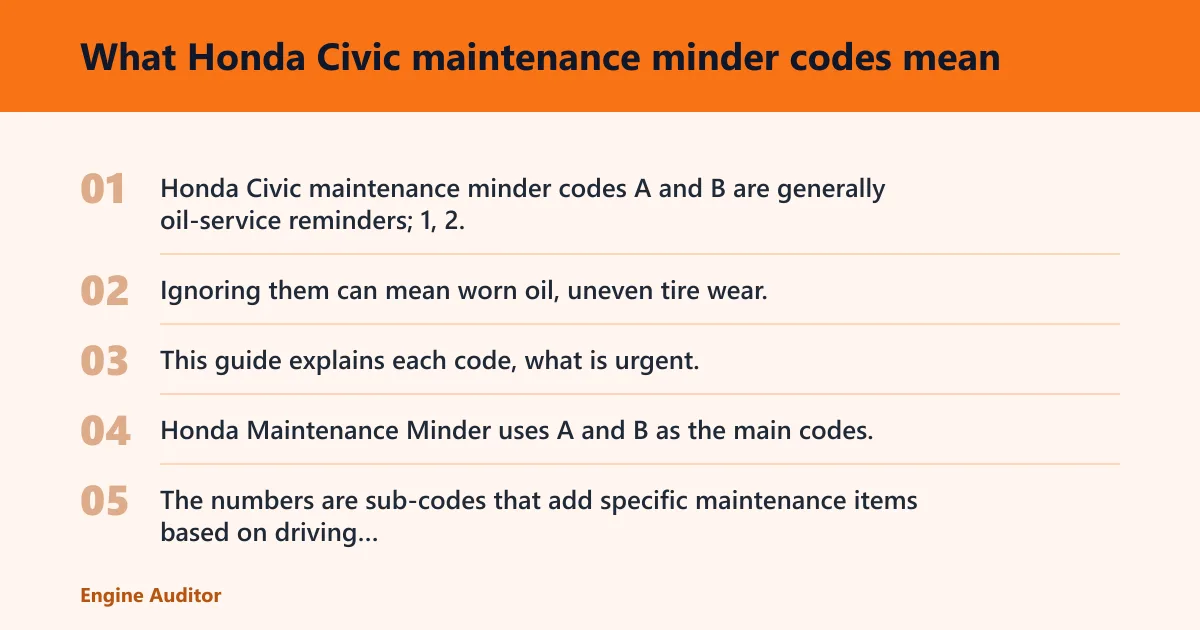
Honda Maintenance Minder uses A and B as the main codes. The numbers are sub-codes that add specific maintenance items based on driving conditions rather than a fixed mileage-only schedule. That matters because short trips, idling, and stop-and-go driving can call for service sooner than steady highway miles.
The owner’s manual still matters by model year and powertrain. Honda Civic gas and hybrid versions do not always share the same maintenance schedule, and some services depend on trim or drivetrain. Use the dashboard code as the trigger, then confirm the exact item list in the manual for your Civic.
Why A and B are the main codes, and numbers are sub-codes
Think of the letter as the base service and the number as the add-on. A and B tell you which oil-service path the car wants. The number codes add tire rotation, air-filter work, fluid replacement, or other checks. A stacked code should be read letter first, then each number in order.
Why the owner’s manual still matters by model year and powertrain
Even with the same badge on the trunk, the service list can change with engine type, hybrid hardware, and equipment. Some Civic trims may include transfer case or rear differential service; others will not. The manual is the final source for whether a listed item applies to your exact car.
📊 Honda Civic is available as a 2027 Civic Sedan on the official Honda site. Source: Honda.
What code A means on a Honda Civic
Code A typically means an engine oil change. On its own, it is the simplest oil-service reminder in the system. It tells you the engine oil has reached the point where Honda wants it changed, but it does not automatically add the filter or the broader inspection list that comes with B.
When A appears by itself versus with sub-codes
When A appears alone, plan for oil service and a reset after the work is done. When A appears with numbers, the number codes tell you what else is due. A1, for example, means oil service plus tire rotation, while A12 adds the air-filter and drive-belt items tied to code 2.

What code B means on a Honda Civic
Code B typically means an engine oil and filter change plus a general multi-point inspection. Honda lists the B inspection items as brakes, suspension, hoses, lines, fluids, exhaust, and fuel lines. That makes B more than an oil reminder. It is the code that usually deserves the most careful review before you authorize extra work.
What the B-code inspection list includes
The inspection portion of B is not a parts-replacement order by itself. It tells the technician to check brake wear, suspension condition, hose condition, line condition, fluid condition, exhaust parts, and fuel lines. If those items look normal, the code does not automatically require replacement.
What B does not automatically mean
B does not automatically mean brakes, suspension parts, or fluids must be changed. It means those systems should be inspected. That distinction matters because a shop may find everything in good shape except the oil and filter, which keeps you from paying for parts you do not need yet.
What do the number codes 1, 2, and 3 mean?
Code 1 means tire rotation. Code 2 means engine and cabin air filter replacement plus drive belt inspection. Code 3 refers to transmission fluid and transfer case fluid if equipped. In practical order, 1 is often a quick service item, 2 is partly replace-now and partly inspect-first, and 3 is a fluid-service code that should get attention sooner rather than later.
Code 1: tire rotation
Code 1 is straightforward. It points to tire rotation, which helps even out tread wear. A driver can usually verify this before paying for anything by checking the last rotation record, tread wear pattern, and tire positions if the shop notes them. Uneven wear or a long gap since the last rotation makes this one easy to justify.
Code 2: engine and cabin air filters plus drive belt inspection
Code 2 mixes replacement and inspection. The engine air filter and cabin air filter are replacement items if they are dirty enough, while the drive belt is inspection-only unless damage or wear is found. That means you can ask for a visual check before approving parts, especially if the filters were changed recently.
Code 3: transmission fluid and transfer case fluid if equipped
Code 3 points to transmission fluid, and transfer case fluid if equipped. This is often a higher-priority code than a simple rotation because fluid condition affects shift quality and component wear. On a Civic with no transfer case, that part of the code does not apply, but the transmission fluid reminder still does.
What do codes 4, 5, 6, and 7 mean?
Code 4 includes spark plugs, timing belt, water pump if equipped, and valve clearance inspection. Code 5 means engine coolant replacement. Code 6 means rear differential fluid replacement. Code 7 means brake fluid replacement. These are the codes most likely to point to fluid changes or larger service intervals, and several are model-dependent.
Code 4: spark plugs, timing belt, water pump if equipped, valve clearance inspection
Code 4 can be a major service item because it bundles several possible jobs. Spark plugs are replacement items, while valve clearance is an inspection item. Timing belt and water pump only apply if equipped. That is a strong reason to check the manual before approving anything beyond the code display.
Code 5: engine coolant replacement
Code 5 means engine coolant replacement. Coolant is a fluid service, not a visual check item. If the code appears, treat it as a scheduled fluid change rather than something to postpone until the next visit.
Code 6: rear differential fluid replacement
Code 6 means rear differential fluid replacement. That applies only if the Civic is equipped with a rear differential that uses serviceable fluid. Many Civic owners will never see this code, which is why model confirmation matters before booking the work.
Code 7: brake fluid replacement
Code 7 means brake fluid replacement. Brake fluid is a safety-related fluid, so this is one of the codes to treat as higher priority. If the code appears, schedule service rather than wait for a later oil change.
How to read combinations like A1, B1, and B137
Read the letter first, then the numbers. A1 means an oil change plus tire rotation. B1 means an oil and filter change plus tire rotation and the B inspection list. A code like B137 stacks multiple services together, so sort the items by safety, fluid change, and inspection before authorizing work.
A1 versus B1: oil service plus rotation, with different inspection scope
Honda A1 service is engine oil change plus tire rotation. Honda B1 service adds a multi-point inspection to an oil and filter change plus tire rotation. The practical difference is that B includes the filter and broader inspection list, while A is the leaner oil-service version.
How to prioritize stacked codes
With a stack such as B137, start with the letter service, then separate the numbers into fluid changes, safety-related items, and simple maintenance. In that example, 3 and 7 call for fluid-related attention, while 1 is tire rotation. That order keeps urgent items ahead of low-risk convenience work.
Say your Civic shows B137 on a Monday morning. The first step is not to book everything blindly. Check whether the car is due for oil and filter service, confirm whether the transmission fluid and brake fluid are actually due, then decide whether the tire rotation can wait until the same visit.
Which codes need service now, and which can you verify first?
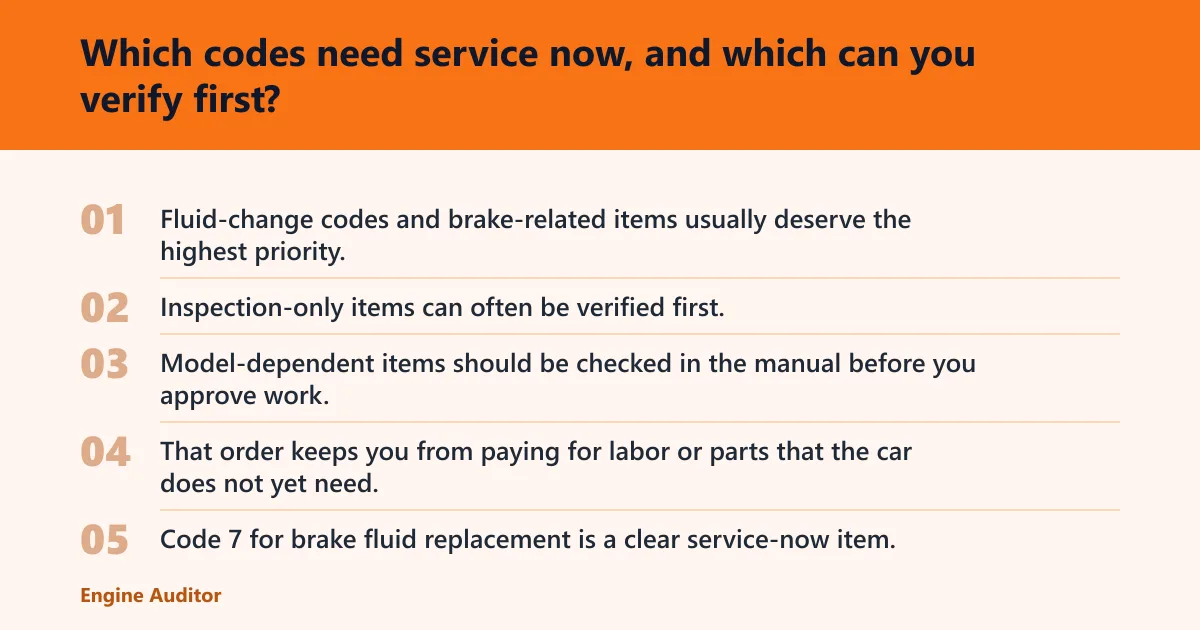
Fluid-change codes and brake-related items usually deserve the highest priority. Inspection-only items can often be verified first, which may prevent unnecessary parts replacement. Model-dependent items should be checked in the manual before you approve work. That order keeps you from paying for labor or parts that the car does not yet need.
Immediate service items that affect fluids and brakes
Code 7 for brake fluid replacement is a clear service-now item. Code 5 for coolant, code 3 for transmission fluid, and code 6 for rear differential fluid are also fluid changes, not casual checkups. If those codes appear, treat them as scheduled maintenance with real consequences if ignored too long.
Inspection-first items you can confirm before authorizing work
Code B includes inspection items, and code 2 includes a drive belt inspection. Those should be confirmed before anyone replaces parts. A dirty cabin filter or engine air filter may need replacement, but a drive belt that still looks healthy does not. That is where a quick visual check can save money.
Model-dependent items that need the exact Civic manual
Timing belt, water pump, rear differential fluid, and transfer case fluid are the items most likely to depend on trim, engine, or drivetrain. If the code calls for one of those and you are not sure your Civic has the part, the manual settles it. Do not assume every Civic uses the same hardware.
Code decoder table: action type, priority, and DIY check
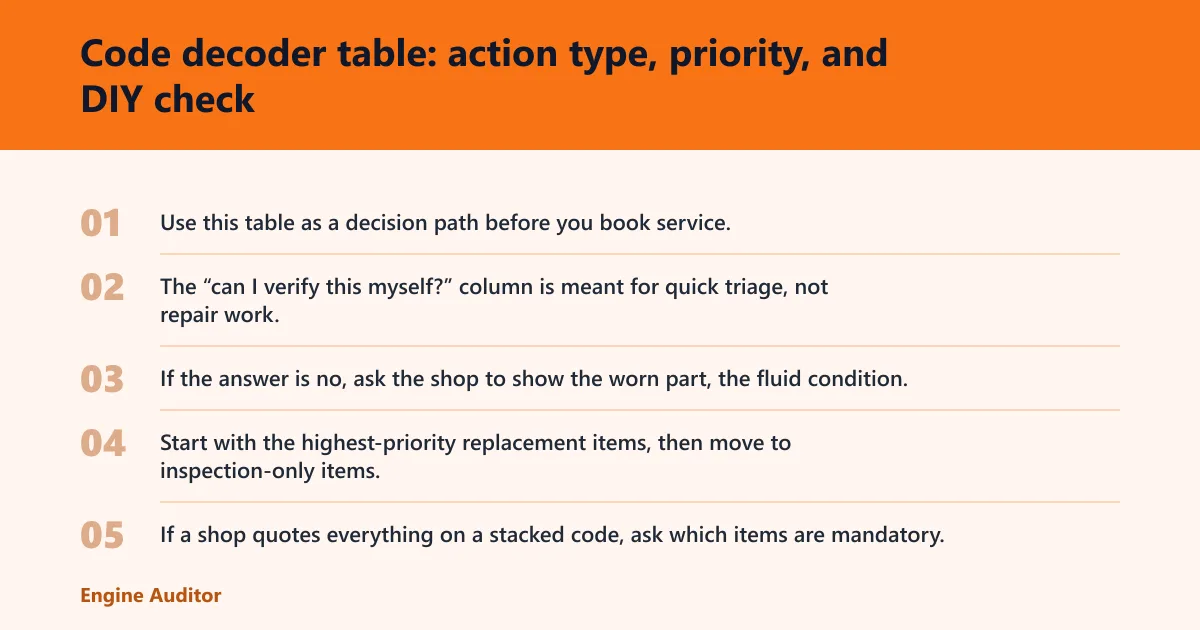
Use this table as a decision path before you book service. The “can I verify this myself?” column is meant for quick triage, not repair work. If the answer is no, ask the shop to show the worn part, the fluid condition, or the model-specific manual reference before approving extra labor.
| Code | What it means | Action type | Priority | Can I verify this myself? |
|---|---|---|---|---|
| A | Engine oil change | Replace now | High | Yes, by checking service history and oil level/condition |
| B | Engine oil and filter change plus multi-point inspection | Inspect first | High | Partly, for fluid levels, obvious leaks, and wear checks |
| 1 | Tire rotation | Immediate service | Medium | Yes, by checking tread wear and last rotation record |
| 2 | Engine and cabin air filter replacement; drive belt inspection | Mixed | Medium | Yes, for filter condition; belt inspection may need a shop |
| 3 | Transmission fluid and transfer case fluid if equipped | Replace now | High | Usually no, fluid service is best confirmed by the manual and shop |
| 4 | Spark plugs, timing belt, water pump if equipped, valve clearance inspection | Model-dependent | High | Partly, but the manual is needed to confirm what applies |
| 5 | Engine coolant replacement | Replace now | High | No, verify schedule and service record first |
| 6 | Rear differential fluid replacement | Model-dependent | High | No, because some Civics will not have this item |
| 7 | Brake fluid replacement | Replace now | High | No, brake-fluid condition should be confirmed by service history or testing equipment |
How to use the table before you book service
Start with the highest-priority replacement items, then move to inspection-only items, then check whether any code is model-dependent. If a shop quotes everything on a stacked code, ask which items are mandatory, which are inspect-first, and which depend on your exact Civic trim or drivetrain.
Frequently asked questions
What do Honda Civic maintenance minder codes A and B mean?
A means an engine oil change. B means an engine oil and filter change plus a multi-point inspection covering brakes, suspension, hoses, lines, fluids, exhaust, and fuel lines. B is broader, so it usually deserves more attention before you approve service, especially if the car has not had an inspection recently.
What is the difference between A1 and B1 service?
A1 is engine oil change plus tire rotation. B1 adds a multi-point inspection to an oil and filter change plus tire rotation. The difference is important because B1 includes both the filter and a broader look at wear items, while A1 is the leaner oil-service version.
Which maintenance minder codes mean I need fluids changed?
Codes 3, 5, 6, and 7 point to fluids. Code 3 covers transmission fluid and transfer case fluid if equipped, code 5 is engine coolant replacement, code 6 is rear differential fluid replacement, and code 7 is brake fluid replacement. Those are the most obvious fluid-change reminders.
Can I drive with a Honda Civic maintenance minder code on?
Usually yes for a short time, but the code should not be ignored. Oil-service and rotation reminders are less urgent than brake fluid or transmission fluid codes, yet waiting too long can still lead to wear or extra repair cost. The code is a prompt to schedule service, not a decoration.
How much does Honda Civic maintenance minder service usually cost?
Cost varies by model, engine, region, and whether the work is done at a dealer, independent shop, or by the owner. A simple oil change and rotation costs less than a fluid service or a code stack with inspections and parts. Use the code to estimate labor first, then compare quotes item by item.
Do all Honda Civics use the same maintenance minder codes?
No. Honda uses the same basic A and B system, but the exact maintenance schedule can vary by model year, powertrain, and equipment. Gas and hybrid Civics may not call for the same items, and some codes only apply if the vehicle has the related component. The manual settles those differences.
Products related to this article
Sponsored / affiliate links. As an Amazon Associate I earn from qualifying purchases. I may earn additional commission from eligible campaigns.