Honda Civic Maintenance at 100,000 Miles: Must-do Jobs
At about 100,000 miles, Civic maintenance should start with timing belt service if equipped, spark plugs, coolant, brake fluid, serpentine belt, and a full brake and suspension inspection. Replace worn parts, even if they are not old. Skipping these jobs raises the risk of breakdowns, misfires, overheating, longer stopping distances, and costly secondary damage. This checklist ranks safety-critical, reliability, and budget-dependent jobs, and separates replacements from inspections.
What 100,000 miles means for a Civic


At this mileage, the Civic is past the point where age-related wear and schedule-based service overlap. The exact list changes by model year, engine, transmission, and maintenance history, so 100,000 miles is a threshold, not a full answer.
Honda schedules often combine mileage, time, and Maintenance Minder codes. That matters because some items are due by age even if the car still feels fine, while others are due only when wear, contamination, or symptoms show up.
How engine, transmission, and schedule history affect the list
Two Civics with the same mileage can need different work. A belt-equipped engine needs different timing service than a chain-equipped engine, a CVT needs different fluid than a conventional automatic, and a car that has already had Minder-driven fluid changes may not need the same stack of services as one with a thin record.
That is why the service record matters as much as the odometer. If the paperwork is missing, treat the car as overdue until the manual and the Minder history prove otherwise.
How to use your owner’s manual and Maintenance Minder
Start with the owner’s manual for your exact model year and drivetrain, then compare it with the Maintenance Minder history. Honda’s schedule can call for replacement by code or interval, so a visual inspection alone is not enough for fluids such as brake fluid or transmission fluid.
If a Civic has about 101,000 miles, the brake fluid code has never been reset, and the service book shows no fluid change, brake fluid replacement is likely due. That is a replacement job, not an “check later” item, even if the reservoir still looks clean.
Civic maintenance priority matrix
| Must do now | Do next if budget allows | Inspect or defer | Why it matters at 100,000 miles and common trigger |
|---|---|---|---|
| Engine oil and oil filter; brake fluid if due by Minder or time; coolant if due by age/interval; timing belt if the engine is belt-equipped and service is due | Transmission fluid service by the correct type; spark plugs on engines with a 100,000-mile replacement interval; serpentine/accessory belt if cracked, glazed, or noisy | Engine air filter and cabin air filter if still clean and within interval; coils and boots if there is no misfire; hoses and battery if testing and inspection are normal | Fresh fluids protect engine, brakes, cooling, and drivetrain parts. Triggers include due codes, age, contamination, rough shifting, a hard pedal, overheating, or a gap in the service record. |
| Brake pads, rotors, calipers, suspension, steering, tires, alignment if wear or symptoms are present | Battery replacement if age is high and starting is weak; drive belt replacement if cracking is found | Shock or strut replacement only if seepage, bounce, or wear appears; tie rods, ball joints, and bushings if play is not present | These items affect stopping distance, tire wear, and control. Triggers include squeal, pulsation, pulling, clunks, uneven wear, or seepage. |
Which fluids come first?
Engine oil, brake fluid, coolant, and transmission fluid are the fluid jobs to sort first at 100,000 miles. Oil is routine, brake fluid is a safety item when the schedule calls for it, coolant protects the engine from heat damage, and transmission fluid is transmission-specific and should match the gearbox in the car.
Engine oil and oil filter
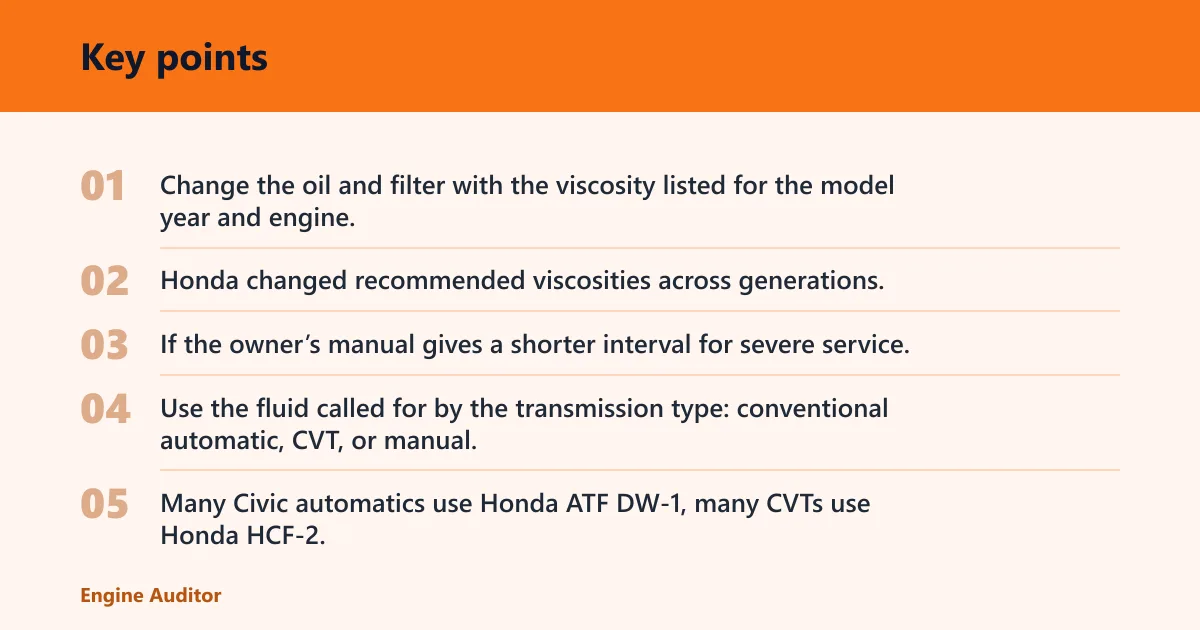
Change the oil and filter with the viscosity listed for the model year and engine. Honda changed recommended viscosities across generations, so do not guess from the badge alone.
The filter should be replaced with the oil. If the owner’s manual gives a shorter interval for severe service, use that interval instead of a generic mileage target.
Transmission fluid
Use the fluid called for by the transmission type: conventional automatic, CVT, or manual. Many Civic automatics use Honda ATF DW-1, many CVTs use Honda HCF-2, and manuals use the gearbox fluid named in the manual.
For a 100,000-mile service, drain-and-fill is the common service approach when Honda specifies routine fluid replacement. A full flush is a different procedure and should not be assumed unless the manual or a Honda procedure explicitly allows it.
Brake fluid
Brake fluid deserves real priority because it absorbs moisture over time. That moisture can soften pedal feel and increase corrosion risk inside the hydraulic system, even when the fluid still looks clear.
If the Maintenance Minder or time interval calls for brake fluid replacement, treat it as due. Do not leave it in the inspect-only pile just because the reservoir is not dark.
Coolant or antifreeze
Replace coolant when the age or mileage interval in the manual is due, using the Honda-specified coolant type for the car. Coolant protects against overheating, freeze damage, and corrosion inside the radiator, water pump, and engine passages.
If the record is incomplete, confirm whether the coolant has already been serviced. A cooling system that is overdue can fail without much warning.
Which filters and ignition parts are due?
Air filters and spark plugs are common 100,000-mile items, but they are not all handled the same way. Honda may treat them by interval, condition, or both, so use the manual and service history together.
Engine air filter
Replace the engine air filter if it is dirty or restricted, and inspect the air box and intake ducting for damage, loose clamps, or debris. A restricted filter can hurt airflow and fuel economy, and a damaged intake can let unfiltered air in.
Cabin air filter
Replace the cabin air filter when it is clogged or overdue. A dirty cabin filter cuts HVAC airflow and can contribute to stale odors or weak defrost performance.
If the vents feel weak on high fan speed, this is a simple place to look before blaming the blower motor.
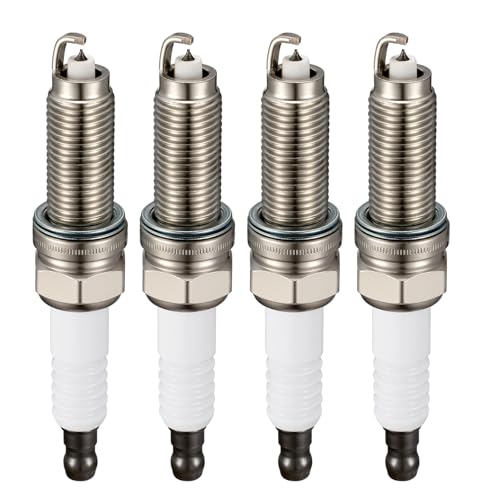
Spark plugs
Spark plug timing depends on engine family. Many Honda engines call for replacement around 100,000 miles, but some newer or different-market variants use a different interval, so check the exact engine code and manual before ordering parts.
Use the plug type specified for the engine. Iridium plugs are common on later Civics, but the part number still has to match the application.
Coils and boots if rough idle or misfire appears
Ignition coils and boots are usually inspected rather than replaced on mileage alone. If the Civic has rough idle, hard starting, or misfire codes, inspect the boots for cracking, oil contamination, and carbon tracking, then test the coils as needed.
What wear items should you inspect now?
Wear items matter more at 100,000 miles because age, heat, and road use stack up. Inspection tells you whether the job is urgent, soon, or still fine to defer.
Brake pads, rotors, and calipers
Check pad thickness, rotor wear, rotor runout symptoms such as pulsation, and caliper slide movement. Look for uneven pad wear, sticking slides, torn boots, and any fluid leak around the caliper.
Suspension and steering parts
Inspect struts or shocks for seepage and poor damping, then check ball joints, bushings, and tie rods for play or torn rubber. Wheel alignment matters if the car pulls, the steering wheel is off-center, or the tires are wearing unevenly.
Drive belts, hoses, and battery
Look for cracks, glazing, swelling, seepage, or soft spots on belts and hoses. Test the battery if starting feels slower than usual, especially in hot or cold weather, because age-related battery failure often shows up without much warning.
Suppose the Civic has a faint squeal at startup, a battery older than the service record, and a coolant hose that feels swollen. That combination moves belts, battery, and hose inspection to the front of the line, even if the car still drives normally.
Tires and alignment clues
Tires are part of the 100,000-mile conversation because they reveal suspension problems. Feathering, cupping, inner-edge wear, or a steady pull can point to alignment or worn chassis parts, not just tire age.
Is a timing belt due at 100,000 miles on a Honda Civic?
Maybe. It depends on the engine. Some Civic engines use a timing belt, and many use a timing chain instead, so the first step is identifying which setup is on your car before you assume the belt is due or not due.
Belt-equipped engines
If the engine is belt-equipped, follow the exact replacement mileage and time in the owner’s manual. On some Honda engines, that service lands near the 100,000-mile window, but the exact interval varies by engine family and market.
Chain-equipped engines
Chain-equipped engines do not get the same scheduled belt replacement. They are inspected for symptoms instead, such as chain noise, rough running, or cam timing faults that suggest stretch or tensioner wear.
Noise, stretch, and service-history clues
If there is no clear proof of belt replacement on a belt engine, treat the service as overdue until proven otherwise. For chain engines, a rattle on cold start, timing-related fault codes, or poor running means inspection moves up the list.
How should you split the work by budget?
Budget pressure is common at 100,000 miles, so priority matters. Start with items that protect stopping, cooling, and engine timing, then move to drivetrain and wear items, and leave clean inspections for last.
Safety-critical first
Prioritize brake fluid if due, brake system repairs, coolant, and timing belt service if equipped and overdue. Those items protect stopping distance, overheating resistance, and engine survival.
Reliability next
After safety items, do spark plugs, transmission fluid, oil and filter, and any battery or belt replacement that shows clear wear. These jobs reduce the risk of misfires, harsh shifting, no-start events, and accessory failures.
Items that can wait if inspection is clean
Engine and cabin air filters can wait if they are still clean and within interval, and suspension parts can wait if there is no play, noise, or uneven tire wear. That said, “wait” means defer, not ignore.
When to use a shop instead of DIY
Use a shop for timing belt service, brake hydraulic work, coolant service if bleeding is required, and transmission fluid service if the procedure is model-specific or access is tight. Always follow the vehicle manual, never work under a vehicle held only by a jack, keep items out of airbag zones and the driver’s view, and check local laws before any work that affects safety systems.
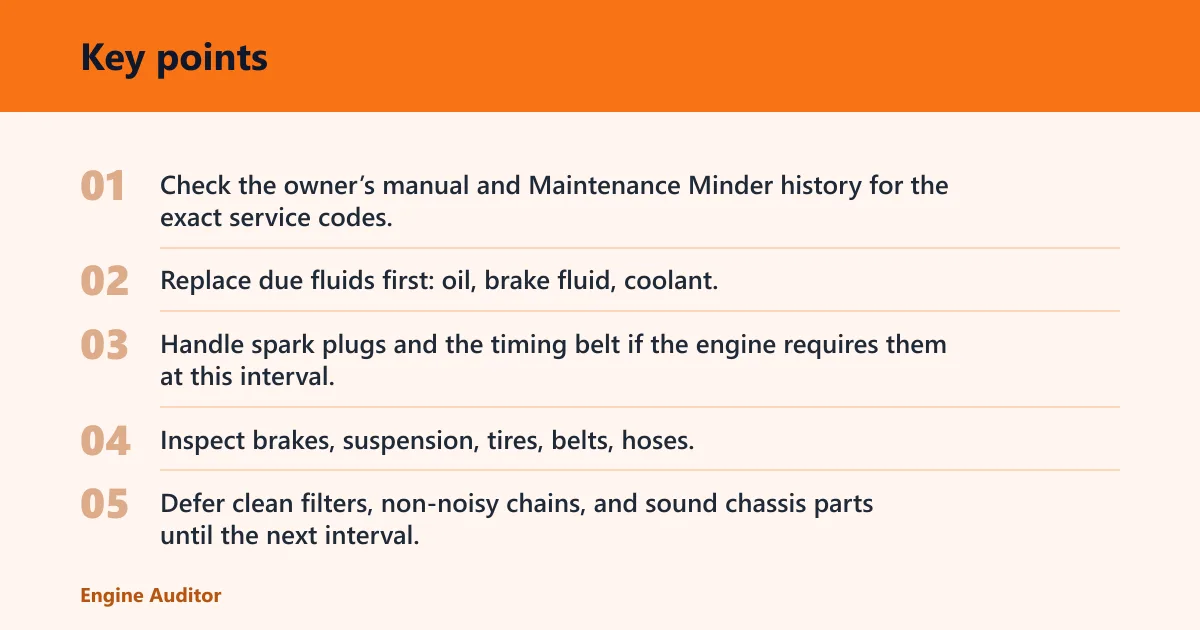
- Check the owner’s manual and Maintenance Minder history for the exact service codes.
- Replace due fluids first: oil, brake fluid, coolant, and transmission fluid by the correct type.
- Handle spark plugs and the timing belt if the engine requires them at this interval.
- Inspect brakes, suspension, tires, belts, hoses, and battery before buying nonessential parts.
- Defer clean filters, non-noisy chains, and sound chassis parts until the next interval.
How much this costs depends on model year, engine, transmission, parts choice, and labor market. A Civic with a belt engine, overdue spark plugs, and brake work costs more than one that only needs fluids and filters, so a quote should be built from the actual VIN and service history rather than a generic “100k package.”
Frequently asked questions
What maintenance does a Honda Civic need at 100,000 miles?
A 100,000-mile Civic usually needs oil and filter service, brake fluid if due, coolant if due, transmission fluid by the correct type, spark plugs on many engines, and a full inspection of brakes, suspension, belts, hoses, battery, and tires. The exact list depends on engine, transmission, and Maintenance Minder history.
What is the must-do list for a Honda Civic at 100k miles?
Must-do items are the ones that protect safety or prevent costly damage: timing belt if equipped and due, brake fluid when called for, coolant when due, engine oil and filter, and any worn brake or steering parts. If budget is tight, these come before cabin filters or other low-risk deferrals.
Should I replace the timing belt at 100,000 miles on a Honda Civic?
Replace it if your Civic has a timing belt and the manual says the interval is due, or if the service history is missing and the engine is known to use a belt. If the engine uses a timing chain, there is no scheduled belt replacement, only inspection for noise or timing symptoms.
How much does 100,000-mile Honda Civic maintenance cost?
There is no single reliable price because costs vary by year, engine, transmission, labor rate, and parts quality. A basic visit with fluids and filters costs less than one that also needs plugs, brake service, or a timing belt, so ask for an itemized quote tied to the VIN.
What fluids should be changed at 100,000 miles on a Honda Civic?
At minimum, check whether engine oil, brake fluid, coolant, and transmission fluid are due by the manual or Maintenance Minder. Use the specified Honda fluid for the transmission and cooling system, and do not skip brake fluid replacement when the schedule calls for it even if the fluid still looks clean.
Can I do 100,000-mile maintenance myself on a Honda Civic?
Yes, some tasks are straightforward for a careful DIY owner, such as oil, filters, battery inspection, and some cabin or engine air filters. Brake fluid, coolant bleeding, timing belt work, and certain transmission services are better left to someone who can follow the exact Honda procedure and dispose of fluids correctly.
Does the 100,000-mile service differ by Honda Civic engine or trim?
Yes. Engine family, transmission type, and market matter, and the service list can change a lot between trims. That is why you should confirm the exact engine code, transmission, and Maintenance Minder record before ordering parts or assuming a universal 100,000-mile checklist.
What happens if I skip the 100,000-mile service on a Civic?
Skipping it raises the odds of misfires, rough shifting, brake wear problems, overheating, and delayed failure of belts or hoses. The damage often costs more than the missed maintenance, especially if overdue fluids or a worn timing belt lead to secondary engine damage.
What should be replaced vs inspected at 100,000 miles?
Replace items that are due by schedule or clearly worn, such as oil, brake fluid, coolant, transmission fluid, spark plugs on many engines, and a timing belt if equipped. Inspect wear items such as brakes, suspension, hoses, and the battery, then replace only the parts that show wear, leaks, play, or poor performance.
Products related to this article
Sponsored / affiliate links. As an Amazon Associate I earn from qualifying purchases. I may earn additional commission from eligible campaigns.