Engine Oil Troubleshooting Guide
Use a simple rule: stop driving for a red oil-pressure light, heavy knocking, or no oil on the dipstick; top up and recheck only for a low reading with no noise, smoke, or fresh leaks. Get that call wrong and a cheap quart or gasket repair can turn into spun bearings, a seized engine, or an exhaust-oil fire. This engine oil troubleshooting guide ties stains, smells, warnings, noises, smoke, and level changes to likely causes, risk, and the next check.
Author: This guide is written from a first-person troubleshooting perspective by an automotive publisher/editor who has worked through common oil-pressure, leak, and consumption complaints on daily drivers and high-mileage vehicles. Reviewed for technical accuracy by: a professional automotive technician/editor familiar with lubrication-system diagnosis, service procedures, and factory maintenance guidance.
How I diagnose this in real life


I do not start with parts. I start with triage: warning light status, dipstick level and condition, whether the symptom happens cold or hot, and whether the oil loss is external or internal. In practice, that order prevents common mistakes. I have personally seen a normal dipstick with real low pressure, a low-level warning confused with an oil-pressure warning, and leaks after oil service that looked like major engine failure until the filter seal or drain plug was checked first.
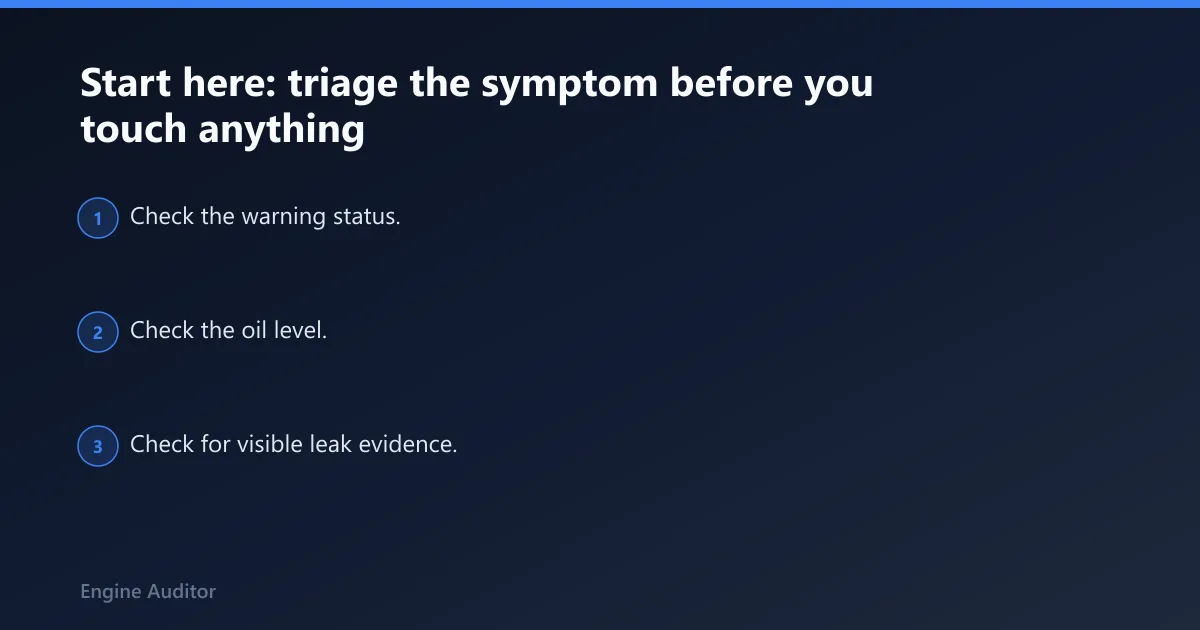
Start here: triage the symptom before you touch anything
Stop-driving signs versus safe-to-check signs
Triage comes first because oil faults overlap. I have seen a low level switch on a pressure warning, a failed pump leave the dipstick reading normal, and a leaking filter seal smoke so badly that people blamed the engine internals when the leak was outside.
Stop driving now if any of these happen together or alone: a red oil-pressure warning light that stays on, heavy knocking, a sudden loud tick that does not fade, fresh oil pouring out, thick smoke from under the hood, or a dipstick that shows no oil at all. Also stop for milky oil with coolant loss or overheating. That urgency is consistent with owner-manual guidance from major manufacturers and consumer safety guidance that warns an illuminated oil-pressure light can indicate inadequate lubrication and possible rapid engine damage.
Safe-to-check signs are narrower: a low dipstick reading with no warning light, no noise, and no smoke; a small old stain on the driveway; or a burnt-oil smell after a recent service with no new drip and no warning light.
The first three checks in order
- Check the warning status. Is the red oil-pressure light on, flickering, or absent? An oil-pressure light is generally treated as an emergency indicator, not a maintenance reminder.
- Check the oil level. Park level, shut the engine off, and wait at least 5 minutes before reading the dipstick. That timing matches common owner-manual instructions and dipstick-check guidance published by manufacturers and service organizations.
- Check for visible leak evidence. Look under the car, around the filter, drain plug, valve cover area, and anywhere oil may be landing on the exhaust.
Why timing matters
When the symptom shows up narrows the fault path fast. Cold-start ticking points to delayed oil delivery, drain-back, lash adjusters, or the wrong viscosity for the weather. Low pressure only when hot leans toward thinning oil, worn bearings, pickup restriction, or pump wear.
Only on highway runs often means consumption, heat-related leaks, or oil pushed through a PCV or turbo path if fitted. Only after parking points toward seepage from a valve cover gasket, oil pan gasket, filter seal, or drain plug. Only after recent oil service raises the odds of underfill, overfill, wrong grade, loose drain plug, or a double-gasketed filter.
A practical baseline that matches many owner manuals: check the dipstick on level ground after shutdown and allow a few minutes for drain-back before reading. The exact wait time varies by vehicle, but 5 minutes is a common service rule and is also reflected in published maintenance advice such as 5 Common Engine Oil Problems and How to Solve Them?.

What does the oil pressure light mean?
The oil pressure light means the engine may not be maintaining enough oil pressure to keep bearings and valvetrain parts separated by an oil film. Treat it as an emergency indicator. In the first five minutes, reduce load, pull over safely, shut the engine off, and check the oil level before you decide anything else. That is also the approach reflected in guidance from organizations such as AAA and multiple automakers, which advise stopping as soon as it is safe and checking level rather than continuing to drive.
What to do in the first five minutes
If the light comes on while driving, lift off the throttle and pull over as soon as it is safe. Shut the engine off. Do not let it sit and idle to “see if it clears.” An engine with true low pressure can still be damaged at idle.
Then check underneath for a fresh trail or a wet splash on the underbody. A failed filter seal or loose drain plug can dump oil fast. Next, check the dipstick after waiting at least 5 minutes.
If the dipstick is low but still shows oil, topping up to the proper range may be reasonable. Only restart briefly if there was no knocking, no heavy ticking, and no major leak. If the light comes back on, shut the engine off again and do not restart it there.
Low oil level, pump failure, sensor fault, or bearing wear
The warning light can come on from low oil level, pump failure, pickup blockage, a failed sender, a wiring fault, or worn bearings. That is why separating level from pressure matters early. Level is easy to verify. Pressure is not.
If the level is normal and the light is still on, assume real low pressure until proven otherwise. Sludge can restrict the pickup. A wrong filter can change startup behavior. A worn engine may lose pressure hot, especially at idle.
When a restart is reasonable and when it is a bad idea
A restart is only reasonable after a low reading has been corrected, there was no harsh mechanical noise, and no active leak is visible. Even then, the restart should be brief and only to confirm whether the warning was tied to low level.
It is a bad idea to restart if the dipstick was dry, the light came on suddenly with noise, oil is dripping heavily, or the oil appears milky. Ignore the light and bearing damage can start very quickly.
How do I check the oil level and condition with the dipstick?
Check the dipstick with the car on level ground and the engine off after waiting at least 5 minutes. Wipe, reinsert, and read both level and condition. The dipstick shows more than quantity: overfill, fuel smell, metal glitter, foam, sludge, or milky contamination each change the next step.
Correct dipstick procedure after shutdown
Park on level ground. Shut the engine off. Wait at least 5 minutes so oil drains back to the pan. Pull the dipstick, wipe it clean, reinsert fully, then pull it again and read both sides. That sequence is consistent with the basic procedure shown in many owner manuals and service references.
The safe range is between the low and full marks. Near the bottom mark is low. Above the full mark suggests overfill. A bone-dry dipstick is a stop-driving event. One example vehicle needed 3.5 liters of oil added after the dipstick was bone dry, which shows how far behind a level check can get.
Reading low, full, and overfilled levels
Low oil level can make pressure loss more likely during turns, braking, hill climbs, and higher-speed driving. A full level does not rule out low pressure. Overfilled oil can foam, aerate, and push leaks harder through crankcase pressure.
If the level is modestly low and the oil looks normal, a top-up to the proper range is reasonable. Recheck after a short drive and again after parking overnight. If it is above full, correct the level before further diagnosis. Overfill alone can create smoke and odd gauge behavior.
What color, smell, and texture can tell you
Thin oil with a fuel smell points toward fuel dilution. Milky tan oil points toward coolant contamination. Thick deposits on the stick or cap suggest sludge. Old neglected oil can get thick as molasses.
Metal glitter is a high-risk sign. A few bright specks may be residue from a fresh repair, but obvious metallic shimmer with low pressure or noise is stop-driving territory.
When the dipstick points to fuel, coolant, or metal contamination
Fuel smell plus a rising oil level can mean fuel is entering the crankcase. Milky oil, coolant loss, sweet smell, or overheating suggest head gasket trouble or an oil cooler failure. Metal in the oil suggests internal wear.
Coolant contamination gets urgent fast because lubrication drops while bearing damage risk rises. Do not keep driving to “burn it off.” Water and coolant do not leave the oil that way.
Why is my oil pressure low even when the level is full?
Low oil pressure with a full dipstick means quantity may be fine while flow or bearing control is not. The pattern matters: low only at hot idle, low all the time, or low after a service each point to different faults such as sender error, filter trouble, pickup restriction, pump wear, or bearing wear.
Low at hot idle versus low all the time
Low only at hot idle often points to oil thinning as it heats, worn bearings, or a tired pump. If pressure comes back with a slight rise in engine speed, clearance wear becomes more likely.
Low all the time is more serious. Think pickup blockage from sludge, pump failure, major internal wear, or a major filter or sender issue. If the gauge drops suddenly from normal to low, do not assume the sender is lying.
Sender and gauge faults versus real pressure loss
A faulty pressure sender or gauge can mimic trouble, especially if the engine sounds normal and the reading jumps around unrealistically. But that is something to confirm, not a guess to keep driving on.
Real pressure loss often brings support clues: startup rattle, ticking when hot, a warning light, or a history of overdue changes. Industry service literature and manufacturer guidance routinely place pressure verification with a mechanical gauge ahead of replacing internal parts, which is why the reading has to be matched to the rest of the symptoms.
Pickup restriction, filter issues, pump wear, and bearing clearance
Oil sludge forms when old oil thickens from heat and contamination. That material can load the filter, restrict passages, and clog the pickup screen. A restricted pickup may act worst when the oil is hot or during long runs.
The filter matters more than many DIY owners think. A clogged filter, wrong filter, collapsed media, or a weak anti-drainback valve can change startup noise and pressure behavior. Filters catch debris, but once loaded they can force bypass behavior or cut normal flow depending on design.
When to confirm with a mechanical pressure test
If the dipstick is full, the warning persists, and no external leak explains it, the next proper test is a mechanical pressure gauge in place of the sender. That step separates an electrical lie from real pressure loss. Until then, treat the engine as if the pressure is truly low.
Why does my engine tick when cold?
Cold-start ticking usually means oil is taking too long to reach the top end, though wear can sound similar. Common paths are drain-back overnight, a weak filter anti-drainback valve, a viscosity mismatch, lash adjuster bleed-down, or early valvetrain wear that gets quieter after pressure builds.
Delayed oil delivery after startup
If the tick lasts a second or two and then fades, delayed oil delivery is more likely than a hard mechanical failure. Oil may be draining out of the filter or upper passages while parked. A poor filter can make this worse.
If the ticking lasts much longer, grows louder in cold weather, or comes with a warning light, move the concern up the priority list. Pressure build should not be slow.
Viscosity grade effects: too thick, too thin, and wrong climate match
Wrong viscosity can contribute to poor lubrication or slow startup flow. In SAE multigrade terms, the number with the W reflects low-temperature performance, while the second number reflects viscosity characteristics at operating temperature under standardized test conditions. In colder weather, lower-W oils such as 0W-20 or 5W-30 are commonly specified because they flow better during cold starts. That basic framework comes from SAE J300 viscosity classification and is reflected in owner-manual recommendations.
Too thick in cold weather can delay pressure at the valvetrain. Too thin for a worn engine or hot use can leave pressure marginal at idle. The owner’s manual specification is the baseline, especially when a symptom appeared right after an oil change.
Filter anti-drainback faults and top-end noise
A filter with a weak anti-drainback valve can drain down while the engine sits. On the next cold start, the pump first refills the filter before feeding the top end. That creates a brief tick or rattle.
Post-service ticking deserves a short checklist: confirm the correct filter part, confirm the oil grade, confirm the level, and inspect for a leaking filter seal.
When cold-start tick points to wear instead of an oil issue
If the noise is getting worse over time, no grade change affects it, and it is joined by hot-idle pressure concerns, wear becomes more likely. Lash adjusters, cam followers, or worn bearing surfaces can all mimic a simple oil issue early on.
How do I know if my car has an oil leak or is burning oil?
An oil leak leaves evidence outside the combustion chambers: driveway spots, underbody wetness, fresh residue around seals, or a burnt-oil smell when oil hits the exhaust. Burning oil usually lowers the level without matching drips and may add blue exhaust smoke, oily plugs, or level loss mainly on long drives.
Driveway spots, underbody wetness, and burnt-oil smell
Fresh spots after parking matter more than old stained concrete. Slide a clean piece of cardboard under the engine area overnight if needed. Then inspect the underbody splash shields, crossmember, and subframe since airflow can move oil away from the true source.
A burnt-oil smell often means a valve cover gasket or upper leak is dripping onto a hot exhaust part. That smell does not prove internal oil burning.
Leak source map
- Valve cover gasket: wetness high on the engine, burnt-oil smell, oil on exhaust heat shields.
- Drain plug: drip near the rear of the pan after service, oil around the plug head.
- Oil pan gasket: wet pan rail, slow drips after parking.
- Filter seal: sudden leak after service, spray pattern, heavy loss.
- Front main seal: oil at the crank pulley area, spread by belt airflow.
- Rear main seal: oil between engine and transmission bellhousing area.
- Cooler lines or cooler housing if fitted: wet lines, drip after highway heat.
Blue smoke, exhaust clues, and oil loss with no external drip
Blue exhaust smoke after idling can point toward valve stem seals. Blue smoke under acceleration leans more toward rings or turbo seals if fitted. No driveway spots plus steady level loss is a strong consumption clue.
That distinction matters because many owners chase external leaks for weeks when the oil is actually leaving through combustion.
Heat-only and while-driving leaks that fool quick inspections
Some leaks appear only when hot oil thins and crankcase pressure rises. Others show only at speed, where wind spreads oil along the floorpan and onto the rear of the car. A quick look at a cold parked car misses both.
If the smell or loss happens only after highway driving, inspect immediately after the trip. Look for fresh wetness around the valve cover, filter, cooler lines, and pan rail.
Why is my car burning oil or losing oil between changes?
Oil loss between changes can be normal in some engines, but the pattern matters more than the existence of loss. Burning oil usually leaves little external evidence and appears during long highway runs, engine braking, or startup smoke, while leaks leave residue outside the engine or on the ground.
What oil consumption looks like in real use
Consumption can be intermittent. A car may show almost no loss in town, then drop the level after sustained highway speed, long downhill engine braking, or heavy load. That pattern often fools owners into blaming a recent spill or a random leak.
High-mileage engines can use oil without obvious smoke. Catalytic converters and modern exhaust systems can hide a lot of it.
Piston rings, valve stem seals, PCV draw, and high-mileage wear
Worn piston rings allow oil past the pistons, often most noticeable under acceleration. Valve stem seals tend to show more after idle or overnight parking. A faulty PCV system can pull excess oil vapor into the intake. Turbocharger seals, where fitted, add another path.
Higher viscosity is not an automatic cure. It may cut visible loss in some worn engines, but it can also worsen cold-start flow if it strays too far from the manual spec.
How much oil loss can be normal and how to track it
There is no single normal amount for every engine. Age, design, mileage, driving style, and operating temperature all matter. The practical method is to track the rate per 1,000 miles, note the grade used, and record whether the driving was mostly short trips or long highway runs.
If the rate suddenly changes, the diagnosis changes too. A long-stable engine that begins using oil faster deserves inspection even if it still runs well.
When level loss after long trips points to consumption instead of leakage
If the driveway stays clean, the underside is dry, and the level drops mainly after long highway drives, consumption is more likely than leakage. Check tailpipe smoke on startup and after a long downhill coast followed by throttle input.
Can the wrong oil grade damage my engine?
The wrong oil grade can create startup noise, slow oil flow in cold weather, weak hot pressure, or added consumption depending on whether it is too thick or too thin for the engine and climate. The owner’s manual specification is the starting point because clearances and pump design were built around it.
How 0W-20, 5W-30, 10W-40, and 20W-50 behave differently
Grades such as 5W-30 and 10W-40 differ in both cold and hot behavior. A 0W-20 or 5W-30 generally reaches critical parts faster in cold weather. A 20W-50 resists thinning more when hot, but it also moves slower when cold. Those differences are defined by standardized viscosity ranges rather than marketing language alone.
Thicker is not automatically safer. Thinner is not automatically risky. The engine design decides the target.
Cold-start flow versus hot-film protection
Lighter oils like 0W-20 or 5W-30 in colder weather can reduce startup delay. Heavier grades may help oil pressure in a worn engine, but they can also hide the cause rather than fix it. Wrong viscosity can contribute to poor lubrication or slow startup flow, which is why a symptom after an oil change always puts grade verification near the top of the list.
What symptoms suggest oil that is too thick or too thin
Too thick: cold ticking, slow pressure build, sluggish cranking in very cold weather, or a new startup rattle after service. Too thin: low hot-idle pressure, flickering warning light when fully warm, or higher consumption.
Conventional oil may oxidize and thicken faster than full synthetic under severe heat and extended drain conditions, depending on the product and service interval. That matters for diagnosis more than for brand preference.
Why is my engine oil milky, sludged, or otherwise contaminated?
Milky oil usually means coolant is mixing with oil, while sludge means the oil has thickened from heat and contamination over time. Both can restrict lubrication, load the filter, and starve parts of oil. Milky oil with coolant loss or overheating is a stop-driving condition.
Milky oil and coolant cross-contamination clues
Milky tan or coffee-colored oil can come from head gasket failure or an oil cooler failure. Support clues include coolant loss, a sweet smell, overheating, rising oil level, or sludge-like emulsion under the oil cap.
Short-trip condensation can leave a light creamy deposit under the cap in some cases, but that does not usually turn the dipstick itself fully milky. If the dipstick shows true milkiness, take it seriously.
Sludge from heat, short trips, and long drain intervals
Oil sludge forms when old oil thickens from heat and contamination. Neglected oil changes can make oil thick as molasses. Short-trip use adds moisture and contaminants because the oil may never stay hot long enough to purge them well.
Regular oil changes every 3,000–7,500 miles can help prevent sludge in many vehicles, but the exact interval depends on the engine design, oil specification, driving conditions, and manufacturer maintenance schedule. Many newer vehicles and oils are designed for longer intervals, while severe service can justify shorter ones. The diagnosis point is simple: overdue oil raises the chance that pressure and noise issues trace back to restricted flow.
Filter loading, restricted passages, and starvation risk
Once sludge forms, the filter has to catch more debris. That can push it toward restriction or bypass behavior. Passages feeding the top end, variable valve components, or the pickup screen can also restrict. The result can be ticking, low pressure hot, or a warning light after longer drives.
Sludge also raises overheating and oil starvation risk because thickened oil does not move or shed heat as well.
When contamination means stop driving now
Stop driving now for milky dipstick readings, coolant in the oil, sudden oil level rise with coolant loss, metal glitter with noise, or sludge paired with an oil-pressure warning. Those are no longer “watch and see” problems.
DIY engine oil troubleshooting decision table
How to use the table
Use this table after the triage steps, not before. Start with warning light status, then dipstick level and condition, then timing: cold start, hot idle, highway, after parking, under load, or right after service. That order separates low oil level from low oil pressure before parts get blamed.
| Symptom | Likely causes | Quick test | Safe next step | Stop-driving threshold |
|---|---|---|---|---|
| Red oil-pressure light comes on while driving | Low oil level, pump failure, pickup blockage, sender fault, bearing wear | Shut off, wait at least 5 minutes, check dipstick, inspect for fresh leak | If low and otherwise quiet, top up to range and restart briefly only to verify | Light stays on, dipstick dry, any knocking, or active leak |
| Low dipstick reading, no warning light, no noise | Gradual consumption, small leak, recent underfill | Top up to full mark, note mileage, recheck after next drive and after overnight park | Safe to top up and recheck | Level drops again quickly, smoke appears, or warning light comes on |
| Oil pressure gauge low only at hot idle | Oil too thin when hot, sender fault, worn bearings, pump wear | Compare hot idle to slight rpm increase, verify level and grade | Drive only a short distance for testing, then confirm with mechanical gauge | Warning light joins it, ticking grows, or pressure stays very low |
| Cold-start tick for a few seconds | Drain-back, wrong viscosity, poor anti-drainback valve, lash adjuster bleed-down | Check grade, filter type, level, and whether symptom began after service | Inspect before next drive if brief and repeatable | Tick lasts longer, warning light appears, or noise turns harsh |
| Burnt-oil smell after driving, no smoke from tailpipe | Valve cover leak, spilled oil from service, oil on exhaust, front seal leak spread by airflow | Inspect hot engine bay edges and exhaust-adjacent areas for fresh wetness | Inspect before next drive | Smoke under hood, visible dripping onto exhaust, or major level loss |
| Blue smoke on acceleration or after idle | Rings, valve stem seals, PCV draw, turbo seal if fitted | Track oil loss per 1,000 miles and note when smoke appears | Drive only a short distance for testing unless level is dropping fast | Smoke becomes heavy, plugs foul badly, or level falls rapidly |
| Milky oil on dipstick | Head gasket failure, oil cooler failure, coolant contamination | Check coolant level, look for overheating and rising oil level | Stop and arrange inspection | Any confirmed milky dipstick with coolant loss or overheating |
| Fresh leak right after oil service | Loose drain plug, double-gasketed filter, underfill, overfill, wrong grade | Inspect plug and filter immediately, verify level on dipstick | Inspect before next drive, correct level if needed | Heavy dripping, oil spray, warning light, or dipstick near empty |
| Oil level above full mark | Overfill, fuel dilution, coolant entry | Smell for fuel, inspect for foam or milkiness, confirm recent fill amount | Drain to proper range if clearly overfilled and oil otherwise normal | Milky oil, strong fuel smell with rising level, or pressure warning |
| Pressure warning after long highway run only | Consumption, heat-thinned wrong grade, pickup restriction, hot-idle wear | Check level immediately after safe stop and again next morning | Inspect before next drive if level low; confirm grade and filter | Light stays on after top-up or returns with noise |
| Bone-dry dipstick, engine still runs | Severe neglect, fast leak, rapid consumption, recent service underfill | Do not keep idling; verify there is truly no oil on the stick after proper wait time | Add oil only if the correct grade is available, then recheck and tow if uncertain | Any no-oil reading with warning light, ticking, knocking, smoke, or leak evidence |
| Oil level falls between changes but driveway stays clean | Normal-to-elevated consumption, rings, valve stem seals, PCV draw, turbo seal | Measure top-up amount per 1,000 miles and look for startup or acceleration smoke | Monitor closely and inspect PCV system before changing viscosity | Consumption suddenly worsens, smoke becomes obvious, or warning light appears |
| Fresh oil spot after overnight parking | Drain plug seep, filter seep, pan gasket leak, rear main seep, cooler line leak | Place cardboard under car, trace spot location forward and upward to source area | Clean and reinspect to identify the highest wet point | Puddle grows quickly, leak reaches exhaust, or dipstick level drops below safe range |
| Thick sludge on dipstick or under oil cap | Overdue oil changes, short-trip moisture buildup, oxidation, overheating history | Check maintenance history, inspect for pressure warning, and verify level | Schedule inspection and service; avoid long hard driving until cause is clear | Sludge is paired with low pressure, overheating, or severe ticking |
| Strong fuel smell in oil or rising oil level | Fuel dilution from rich running, injector leak, repeated short-trip cold operation | Smell dipstick, confirm whether level is rising rather than falling | Limit driving and diagnose fuel source soon | Oil becomes very thin, warning light appears, or engine runs poorly |
| Burnt-oil smell only after highway speed | Heat-activated seep, oil hitting exhaust under load, airflow spreading leak from front of engine | Inspect immediately after drive for fresh wetness around valve cover, filter, and cooler housing | Inspect before next long trip | Smoke develops under hood, leak becomes visible, or level drops materially |
Frequently asked questions
Why is my car burning oil?
Cars burn oil when it gets past piston rings, valve stem seals, the PCV path, or turbo seals if fitted. The clue is level loss without matching drips. Blue smoke helps, but it may be slight. Track loss per 1,000 miles and note whether it happens on highway runs or after idling.
What does the oil pressure light mean?
It means oil pressure may be too low to protect the engine, so treat it as an emergency warning. Pull over, shut the engine off, and check the dipstick after waiting at least 5 minutes. If the light stays on after correcting a low level, stop driving and diagnose pressure directly.
Why does my engine tick when cold?
Cold ticking usually points to delayed oil delivery, filter drain-back, a viscosity mismatch, or valvetrain parts that bleed down while parked. Brief ticking that fades is less severe than ticking that lasts. If it gets worse, joins a warning light, or appears after a service, check level, grade, and filter first.
Why is my engine oil milky?
Milky oil usually means coolant is mixing with the oil from a head gasket fault or oil cooler failure. Look for coolant loss, overheating, a sweet smell, or a rising oil level. Because lubrication drops fast in this condition, milky oil on the dipstick is a stop-driving problem.
Can the wrong oil grade damage my engine?
Yes. Oil that is too thick can slow cold-start flow and add startup noise, while oil that is too thin can reduce hot-idle pressure and increase consumption. Grades like 0W-20, 5W-30, 10W-40, and 20W-50 behave differently, so the owner’s manual spec should stay the baseline.
Should I keep driving with an oil warning light on?
No, unless the light was clearly tied to a low level that was corrected and a brief restart proves the warning is gone with no noise or leak. In all other cases, keep the engine off. Continued driving with true low pressure can damage bearings very quickly.
Conclusion
If you remember only one workflow, use this one: verify whether the warning is about pressure, check the dipstick correctly after a short wait, then decide whether the oil is leaving externally, being burned internally, or failing to circulate properly. In my experience, that simple sequence catches most oil problems before guesswork and unnecessary parts replacement take over.
The red-line cases are consistent throughout this guide: a red oil-pressure light that stays on, a dry dipstick, heavy noise, fresh heavy leakage, or milky oil with coolant loss mean stop driving. Lower-risk cases, such as a modestly low reading with no noise or smoke, can often be topped up and rechecked carefully. When the level is full but the warning or symptoms remain, move past assumptions and confirm pressure mechanically.
Sources
- AAA automotive safety guidance on dashboard warning lights and responding to an illuminated oil-pressure warning.
- Owner-manual maintenance guidance from major automakers on checking engine oil on level ground after shutdown and following vehicle-specific wait times and oil specifications.
- SAE J300 Engine Oil Viscosity Classification for the meaning of multigrade viscosity labels such as 0W-20 and 5W-30.
- API and manufacturer maintenance information on oil specification, service categories, and following the vehicle owner’s manual for correct viscosity and service interval.
- Published service advice used in the callout above: 5 Common Engine Oil Problems and How to Solve Them?.
Products related to this article
Sponsored / affiliate links. As an Amazon Associate I earn from qualifying purchases. I may earn additional commission from eligible campaigns.
 MANNOL 7709 Full Synthetic Engine Oil 5W-30 for Modern Toyota & Lexus, 1L
 ACROPIX Engine Oil Level Indicator Dipstick for Ford Fusion 2010-2012 for Ford Escape 2010-2012 for Ford Fusion 2006-2007 No.6E5Z6750AC Car Parts
 FUELHOOD Engine Oil Level Indicator Dipstick for Honda CR-V 1997-2001 No.15650-P3F-A00 Premium Fit Design