Honda Civic Transmission Fluid Interval: When to Change It
For many Honda Civic CVTs, fluid changes are often recommended at about 25,000 to 30,000 miles in severe use and around 60,000 miles in normal use; manuals and older automatics may follow longer intervals, and model year matters. Miss the interval and you risk shudder, hard shifts, heat buildup, and transmission wear that becomes expensive fast. This guide breaks down the Honda Civic transmission fluid interval by transmission type, model year, driving severity, and warning symptoms.
Civic fluid interval matrix
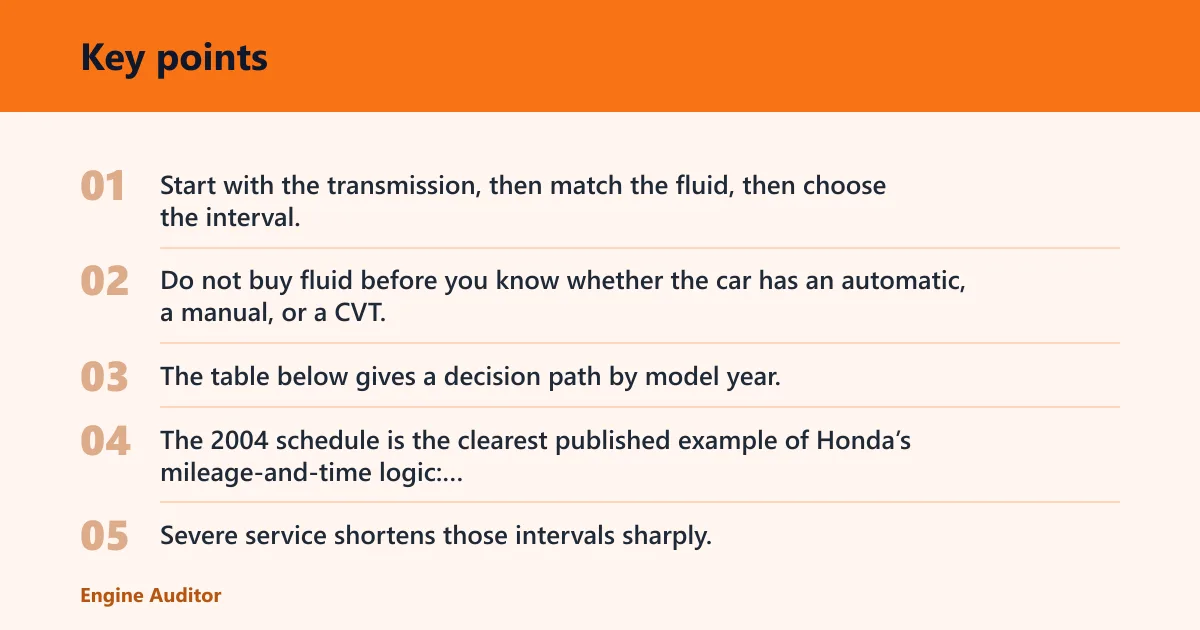


Start with the transmission, then match the fluid, then choose the interval. Do not buy fluid before you know whether the car has an automatic, a manual, or a CVT. The table below gives a decision path by model year, with drain-and-fill amounts shown as partial-service capacities, not total dry fill.
| Model year | Transmission type | Fluid spec | Normal interval | Severe interval | Drain-and-fill capacity |
|---|---|---|---|---|---|
| 2001-2010 | Automatic | Honda ATF-Z1 | Use the owner’s manual for the exact schedule | Use the severe-duty schedule in the manual | Varies by model; confirm in the manual |
| 2001-2010 | Manual | Honda manual-transmission fluid specified for that year | Use the owner’s manual for the exact schedule | Use the severe-duty schedule in the manual | Varies by model; confirm in the manual |
| 2004 | Automatic | Honda ATF-Z1 | 120,000 miles or 6 years | 60,000 miles or 3 years first, then 30,000 miles or 2 years | Varies by model; confirm in the manual |
| 2004 | Manual | Honda manual-transmission fluid specified for that year | 120,000 miles or 6 years | 60,000 miles or 3 years | Varies by model; confirm in the manual |
| 2011 | Automatic | Honda DW-1 | Use the owner’s manual or Maintenance Minder schedule | Use the severe-duty schedule in the manual or Minder | Varies by model; confirm in the manual |
| 2012-2013 | Automatic | Honda DW-1 | Use the owner’s manual or Maintenance Minder schedule | Use the severe-duty schedule in the manual or Minder | Varies by model; confirm in the manual |
| 2014-2015 | CVT | Honda HCF-2 | Use the owner’s manual or Maintenance Minder schedule | Use the severe-duty schedule in the manual or Minder | Varies by model; confirm in the manual |
| 2016-2019 | CVT | Honda HCF-2 | Use the owner’s manual or Maintenance Minder schedule | Use the severe-duty schedule in the manual or Minder | 3.7 US qt for 2.0L engines; 3.9 US qt for 1.5L engines |
| 2007-2009 manual | Manual | Honda manual-transmission fluid specified for that year | Use the owner’s manual for the exact schedule | Use the severe-duty schedule in the manual | 1.5 US qt; Si models 1.6 US qt |
The 2004 schedule is the clearest published example of Honda’s mileage-and-time logic: automatic fluid at 120,000 miles or 6 years in normal use, and manual fluid at the same 120,000-mile or 6-year mark. Severe service shortens those intervals sharply. Honda also listed brake fluid replacement every 3 years independent of mileage, which shows how some maintenance items use time as well as distance.
For many later Civics, Honda moved to Maintenance Minder guidance instead of a single fixed chart printed in the same way across every trim. That does not mean the interval is random. It means the reminder system and the owner’s manual set the schedule by model year, transmission type, and duty cycle.
When should you change it?
The simplest answer is this: change Civic transmission fluid when the mileage or time limit for your model year is reached, whichever comes first. For CVT-equipped Civics, that often means a shorter cadence in hard use and about 60,000 miles in normal use. Older automatics and manuals can run longer, but the exact year and transmission still set the rule.
Mileage-based rule
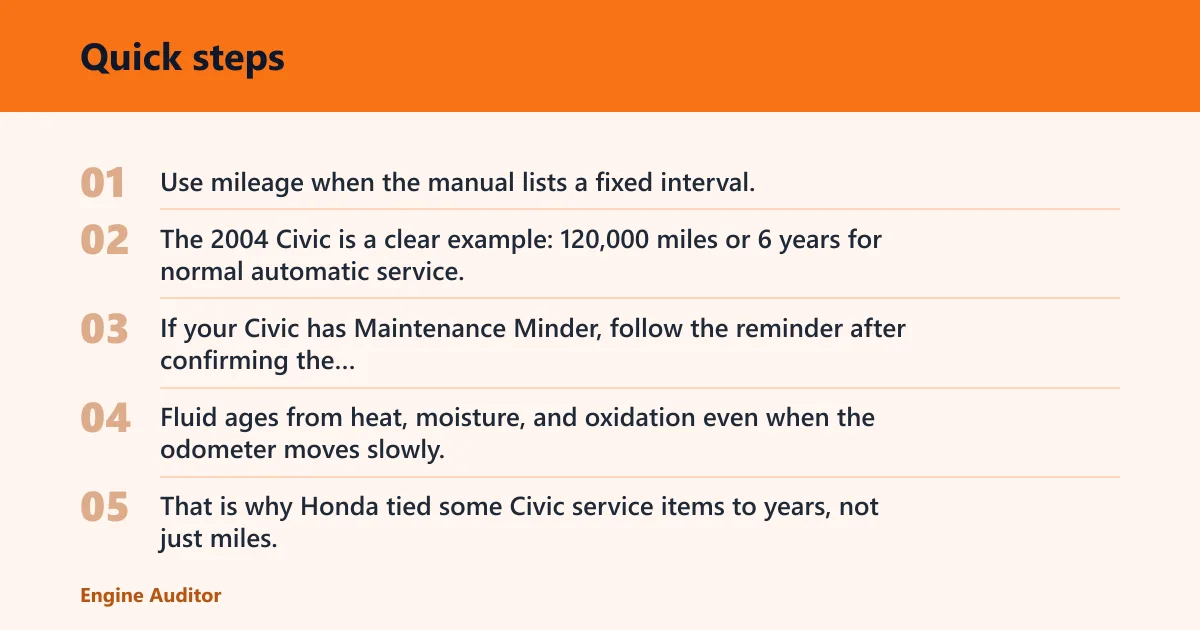
Use mileage when the manual lists a fixed interval. Severe-duty operation cuts those schedules. If your Civic has Maintenance Minder, follow the reminder after confirming the transmission type and fluid spec.
Time-based rule
Use time when the car is driven less often. Fluid ages from heat, moisture, and oxidation even when the odometer moves slowly. That is why Honda tied some Civic service items to years, not just miles. A low-mileage commuter that sits for long stretches can still need service on time.
How Honda schedules differ by year
Older Civics with automatics used ATF-Z1. Honda later replaced that with DW-1 for the 2011 Civic automatic in the cited capacity table. By 2014-2015, the Civic automatic in the cited table is HCF-2, which is a CVT fluid, not an automatic-transmission fluid. That year-to-year split is why a one-size interval misses the point.
Picture a 2016 Civic with 48,000 miles and a CVT. The owner sees no warning light and assumes the fluid can wait because the car is under 60,000 miles. That may be fine in normal use, but if the car spends its life in dense stop-and-go traffic, the severe schedule can call for earlier service.
Where Maintenance Minder fits
Honda Maintenance Minder can replace a fixed mileage chart on some later Civics, but it does not remove the need to know the transmission type. The reminder code tells you service is due. It does not choose the fluid for you. Match the code to the manual and use the Honda-spec fluid listed for that drivetrain.
Before you buy fluid, confirm whether the car has a CVT, a conventional automatic, or a manual gearbox. The shifter pattern, the owner’s manual, and the build sheet usually make this clear. Do not guess from model year alone, especially on 2014-2019 Civics, where CVT equipment is common.
- Check the shifter and pedal layout. A clutch pedal means manual transmission. No clutch pedal points to automatic or CVT.
- Look for a CVT label, trim note, or transmission code on the build sheet or service tag.
- Confirm the exact drivetrain in the owner’s manual before buying fluid.
- Match that transmission to the correct Honda fluid spec: ATF-Z1, DW-1, or HCF-2.
Suppose the car is a 2015 Civic with no clutch pedal and the manual says CVT. That means HCF-2, not DW-1. The interval you choose then follows the CVT schedule, not the older automatic schedule.
What counts as severe use?
Severe use means conditions that heat the fluid, load the transmission, or force frequent shifting more often than steady highway driving. For a Civic, that usually means stop-and-go traffic, repeated short trips, very cold starts, hot weather, or steep terrain. Those conditions shorten fluid life and pull service forward.
Stop-and-go driving
Repeated low-speed driving with constant shifting keeps heat in the fluid. In a CVT, that heat matters because belt-and-pulley control depends on fluid condition. In an automatic, it matters because hydraulic pressure and clutch control depend on the same fluid film.
Short trips and cold starts
Short trips do not always let the transmission reach full operating temperature. Moisture and contaminants stay in the fluid longer. If most drives are only a few miles, the severe schedule is the safer choice.
Hot climate or steep terrain
Heat is fluid’s enemy. So is sustained grade climbing or frequent hill starts. A Civic used in those conditions often needs the shorter interval even if the mileage stays modest.
What if it’s already overdue?
If the service date has passed, do not treat the fluid as optional. Change it soon, then reassess for symptoms such as shudder, delayed engagement, flare on shifts, or noisy operation. If the car is already slipping, the fluid change should be paired with a transmission inspection rather than treated as a cure-all.
Signs the fluid should be changed soon
Watch for darkened fluid, burnt odor, hesitation when shifting from park to drive, or a CVT that feels uneven on light throttle. Those signs do not always mean the transmission is failing, but they do mean the fluid should not stay in service much longer.
What a drain-and-fill does
A drain-and-fill replaces part of the fluid, not all of it. That is why the service amount is lower than total system capacity. Honda Civics often use this method because it refreshes the fluid without opening the entire transmission. Some severely overdue units benefit from repeat drain-and-fill service after a short drive cycle, but only with the correct Honda-spec fluid.
When to avoid waiting longer
Do not wait if the transmission already shudders, bangs into gear, or shows a warning light. Fresh fluid will not fix worn clutches, a failing valve body, or internal damage. It can, however, reduce further stress while the issue is diagnosed.
A common first-timer mistake is to ignore the interval because the car “still drives fine.” That can work until the first cold morning, when delayed engagement or shudder becomes obvious. By then, the missed service has already done its work.
Drain-and-fill service basics
Honda Civic transmission service usually means drain-and-fill, not a full dry fill. That distinction matters because the amount drained is only part of the total capacity. The exact fill amount varies by year, engine, and transmission design, so use the service data for your model, not a universal quart count.
Partial replacement versus full capacity
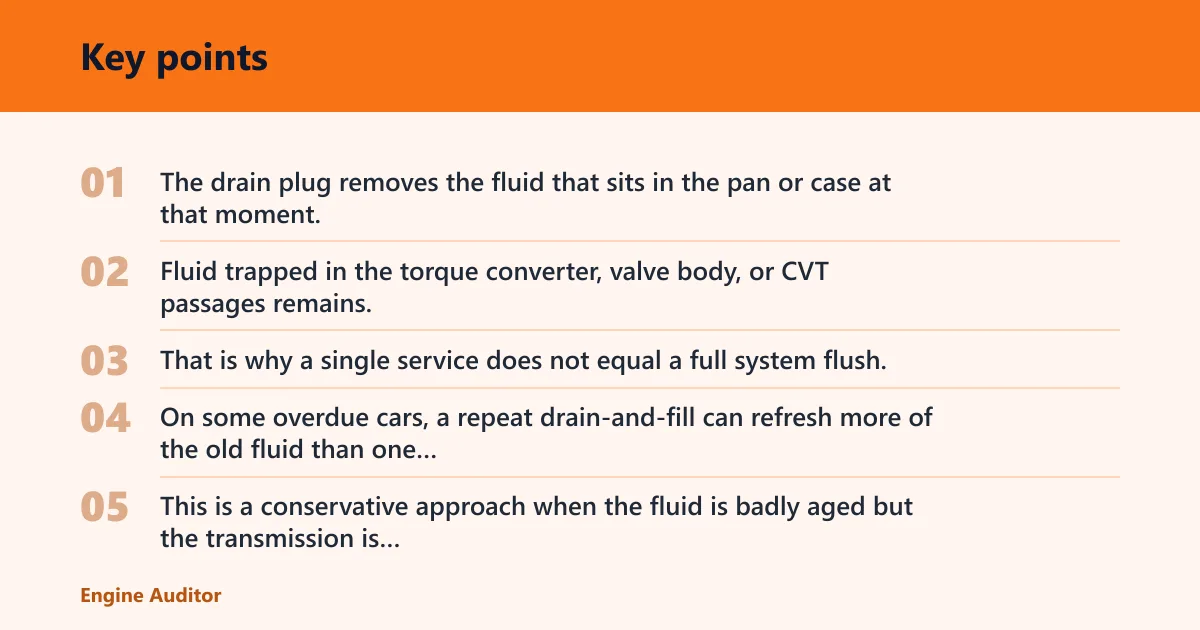
The drain plug removes the fluid that sits in the pan or case at that moment. Fluid trapped in the torque converter, valve body, or CVT passages remains. That is why a single service does not equal a full system flush.
Why repeat service may be used
On some overdue cars, a repeat drain-and-fill can refresh more of the old fluid than one service alone. This is a conservative approach when the fluid is badly aged but the transmission is still functioning. Use the proper Honda fluid each time.
Why the exact fill amount varies by model
Honda’s cited capacities show how much the numbers can change. The 2007-2009 manual capacity was 1.5 US qt, with Si models at 1.6 US qt. For 2016-2019 CVT Civics, the cited drain-and-fill capacity is 3.7 US qt for 2.0L engines and 3.9 US qt for 1.5L engines. That is service amount, not total system volume.
Why the right Honda-spec fluid matters
Honda calibrates friction behavior, pressure response, and heat tolerance around the specified fluid. Using the wrong spec can change shift feel and wear patterns. The risk is higher on CVTs, where the fluid is part of the control strategy, not just a lubricant.
Can you use universal fluid?
No. A universal fluid may claim broad coverage, but Honda transmissions are spec-driven. Use the exact Honda fluid called for by the year and transmission. Mixing incompatible fluids can alter friction characteristics and shorten transmission life. If the bottle does not clearly list the correct Honda approval or equivalent spec for your model, skip it.
Why Honda specs matter
Older Civic automatics may call for ATF-Z1, later automatics may use DW-1, and CVT-equipped Civics use HCF-2. Those are not interchangeable. The wrong fluid can produce shudder, poor engagement, or long-term wear even if the car still moves normally at first.
What can go wrong with the wrong fluid?
Wrong-fluid use can lead to hard shifts, slipping, fluid aeration, and overheating. In a CVT, incorrect friction behavior can affect pulley control. In an automatic, it can upset clutch apply timing. Neither case is worth the gamble.
Why mixing fluids is a bad idea
Mixing adds uncertainty to a system that depends on repeatable hydraulic behavior. If the transmission has already been serviced with the wrong fluid, the safest next step is to identify what was added and correct the fill with the proper Honda-spec product as soon as practical.
Frequently asked questions
When should I change Honda Civic transmission fluid?
Change it when the model-year schedule says it is due, or sooner if the car sees severe use. Older automatics and manuals can follow longer intervals, but the exact year matters.
How often does Honda recommend changing Civic transmission fluid?
Honda’s recommendation varies by year and transmission type. Later Civics may use Maintenance Minder guidance instead.
Is transmission fluid interval different for severe driving?
Yes. Severe driving shortens the service interval because it heats the fluid and stresses the transmission more often. Stop-and-go traffic, short trips, cold starts, and hot or hilly conditions all count as harder use. If most driving looks like that, use the severe schedule, not the normal one.
Does my Civic use ATF-DW1 or HCF-2 fluid?
It depends on the transmission. Honda DW-1 replaced ATF-Z1 for the 2011 Civic automatic in the cited table. Check the owner’s manual or build sheet before buying anything.
How do I know if my Civic has a CVT or automatic?
Check for a clutch pedal first. If there is no clutch pedal, confirm the transmission on the build sheet, service tag, or owner’s manual. Do not rely on model year alone. Some Civic years moved between automatic and CVT setups, and the wrong guess leads to the wrong fluid.
What happens if I wait too long to change transmission fluid?
Old fluid can lose its friction control and heat resistance. The result may be shudder, delayed engagement, hard shifts, or wear inside the transmission. If symptoms have already started, service the fluid soon and inspect the transmission rather than assuming a fluid change will solve everything.
How much transmission fluid does a Honda Civic take?
It depends on the model and service type.
Can I use universal transmission fluid in a Honda Civic?
Do not treat universal fluid as a substitute for Honda-spec fluid. Civic transmissions are calibrated for the correct Honda formula, whether that is ATF-Z1, DW-1, or HCF-2. Mixing or substituting fluid can cause shift quality problems and may shorten transmission life. Use the exact spec listed for your year.
Products related to this article
Sponsored / affiliate links. As an Amazon Associate I earn from qualifying purchases. I may earn additional commission from eligible campaigns.