Honda Civic Oil Change Interval: How Often Should You Replace It?
For most Honda Civics, change the oil when the Maintenance Minder reaches about 15% remaining, which commonly lands around 7,500 to 10,000 miles or about 12 months; older Civics without a minder often need oil at about 5,000 miles or 6 months. Honda’s owner’s manuals and maintenance schedules also make time-based service limits explicit, and the exact interval depends on year, engine, and driving conditions. Honda Owners and the API Engine Oil Licensing and Certification System are good references for the vehicle-specific oil spec behind those intervals.
Check your civic’s oil change needs by model year
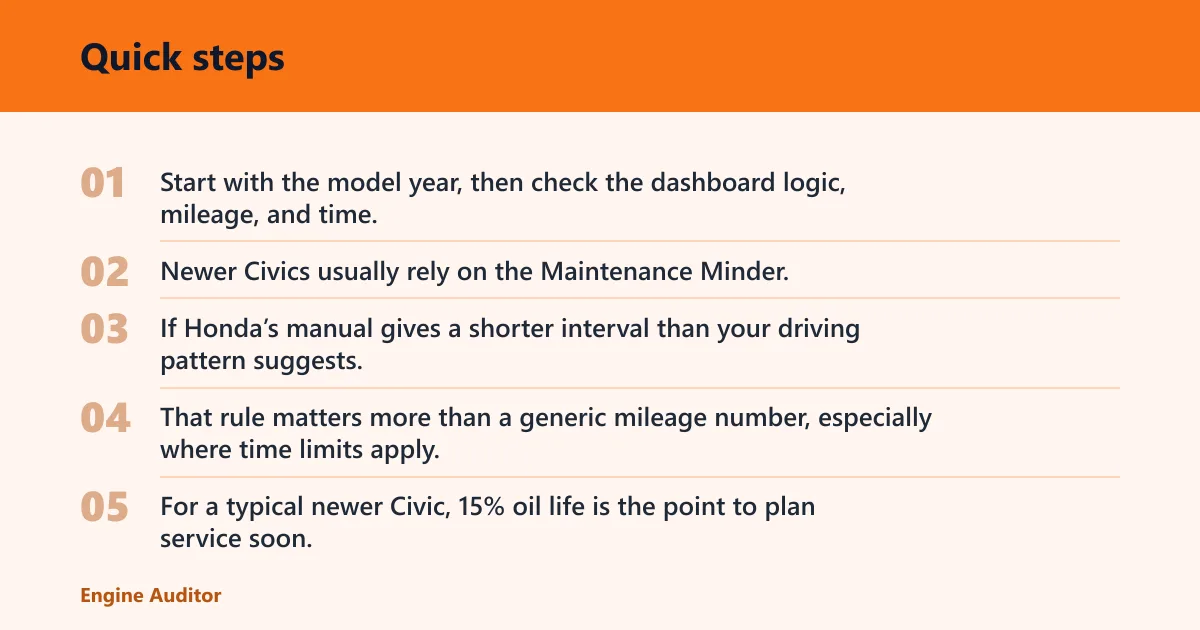


Start with the model year, then check the dashboard logic, mileage, and time. Newer Civics usually rely on the Maintenance Minder, while older Civics often follow a fixed mileage schedule. If Honda’s manual gives a shorter interval than your driving pattern suggests, use the shorter interval. That rule matters more than a generic mileage number, especially where time limits apply.
For a typical newer Civic, 15% oil life is the point to plan service soon. For older Civics, 5,000 miles is a common conservative target, while some modern synthetic schedules can reach 7,500 to 10,000 miles under normal use. Low-mileage drivers still need a time limit, usually 12 months, and Honda’s maintenance schedules should override any broad rule of thumb. For official guidance, see Honda’s owner’s manual.
Civic oil interval table
| Model year group | Engine / schedule type | Practical oil-change recommendation | Shorten the interval if you drive mostly |
|---|---|---|---|
| Pre-2016 Civics | Fixed mileage schedule, often conventional or synthetic blend | About 5,000 miles or 6 months | Short trips, stop-and-go traffic, extreme heat or cold |
| 2016 and newer Civics | Maintenance Minder, usually full synthetic | About 7,500 to 10,000 miles or when oil life reaches about 15% | City use, cold starts, mountain driving, long idling, towing if equipped |
| Turbocharged Civic engines | More heat and load than many non-turbo versions | Plan closer to 5,000 to 7,500 miles unless the manual says otherwise | Frequent boost, short trips, high ambient heat, repeated stop-and-go use |
| Low-mileage or stored cars | Any schedule | Change at least every 12 months, even if mileage is low | Storage, infrequent use, repeated cold starts without long drives |
Say your 2018 Civic has 8,200 miles since the last oil change and the display reads 20% oil life. That is close enough to plan service soon, especially if the car sees short trips and traffic. A 2021 Civic with 4,000 miles and 40% oil life may still be fine if time is under 12 months and the manual does not call for earlier service, but a lower time limit in the owner’s manual always wins.
How does the maintenance minder work?
The Honda Maintenance Minder tracks oil life percentage on the driver information display and pairs it with service codes. On many Civics, the oil life percentage drops as the car logs miles, starts, idle time, and operating conditions. A low percentage is not a random warning; it is Honda’s service timing system, built to replace fixed intervals in many newer model years.
Oil life percentage and service codes
When oil life gets low, the display may show a service due message and a code such as A or B, sometimes with sub-codes. The oil code means oil and filter service. Other codes can point to inspections or additional maintenance items. The code set helps separate oil changes from unrelated service, and Honda ties those reminders to its published maintenance schedule rather than to a random warning lamp.
About 15% oil life is the practical planning point. Around 5%, the reminder is urgent enough that service should not wait long. At 0%, the car is overdue. The exact wording can vary by model year, but the timing logic is the same: lower percentage means less remaining service life under Honda’s schedule, and the schedule should be checked against the model-specific manual. See Honda manuals for the exact reminder language by year.
What a low oil life alert means
A low oil life alert means the system has estimated that the oil is near the end of its service window. It does not mean the oil instantly fails at a fixed mile count. It does mean you should stop treating the interval as open-ended and schedule service soon, especially if the car sees hard use or the owner’s manual specifies a shorter time-based replacement limit.
What oil should you use?
Use the viscosity and certification listed in the owner’s manual for your exact engine and model year. Many Civic engines call for SAE 0W-20, while some older or specific engines may call for another grade. Look for API certification and the proper ILSAC rating on the bottle, and use full synthetic where Honda requires it or recommends it. Honda’s oil viscosity guidance is model-specific, so a Civic trim from one year should not be assumed to match another.
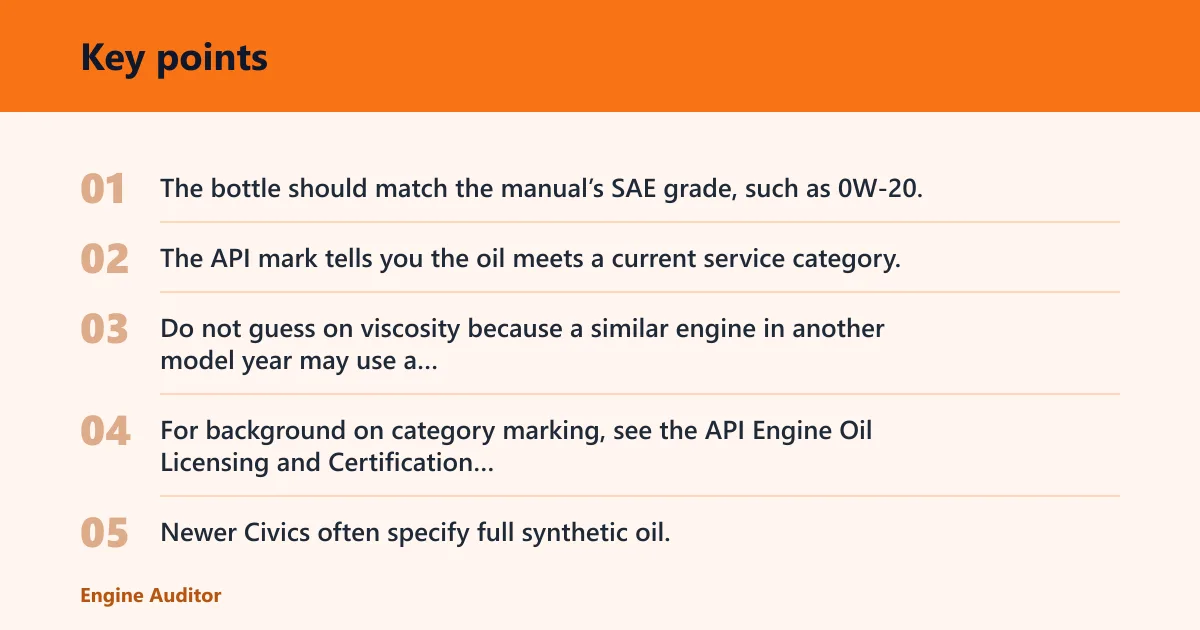
Viscosity and certification
The bottle should match the manual’s SAE grade, such as 0W-20. The API mark tells you the oil meets a current service category, and the ILSAC starburst or equivalent indicates passenger-car fuel economy and protection requirements. Do not guess on viscosity because a similar engine in another model year may use a different grade, and the published spec is the best source for that decision. For background on category marking, see the API Engine Oil Licensing and Certification System.
Newer Civics often specify full synthetic oil. Older Civics may accept conventional or synthetic blend depending on the exact engine and year, but synthetic generally resists heat better and supports longer intervals. Synthetic does not cancel the need for regular changes. It simply gives more margin when the schedule calls for it. If Honda specifies 0W-20 for your model year, that specification takes priority over general habits or older recommendations.
Turbo versus non-turbo guidance
Turbocharged Civics often benefit from a more conservative oil-change plan than non-turbo models, unless the owner’s manual says otherwise. Turbochargers raise oil temperature and stress the oil more, especially in short-trip or stop-and-go use. If the manual allows a wide interval, many owners still choose the shorter end of that range for turbo engines, while non-turbo models may more comfortably follow Honda’s standard Maintenance Minder pace.
When should you shorten the interval?
Cut the interval for severe service. That includes repeated short trips, heavy city traffic, long idling, extreme heat or cold, dusty roads, mountain driving, and long periods of storage with only occasional start-ups. These conditions can leave oil in service longer by mileage, but shorter by actual condition, so Honda’s severe-service guidance and time limits matter as much as the odometer.
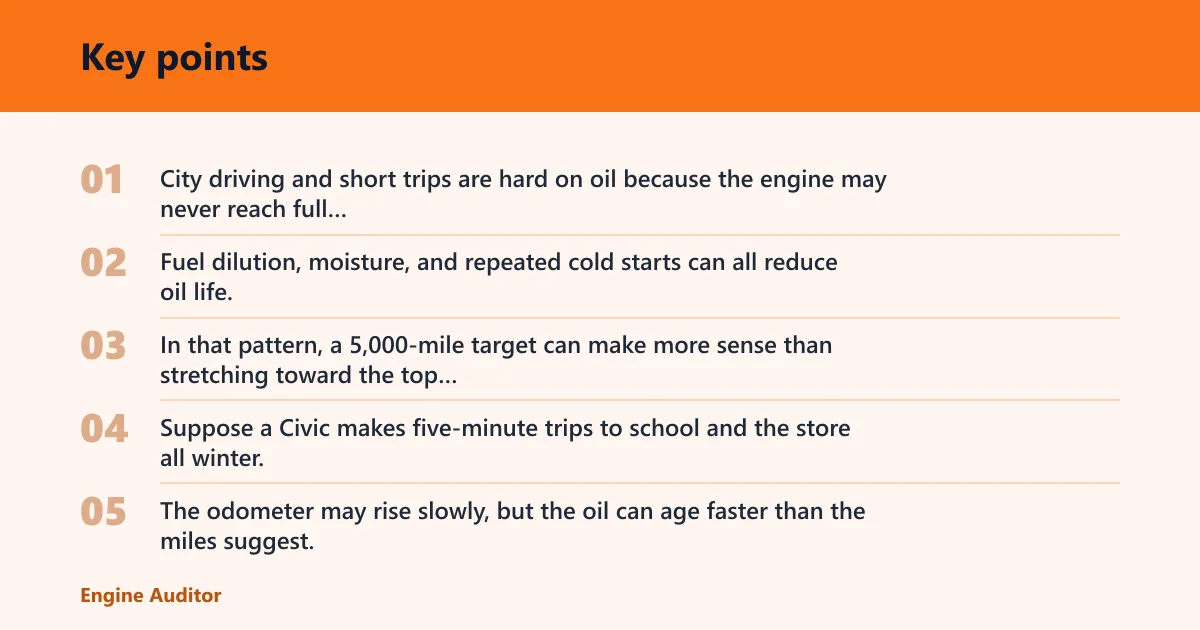
City driving and short trips
City driving and short trips are hard on oil because the engine may never reach full operating temperature for long. Fuel dilution, moisture, and repeated cold starts can all reduce oil life. In that pattern, a 5,000-mile target can make more sense than stretching toward the top end of a modern synthetic interval, even on a Civic that otherwise uses Maintenance Minder logic.
Suppose a Civic makes five-minute trips to school and the store all winter. The odometer may rise slowly, but the oil can age faster than the miles suggest. In that case, time and driving pattern matter more than the number on the dash, and a yearly service limit can become the controlling factor before mileage does.
Extreme temperatures and low-mileage storage
Very hot or very cold weather can shorten the useful life of oil. So can long storage, because moisture and contamination can still build up without much driving. If the car logs few miles in a year, change the oil at least annually even if the Maintenance Minder has not reached the usual service point, because Honda’s schedules and time-based limits are designed to protect against age as well as mileage.
A common first-timer mistake is waiting for mileage alone on a car that barely moves. A Civic with 2,000 miles in 14 months still needs fresh oil if Honda’s schedule calls for 12-month service. Time counts, and the owner’s manual is the authoritative source for that limit.
How do you know it needs service now?
Check the dipstick, the dashboard, and the service history together. If the oil life percentage is low, the oil level is below the dipstick marks, or the engine shows low-oil symptoms, do not wait for a perfect mileage number. A top-off can help if the level is low, but it does not replace overdue oil and filter service. Dashboard prompts and the due-soon display should be treated as planning signals, not optional reminders.
Dipstick check and oil level
Park on level ground and let the engine sit briefly after shutdown so oil can drain back to the pan. Pull the dipstick, wipe it clean, reinsert it, then read it again. The level should sit between the marks. If it is near or below the low mark, add oil in small amounts and recheck. This level check is separate from the maintenance schedule and should be done even if the oil is relatively new.
Dark oil alone does not prove failure, because many oils darken in normal use. What matters more is level, smell, contamination, and service interval. If the oil looks gritty, smells strongly of fuel, or is far past the schedule, plan a full change rather than a top-off, and confirm the correct viscosity before adding anything.
Low oil warning symptoms
Watch for the low oil pressure light, unusual ticking from the valvetrain, rough idle, burning-oil smell, or visible leaks under the car. Those are warning signs, not reminders. If the oil pressure light comes on while driving, shut the engine off as soon as it is safe and check the oil level before restarting. That warning is more serious than a Maintenance Minder notice.
What happens if you wait too long to change the oil?
Waiting too long can thicken sludge, raise engine wear, and reduce protection for camshafts, pistons, and timing components. In turbo engines, old oil can be especially hard on the turbocharger because of heat and coking risk. Delay also raises the chance that oil consumption problems or leaks go unnoticed until the level is low, which is why Honda’s schedule and the oil-life monitor should be followed promptly.
That is why the safe answer is not “the longest interval possible.” It is the correct interval for the model year, engine, and driving pattern. A Civic that mostly commutes on the highway may support a longer interval than one that idles in traffic all week, but the manual’s oil grade and time limit still control the final decision.
- Check the owner’s manual for your exact model year and engine.
- Use the Maintenance Minder if your Civic has one.
- Shorten the interval for short trips, city driving, severe weather, or turbo use.
- Replace the oil filter with every oil change.
- Check the drain plug washer or gasket and replace it if the service parts call for it.
- Verify the dipstick level after the service and top off if needed.
Frequently asked questions
How often should I change the oil in my Honda Civic?
Older Civics without that system often need oil every 5,000 miles or 6 months. Severe driving should shorten either schedule, and the owner’s manual can set a tighter limit for your exact trim or engine.
Is the Honda Civic oil change interval 5,000 miles or 10,000 miles?
It can be either, depending on model year, engine, and driving conditions. Older Civics often fit the 5,000-mile pattern, while newer Civics with full synthetic oil and Maintenance Minder logic can reach the higher end of the range. Use the manual, not a single universal number, because turbo, hybrid, and non-turbo trims can differ.
Does synthetic oil last longer in a Honda Civic?
Yes, synthetic oil generally lasts longer than conventional oil under heat, cold starts, and extended service intervals. That does not mean it should be left in the engine indefinitely. The Civic’s manual or Maintenance Minder still sets the actual replacement point, and Honda’s published time limit can still require a change before mileage does.
Does the oil change interval change if I mostly drive in the city?
Yes. City driving, short trips, and stop-and-go traffic shorten oil life because the engine sees more starts, more idling, and less full-temperature run time. In that pattern, change the oil sooner than the longest schedule, even if the odometer does not move quickly. Severe-service driving can move the recommendation closer to the lower end of Honda’s range.
What if my Civic has a maintenance minder instead of a fixed interval?
Use the oil life percentage and service code as the main guide. Plan service when oil life drops near 15%, and do not wait long once it reaches the low single digits. The system is designed around actual driving conditions, not just miles, and Honda’s manual still defines the oil grade and any time-based replacement limit.
How do I know if my Civic needs an oil change now?
Check the oil life display, the mileage since the last service, the date of the last change, and the dipstick level. If the reminder is low, the oil is overdue by time, or the level is low, service is due now. A top-off only solves a low level, not overdue oil, and dashboard alerts should be paired with the owner’s manual schedule.
Products related to this article
Sponsored / affiliate links. As an Amazon Associate I earn from qualifying purchases. I may earn additional commission from eligible campaigns.