Honda Civic Coolant Service: When to Flush and Refill
For many Honda Civics with Honda Type 2 coolant, the first factory coolant replacement is commonly around 10 years or 120,000 miles, then about every 5 years or 60,000 miles after that; inspect sooner and repair leaks, contamination, or overheating first. Skip the wrong service, and old coolant can turn acidic, raise corrosion risk, and damage the radiator, water pump, or heater core. This guide explains when to inspect only, choose a drain-and-fill, do a full flush, or fix a cooling-system problem before any coolant service.
Coolant service types and when to choose them


This guide helps you choose the right path, not only the right interval. On a Honda Civic, coolant work can mean a simple inspection, a drain-and-refill, a full flush, or repair work before any refill happens. Those are not interchangeable services.
Start with the owner’s manual. Honda’s exact coolant spec and interval can change by model year, trim, and coolant formulation. Many modern Civics use Honda Long-Life Coolant Type 2, often described as blue, but the owner’s manual still sets the final rule for your car.
How flush, refill, and repair differ
A drain-and-refill removes much of the old coolant from the radiator and related passages, then replaces it with fresh coolant. A full flush is more aggressive and is used when the system needs cleaner coolant circulation, such as after contamination or when service history is unknown. Repair first means fixing leaks, overheating faults, or contaminated coolant before any routine service.
The cooling system works as one unit. The radiator, water pump, hoses, thermostat, and air-purge process after refill all affect whether the new coolant does its job. If air remains trapped, the engine can still run hot after a service that looked complete on paper.
- Check the owner’s manual for the exact model year and trim.
- Look at coolant color and clarity with the engine cold.
- Check for leaks, warning lights, and temperature rise.
- Choose inspect only, drain-and-refill, full flush, or repair first.
- After refill, bleed air from the cooling system.
What interval does your Civic follow?
The safest answer is the one in your owner’s manual. Honda also uses Maintenance Minder reminders on some models.
That means a Civic owner should not use one generic internet interval for every model year. A newer car may have a longer first interval than an older one, and the service reminder on one trim can differ from another trim with a different coolant spec.
Why model year changes the answer
Honda Civic coolant service is not one fixed number across every generation. Newer Civics can have a longer first interval, while older models may call for earlier replacement. One commonly cited schedule for 2016-2025 Civics lists the first coolant service at around 100,000 to 120,000 miles, then later service about every 60,000 miles.
That is why year and formulation matter more than a universal mileage rule. If you know the model year but not the coolant history, inspect first before assuming a flush is due.
Where Maintenance Minder code 5 fits
On some newer Civics, Maintenance Minder code 5 points to coolant service. It is a reminder, not a universal fixed-mileage promise. The reminder and the manual should be read together.
Say your Civic shows code 5 at 56,000 miles and the coolant still looks clear, full, and the service history is documented. That can still call for coolant service soon, but it should be checked against the manual before a shop does unnecessary work.
Honda Civic coolant decision table
This table separates the four practical paths. Use the coolant’s condition, the symptoms, and the service history together. A clean system with clear coolant is a different case from a Civic that has overheated or shows rust in the radiator neck.
| Mileage or age band | Coolant condition | Symptoms | Likely action | Why that choice is safest |
|---|---|---|---|---|
| Within the manual interval, no warning signs | Clear, correct color, no sediment | No overheating, no leaks, stable temperature | Inspect only | A healthy system does not need extra service just because mileage is rising. |
| At the due interval, or service history is uncertain | Still clean, but age or mileage is due | No major symptoms | Drain-and-refill | Fresh coolant restores corrosion protection without forcing unnecessary repair work. |
| Overdue, mixed coolant suspected, or coolant is dirty | Rust, sediment, sludge, or wrong color mix | Poor heater output, minor temp swings, past top-offs | Full flush | Contamination can stay behind after a simple drain, so a cleaner system is safer. |
| Any mileage, any age | Milky, oily, low after repeated top-offs, or contaminated by leak repair concerns | Overheating, coolant loss, steam, warning light | Repair first | Coolant service will fail if the radiator, hose, thermostat, or water pump problem is still active. |
When does a Civic need coolant early?
Early service is justified when the cooling system shows a problem, not only when the calendar says so. Overheating, leaks, rust, sediment, sludge, and milky appearance are all signs that the coolant or the system needs attention before the next routine interval. Severe service driving can also shorten useful life.
Overheating and temperature warnings
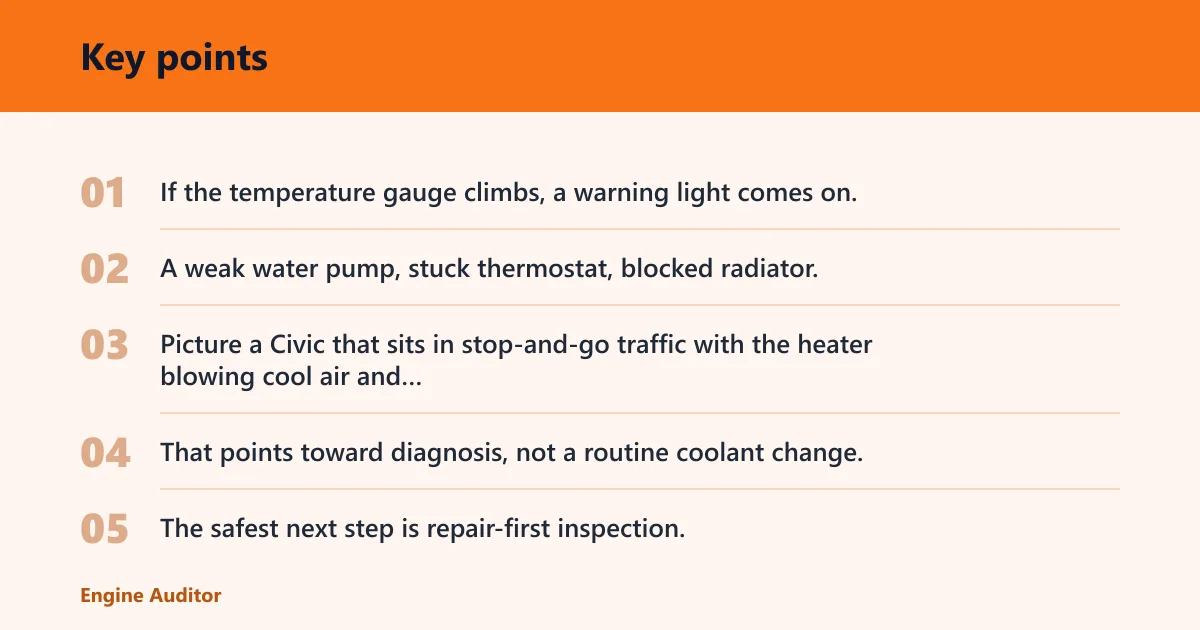
If the temperature gauge climbs, a warning light comes on, or the cabin heat suddenly drops, treat that as a cooling-system issue first. Do not assume a flush will fix it. A weak water pump, stuck thermostat, blocked radiator, or trapped air can cause the same symptom.
Picture a Civic that sits in stop-and-go traffic with the heater blowing cool air and the gauge creeping up at idle. That points toward diagnosis, not a routine coolant change. The safest next step is repair-first inspection.
Leaks, discoloration, and contamination
Low coolant is a symptom, not a normal condition to ignore. Check the radiator, hose ends, water pump area, and expansion tank for wetness or crusty residue. Rust, sediment, sludge, or a milky appearance can mean contamination or mixing, and that usually calls for more than a simple top-off.
A common first-timer mistake is to top off a dark, rusty reservoir with the wrong bottle and call it done. That can hide the real problem and leave corrosion protection weak.
Severe service driving
Short trips, stop-and-go traffic, hot climates, and dusty roads can justify earlier inspection or service. Those conditions do not automatically mean the coolant is bad, but they can make it wise to check the system sooner than a normal schedule would suggest.
For severe use, the smart move is earlier inspection, then service only if the coolant condition or the manual supports it.
Honda long-Life Coolant Type 2 basics
Many modern Honda Civics use Honda Long-Life Coolant Type 2. It is a long-life formulation and is often described as blue.
Why the correct coolant matters
Honda coolant is not interchangeable with every universal product on the shelf. That matters because the wrong chemistry can reduce corrosion protection or create compatibility problems inside the system.
Use the owner’s manual to confirm whether your Civic takes Type 2 or a different factory fill. If the manual does not match the bottle, the manual wins.
Why mixing coolant types is a problem
Mixing coolant types can leave behind sludge, reduce corrosion control, and make future service harder to interpret. Cooling systems depend on stable chemistry. If the coolant looks murky, has a strange color mix, or shows signs of contamination, the safest route is to inspect first and then choose the right service path.
Bleeding air after refill
After a refill or flush, the system must be bled to remove air pockets. Air trapped in the radiator or heater circuit can cause hot spots, poor heater performance, and false temperature readings. A complete service includes filling, bleeding, and confirming stable operation afterward.
Can you use universal coolant?
Only if the owner’s manual and the coolant spec allow it. For many Honda Civics, the better answer is no: use the specified Honda coolant, not a generic bottle. If the car already has mixed or unknown coolant, do not top off blindly. Check the system and service it properly first.
What to verify before topping off
Check the coolant reservoir and radiator only when the engine is cold. Confirm the color, the fill level, and whether the coolant looks clean or contaminated. If the level is low but the system is otherwise healthy, a correct top-off may be reasonable. If the fluid is muddy or oily, it is not a simple top-off case.
When mixed coolant means service first
Mixed coolant usually calls for more than a quick refill. If the wrong coolant type is already in the system, a drain-and-refill may not be enough. A full flush is often safer because it removes old fluid more completely, but only after the underlying compatibility issue is understood.
What happens if you wait too long?
Old coolant loses corrosion protection and can let rust, scale, and sediment build inside the system. That can affect the radiator, water pump, hoses, and thermostat, and it can reduce heater performance. If the coolant is neglected long enough, overheating becomes more likely.
Corrosion and sediment risk
Coolant is supposed to protect metal surfaces as well as control temperature. When it ages or gets contaminated, corrosion risk rises. Deposits can settle in narrow passages and make a flush more important, or make a repair necessary if the system is already damaged.
Water pump, hose, and thermostat damage
Old or contaminated coolant can stress seals and internal parts. Hoses can harden, thermostats can stick, and a water pump can wear faster if the coolant no longer protects the system well. That is why repair-first checks matter when the car has overheated or shown repeated coolant loss.
Overheating consequences
Overheating can escalate quickly. A short drive with a bad hose or failing thermostat can become a much larger repair if the engine runs hot long enough. If you see steam, a strong sweet smell, or repeated temperature warnings, stop treating the issue like routine maintenance.
Honda Civic coolant service cost
A coolant service for a Honda Civic usually costs less for a basic drain-and-refill than for a full flush, and both usually cost less than diagnosis or repair work. The final price depends on the shop, region, and the exact work involved.
What a basic drain-and-refill usually costs
A simple service is usually the least expensive path because it removes and replaces coolant without major repair work. It still requires the correct coolant, proper bleeding, and a final check for stable temperature and leaks. The price rises if the technician has to spend time clearing air from the system.
When a flush costs more
A full flush usually costs more than a drain-and-refill because it takes more time and more coolant handling. It may also include extra steps to remove old fluid from passages the drain plug does not empty well. If the system is dirty or the service history is unknown, that added work can be worth it.
Why repair work changes the bill
If the radiator, water pump, hose, thermostat, or a seal is leaking, the bill changes fast. In that case, the cost is not a coolant-service cost anymore. It becomes a cooling-system repair bill, and that is the right place to spend the money before fresh coolant goes in.
Frequently asked questions
How often should I flush the coolant on a Honda Civic?
The owner’s manual for your exact model year and trim should set the final interval.
Does my Honda Civic need coolant changed at 60,000 miles?
Often, yes, but not always. A 60,000-mile service is common for many modern Civics using Honda Type 2 coolant after the first replacement interval, while some newer schedules go longer for the first change. If the car has code 5, unknown history, contamination, or overheating, inspect first and do not treat mileage alone as the only trigger.
How long does Honda Type 2 coolant last?
Use the owner’s manual to confirm which interval applies to your Civic.
What are the signs my Civic coolant needs to be changed early?
Overheating, leaks, rust, sediment, sludge, and milky appearance are the main warning signs. Severe service driving such as short trips, stop-and-go traffic, hot climates, and dusty roads can also justify earlier inspection. If the car is overheating, repair the cause before any routine coolant service.
Can I use universal coolant in a Honda Civic?
Do not assume universal coolant is the right choice. Many Honda Civics use Honda Long-Life Coolant Type 2, and the wrong coolant type should not be mixed in. If the system already contains unknown or mixed coolant, verify the spec in the owner’s manual and consider service first.
Is the coolant interval different for newer Civic models?
Yes. Newer Civics can have a longer first interval than older ones, and some schedules extend to 10 years or 120,000 miles for the first change. Honda also uses condition-based reminders on some models. That is why model year, trim, and coolant formulation matter more than a single universal rule.
What happens if I wait too long to flush Honda Civic coolant?
Old coolant can lose corrosion protection, let sediment build up, and raise the risk of overheating. That can affect the radiator, water pump, hoses, thermostat, and heater performance. If symptoms are already present, the safest step is diagnosis and repair first, not a routine flush alone.
How much does a Honda Civic coolant flush cost?
A coolant service usually costs less for a drain-and-refill than for a full flush, and repair work can raise the total quickly. Unknown history or contamination often means a more involved bill.
Products related to this article
Sponsored / affiliate links. As an Amazon Associate I earn from qualifying purchases. I may earn additional commission from eligible campaigns.