
Honda Civic tire rotation interval for even wear guide
For many Honda Civics, I rotate tires about every 5,000 to 7,500 miles. I usually shorten that interval to roughly 3,000 to 5,000 miles for short-trip, stop-and-go, or sporty driving, and I rotate sooner if wear looks uneven. Skip it, and the front tires can cup, get noisy, and wear out early. This article shows how to pick the right interval by driving pattern, tire type, and tread wear.
This guide is part of our Honda Civic maintenance guide series.
How often should you rotate Honda Civic tires?
The default interval most Civic owners can start with
A Honda tire guide says to rotate every 5,000-7,500 miles. That range fits most Civic use because the front tires do more work on FWD models, especially during acceleration, braking, and turning. On a Civic Sedan, Civic Hatchback, Civic Sedan Hybrid, Civic Hatchback Hybrid, or Civic Si Sedan, the right answer still depends on how the car is driven and what tires are on it.
Why many owners pair rotation with oil changes
Many owners do rotation at oil-change visits because the schedule is easy to remember. That works well when the vehicle sees mixed driving and the tires wear evenly. It is a weak hard rule. A maintenance minder reminder can be a good planning cue, but the tires still need a visual check before deciding whether to rotate now or wait.
When 5,000 miles is early, normal, or overdue
Around 5,000 miles, rotation is often reasonable for city use, frequent short trips, and spirited driving. It can be a bit early for mostly highway commuting on evenly wearing all-season tires. It is overdue if the front shoulders are already more worn, the car pulls, or there is vibration. The best interval is the one that keeps a visible wear gap from growing.
According to automobiles.honda.com — The Honda Civic Sedan has a 32/41 city/highway MPG rating.
What changes the interval on a Civic?
Driving pattern, tire type, and wear condition change the interval more than the odometer alone. A Civic that racks up highway miles on smooth pavement can often stay near the longer end of the range, while a car used in traffic, on rough roads, or with heavier loads may need rotations sooner to keep tread wear even.
City miles, highway miles, and stop-and-go wear
City driving usually shortens the interval because of more braking, cornering, and low-speed steering input. Highway miles are easier on tread, but they do not erase the front-to-rear wear difference on a front-wheel-drive Civic. Stop-and-go use is hard on front tires because the fronts handle most of the work.
Road condition, load, and seasonal tire changes
Rough pavement, potholes, frequent curb strikes, and carrying passengers or cargo can all speed up shoulder wear. Seasonal tire swaps can also change the rotation plan. Winter tires often follow their own storage and swap cycle, while directional tires limit which positions they can move to. The rotation pattern must match the tire design, not the owner’s preference.
How Civic Hybrid and Si use cases can shift the schedule
The Civic Sedan Hybrid and Civic Hatchback Hybrid often see gentler throttle use, but that does not mean long intervals by default. Regen braking still leaves plenty of front tire load in real use. The Civic Si Sedan may need shorter intervals if the driver uses more cornering grip, harder launches, or track-style road behavior. Tire wear decides the interval more than trim alone.
What rotation pattern fits your Civic tires?
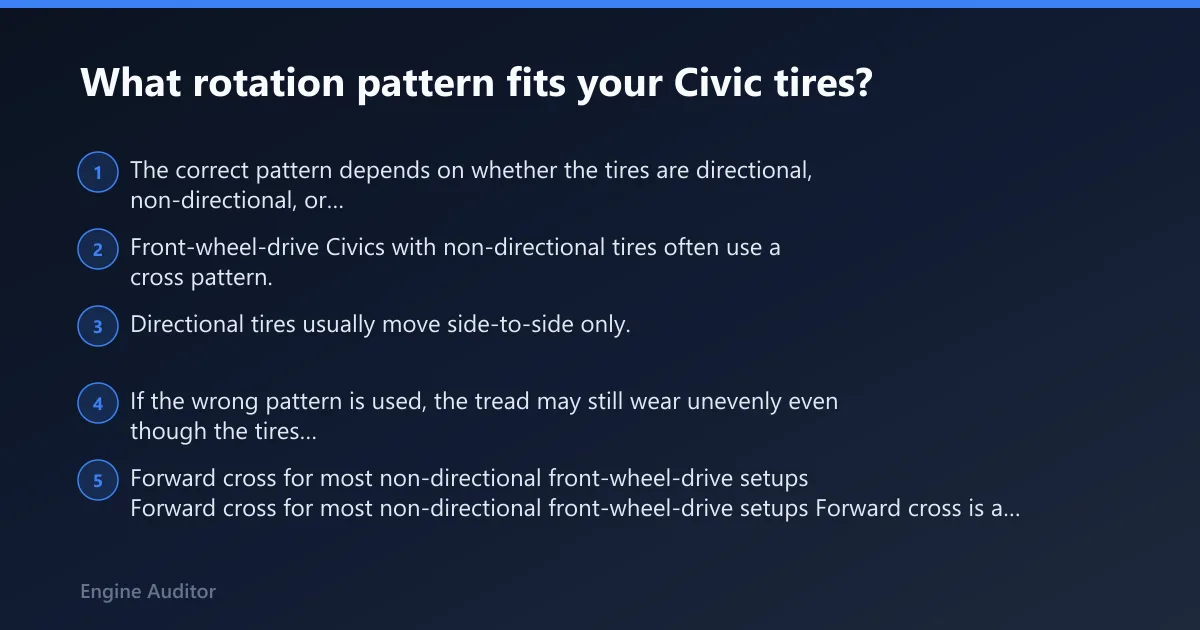
The correct pattern depends on whether the tires are directional, non-directional, or part of a staggered setup. Front-wheel-drive Civics with non-directional tires often use a cross pattern. Directional tires usually move side-to-side only. If the wrong pattern is used, the tread may still wear unevenly even though the tires were rotated on schedule.
Forward cross for most non-directional front-wheel-drive setups
Forward cross is a common fit for many Civic setups with non-directional tires. In this pattern, the rear tires move straight to the front, and the front tires move to the opposite rear positions. It helps balance the higher front wear seen on FWD Civics. This is the pattern most owners mean when they ask for “normal rotation.”
Rearward cross when the pattern calls for it
Rearward cross is used when the tire maker or service data specifies it, or when the shop wants to preserve a wear path on certain setups. It is less common than forward cross on a Civic, but it can be the right call for some performance tires and mixed wear cases. The tire itself should decide the pattern.
Side-to-side only for directional tires
Directional tires are built to roll in one direction only. They can usually be moved side-to-side on the same axle if the wheel and tire setup allows it, but they should not be crossed to the opposite side unless the tire is remounted. This matters on Civics with winter tires or performance tires that have an arrow-marked tread direction.
When an X-pattern makes sense and when it does not
An X-pattern can fit some non-directional tires when the service plan calls for moving each tire to the opposite corner. It is not a default answer for every Civic. It does not suit directional tires, and it may not be the best choice if the front tires show much more wear than the rear. Pattern choice should follow the tire design and wear map.
What tire wear signs mean rotate now?

If wear is already uneven, the right time is now. Uneven shoulder wear, pulling, vibration, and reduced traction mean the tires are no longer wearing at the same rate. Waiting for the next oil change can cost usable tread if the front pair is already much farther along than the rear.
Uneven shoulder wear and feathering
Shoulder wear is the classic Civic warning sign. Front tires can scrub their outer or inner edges faster, especially after long city use or underinflation. Feathering across the tread often points to wear imbalance or alignment trouble. If the edges look more rounded or more bald than the center, rotation should not wait.
Pulling to one side and steering feel changes
A Civic that begins to drift, pull, or feel less centered may have a tire wear issue, even when alignment is still within range. Rotation can help identify whether the pull follows a tire or stays with the car. If the steering wheel feel changes after tire wear changes, the tires deserve a closer look.
Vibration, noise, and traction loss
Vibration while driving can come from tire wear, a balance issue, or both. Increased road noise can also mean the tread has started to cup or scallop. Reduced traction in rain or on cold pavement is another sign that the tread depth is no longer even. That is a rotate-now condition, not a wait-and-see condition.
Civic tire-rotation decision table and pre-rotation checklist
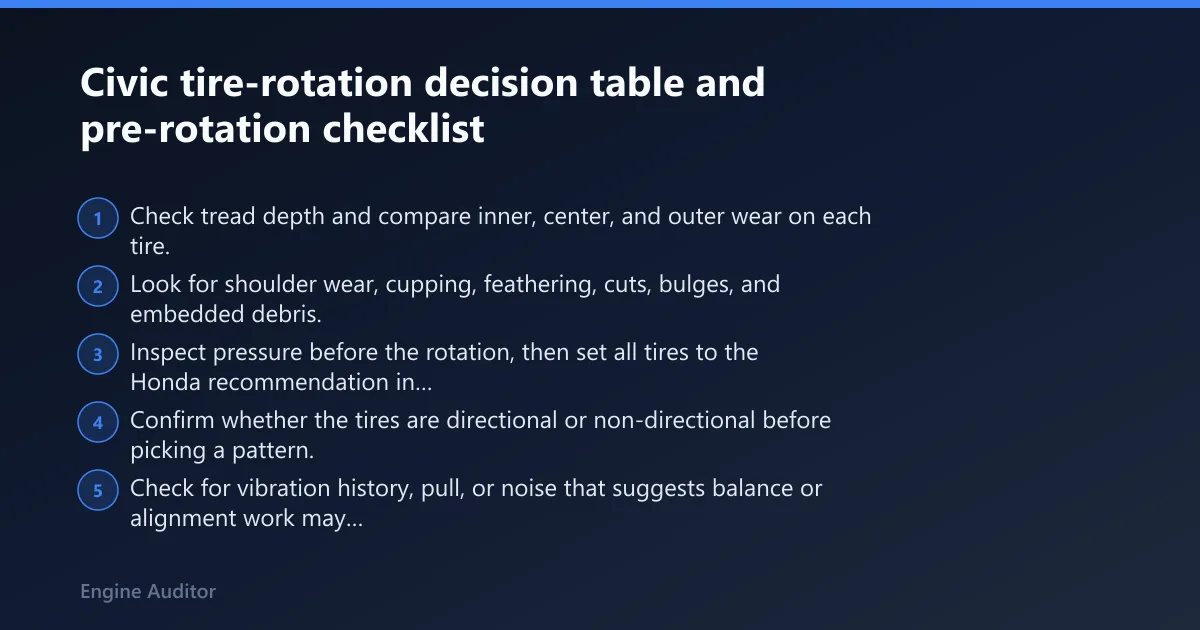
This table gives a practical decision path. Use the row that best matches the car, then follow the suggested interval and pattern. If the wear symptom is present, rotate now rather than waiting for the next service visit.
| Driving pattern | Tire type | Wear symptom | Best interval | Best pattern |
|---|---|---|---|---|
| Mostly highway commuting | Non-directional all-season | Even wear | 5,000-7,500 miles | Forward cross |
| Mostly city, short trips, stop-and-go | Non-directional all-season | Front shoulders wearing faster | 3,000-5,000 miles | Forward cross |
| Mixed use with heavy loads or rough roads | Non-directional all-season | Feathering or cupping | About 4,000-5,000 miles | Forward cross or rearward cross per service data |
| Winter tire season | Directional winter tires | Uneven edge wear | At each seasonal check | Side-to-side only unless remounted |
| Civic Si with more aggressive driving | Performance all-season or summer | Vibration, noise, traction loss | 3,000-5,000 miles | Pattern per tire maker or service data |
| Civic Hybrid with gentle use | Non-directional all-season | Light front wear imbalance | 5,000-7,500 miles | Forward cross |
Quick pre-rotation inspection checklist
- Check tread depth and compare inner, center, and outer wear on each tire.
- Look for shoulder wear, cupping, feathering, cuts, bulges, and embedded debris.
- Inspect pressure before the rotation, then set all tires to the Honda recommendation in the owner’s manual or door-jamb label.
- Confirm whether the tires are directional or non-directional before picking a pattern.
- Check for vibration history, pull, or noise that suggests balance or alignment work may also be needed.
- Verify that the wheel fasteners will be torqued to the Honda manual or service data after the work is done.
How to decide between rotate now and wait
Rotate now if the front pair is clearly wearing faster, the car pulls, or the tread is noisy or rough. Wait if wear is even, the tire type limits the pattern, and the service date is still near the planned interval. If in doubt, the safer choice is usually to rotate and record the mileage.
Can you rotate Honda Civic tires yourself?
Yes, many Civic owners can do a tire rotation themselves if they have the right tools, a level work area, and a clear pattern for their tire type. It is a reasonable DIY task on a normal Civic, but the work stops being simple if the car has uneven wear, a stuck wheel, or no torque wrench available.
Tools needed for a safe DIY rotation
A floor jack, jack stands, wheel chocks, a lug wrench, and a torque wrench are the core tools. A clean way to mark tire positions helps track wear over time. The owner’s manual or service data should be on hand before starting, because the correct lug nut torque must be confirmed after the wheels are back on.
Torque wrench use and lug nut recheck
After rotation, each lug nut should be tightened with a torque wrench to the specification in the manual or service data. This step matters. Guessing by feel can leave the wheel too loose or too tight. If the wheels were removed, a recheck after a short drive is a smart habit, especially after the first DIY attempt.
When a shop is the better option
A shop is the better call when the tires are directional, the wear is uneven enough to suggest alignment trouble, or the vehicle needs balancing at the same time. A shop is also useful when service records are missing and the owner wants the rotation pattern documented. That record helps plan the next interval with less guessing.
Frequently asked questions
How often should I rotate my Honda Civic tires?
Most Honda Civic tires should be rotated every 5,000 to 7,500 miles, with shorter intervals for city driving, stop-and-go use, or aggressive driving. If the front shoulders wear faster, do not wait for the upper end of the range. The tire condition matters more than the calendar or odometer alone.
Is 5,000 miles too early to rotate Civic tires?
No. For many Civics, 5,000 miles is a normal rotation point, especially if the car sees traffic, short trips, or rough roads. It may be early for mostly highway use with even wear, but it is rarely wasted maintenance. Early rotation is cheaper than replacing a front pair too soon.
Do Honda Civic tires need rotation every oil change?
Not automatically. Many owners match the two services because it is convenient, but the tire condition should decide the timing. If the oil change falls at 7,500 miles and the tread still looks even, that works. If the front tires are already wearing faster, rotate sooner.
What tire rotation pattern is best for a front-wheel-drive Civic?
For most front-wheel-drive Civics with non-directional tires, forward cross is the usual choice. It helps even out the heavier front wear. Directional tires are different and usually stay side-to-side only. If the tire sidewall or service data calls for another pattern, follow that instruction instead.
Should I rotate tires sooner if I drive mostly city miles?
Yes. City driving usually shortens the interval because of more braking, turning, and stop-and-go stress on the front tires. A Civic used mostly in town may need rotation closer to 3,000 to 5,000 miles. That helps keep the shoulders from wearing down before the rear tires catch up.
Does tire rotation help tire life and fuel economy?
Yes, rotation helps tire life by spreading wear more evenly, and that can delay replacement. It can also help fuel economy indirectly when the tires wear evenly and maintain better rolling behavior. The effect is not magic. The main benefit is balanced tread, better traction, and fewer early replacements.
Products related to this article
Sponsored / affiliate links. As an Amazon Associate I earn from qualifying purchases. I may earn additional commission from eligible campaigns.