
Ford Engine Oil Type by Model: How to Choose the Right One
Choose Ford engine oil by matching your model, engine, and market to the exact Ford WSS specification first, then confirm viscosity and API, ILSAC, or ACEA approval. The bottle must meet that spec, not only the grade. Wrong oil can trigger timing-chain wear, DPF or catalyst issues, cold-start noise, and warranty disputes. This guide shows the model-to-engine-to-market workflow that leads to the right WSS code, viscosity, and approval status.
Ford oil choice by model and engine
Ford says oil recommendations vary by model year, vehicle model, and engine. That means the badge on the tailgate is not enough. A Mustang, F-150, Bronco Sport, Maverick, and Super Duty can all need different oil even when the bottle looks close.
The three filters are model year, engine family, and market. Model year matters because Ford can change oil requirements at a changeover point. Engine family matters because a 2.5L hybrid, 3.5L EcoBoost, and 6.7L diesel do not share the same approval path. Market matters because Ford oil specifications can be market-specific.
Why model name alone is not enough
A trim name does not tell you the oil spec. The same nameplate can hide different engines, different emissions hardware, and different service requirements. Ford directs owners to the exact owner’s manual for the applicable oil, so that manual outranks a generic parts listing or a bottle claim.
Say your 2022 F-150 has the 3.5L EcoBoost. The manual example for that engine calls for SAE 5W-30 and WSS-M2C961-A1. A different F-150 engine in a different model year can call for something else, even though the truck badge stays the same.
What does your Ford owner’s manual say?
Your owner’s manual is the first authority for the oil recommendation. Use the oil specification section, not the marketing copy on the bottle. Look for three lines: SAE viscosity, Ford WSS code, and any API, ILSAC, or ACEA category that applies.
Find the oil recommendation section
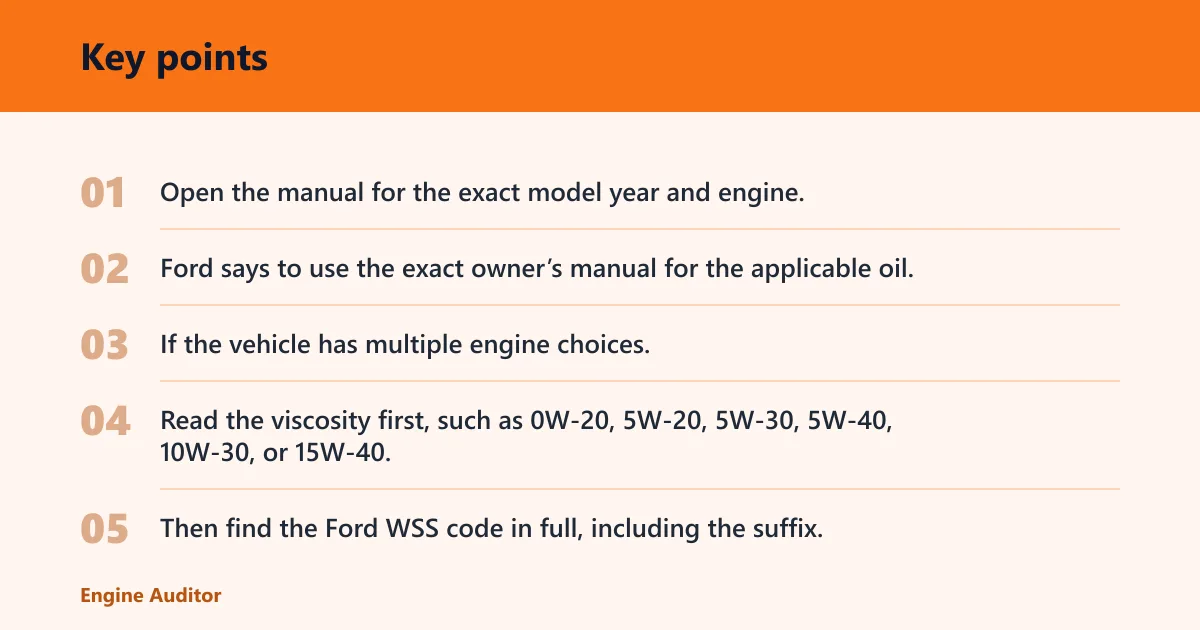
Open the manual for the exact model year and engine. The same source says to use the exact owner’s manual for the applicable oil, and that instruction matters more than brand familiarity or a shop counter recommendation. If the vehicle has multiple engine choices, make sure the engine listed matches the one under the hood.
Read the viscosity and approval lines exactly
Read the viscosity first, such as 0W-20, 5W-20, 5W-30, 5W-40, 10W-30, or 15W-40. Then find the Ford WSS code in full, including the suffix. The full code matters. The same source recommends treating the full WSS code as a requirement, not a suggestion.
FordParts can retrieve oil information by year, make, model, or VIN. That makes it a useful second check when the manual is missing, the vehicle changed hands, or the engine family is not obvious from the trim badge.
Ford WSS codes and what they mean
The Ford WSS code is the approval target. It is separate from the viscosity grade and separate from the API label. A bottle can carry the right SAE number and still miss the required Ford material specification. That is the common failure case to avoid.
Why the full code and revision suffix matter
The full code must match the exact engine and application. The suffix is not cosmetic. WSS-M2C961-A1 is a different target from WSS-M2C960-A1 or WSS-M2C962-A1, even though the codes look similar.
Common example codes include M2C961-A1, M2C960-A1, M2C962-A1, M2C931-C, and M2C171-F1. A later 6.7L manual commonly calls for WSS-M2C171-F1. A 2023 Super Duty 6.7L Power Stroke example uses that code with SAE 10W-30.
How a correct viscosity can still be the wrong oil
Viscosity only describes flow grade. It does not prove the oil meets the Ford requirement. An oil can be 5W-30, carry an API category, and still fail the exact Ford approval your engine needs. That is why the bottle must be checked against the manual and the technical data sheet.
A Ford oil label may show SAE viscosity, API category, and Ford material specification separately. Read all three. Do not treat the API line as a substitute for the Ford WSS code.
How to read viscosity grades on the bottle
SAE viscosity has two parts. The first number with W describes cold-start flow, and the second number describes operating-temperature viscosity. A lower first number helps cold cranking; the second number relates to film thickness when the engine is warm.
Cold-start rating versus operating-temperature rating
0W-20 and 5W-20 are both low-temperature grades, but they are not identical. 5W-40 and 10W-30 are thicker at operating temperature than 0W-20 or 5W-20. The manual decides which grade Ford wants, and the grade must match exactly.
When different SAE grades appear
Ford examples in the sourced data show how wide the spread can be. A 2024 Bronco Sport 1.5L EcoBoost example uses WSS-M2C960-A1 and SAE 5W-20. A 2022 Mustang Shelby GT500 5.2L example uses WSS-M2C931-C and SAE 5W-50.
Do not assume 5W-30 is right just because it appears often. It is correct for some Ford engines and wrong for others. If the manual calls for 0W-20 or 5W-20, buying 5W-30 because it is “close” is still a mismatch.
Ford oil decision checklist
Use this checklist before you put any bottle in the cart. It keeps the process tied to the vehicle, not the brand shelf tag. The order matters: model-year and engine first, then viscosity, then Ford approval, then the other category labels.
| Model/year | Engine | Market | Required SAE viscosity | Required Ford WSS code | API/ILSAC/ACEA category | Bottle/data-sheet verification step |
|---|---|---|---|---|---|---|
| 2022 F-150 | 3.5L EcoBoost | North America example | 5W-30 | WSS-M2C961-A1 | Check bottle for API category; verify manual for any additional requirement | Confirm the label and data sheet both show 5W-30 and WSS-M2C961-A1 |
| 2024 Bronco Sport | 1.5L EcoBoost | North America example | 5W-20 | WSS-M2C960-A1 | Check API category; market guidance may add another requirement | Match the bottle to the exact WSS code before buying |
| 2022 Maverick | 2.5L hybrid | North America example | 0W-20 | WSS-M2C962-A1 | Check API and any ILSAC category listed by the manual | Verify the bottle says 0W-20 and the same Ford code suffix |
| 2022 Mustang Shelby GT500 | 5.2L | North America example | 5W-50 | WSS-M2C931-C | Check API category and manual notes | Do not substitute a lower-viscosity performance oil without manual confirmation |
| 2023 Super Duty | 6.7L Power Stroke | North America example | 10W-30 | WSS-M2C171-F1 | Check diesel service category such as API CK-4 when listed | Match the bottle and data sheet to the diesel spec before purchase |
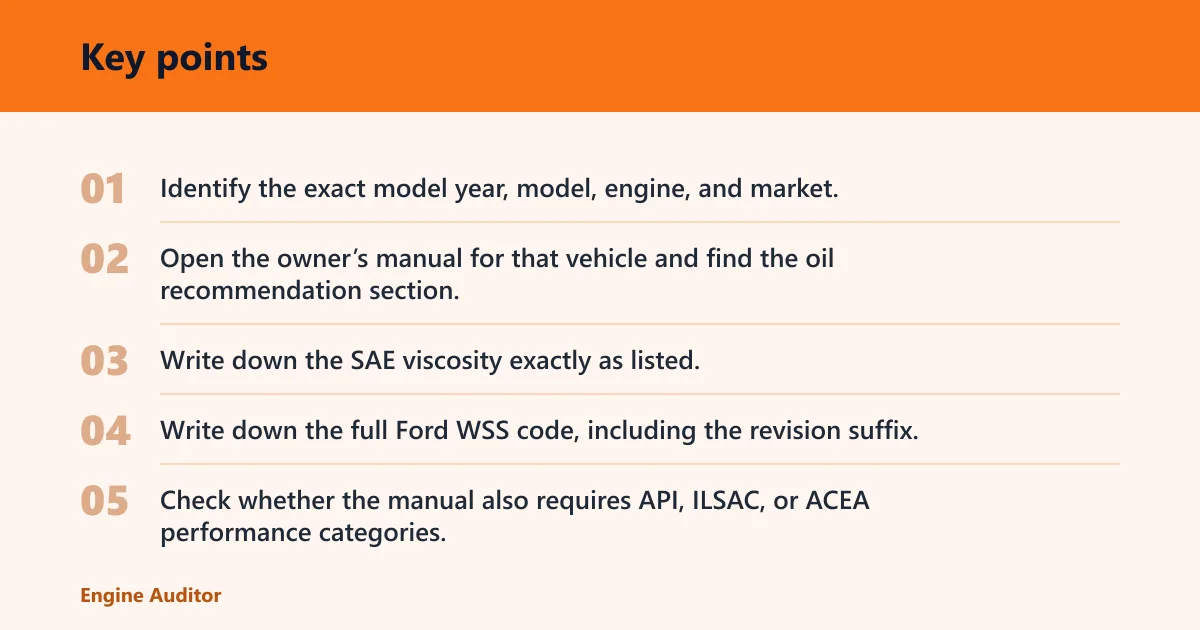
- Identify the exact model year, model, engine, and market.
- Open the owner’s manual for that vehicle and find the oil recommendation section.
- Write down the SAE viscosity exactly as listed.
- Write down the full Ford WSS code, including the revision suffix.
- Check whether the manual also requires API, ILSAC, or ACEA performance categories.
- Compare the bottle label to the manual line by line.
- Open the product data sheet and confirm the same SAE grade and same Ford WSS code.
- Buy only if the bottle and data sheet match the manual.
What to verify before purchase
Check the bottle, but do not stop there. Some labels present a Ford material specification in small print while the marketing front panel stresses the viscosity and brand name. The technical data sheet is where you can confirm whether the approval is current and whether the listed Ford code matches your exact application.
A common first-timer mistake is buying an oil because the front label says synthetic 5W-30. That may be the right viscosity and still be the wrong Ford approval. Another common mistake is assuming any oil with a Ford logo is approved for every Ford engine.
Can you use motorcraft oil in a Ford?
Motorcraft oil can be the right shortcut only when it matches the exact manual requirement. The brand does not replace the spec. You still need the correct SAE grade and the correct Ford WSS code for your engine and market.
When Motorcraft is the right shortcut
If the manual and the bottle agree on viscosity and WSS code, Motorcraft is a practical choice because it is built around Ford requirements. That said, the label still needs verification. A familiar brand is not a universal answer.
What to do if the label lists a different WSS code
If the bottle shows a different Ford code, do not assume it is close enough. The same source recommends treating the full code as a requirement. If the code does not match, leave it on the shelf even when the viscosity looks right.
Diesel and European Ford oil specs

Ford diesel applications use a different decision path from gasoline engines. The oil choice must account for soot loading, aftertreatment hardware, and the engine-specific Ford requirement. For some European-market Ford vehicles, ACEA categories may appear alongside the Ford code.
How diesel requirements differ from gasoline engines
Gasoline-engine guidance often centers on API and sometimes ILSAC. Diesel guidance can add API CK-4 and may involve different Ford WSS codes. Do not move a gasoline spec onto a diesel engine just because the viscosity number looks plausible.
What to verify for a 6.7L Power Stroke
Later 6.7L manuals commonly call for WSS-M2C171-F1. A 2023 Super Duty 6.7L Power Stroke example uses that code and SAE 10W-30. Because Ford diesel requirements can change by model year and calibration, verify the exact manual and the VIN-specific lookup before buying oil.
FordParts can retrieve oil information by year, make, model, or VIN. That is especially useful when a Super Duty has had an engine, emissions, or model-year transition that makes a generic parts listing risky.
When ACEA categories matter
ACEA can matter on European-market Ford vehicles or on applications where Ford pairs an ACEA category with its own approval. That category is not a substitute for the Ford WSS code. Treat it as an additional filter, not the first one.
Frequently asked questions
What oil does my Ford take by model and engine?
Use the exact model year, engine, and market from the owner’s manual or a VIN-based lookup. The same source says oil recommendations vary by model year, vehicle model, and engine. FordParts can retrieve oil information by year, make, model, or VIN, which helps narrow the answer before you buy.
Is 5W-30 the right oil for my Ford?
Sometimes, but not always. Follow the manual, not the most common shelf grade.
How do I find the Ford WSS spec on my owner’s manual?
Open the oil recommendation section for the exact model year and engine. Look for the full Ford WSS code, including the suffix, alongside the SAE viscosity. The same source recommends treating the full code as a requirement, so copy it exactly before shopping.
Can I use synthetic oil in my Ford instead of conventional oil?
Synthetic oil may be acceptable or preferred, but it is not automatically approved. The deciding factors are the exact SAE viscosity and the Ford WSS code in the manual. If the bottle does not meet both, the oil is not the right choice, no matter the base stock.
Do different Ford EcoBoost engines use different oil specs?
Yes. EcoBoost is not one oil rule. Engine family and model year both matter.
What is the difference between API, ILSAC, and Ford WSS oil specs?
API, ILSAC, and ACEA are performance categories, while Ford WSS is Ford’s own material specification. A Ford oil label may show all of them separately. The key point is simple: API, ILSAC, or ACEA does not replace the Ford WSS code, and the Ford code still has to match.
Can I use Motorcraft oil in my Ford?
Yes, if the exact Motorcraft product matches the manual’s SAE viscosity and Ford WSS code. The brand alone is not enough. Check the bottle and the data sheet, and do not buy it if the code on the label differs from the manual.
How do I choose oil for a Ford diesel like the 6.7 Power Stroke?
Start with the exact model year and engine, then verify the manual and VIN-based lookup. Diesel requirements are not interchangeable with gasoline requirements.
What should I check besides viscosity before buying Ford oil?
Check the full Ford WSS code, the model year, the engine, the market, and any API, ILSAC, or ACEA category listed by the manual. Then confirm the same information on the bottle and the technical data sheet. A matching viscosity alone does not make the oil right.
Products related to this article
Sponsored / affiliate links. As an Amazon Associate I earn from qualifying purchases. I may earn additional commission from eligible campaigns.