Can Dirty Oil Trigger Engine Problems? Signs to Watch
Dirty oil can trigger engine problems when it comes with low oil pressure, knocking, ticking, sludge, or a burning smell. Dark color alone is normal, but metal flakes, thick deposits, or warning lights mean inspect it now. Ignore those signs and you can turn a cheap oil change into bearing, lifter, or turbo damage. This guide shows which oil symptoms are harmless, which demand immediate action, and when diagnostics beat another drain-and-fill.
What dirty oil means


Dirty oil is not one condition. It can be dark from heat and normal use, or it can carry soot, fuel, moisture, coolant, or oxidation products that change flow and film strength. The difference matters because a dark dipstick reading may be normal, while contaminated oil can stop protecting moving parts.
Dark oil versus contaminated oil
Fresh oil starts amber and gets darker as additives age and suspend particles. That alone does not prove damage. The trouble starts when the oil also smells burnt, feels unusually thin or gritty, looks milky, or leaves sludge under the cap.
Main contamination types
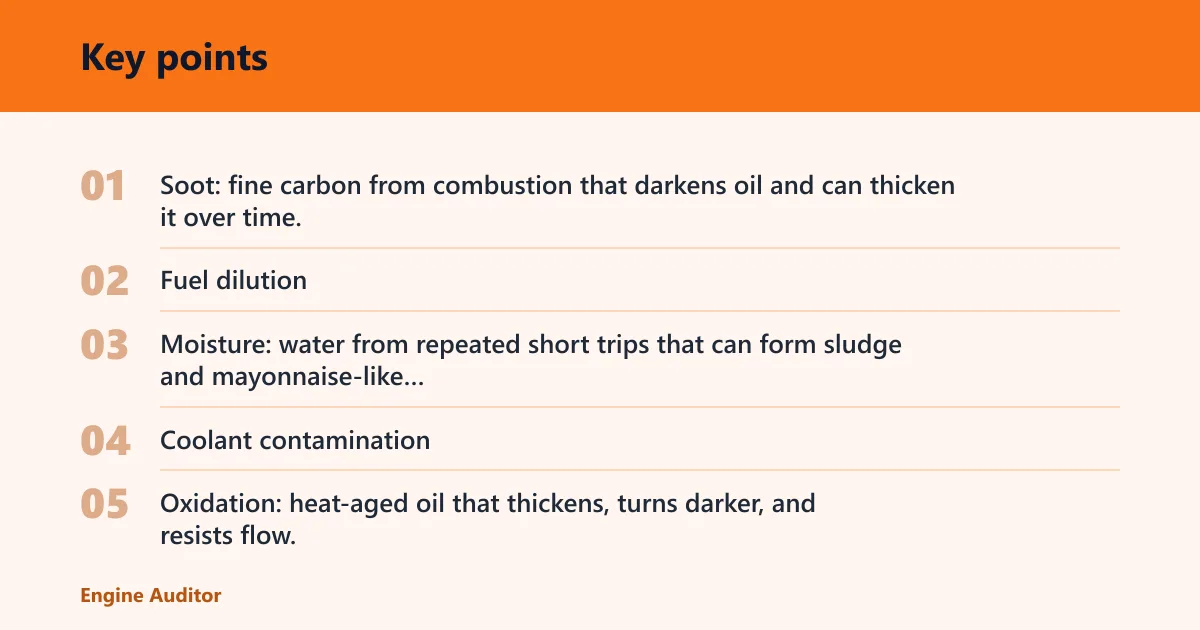
- Soot: fine carbon from combustion that darkens oil and can thicken it over time.
- Fuel dilution: raw fuel in the crankcase that thins oil and cuts film strength.
- Moisture: water from repeated short trips that can form sludge and mayonnaise-like deposits.
- Coolant contamination: coolant leak into oil, often seen as milky oil or a creamy residue.
- Oxidation: heat-aged oil that thickens, turns darker, and resists flow.
- Sludge: hardened deposits from oxidized oil, contaminants, and long intervals.
- Viscosity loss: oil that has thinned too much to hold a strong lubricating film.
Why viscosity and film strength matter
Your engine oil must match the SAE grade listed by the manufacturer because that grade is chosen for bearing clearance, pump output, and temperature range. If oil thins from fuel dilution or shears down, it can escape from bearings too easily. If it thickens from oxidation or sludge, it may not reach lifters and cam phasers fast enough.
Can dirty oil trigger engine problems?
Dirty oil can trigger problems when contamination changes viscosity, blocks flow, or leaves deposits in passages and control valves. The result can be ticking, rough idle, low oil pressure, higher wear, and in severe cases bearing damage. A dirty-looking sample is not always dangerous, but dirty oil with symptoms is a warning.
How dirty oil affects lubrication
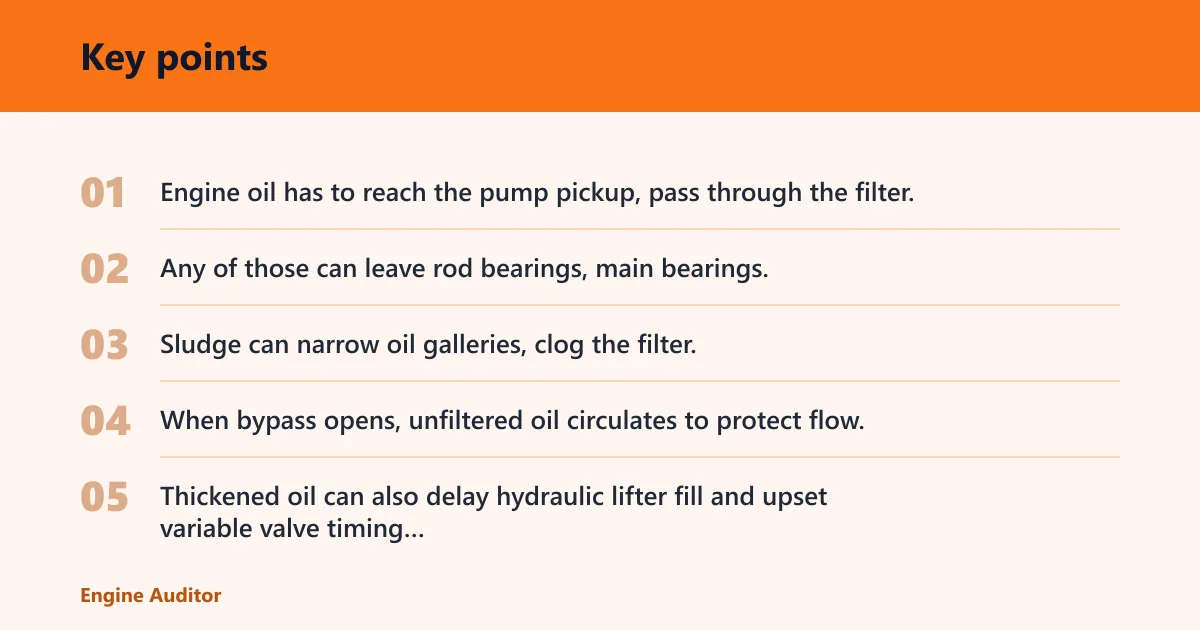
Engine oil has to reach the pump pickup, pass through the filter, and feed the pressure system without losing film strength. Fuel dilution lowers viscosity. Oxidation raises it. Soot and sludge can reduce circulation. Any of those can leave rod bearings, main bearings, and valvetrain parts with less protection.
How sludge and thickening restrict flow
Sludge can narrow oil galleries, clog the filter, and push the filter into bypass valve operation. When bypass opens, unfiltered oil circulates to protect flow, but that also means more debris can reach wear surfaces. Thickened oil can also delay hydraulic lifter fill and upset variable valve timing control.
What happens to bearings and valvetrain parts
Rod bearings and main bearings rely on a stable oil film. If the film gets too thin, metal contact increases and knock risk rises. Hydraulic lifters, cam phasers, and VVT solenoids are also sensitive to varnish and sludge, which can cause ticking, slow phasing, or erratic idle quality.
Dirty oil symptom table
Use the pattern, not one clue alone. Dark color with no other symptoms often points to normal aging. Dark color plus smell, noise, pressure loss, or milkiness points toward contamination that needs action now.
| Sign | Likely contamination or issue | Urgency | Next check |
|---|---|---|---|
| Dark oil | Normal aging, soot, or oxidation | Monitor unless other symptoms appear | Check level, service date, and service interval |
| Burnt smell | Oxidation, overheating, or extended interval | Inspect soon | Check oil level, look for sludge, consider oil analysis |
| Ticking | Low film strength, lifter noise, oil starvation | Immediate inspection if persistent | Check level and pressure light; listen for valve-train noise |
| Low oil pressure light | Low level, pump issue, clogged pickup, severe sludge | Stop driving | Shut down and diagnose pressure system |
| Milky oil | Coolant contamination or moisture | Urgent | Check coolant loss, cap residue, and head-gasket signs |
| Sludge under cap | Oxidation, moisture, long intervals, short-trip use | Inspect soon | Check for restricted flow and overdue service |
| Rough idle | Dirty VVT solenoid, oil control issue, misfire from oil contamination | Inspect soon | Scan for codes and verify oil condition |
| Oil consumption | Burning oil, leaks, worn seals, fuel dilution masking level loss | Inspect soon | Check level often and look for external leaks or blue smoke |
What signs should you watch?
The most useful clues are combinations. Burnt smell, ticking, rough idle, or oil use matter more than color alone. If a pressure light appears, or if the engine sounds dry or noisy, treat that as a lubrication problem until proven otherwise.
Burnt smell, ticking, and rough idle
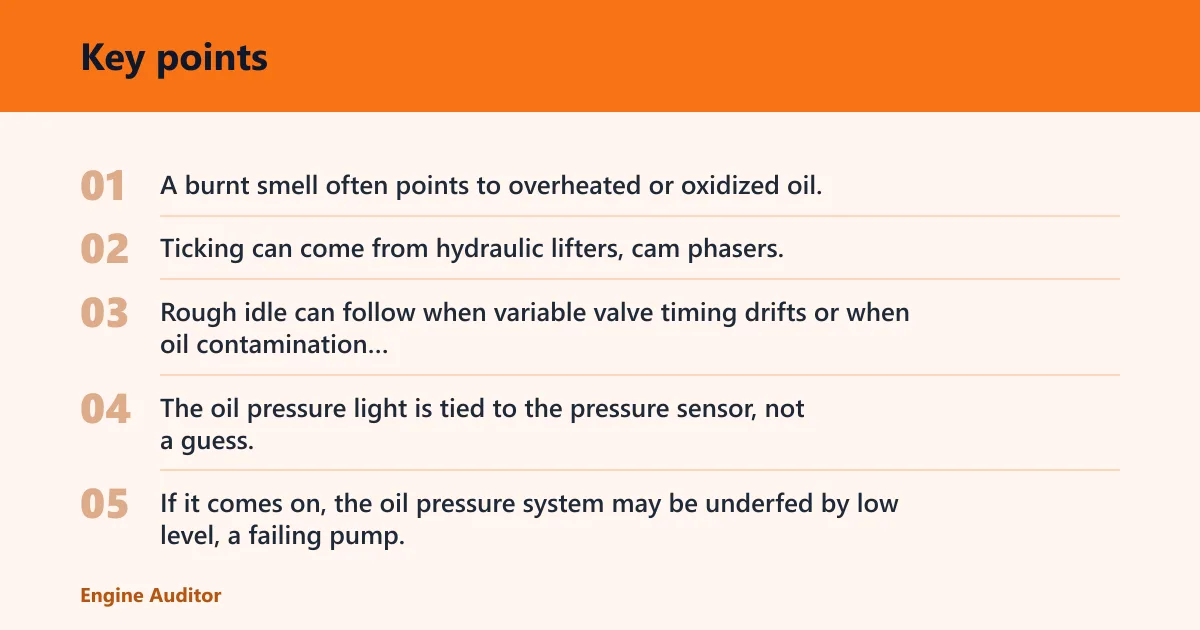
A burnt smell often points to overheated or oxidized oil. Ticking can come from hydraulic lifters, cam phasers, or VVT solenoids that are not getting clean oil fast enough. Rough idle can follow when variable valve timing drifts or when oil contamination contributes to misfire or airflow control issues.
Low oil pressure light and pressure loss
The oil pressure light is tied to the pressure sensor, not a guess. If it comes on, the oil pressure system may be underfed by low level, a failing pump, a clogged pickup, or sludge. Because bearings depend on pressure-fed lubrication, stop the engine and diagnose the cause.
Milky oil and sludge under the cap
Milky oil often points to coolant contamination or water intrusion. Sludge under the cap suggests oxidation or repeated condensation from short trips. Neither should be dismissed as normal darkening. Both can signal a problem that needs more than a simple drain-and-fill.
Say your compact SUV has 4,000 miles on the oil but starts ticking after a week of five-minute trips. The dipstick shows dark oil, and the cap has tan sludge. That pattern fits moisture and sludge buildup more than ordinary color change, so the next step is a full inspection, not just a glance at the dipstick.
Suppose a 3.5-liter V6 idles rough after a long highway run and the dipstick smells like fuel. The oil looks thin, not thick. That points more toward fuel dilution than oxidation, so the concern is viscosity loss and poor film strength, not just old oil color.
Is dark oil always bad?
No. Dark oil alone is often normal and does not prove engine damage. Oil turns darker as it collects soot, heat byproducts, and suspended contaminants. What matters is whether the oil still has the right level, smell, consistency, and service history for the engine.
Normal darkening from heat and use
Many engines darken oil quickly, especially if they run hot or use detergents that hold soot in suspension. A dark dipstick reading with clean smell, normal level, and no symptoms can still be acceptable if the oil change interval is within the manufacturer recommendation.
How to inspect the dipstick correctly
- Park on level ground.
- Let the engine sit long enough for the reading method in the owner’s manual.
- Pull the dipstick, wipe it, reinsert it fully, then read again.
- Check color, smell, level, and whether the oil looks gritty, foamy, or milky.
- Compare the result with mileage, months, and driving style.
Oil change timing
The starting point is the owner’s manual, not the dipstick color. Most manufacturers list a mileage interval, a time interval, or both. Severe service shortens that schedule, especially with short trips, stop-and-go traffic, long idling, towing, or dusty conditions.
Miles and months as the starting point
For many cars, a common rule of thumb is around 5,000 to 7,500 miles or 6 to 12 months, whichever comes first, but the manual takes priority. If the engine sees repeated short trips or heavy idle time, oil ages faster because moisture and fuel stay in the crankcase longer.
Severe-service schedules for short trips and idling
Short-trip driving never lets oil reach full operating temperature for long. That encourages moisture, fuel dilution, and sludge. Idling-heavy use can also slow contaminant evaporation. If that is your pattern, follow the severe-service schedule in the manual, even if mileage is low.
Why the filter change matters too
The oil filter is part of the fix, not an extra. Its filtration efficiency falls as it loads up with debris. If it clogs, the bypass valve can open and send unfiltered oil through the engine. Change the filter at the same interval as the oil unless the manual says otherwise.
Oil analysis and diagnosis
Used oil analysis is the cleanest way to move from guessing to diagnosis. A report can show viscosity, fuel dilution, wear metals, coolant markers, and contamination levels. That is useful when symptoms repeat, when intervals are tight, or when a noisy engine needs a better answer than “the oil looks dark.”
What a used oil report can show
A report can indicate whether the oil is too thin from fuel dilution, too thick from oxidation, or contaminated with coolant. It can also flag wear metals that suggest bearing, ring, or valvetrain wear. That helps separate a simple service issue from a mechanical fault.
How to compare viscosity and contamination markers
Compare the measured viscosity to the SAE grade the engine calls for. If the oil has drifted far from spec, protection may be compromised. Also look at fuel dilution and coolant markers, because those can explain noise, pressure loss, or sludge better than color alone.
When diagnosis is better than guessing
If the engine has a pressure light, repeated ticking, milkiness, or sludge, a basic oil change may not be enough. Diagnostics are the better choice when the symptom points beyond aged oil and toward a pressure, cooling, or sealing fault.
Frequently asked questions
Can dirty oil cause engine knocking or ticking?
Yes. Dirty oil can lead to ticking if hydraulic lifters, cam phasers, or VVT solenoids do not get clean oil quickly. Severe low film strength can also contribute to bearing knock. If the noise is persistent or loud, do not keep driving and hoping it clears.
Will dark oil always mean I need an oil change?
No. Dark oil can be normal if the level is correct, the smell is normal, and the service interval is still within spec. What matters is the whole picture: mileage, months, driving pattern, and whether you also see noise, smoke, sludge, or pressure warnings.
Can dirty oil make oil pressure drop?
Yes. Fuel dilution can thin oil, while sludge and oxidation can restrict flow. Either problem can reduce effective pressure at the bearings. A pressure light calls for prompt diagnosis, because low oil pressure can damage rod bearings and main bearings quickly.
Can dirty oil trigger overheating or rough running?
It can contribute. Thickened oil may slow flow through VVT parts and lifters, which can affect idle quality and performance. If contamination is severe, friction rises and heat management can suffer. Check for level loss, cooling problems, and codes instead of assuming the oil alone is the issue.
How do I know if the problem is dirty oil or low oil level?
Check the dipstick first. Low level can mimic dirty-oil symptoms by starving the pump and lowering pressure. If the oil is at the correct mark but looks milky, smells burnt, or has sludge, the issue is contamination. If the level is low, fix that before anything else.
How often should I change oil if I do short trips or stop-and-go driving?
Use the severe-service schedule in the owner’s manual. Short trips and stop-and-go use shorten oil life because the engine spends more time cold or partially warmed up. In that use pattern, months matter as much as miles, and the filter should be changed with the oil.
Products related to this article
Sponsored / affiliate links. As an Amazon Associate I earn from qualifying purchases. I may earn additional commission from eligible campaigns.
 ACROPIX Engine Oil Level Indicator Dipstick for Ford Fusion 2010-2012 for Ford Escape 2010-2012 for Ford Fusion 2006-2007 No.6E5Z6750AC Car Parts
 DongJinK Engine Oil Level Gage Dipstick Compatible with Toyota 4Runner 1984-1995 for Toyota Celica 1984-1985 for Toyota Pickup 1984-1995 Replace# 15301-35020 1530135020