How to Read an Oil Dipstick Correctly Every Time
Check the oil on level ground, wait about 5–10 minutes after shutdown unless the owner’s manual says otherwise, seat the dipstick fully, and read both sides; the level should sit between the MIN and MAX marks, ideally near the middle. Vehicle-specific instructions can differ by make, model, engine, and whether the check is hot or cold, so the owner’s manual or OEM service procedure always overrides generic timing advice. A bad reading can hide low oil, trigger overfilling, or send you chasing a problem that is only a bad check. This guide shows how to avoid slope, timing, seating depth, and smear errors, then interpret unclear marks correctly.
Checking procedure and timing
Use the manual first if it gives a specific method. Some engines call for a hot check, some allow a cold check, and some specify a wait time after shutdown that differs from the usual 3 to 5 minutes. OEM procedures and owner manuals also vary on whether the engine should be idling briefly before shutdown or checked only after a defined soak period, so the exact procedure matters more than any generic rule of thumb.
You need a lint-free rag or paper towel, the owner’s manual or service guide, a level parking spot, and gloves if the engine is hot. The dipstick itself may use lines, dots, holes, crosshatch, or letters such as MIN and MAX, so treat the mark style as a measurement scale, not decoration. On many designs, the safest reading is the one that is clear, repeatable, and centered in the marked range rather than barely touching one end of it.
What you’ll need
- Lint-free rag or paper towel
- Owner’s manual or service guide
- Level parking spot
- Gloves if the engine is hot
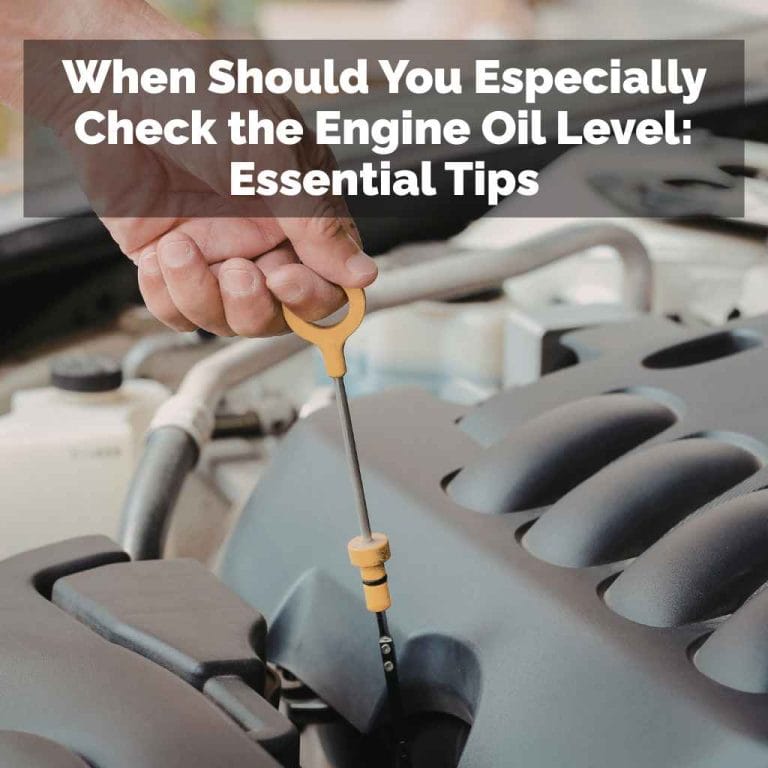
Park on level ground, shut the engine off, let the oil settle, then pull the dipstick, wipe it clean, fully reinsert it, and pull it again for the real reading. The first pull is mainly for cleaning the stick. The second pull is the one that matters. Typical wait times vary by engine and oil return path, but many owner manuals call for a short delay after shutdown so oil can drain back into the pan before the reading is taken.
Some manufacturers specify a warm check, and others allow a cold check only if it is done the way the manual describes. For example, SAE and OEM service guidance recognize that drain-back, temperature, and crankcase design affect the measured level, which is why the same engine can read differently if you check it too soon or on the wrong surface.
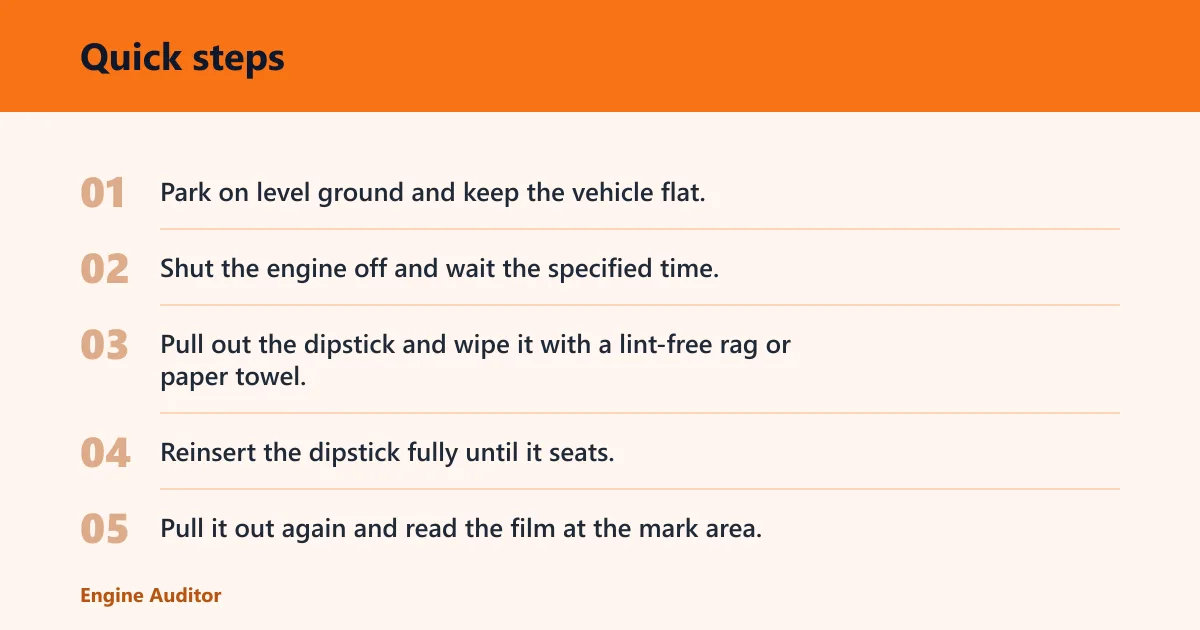
- Park on level ground and keep the vehicle flat.
- Shut the engine off and wait the specified time.
- Pull out the dipstick and wipe it with a lint-free rag or paper towel.
- Reinsert the dipstick fully until it seats.
- Pull it out again and read the film at the mark area.
- Check both sides of the stick if the line is faint or uneven.
- Add oil only if the level is below MIN, then recheck after each addition.
What the marks on the dipstick mean
The safe range is the area between the low and high marks. Manufacturer guidance generally treats the full marked span as the acceptable band, but the exact meaning of the marks can vary by engine, and some OEMs note that the span itself may represent a defined volume. That means the level should not sit below MIN or L, and it should not rise above H or MAX.
Some dipsticks use two holes, some use a hatched area, and some use a single pair of marks. If the oil covers the hatched area or sits between the marks, the level is in range. If the oil is near the middle, the reading is usually easier to trust than one that barely kisses a mark. A centered reading also gives you room for normal consumption between checks without drifting out of range immediately.
| Condition | Symptom | Likely error source | Correction | Trustworthy reading looks like |
|---|---|---|---|---|
| Flat ground | Level changes from one check to the next | Car parked on a slope | Move to level ground and repeat the check | The film settles in the same place on repeated checks |
| Wait time after shutdown | Reading seems high right after stopping | Oil has not settled yet | Wait 3 to 5 minutes, or use the manual’s timing | The line becomes shorter and more defined after the wait |
| First-pull wipe | Oil line looks smeared or streaked | Old film left on the stick | Wipe clean with a lint-free rag or paper towel | The second pull shows a clean, continuous film |
| Full reinsertion | Oil line looks too low or uneven | Dipstick not fully seated | Push the stick fully home, then pull it again | The same mark appears each time the stick is fully seated |
| Reading orientation | One side shows a different line than the other | Reading only one face of the stick | Check both sides and use the clearer mark | One face will usually show a sharper edge or cleaner transition |
| Unclear oil line | Faint, ragged, or diagonal film | Smear, splash, or recent shutdown | Repeat the wipe-and-read cycle and compare both sides | The film is narrow, even, and easy to place within the marks |
| Hot-check-only vehicle | Cold reading does not match the manual | Wrong temperature condition for that engine | Warm the engine and follow the stated hot-check method | The reading is taken at the temperature and soak time the manual specifies |
| No-dipstick vehicle | No manual stick is available | Electronic oil-level system instead of a dipstick | Use the dash or menu procedure in the owner’s manual | The display confirms the level only when the required conditions are met |
Why your reading looks unclear
An unclear reading usually comes from one of four things: the stick was not fully seated, the oil was checked on a slope, the engine was shut off too recently, or the film is smeared on one side more than the other. A single muddy line is not enough to trust, especially when the level is close to the marks or when the crankcase design makes drain-back slower than average.
Say your sedan is parked on a driveway that tilts slightly, and the dipstick shows a long streak instead of a clear mark. Move to a flat lot, wait again if the engine was just shut off, then repeat the full wipe-and-reinsert cycle. If the second reading is still vague, use the cleaner side of the stick. If both sides remain unclear, consult the manual or service information before adding oil, because a smeared reading can be a procedure problem rather than an actual low-oil condition.
Common mistakes
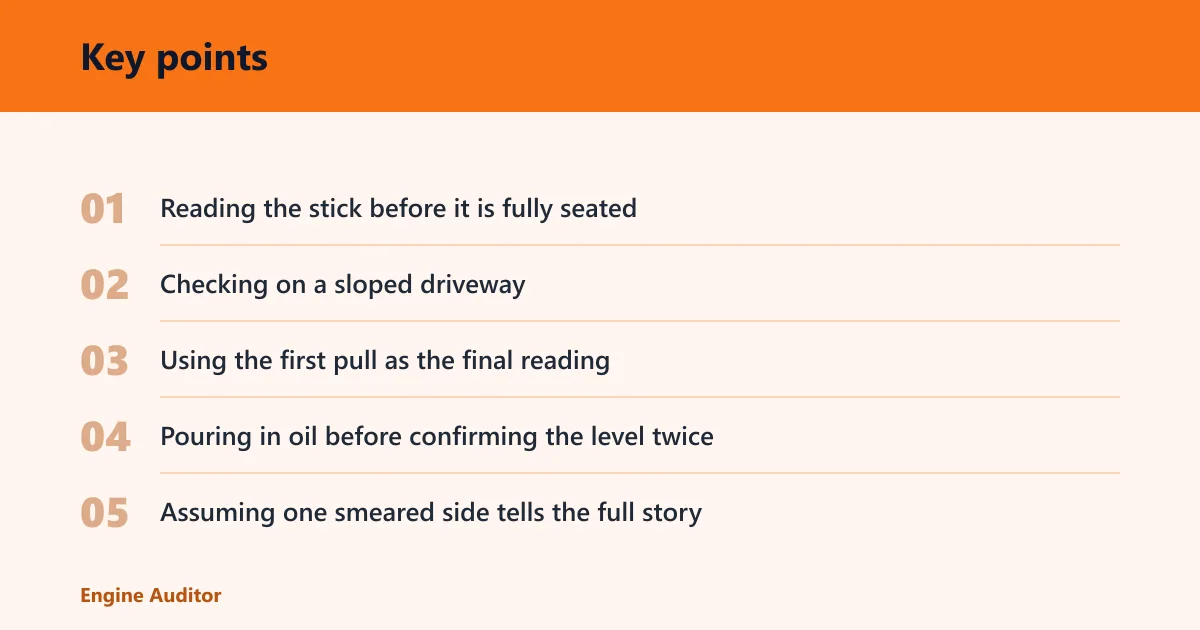
- Reading the stick before it is fully seated
- Checking on a sloped driveway
- Using the first pull as the final reading
- Pouring in oil before confirming the level twice
- Assuming one smeared side tells the full story
What to do if oil is low or high
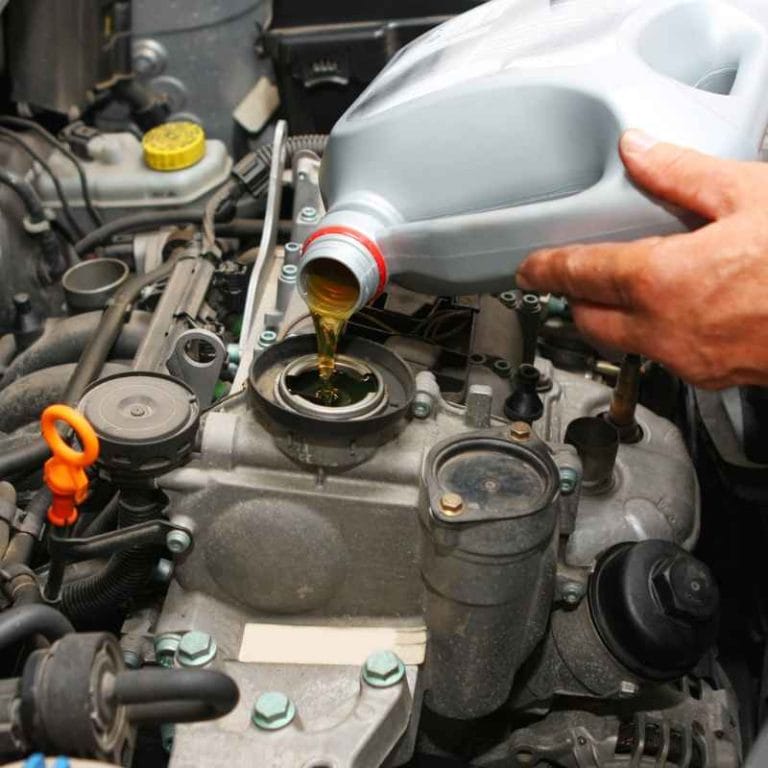
If the oil is below MIN, add oil in measured steps and recheck after each addition. Do not pour in a full quart unless the manual and the gap clearly call for that much. A common rule is to add about 1/4 quart at a time when the level is only slightly low, then check again after a short wait. That approach reduces the risk of overshooting the target, which matters because many engines hold only a narrow margin between safe and too much.
If the oil is above MAX, stop driving blindly and correct it by the proper method. Too much oil can aerate, foam, increase crankshaft windage, and in some engines contribute to seal stress or oil consumption problems, so the level should be brought back into range rather than ignored. OEM service information is the right source for the draining method, because the correct fix depends on the engine and on how far above the mark the level sits.
Suppose a compact car shows oil just below MIN after a morning check. Add 1/4 quart, seat the dipstick fully, and read it again after the oil settles. That keeps you from overshooting the safe range on the first top-up.
If that didn’t work, try this next
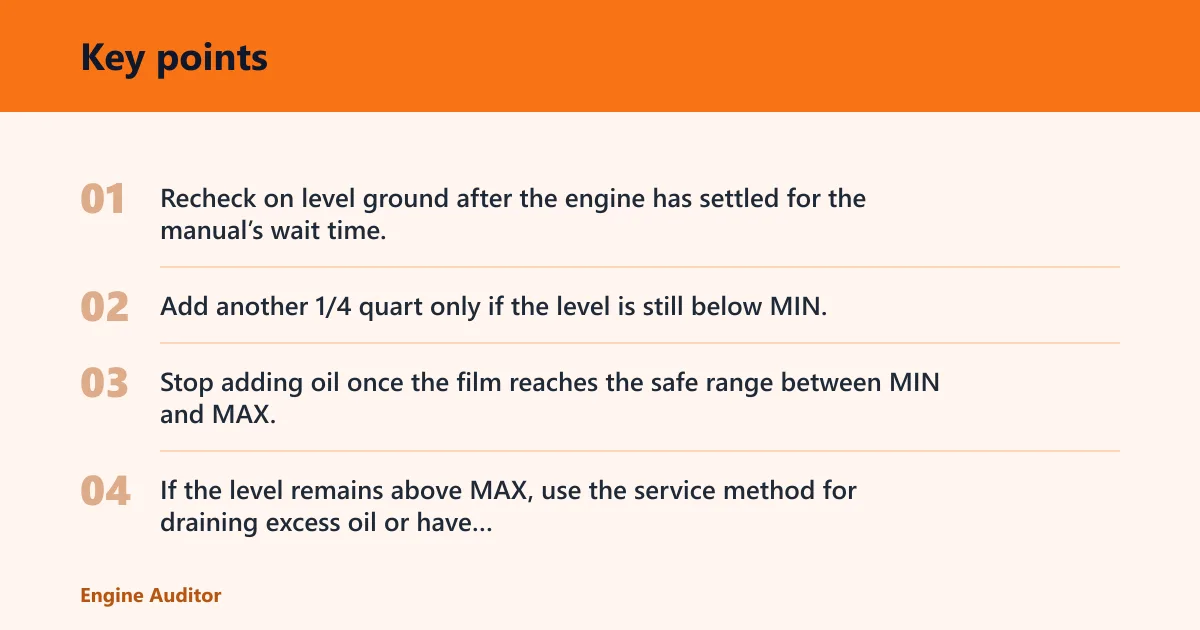
- Recheck on level ground after the engine has settled for the manual’s wait time.
- Add another 1/4 quart only if the level is still below MIN.
- Stop adding oil once the film reaches the safe range between MIN and MAX.
- If the level remains above MAX, use the service method for draining excess oil or have it corrected.
Oil condition clues to watch
Oil color alone does not tell the whole story. Normal darkening is common, especially after the oil has been in service for a while. Dark oil can still be usable if the level is correct and the engine is running normally, and the reverse is also true: light-looking oil is not automatically healthy if it is diluted, aerated, or contaminated.
Look harder at the texture and smell. Milky oil can point to coolant contamination, fuel smell can suggest dilution, and foaming can mean air is mixed into the oil. Those signs need context and manual guidance, not guesswork from color alone. If the oil level also seems unstable or unexpectedly high, that can support a contamination or overfill concern and should be checked against the manufacturer’s diagnostic procedure.
Hot versus cold checks
Should you check oil hot or cold? Check it the way the manufacturer specifies. Some engines want a warm check, and some allow a cold check as a quick reference. A cold reading can sit higher or lower than a hot one because oil expands and contracts with temperature, and because drain-back behavior changes as the oil cools.
For hot-check-only vehicles, use the stated warm-up and shutdown procedure. Some OEMs call for a brief idle before shutdown, others call for a timed wait after shutdown, and some require the engine to be fully off before the level is displayed or read. That is why the manual overrides any generic advice.
What if your vehicle has no dipstick?
Some cars have no dipstick and rely on an electronic oil level sensor instead. In that case, use the dash menu or the owner’s manual procedure, since the factory may not provide a manual stick check at all. Do not keep searching for a dipstick that is not there.
Look for the oil level display in the vehicle’s information menu, often under vehicle status or service information. If the display is unclear or the warning lamp appears, check the manual for the exact on-screen path and the required conditions, such as engine temperature, ignition state, engine run time, vehicle level, or parking brake setting. OEM guidance commonly requires the car to sit within a narrow set of conditions before the sensor result is considered valid.
Frequently asked questions
How do I read an oil dipstick correctly?
Use level ground, wait for the oil to settle, wipe the stick clean, fully reinsert it, and read the second pull. The oil film should sit between MIN and MAX, or between the bottom and top marks. If the line is faint, read both sides and repeat the check before adding oil.
How do I check oil with a dipstick?
Park flat, shut the engine off, wait the specified time, pull the dipstick, wipe it, reinsert it fully, and pull it again. Then compare the wet line to the marked range. If the vehicle needs a hot check, follow that sequence after the engine is warm and shut down.
What does the oil level on a dipstick mean?
The mark shows whether the engine is within its safe range. Below MIN or L means the level is low and needs oil added in steps. Above MAX or H means there is too much oil and the level should be corrected, not ignored.
Should I check oil hot or cold?
Use the method named in the owner’s manual. Some engines call for a hot check, and some allow a cold check as a reference. To wait 3 to 5 minutes after shutdown, but that wait does not replace a vehicle-specific procedure.
Why does my dipstick reading look unclear?
Unclear lines usually come from a slope, a stick that was not fully seated, or oil that has not settled yet. Wipe and recheck, then compare both sides of the dipstick. If the mark still looks ragged, use the manual’s method again before adding oil.
What should I do if the oil level is below MIN?
Add oil in measured amounts, then recheck after each addition. A practical starting amount is about 1/4 quart when the level is only slightly low. Stop once the film reaches the safe range between MIN and MAX, because a low reading does not always mean a full quart is needed.
Products related to this article
Sponsored / affiliate links. As an Amazon Associate I earn from qualifying purchases. I may earn additional commission from eligible campaigns.