Why Is My Oil Level Dropping Without a Leak?
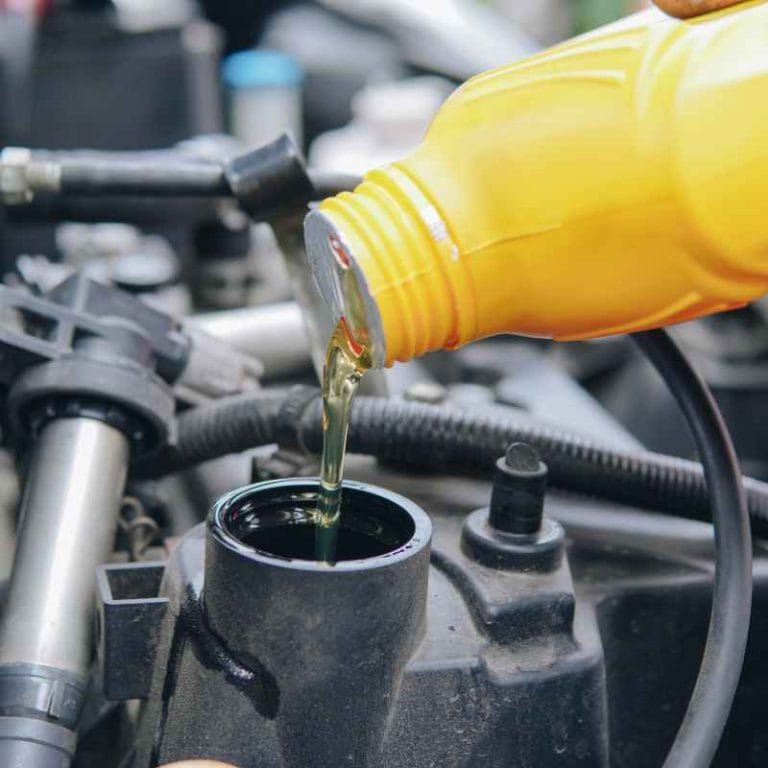
Your oil level is dropping because the oil is being burned, pushed into the intake, leaking past seals, or escaping through a bad PCV system. If you add about 1 quart every 1,000 miles or less, treat it as abnormal. Ignore it and you can damage bearings, foul plugs, or trigger catalytic converter failure. This guide explains the main routes, the symptom patterns that identify each one, and how engine design changes the odds.
Why is my oil dropping?
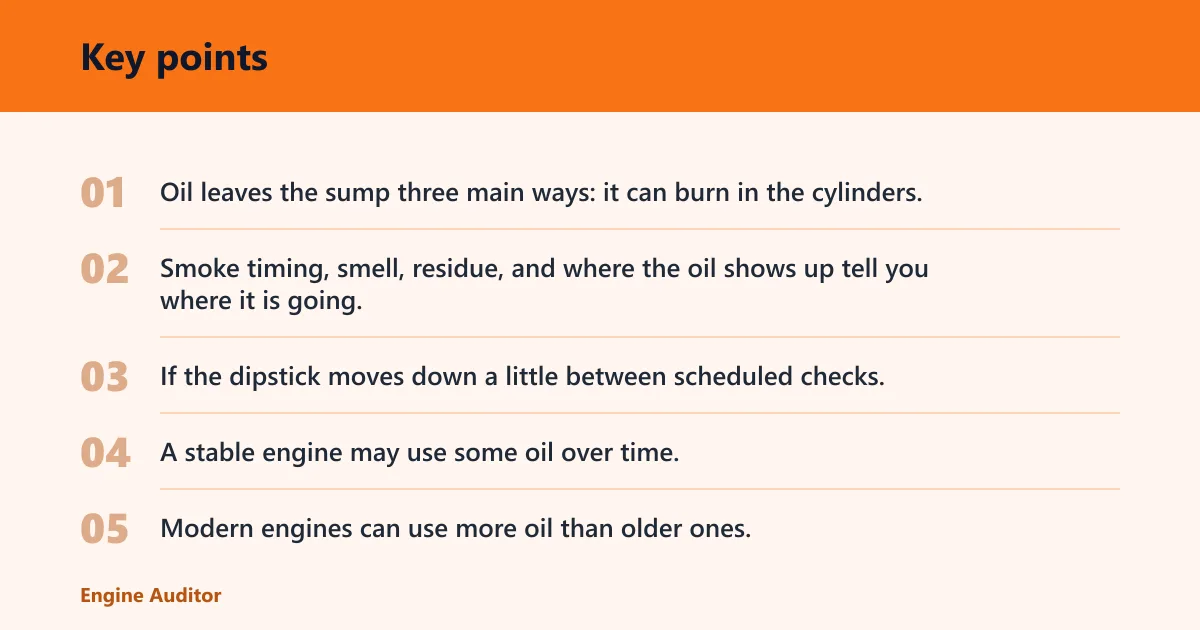

Oil leaves the sump three main ways: it can burn in the cylinders, move through the crankcase ventilation path, or leak onto hot engine parts and burn off before it reaches the ground. The pattern matters more than the puddle. Smoke timing, smell, residue, and where the oil shows up tell you where it is going.
What a small drop means
A small drop can still be worth documenting. If the dipstick moves down a little between scheduled checks, note the mileage and how much you topped off. A stable engine may use some oil over time, but repeated top-offs between oil changes are no longer normal maintenance noise.
Modern engines can use more oil than older ones, especially turbocharged and direct-injection designs. Turbo heat, higher cylinder pressure, tighter ring packages, and long drain intervals can all change consumption. Wrong viscosity, overdue changes, and fuel dilution can also push oil use higher than expected.
When the drop is no longer normal
A practical rule of thumb is that if you are adding about 1 quart every 1,000 miles or less, treat the loss as abnormal and start diagnosing it. A sudden drop is usually more urgent than a slow trend. If the low-oil warning light comes on, do not keep driving.
Suppose the dipstick loses half a quart over 500 miles after years of stable readings. That is worth logging. If it then drops another half quart in the next 300 miles, the pattern has changed enough to justify inspection before the level reaches the add mark again.
Where the oil is going
| Symptom pattern | Likely path | First inspection point | Stop-driving threshold | Next test to perform |
|---|---|---|---|---|
| Cold-start blue smoke after sitting | Valve stem seals | Tailpipe smoke on first start of the day | Stop if smoke becomes heavy or level drops fast | Monitor startup smoke after overnight soak |
| Blue smoke under acceleration | Piston rings or turbo seal | Exhaust during load | Stop if smoke is frequent or oil level falls quickly | Compression or leak-down test |
| Burnt-oil smell with no puddle | Hidden external leak burning on hot parts | Top of engine, exhaust side, and undertray edges | Stop if smell is strong and oil level keeps dropping | Inspect for wet residue above the leak path |
| Oily intake tubing | PCV carryover | Intake tube and throttle body | Stop if intake is heavily wet or level falls fast | Check PCV valve for blockage and oil carryover |
| Turbo boost smoke | Turbocharger oil seal | Charge pipes and intercooler | Stop if smoke grows under boost or oil level drops quickly | Inspect charge pipes for pooled oil |
| Rapid level drops | Major leak, severe internal wear, or PCV fault | Dipstick trend and underhood residue | Stop immediately if the low-oil light comes on | Check for leaks, smoke, and compression loss |
Is the engine burning oil?
Blue smoke tells you oil is entering the combustion process. Startup blue smoke after the engine has sat often points to valve stem seals, while blue smoke during acceleration or higher load leans toward piston rings. On some cars the catalytic converter can reduce visible smoke, so smell, plug fouling, and oil use still matter.
Blue smoke at cold start
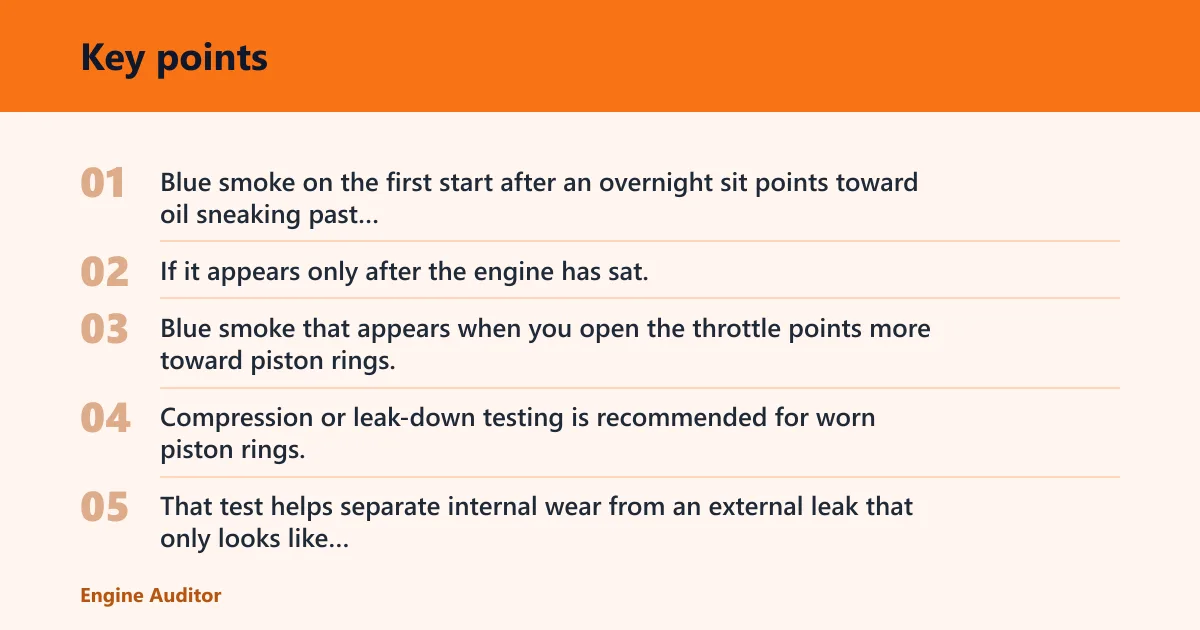
Blue smoke on the first start after an overnight sit points toward oil sneaking past valve stem seals and pooling where it should not. The smoke may clear quickly after startup. If it appears only after the engine has sat, that timing matters more than the amount of smoke.
Blue smoke on acceleration
Blue smoke that appears when you open the throttle points more toward piston rings, cylinder wear, or a turbo oil seal on boosted engines. Compression or leak-down testing is recommended for worn piston rings. That test helps separate internal wear from an external leak that only looks like burning oil.
Why the converter can hide smoke
A catalytic converter can reduce the amount of visible blue smoke, especially on light oil use. That means no visible plume does not clear the engine. If the dipstick is still falling and the plugs, tailpipe, or intake show oil evidence, keep looking for the path instead of waiting for thick smoke.
Could it be a hidden leak?
Yes. Hidden external leaks are common when oil lands on hot exhaust parts or gets trapped by splash shields and undertrays. A valve cover gasket or oil filter housing can leak without leaving a driveway puddle. The first clue is often a burnt-oil smell under the hood, not oil on the ground.
Valve cover gasket seepage
A valve cover gasket can leak onto hot engine parts and burn off before oil reaches the floor. That often leaves a burnt-oil smell and oily residue along the top or side of the engine. Check the valve cover edge, spark plug wells, and the area above the exhaust manifold.
Oil filter housing residue
An oil filter housing leak can be hidden behind nearby hardware and drip onto hot components. Inspect for wetness, sticky dust, and fresh oil residue around the housing, the filter seal, and the path below it. If the leak burns off, the smell may be stronger than the visible wetness.
Splash shields and undertrays
Plastic undertrays and splash shields can trap oil and keep it from reaching the driveway. They can also hide the first wet point. Remove the shield if needed and look from the top down, because the highest wet area is usually closer to the source than the puddle location.
Is the PCV system moving oil?
Yes. A faulty PCV system can pull oil into the intake or push oil past seals. If the PCV valve is stuck or restricted, crankcase pressure can rise and oil carryover can increase. Oil in the intake tube or throttle body points strongly toward this path.
Stuck or restricted PCV valve
Check the PCV valve and connected hoses for blockage, collapse, or oil soaking. A stuck valve can draw oil mist into the intake stream, while a restricted system can raise crankcase pressure and force oil where it should not go. Both faults can raise consumption without leaving a puddle.
Crankcase pressure clues
Signs of crankcase pressure problems include oil weeping from seals, a dipstick that is hard to seat properly, and oil residue around breather hoses. If the engine has fresh oil near the PCV lines and the intake tubing is wet, that pattern fits ventilation carryover better than a ground leak.
Oily intake tubing checks
Open the intake tube and look for wet oil film, pooled oil, or oil at the throttle body. A light mist is one thing. Heavy wetness is another. Oil in the intake tube or throttle body points to PCV-related carryover and should not be ignored if the level keeps dropping.
Are rings or seals worn?
They might be. Piston rings and valve stem seals cause different smoke patterns. Rings usually show their problems under load, while valve stem seals often show up after sitting overnight. Matching the symptom timing to the smoke pattern is the cleanest way to sort them.
Piston rings under load
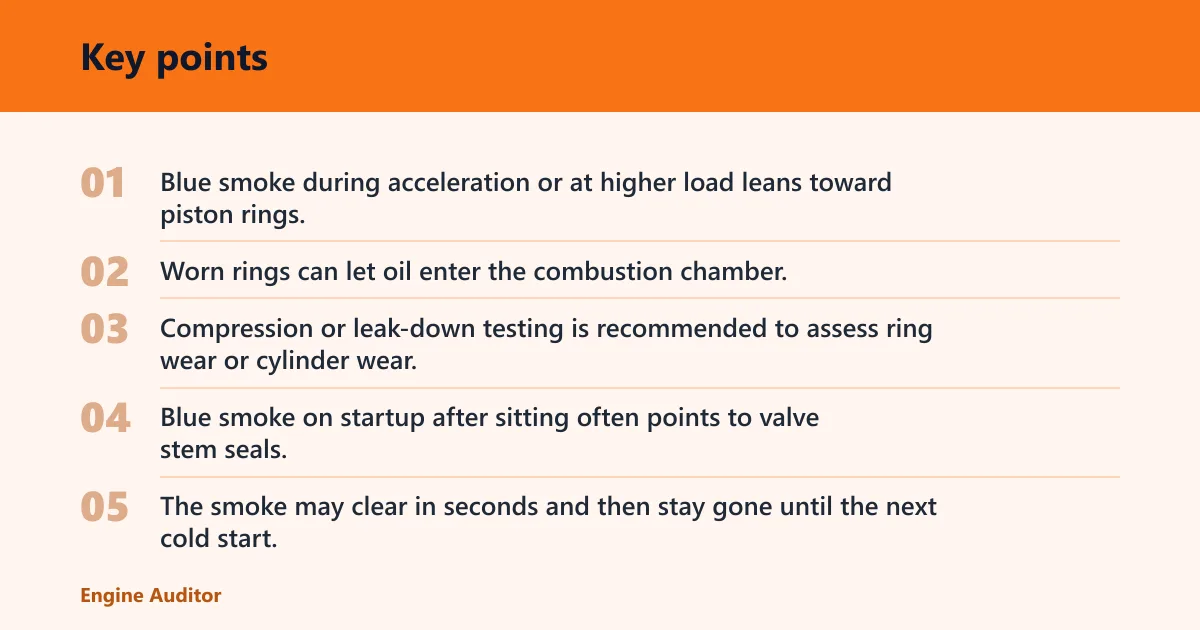
Blue smoke during acceleration or at higher load leans toward piston rings. Worn rings can let oil enter the combustion chamber, and the loss often gets worse when cylinder pressure rises. Compression or leak-down testing is recommended to assess ring wear or cylinder wear.
Valve stem seals after sitting
Blue smoke on startup after sitting often points to valve stem seals. The smoke may clear in seconds and then stay gone until the next cold start. That pattern is different from load-related smoke. It tells you oil is collecting while the engine is off, then burning at startup.
Compression or leak-down test
If the symptom pattern points to internal wear, compression or leak-down testing helps separate ring wear from external leakage. That is especially useful when there is no obvious seepage and the smoke pattern is unclear. Pair the test with oil use notes, not with guesswork alone.
A common first-timer mistake is to blame rings first because the tailpipe smokes once under hard acceleration. If the intake tube is oily and the PCV valve is restricted, the same smoke can come from crankcase ventilation instead. Check the simpler path before assuming the engine needs major work.
Turbo engine oil loss clues
Turbo engines have a separate oil path to inspect. A leaking turbocharger oil seal can cause smoke under boost, and oil can collect in charge pipes or the intercooler. That makes the diagnosis different from a simple valve cover seep or a worn seal on a naturally aspirated engine.
Smoke under boost
Blue smoke that appears when the turbo is making boost leans toward the turbocharger oil seal. The smoke may not appear at idle or on gentle cruising. That timing is the clue. If the exhaust gets smoky only under load, inspect the turbo path before blaming the whole engine.
Charge pipe residue
Remove or inspect the charge pipes for wet oil film and pooling. A light haze can be normal on some turbo setups, but a wet pipe or dripping connector is not. Check both sides of the turbo plumbing, because oil can collect far from the actual seal that is leaking.
Intercooler pooling
Oil pooled in the intercooler points to oil traveling through the turbo charge path. That finding fits a turbo seal problem better than a valve cover gasket. If boost smoke, oily charge pipes, and intercooler pooling appear together, the turbo path moves to the top of the list.
What to check first
Start with the fastest evidence, not teardown. Read the dipstick consistently, note the mileage, inspect for smell and residue, then check the intake and PCV path. If the smoke pattern points to a specific path, test that path next. The sequence below keeps the diagnosis tight.
- Confirm the oil level on level ground with the engine at the same warm or cold condition each time.
- Record how much oil you add and the miles since the last check.
- Look for burnt-oil smell under the hood and inspect the valve cover, filter housing, and nearby hot parts.
- Check the PCV valve, hoses, and intake tube for blockage or oil carryover.
- Watch for blue smoke at cold start, during acceleration, and under boost if the engine is turbocharged.
- If the symptom pattern points to internal wear, schedule compression or leak-down testing.
Do not keep driving if the low-oil warning light comes on. Do not keep driving if the level is dropping rapidly either. A low sump can damage bearings quickly, and a warning light means the engine may already be at risk.
Frequently asked questions
Why is my oil level dropping but no leak?
The oil may be burning in the cylinders, passing through the PCV system, or leaking onto hot parts and burning off before it reaches the ground. The symptom pattern tells you which path is most likely. Smoke timing, intake oil, smell, and residue are better clues than the absence of a puddle.
What causes oil consumption with no visible leak
Common causes include worn piston rings, valve stem seals, a stuck or restricted PCV valve, hidden external leaks, and turbocharger oil seal problems on turbo engines. Wrong oil viscosity, overdue oil changes, and fuel dilution can also raise consumption. The key is to match the cause to the symptom pattern.
How do I tell if my engine is burning oil?
Look for blue smoke, then note when it happens. Startup smoke after sitting often points to valve stem seals. Smoke during acceleration leans toward piston rings. On turbo engines, smoke under boost points to a turbo oil seal. Oil in the intake or a burnt-oil smell changes the diagnosis.
Is it normal for oil level to drop?
Some drop over time can be normal, but repeated top-offs are not something to ignore. If you are adding about 1 quart every 1,000 miles or less, treat it as abnormal. A stable engine should not need constant make-up oil between routine checks or oil changes.
Why does my oil level keep dropping?
When the level keeps dropping, the loss is usually ongoing rather than random. The oil may be leaving through the PCV system, burning in the engine, leaking onto hot parts, or escaping through a turbo seal. The repeating pattern matters most; document the miles and the amount added.
Can oil disappear without leaking onto the ground?
Yes. Hidden leaks can burn off on hot parts and never leave an obvious puddle. Oil can also move into the intake through the PCV path or burn inside the engine. That is why you should inspect for residue, smell, intake oil, and smoke timing rather than waiting for a spot on the floor.
Products related to this article
Sponsored / affiliate links. As an Amazon Associate I earn from qualifying purchases. I may earn additional commission from eligible campaigns.